
June 20, 2026
Understanding Mining Automation Technologies
The integration of advanced technological systems into extraction operations represents a fundamental shift in how mineral resources are accessed and processed. Modern automation in mining encompasses sophisticated sensor networks, machine learning algorithms, and autonomous control systems that operate continuously across diverse mining environments. Furthermore, these technologies are driving unprecedented changes in operational efficiency and safety standards across the industry.
Core Automation Technology Categories
| Technology Category | Primary Function | Implementation Scope |
|---|---|---|
| Autonomous Vehicles | Unmanned equipment operation | Haul trucks, dozers, excavators |
| Remote Operations | Centralised control systems | Drilling, loading, processing |
| AI Analytics | Predictive maintenance & optimisation | Fleet management, resource planning |
| Process Automation | Continuous operations management | Crushing, separation, quality control |
Autonomous vehicle systems represent the most visible transformation in mining automation. These platforms integrate GPS navigation, LiDAR sensors, and machine learning algorithms to enable unmanned equipment operation across extraction and transport functions. Moreover, the technology has evolved beyond simple teleoperation to include sophisticated obstacle detection, route optimisation, and fleet coordination capabilities.
Remote operation centres fundamentally alter the relationship between human operators and mining equipment. These facilities allow personnel to control machinery from centralised locations, often hundreds of kilometres from actual mining sites. Consequently, this approach reduces on-site personnel exposure while maintaining operational precision through high-definition cameras, sensor feedback, and haptic control systems.
AI in mining operations process massive datasets from operational sensors to optimise maintenance schedules, predict equipment failures, and enhance resource extraction efficiency. These platforms continuously analyse equipment performance patterns, geological conditions, and operational variables to identify optimisation opportunities that human operators might miss.
Operational Implementation Frameworks
The deployment of automation in mining follows structured progression models that accommodate different operational requirements and risk tolerances. Companies typically begin with basic remote control systems before advancing to full autonomous operations. In addition, this phased approach allows organisations to build expertise whilst managing implementation risks.
Teleoperation represents the entry-level approach, where individual machines operate under remote human control from surface facilities. This implementation provides immediate safety benefits by removing operators from hazardous environments while maintaining human decision-making capabilities for complex situations.
Driver assistance systems offer the next implementation tier, providing automated functions whilst maintaining human operators for strategic decisions and exception handling. These systems typically include features like automated navigation along predetermined routes, collision avoidance, and load optimisation.
Semi-autonomous operations integrate multiple automated systems with human oversight for complex decision-making. This approach enables automated routine tasks while preserving human intervention capabilities for unusual circumstances or strategic operational adjustments.
Full autonomy represents the most advanced implementation level, featuring complete unmanned operations with centralised fleet coordination and traffic management systems. These deployments require comprehensive infrastructure development, including communication networks, maintenance facilities, and emergency response protocols.
Equipment Categories and Automation Adoption
Heavy haulage systems demonstrate the highest automation adoption rates within mining operations due to their repetitive operational patterns and significant safety improvement potential. Autonomous haul trucks operate on predetermined paths between loading and dumping locations, utilising advanced obstacle detection and route optimisation algorithms to maintain efficiency whilst avoiding collisions.
Quantified Automation Benefits
| Performance Metric | Traditional Operations | Automated Operations | Improvement |
|---|---|---|---|
| Operating Hours | 16-18 hours/day | 22-24 hours/day | 25-35% |
| Equipment Utilisation | 65-75% | 85-95% | 20-30% |
| Maintenance Efficiency | Reactive scheduling | Predictive optimisation | 30-40% |
| Safety Incidents | Baseline | Reduced exposure | 40-60% |
Drilling operations leverage automation for precision positioning, depth control, and pattern execution. Automated drilling systems maintain consistent hole spacing, depth accuracy, and operational tempo whilst reducing operator fatigue and exposure risks. Furthermore, the technology enables 24-hour drilling operations in challenging environments where human operators would face significant safety risks.
Loading and excavation equipment increasingly incorporate automated functions including bucket positioning, load optimisation, and cycle time management. These systems analyse material characteristics, equipment positioning, and operational priorities to maximise productivity whilst minimising equipment wear.
Performance Enhancement Through Automation
Productivity improvements through automation emerge from multiple operational vectors that traditional mining methods cannot achieve. Extended operating hours represent one of the most significant benefits, as automated systems operate continuously without shift changes, break periods, or fatigue-related performance degradation.
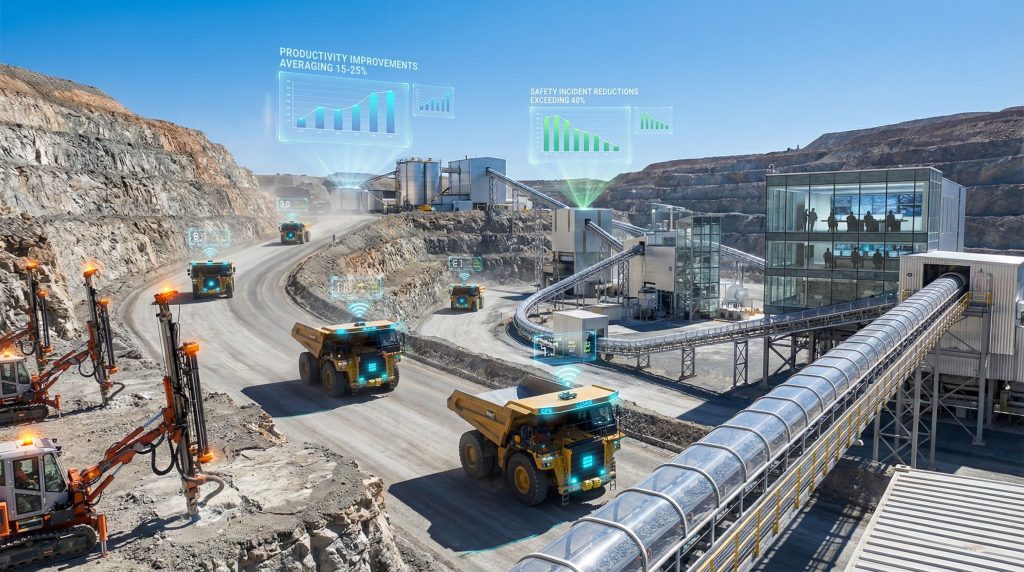
Implementation Success Metrics: Mining operations report productivity improvements averaging 15-25% following comprehensive automation deployment, with safety incident reductions exceeding 40% in high-risk operational areas.
Route optimisation algorithms continuously analyse traffic patterns, equipment positioning, and operational priorities to minimise cycle times and maximise throughput. These systems consider factors including equipment capacity, road conditions, weather patterns, and maintenance schedules to determine optimal routing and timing decisions.
Predictive maintenance systems represent a critical automation component that fundamentally changes equipment management approaches. These platforms analyse equipment performance data, operating conditions, and historical failure patterns to schedule interventions before breakdowns occur, reducing unplanned downtime and extending asset lifecycles.
Data Analytics Integration
Advanced AI analytics platforms process real-time operational data to identify optimisation opportunities and performance bottlenecks that would be impossible for human operators to detect across large-scale operations. Machine learning algorithms analyse historical patterns to predict equipment behaviour, optimise resource allocation, and enhance decision-making processes.
Digital twin technologies create virtual replicas of physical mining operations, enabling scenario modelling and optimisation testing without disrupting production activities. These systems integrate geological data, equipment performance metrics, and environmental conditions to optimise extraction strategies and predict operational outcomes.
Sensor networks throughout mining operations collect data on equipment performance, environmental conditions, material characteristics, and safety parameters. This information feeds into centralised analytics platforms that provide real-time operational insights and long-term strategic planning support.
Safety Transformation Through Automation
Automation in mining fundamentally transforms safety paradigms by removing personnel from high-risk environments and eliminating human error factors in dangerous tasks. Remote operation centres position operators in controlled environments away from heavy machinery, explosive materials, and unstable geological conditions. Consequently, this approach has revolutionised workplace safety standards across the industry.
Autonomous systems maintain consistent operational protocols without the variability introduced by fatigue, distraction, or human judgement errors. Advanced sensor networks provide comprehensive environmental monitoring, detecting potential hazards including gas accumulations, structural instability, and equipment malfunctions before they impact operations or personnel safety. Additionally, these systems can respond to dangerous situations faster than human operators.
Workforce Transformation Requirements
| Traditional Role | Automated Role | Required Skills Development |
|---|---|---|
| Equipment Operator | Remote Controller | System monitoring, digital interfaces |
| Maintenance Technician | Automation Specialist | Sensor diagnostics, software troubleshooting |
| Supervisor | Operations Coordinator | Fleet management, data analysis |
| Safety Officer | Risk Analytics Specialist | Predictive modelling, system integration |
Emergency response capabilities in automated systems enable rapid system shutdown and evacuation procedures when hazardous conditions develop. Integrated communication systems maintain constant connectivity between automated equipment and control centres, ensuring immediate response to operational anomalies.
Proximity detection systems prevent collisions between automated and manual equipment through real-time positioning and communication protocols. Environmental monitoring sensors continuously track air quality, structural stability, and weather conditions to trigger appropriate safety responses before dangerous conditions develop.
Implementation Challenges and Solutions
Technical obstacles to automation deployment vary significantly based on mining environment characteristics and existing infrastructure capabilities. Remote mining locations often lack the connectivity and power systems required for sophisticated automation technologies, requiring substantial infrastructure investments before implementation.
Harsh environmental conditions including dust, vibration, temperature extremes, and moisture challenge sensor reliability and equipment durability. Mining companies must invest in ruggedised equipment and comprehensive maintenance protocols to ensure automation systems perform reliably in demanding conditions.
Legacy equipment integration poses compatibility challenges when incorporating automated systems with existing machinery and control platforms. Companies often face decisions between replacing functional equipment or investing in retrofit solutions that may not provide optimal performance.
Wireless communication limitations restrict the number of automated units that can operate simultaneously in confined areas. Signal interference from geological formations, equipment operations, and weather conditions can disrupt automation systems, requiring redundant communication methods and fail-safe protocols.
Economic Investment Considerations
Capital investment requirements for mining automation vary significantly based on implementation scope, ranging from individual equipment upgrades costing hundreds of thousands of dollars to comprehensive fleet automation requiring investments of hundreds of millions. Return on investment calculations must incorporate productivity gains, safety cost reductions, and operational efficiency improvements over extended timeframes.
Financing models include phased implementation approaches that spread costs over multiple budget cycles whilst delivering incremental benefits. These strategies allow companies to validate automation benefits in limited applications before committing to comprehensive deployments. Moreover, this approach reduces financial risk whilst building organisational confidence.
Leasing and service agreements provide alternative funding mechanisms for smaller operations with limited capital resources. Equipment manufacturers increasingly offer automation-as-a-service models that reduce upfront costs whilst providing ongoing technical support and system updates.
Long-term operational cost impacts typically favour automation despite substantial initial investments. Automated systems reduce labour costs, improve energy efficiency through optimised operations, and decrease maintenance expenses through predictive management approaches.
Insurance cost reductions reflect improved safety performance and reduced risk exposure associated with automated operations. Regulatory compliance costs may decrease due to enhanced monitoring and reporting capabilities, though companies must invest in comprehensive documentation and validation systems.
Future Technology Integration Trends
Edge computing capabilities enable real-time decision-making at equipment level, reducing dependence on centralised processing and communication systems. This technology allows automated equipment to respond immediately to local conditions whilst maintaining coordination with broader operational systems. Furthermore, this advancement represents the next evolution in autonomous system development.
Advanced robotics integration expands automation in mining beyond traditional heavy equipment to include maintenance, inspection, and specialised operational tasks. These systems can perform detailed equipment inspections, collect geological samples, and execute precision tasks in environments too dangerous or inaccessible for human personnel.
Artificial intelligence evolution toward autonomous decision-making will reduce human oversight requirements whilst improving system adaptability to changing operational conditions. Machine learning algorithms will enable automated systems to learn from operational experience and optimise performance without human intervention.
Interoperability standards development will enable seamless integration between equipment from different manufacturers, reducing technology lock-in and improving system flexibility. Industry collaboration on communication protocols and data formats will facilitate more comprehensive automation deployments.
How Will Competitive Dynamics Change?
Early automation adopters gain significant competitive advantages through improved operational efficiency, enhanced safety performance, and reduced operational costs. These benefits compound over time as automated systems generate operational data that enables continuous optimisation and performance improvement.
Market differentiation increasingly depends on technological capability rather than traditional operational factors like equipment size or workforce availability. Companies with advanced automation capabilities can operate in environments and conditions that would be uneconomical or unsafe for traditional mining methods.
Supply chain integration through automated systems enables real-time coordination between mining operations and downstream processing facilities, optimising overall value chain performance. This integration reduces inventory costs, improves quality control, and enhances customer service capabilities.
Sustainability benefits from optimised resource utilisation and reduced environmental impact support long-term operational viability in increasingly regulated markets. Automated systems can optimise energy consumption, reduce waste generation, and minimise environmental disturbance through precision operational control.
Regulatory and Compliance Frameworks
Regulatory requirements for automated mining operations vary significantly across jurisdictions, with some regions developing specific automation guidelines whilst others apply traditional safety regulations to automated systems. Companies must navigate complex approval processes that address both equipment certification and operational procedure validation.
Compliance strategies must address comprehensive system documentation requirements that often exceed traditional operational standards. Automated systems require detailed validation of safety protocols, emergency response procedures, and performance monitoring capabilities to satisfy regulatory authorities.
Regular audits and safety assessments ensure continued compliance with evolving regulatory frameworks as mining automation systems advance and regulatory understanding improves. Companies must maintain detailed operational records and demonstrate system reliability through comprehensive testing and validation procedures.
Environmental monitoring capabilities integrated into automated systems often exceed regulatory requirements, providing comprehensive data collection and reporting capabilities that support environmental compliance objectives whilst delivering operational benefits.
Dust control, noise reduction, and energy efficiency improvements through automation often support environmental compliance objectives whilst delivering operational cost savings. Automated systems can optimise operations to minimise environmental impact whilst maintaining production targets, supporting both regulatory compliance and operational efficiency goals.
What Are the Key Success Factors?
Successful automation implementation requires comprehensive planning that addresses technical capabilities, financial resources, organisational readiness, and market conditions. Mining industry innovation demands a holistic approach that considers all operational aspects and stakeholder requirements.
3D geological modeling integration enhances automation effectiveness by providing detailed subsurface information that improves autonomous system navigation and operational planning. This technology enables automated equipment to operate more efficiently whilst reducing geological risks.
Change management strategies must address employee concerns about technology adoption whilst highlighting opportunities for skill development and career advancement within automated operational frameworks. Training programmes, communication initiatives, and performance incentives support successful transitions to automated operations.
Long-term strategic planning must consider technology evolution trends and industry competitive dynamics to ensure automation investments remain relevant and valuable throughout their operational lifecycles. This includes evaluating technology roadmaps, supplier stability, and regulatory development trends that could impact automation system performance and viability.
Strategic Implementation Planning
Mining automation represents a comprehensive operational transformation that extends beyond equipment upgrades to encompass system integration, workforce development, and business model evolution. Successful implementation requires careful consideration of technical capabilities, financial resources, organisational readiness, and market conditions. In addition, mining workforce transformation must be managed thoughtfully to maximise both technological and human potential.
The competitive advantages gained through automation adoption will increasingly define industry leadership as technology capabilities mature and implementation costs decrease. Organisations that effectively integrate automation technologies whilst managing associated challenges will establish sustainable competitive positions in evolving global markets.
Companies must develop comprehensive change management strategies that address employee concerns about technology adoption whilst highlighting opportunities for skill development and career advancement within automated operational frameworks. Training programmes, communication initiatives, and performance incentives support successful transitions to automated operations.
Strategic planning must consider long-term technology evolution trends and industry competitive dynamics to ensure automation investments remain relevant and valuable throughout their operational lifecycles. This includes evaluating technology roadmaps, supplier stability, and regulatory development trends that could impact automation system performance and viability.
Ready to Capitalise on Mining Technology Advances?
Discovery Alert's proprietary Discovery IQ model delivers instant notifications on significant ASX mineral discoveries, including companies at the forefront of mining automation and technological innovation. Begin your 14-day free trial today and gain immediate access to actionable insights that position you ahead of the market when the next breakthrough mining technology company announces a major discovery.