July 21, 2026
The mining industry stands at the intersection of technological transformation and operational necessity, where traditional methods of infrastructure monitoring are increasingly inadequate for modern fleet management demands. Complex haul road networks, spanning thousands of kilometers across remote mining sites, present continuous maintenance challenges that directly impact equipment longevity, operational efficiency, and worker safety. As mining operations scale toward higher tonnage capacity and autonomous vehicle integration, the limitations of manual road inspection protocols become magnified. Furthermore, this creates compelling business cases for intelligent monitoring systems like Kal Tire and Decoda autonomous haul road hazard detection that can deliver real-time hazard detection across entire haul circuits.
Understanding the Technology Behind Smart Mining Infrastructure
What Is Autonomous Haul Road Hazard Detection?
Autonomous haul road hazard detection represents a paradigm shift from reactive maintenance approaches toward predictive infrastructure management. These systems utilize integrated sensor arrays to continuously monitor road conditions, identifying hazardous situations before they impact vehicle operations or cause equipment damage. In addition, unlike traditional inspection methods that rely on scheduled human assessment, autonomous detection provides 24/7 monitoring capabilities across entire haul circuit networks.
The technology foundation combines multiple detection methodologies to create comprehensive road awareness. LiDAR sensors generate precise three-dimensional mapping data, enabling accurate measurement of road surface variations and hazard volumetrics. Camera arrays provide visual analysis capabilities for material identification and contamination assessment. Edge computing systems process sensor data locally, eliminating cloud connectivity dependencies and ensuring rapid response times even in remote mining locations.
Integration with existing fleet management platforms enables seamless data sharing and operational coordination. The KalPRO HaulSight system, developed through the strategic alliance between Kal Tire and Decoda, demonstrates this integration approach by building upon proven TOMS (Tire & Operations Managing System) infrastructure while adding autonomous hazard detection capabilities.
The distinction between reactive maintenance and predictive hazard prevention becomes critical in high-tonnage mining operations. Traditional approaches respond to damage after it occurs, resulting in equipment downtime, repair costs, and productivity losses. However, predictive systems identify conditions that cause damage, enabling preventive intervention before operational impact occurs.
Key Technologies Powering Road Hazard Detection
LiDAR Technology Applications provide the spatial awareness foundation for autonomous road monitoring. These systems generate millions of distance measurements per second, creating detailed point-cloud representations of road surfaces. Detection accuracy enables identification of undulations, depressions, and surface irregularities at sub-centimetre resolution levels. Weather resistance specifications ensure consistent performance across extreme mining environments, with testing validating functionality in sub-zero Canadian mining conditions over 18-month validation periods.
Computer Vision Systems complement LiDAR data with material identification capabilities. Machine learning algorithms analyse visual patterns to distinguish between different hazard types, material compositions, and contamination levels. Real-time image processing enables immediate hazard classification, while pattern recognition algorithms improve detection accuracy through continuous learning from operational data. False positive reduction techniques prevent alert fatigue by filtering environmental variations that don't represent actual operational hazards.
The technological architecture emphasises edge computing capabilities, processing sensor data locally on vehicles rather than relying on remote cloud infrastructure. This design choice ensures sub-5-second alert response times while maintaining functionality in remote locations with limited connectivity. Consequently, multi-sensor integration provides redundancy and complementary detection capabilities, with LiDAR excelling at spatial measurement while camera systems provide material analysis functions.
When big ASX news breaks, our subscribers know first
Why Do Mining Operations Need Automated Road Monitoring?
The Hidden Costs of Haul Road Damage
Mining operations experience substantial economic impact from road-related equipment damage and operational inefficiencies. Tyre replacement costs represent a significant expense category, with road hazards causing premature tyre failure and reducing expected service life. Industry analysis indicates potential tyre life extension of 15-25% through proactive hazard management, translating to substantial cost savings across large fleet operations.
Fuel efficiency losses compound across thousands of haul trips, with vehicles repeatedly decelerating and re-accelerating around road hazards consuming excess fuel. Research demonstrates potential fuel efficiency improvements of 8-12% through optimised road conditions that enable consistent vehicle speeds. For instance, operations running continuous haulage cycles generate measurable operational cost reduction with 3-6 month ROI timelines through these efficiency gains.
Safety risk factors extend beyond immediate accident potential to encompass broader operational hazards. Driver fatigue increases when operators must constantly navigate challenging road conditions, potentially leading to reduced alertness and increased incident risk. Equipment stress factors affect vehicle components beyond tyres, with repeated impact events causing accelerated wear on truck struts, frames, and suspension systems.
The spillage detection capability addresses both commodity loss and secondary hazard creation. Material spillage represents direct revenue loss through commodity wastage while simultaneously creating traction hazards and potential equipment damage risks for subsequent vehicles. Furthermore, a single significant spillage incident can generate substantial economic impact before considering potential safety consequences.
Traditional Road Inspection Limitations
Manual inspection protocols suffer from fundamental limitations that become magnified in large-scale mining operations. Human error factors in hazard identification can result in missed hazards or inconsistent assessment standards between different inspection personnel. Coverage gaps occur when inspection frequency cannot match the rate of road deterioration, particularly during periods of high traffic volume or adverse weather conditions.
Response time delays between hazard detection and repair execution create extended exposure windows where equipment and operators remain at risk. Traditional workflows require hazard identification, reporting, work order generation, resource allocation, and repair execution, often spanning multiple shifts before resolution occurs. Resource allocation challenges for maintenance crews must balance multiple competing priorities, with road maintenance competing against equipment repairs and other operational demands.
The inspection frequency limitations become particularly problematic in high-tonnage operations where road conditions deteriorate rapidly. A road section inspected and approved in the morning may develop hazardous conditions by afternoon shift changes. However, traditional protocols may not detect these changes until the next scheduled inspection cycle.
How Do Autonomous Systems Detect and Classify Road Hazards?
Real-Time Hazard Identification Process
Spillage Detection Methods utilise multi-modal analysis to identify, classify, and assess material spillage incidents. Computer vision algorithms analyse material composition through visual pattern recognition, distinguishing between different ore types, contamination materials, and foreign objects. Volume estimation algorithms calculate spillage quantity to determine operational impact severity, enabling priority-based response allocation. Contamination risk assessment protocols evaluate potential hazards created by material mixing or chemical reactions between different spillage types.
Road Surface Analysis combines LiDAR spatial data with historical trending to create comprehensive hazard profiles. Undulation mapping technologies generate precise topographical representations of road surfaces, identifying variations that exceed safe operating parameters. Severity grading systems categorise hazards based on potential impact severity, vehicle speed limitations, and equipment damage risk factors. Moreover, surface degradation pattern recognition identifies progressive deterioration trends that indicate preventive maintenance opportunities.
The detection process operates continuously during vehicle operation, with sensor arrays mounted on both front and rear vehicle sections to provide comprehensive haul circuit coverage. Real-time feedback capabilities enable immediate operator guidance for loading and dumping positioning, helping avoid known hazard locations while maintaining operational efficiency.
Data Processing and Alert Systems
Edge computing architecture processes sensor data locally on vehicles, eliminating cloud connectivity dependencies while ensuring rapid response times. Priority-based alert classification systems prevent alert fatigue by categorising hazards according to operational impact severity and required response urgency. Critical hazards requiring immediate attention receive highest priority alerts, while minor issues are logged for routine maintenance scheduling.
Integration with maintenance work order systems automates the transition from hazard detection to repair execution. Automated work order generation includes hazard location coordinates, severity assessment, recommended repair methods, and estimated resource requirements. This automation eliminates manual reporting delays and ensures consistent documentation standards across all detected hazards.
Historical trend analysis capabilities enable long-term planning and preventive maintenance optimisation. The system identifies recurring hazard locations, seasonal deterioration patterns, and progressive degradation trends that inform infrastructure investment decisions. Consequently, this analytical capability transforms reactive maintenance approaches into strategic asset management programmes.
What Are the Operational Benefits of Smart Road Monitoring?
Productivity Enhancement Metrics
Cycle Time Improvements result from consistent road conditions that enable vehicles to maintain optimal speeds throughout haul circuits. Elimination of unexpected hazard encounters reduces the deceleration-acceleration cycles that consume excess time and fuel. Operations implementing autonomous road monitoring systems report measurable improvements in average cycle completion times. Additionally, benefits compound across hundreds of daily haul trips.
Fleet Efficiency Gains extend beyond individual vehicle performance to encompass entire operational systems. Fuel consumption optimisation achieves 8-12% efficiency improvements through reduced engine load variations and consistent speed maintenance. Tyre life extension reaches 15-25% improvement levels, significantly reducing tyre procurement costs and change-out downtime. Maintenance-related downtime reduction of 20-30% results from preventing damage rather than repairing it after occurrence.
The compounding effect of these improvements creates substantial operational benefits. A single vehicle avoiding one hazard encounter saves minimal time and fuel. However, fleet-wide hazard avoidance across continuous operations generates measurable productivity improvements with rapid return on investment timelines.
Cost-Benefit Analysis Framework
| Benefit Category | Measurable Impact | ROI Timeline |
|---|---|---|
| Tyre Life Extension | 15-25% increase | 6-12 months |
| Fuel Efficiency | 8-12% improvement | 3-6 months |
| Maintenance Reduction | 20-30% decrease | 12-18 months |
| Safety Incidents | 40-60% reduction | Immediate |
The cost-benefit framework demonstrates rapid payback periods across multiple operational categories. Tyre life extension benefits typically achieve positive ROI within 6-12 months through reduced procurement costs and extended service intervals. Fuel efficiency improvements provide the fastest payback timelines at 3-6 months due to immediate consumption reduction upon system deployment.
Safety incident reduction of 40-60% provides immediate benefits through reduced insurance costs, regulatory compliance improvements, and workforce confidence enhancement. While difficult to quantify precisely, safety improvements contribute significantly to long-term operational sustainability and regulatory standing.
How Does This Technology Support Autonomous Vehicle Operations?
Integration with Autonomous Haul Truck Systems
Autonomous vehicle operations require enhanced environmental awareness compared to human-operated equipment. Human drivers possess intuitive hazard recognition capabilities and can make real-time adjustments to vehicle operation based on road conditions. However, autonomous systems depend entirely on sensor inputs and programmed responses, making comprehensive hazard detection critical for safe and efficient operation.
Sensor data sharing between road monitoring systems and vehicle navigation platforms creates integrated awareness systems. Data-driven mining operations provide environmental data that enhances autonomous vehicle decision-making, enabling route optimisation based on current road conditions rather than static mapping data. Real-time route optimisation adjusts vehicle paths to avoid detected hazards while maintaining operational efficiency.
Collision avoidance system enhancements benefit from comprehensive hazard databases that inform autonomous vehicle behaviour. Rather than reacting to hazards upon detection, vehicles can anticipate known hazard locations and adjust operation proactively. Predictive maintenance scheduling coordination aligns vehicle maintenance requirements with road condition data, optimising overall fleet availability.
The integration becomes particularly critical for heavy haul trucks where sudden impacts can cause significant damage. A 400-tonne haul truck impacting an unexpected road undulation experiences massive forces that can damage truck struts, frames, and cargo systems while creating spillage hazards for subsequent vehicles.
Future-Proofing Mining Operations
Electric Vehicle Compatibility represents a crucial consideration as mining operations transition toward electrification. Electric vehicles in mining experience greater efficiency penalties from speed variations compared to diesel vehicles, making consistent road conditions more economically important. Energy efficiency optimisation through smooth road maintenance directly impacts battery life and operational range, critical factors in electric vehicle economics.
Battery life preservation benefits significantly from reduced vibration and impact loading achieved through hazard-free road conditions. Electric vehicle batteries are sensitive to mechanical stress, making road condition optimisation an important factor in asset longevity. Charging infrastructure protection ensures that electrical systems and charging stations remain accessible and undamaged by road-related hazards.
Scalability Considerations address the growing complexity of mining operations as they expand autonomous and electric vehicle fleets. Multi-site deployment strategies must account for different environmental conditions, traffic patterns, and operational requirements across various mining locations. Data standardisation approaches ensure consistent hazard classification and response protocols regardless of specific site characteristics.
What Implementation Challenges Should Mines Consider?
Technical Infrastructure Requirements
Hardware Installation Considerations encompass optimal sensor placement strategies that maximise detection coverage while minimising interference with vehicle operations. Power supply requirements must integrate with existing vehicle electrical systems without compromising operational capacity. Environmental protection measures ensure sensor durability across extreme temperature ranges, dust exposure, and vibration conditions typical in mining environments.
Software Integration Complexity involves compatibility assessment with existing fleet management systems, maintenance management platforms, and operational reporting tools. Data migration requirements must address historical maintenance records, vehicle performance data, and operational benchmarks. In addition, cybersecurity considerations become increasingly important as connected systems create potential vulnerability points requiring robust security protocols.
The 18-month testing period conducted on Canadian mine sites demonstrates the extensive validation required for reliable system deployment. Sub-zero temperature testing ensures functionality across diverse climate conditions, while extended operational testing validates long-term reliability and performance consistency.
Change Management Factors
Workforce training requirements address both technical operation of monitoring systems and interpretation of hazard data for decision-making purposes. Maintenance crews require skill development in system calibration, sensor maintenance, and data analysis techniques. Performance measurement establishment defines key performance indicators that demonstrate system effectiveness and guide continuous improvement efforts.
Stakeholder buy-in requires demonstration of clear operational benefits and return on investment timelines. Communication strategies must address concerns about technology adoption while highlighting safety improvements and operational efficiency gains. Furthermore, successful implementation depends on cultural acceptance of automated systems as operational enhancement tools rather than replacement technology.
The next major ASX story will hit our subscribers first
How Do Different Mining Environments Affect System Performance?
Environmental Adaptation Capabilities
Extreme Weather Performance validation through sub-zero temperature testing demonstrates system resilience across diverse climate conditions. Canadian mining environments provide particularly challenging test conditions, with temperature extremes, moisture variations, and seasonal changes that stress both hardware and software components. Dust and moisture resistance specifications ensure consistent sensor performance despite harsh environmental conditions common in mining operations.
Visibility limitations caused by dust, weather, or lighting conditions require compensation methods through multi-sensor integration and enhanced processing algorithms. Site-Specific Customisation addresses variations in terrain, material types, and traffic patterns that affect hazard detection requirements. Different mining environments create unique hazard profiles requiring customised detection parameters and response protocols.
Material-specific hazard recognition accounts for different spillage characteristics, road surface materials, and environmental conditions that affect hazard development patterns. For instance, coal mining operations experience different road deterioration patterns compared to hard-rock mining, requiring tailored detection algorithms and maintenance protocols.
Performance Optimisation Strategies
Calibration procedures must be customised for specific mine sites, accounting for local environmental conditions, vehicle types, and operational patterns. Seasonal adjustment protocols accommodate changing conditions throughout annual cycles, ensuring consistent performance across weather variations. Continuous learning algorithm improvements enhance detection accuracy through operational experience and pattern recognition development.
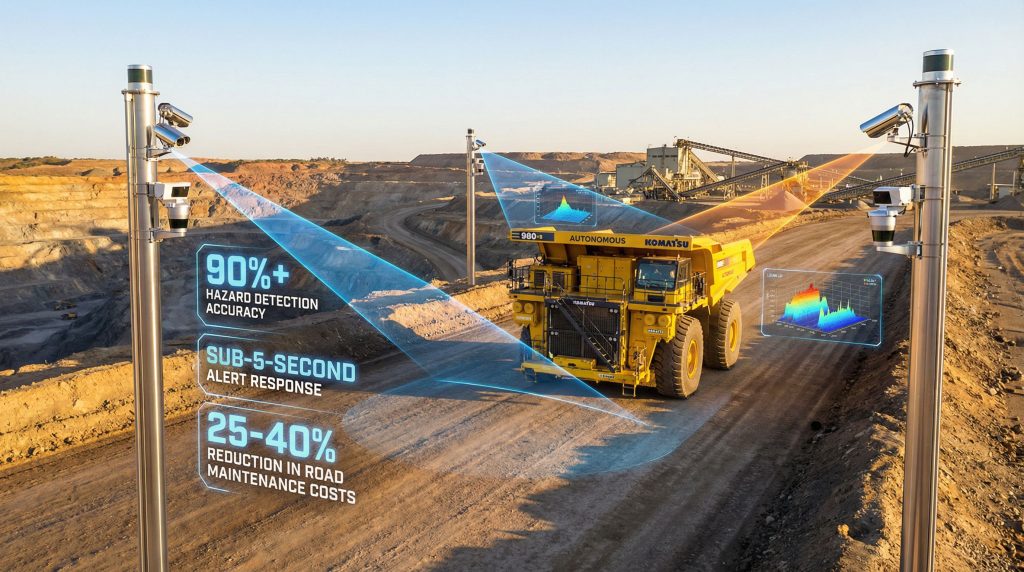
Regular system performance audits validate detection accuracy, response time consistency, and integration effectiveness with existing operational systems. Performance metrics including 90%+ hazard detection accuracy rates and sub-5-second alert response times provide benchmarks for system evaluation and optimisation opportunities.
What Does the Future Hold for Mining Road Intelligence?
Emerging Technology Trends
Artificial Intelligence Advancement enables predictive analytics for road deterioration, moving beyond reactive hazard detection toward preventive maintenance optimisation. Furthermore, the AI revolution in mining enhances pattern recognition capabilities while reducing false positive rates. Automated repair scheduling optimisation integrates hazard detection data with maintenance resource availability and operational priorities.
IoT Integration Possibilities expand sensor network capabilities through interconnected monitoring systems across entire mine sites. Real-time weather integration provides environmental context for hazard development prediction and maintenance planning. Equipment health monitoring correlation links road condition data with vehicle maintenance requirements, optimising fleet availability and operational efficiency.
The evolution toward comprehensive mine intelligence systems integrates road monitoring with broader operational management platforms. Consequently, this creates holistic optimisation opportunities that extend beyond individual vehicle or infrastructure management.
Industry Adoption Projections
Market penetration forecasts indicate increasing adoption of autonomous monitoring systems as mining operations expand autonomous and electric vehicle fleets. Technology cost reduction trends improve accessibility for smaller operations while enhancing capabilities for large-scale deployments. Regulatory developments supporting automation create favourable environments for advanced monitoring system adoption.
Competitive advantage considerations favour early adopters who can demonstrate superior operational efficiency, safety performance, and cost management through intelligent infrastructure systems. The strategic value of Kal Tire and Decoda autonomous haul road hazard detection extends beyond immediate operational benefits to encompass long-term positioning for mining industry evolution.
Key Performance Indicators for Successful Implementation
Leading autonomous road hazard detection systems consistently deliver:
• 90%+ hazard detection accuracy across diverse environmental conditions
• Sub-5-second alert response times for critical hazard identification
• 25-40% reduction in road maintenance costs through preventive intervention
• 15-30% improvement in overall fleet productivity metrics
Transforming Mining Operations Through Intelligent Infrastructure
Strategic Implementation Roadmap
Phase 1: Pilot Programme Development involves testing autonomous road monitoring systems on limited haul circuits to validate performance and establish operational protocols. Initial deployment focuses on high-traffic routes where hazard impact is most significant and benefits most measurable. Performance baseline establishment creates comparison metrics for evaluating system effectiveness.
Phase 2: Gradual Fleet Integration expands monitoring coverage across additional vehicles and haul routes while optimising detection parameters and response procedures. Integration with existing maintenance systems streamlines work order generation and resource allocation processes. Training programme expansion ensures operational personnel develop necessary skills for system utilisation.
Phase 3: Full-Scale Deployment implements comprehensive haul circuit monitoring with advanced analytics capabilities for predictive maintenance and long-term planning. Multi-site standardisation creates consistent protocols and performance standards across diverse operational environments. Continuous improvement processes refine detection accuracy and operational integration.
Phase 4: Advanced Analytics Integration leverages accumulated operational data for strategic infrastructure investment planning and fleet optimisation. Predictive deterioration modelling enables proactive maintenance scheduling and budget planning. In addition, performance optimisation analytics identify opportunities for further efficiency improvements and cost reduction.
Long-Term Value Proposition
Sustainable cost reduction through predictive maintenance eliminates reactive repair expenses while extending infrastructure service life. Enhanced safety culture develops through proactive hazard management that demonstrates organisational commitment to worker protection and operational excellence. Competitive positioning in autonomous mining adoption provides strategic advantages as industry transformation accelerates.
Environmental benefits through optimised fuel consumption contribute to sustainability objectives while reducing operational costs. The integration of autonomous road monitoring with electric vehicle adoption creates synergistic benefits that enhance both environmental and economic performance.
The transformation toward intelligent mining infrastructure represents more than technological advancement; it embodies a fundamental shift toward predictive, data-driven operational management that optimises safety, efficiency, and profitability across entire mining systems. Organisations implementing Kal Tire and Decoda autonomous haul road hazard detection position themselves at the forefront of industry evolution, capturing immediate operational benefits while building capabilities for continued technological advancement and competitive differentiation. Moreover, AI transforming mining operations demonstrates how these intelligent systems represent the future of sustainable and efficient resource extraction.
Ready to Invest in Mining Technology Innovations?
Discovery Alert's proprietary Discovery IQ model delivers real-time alerts on significant mining technology discoveries, instantly empowering subscribers to identify actionable opportunities in companies developing breakthrough solutions like autonomous haul road monitoring systems. Explore how major mineral and technology discoveries have generated substantial returns for early investors and begin your 30-day free trial today to position yourself ahead of the market.