August 6, 2026
The Geology Beneath the Capital: Why Latin America's Mineral Endowment Is Reshaping Global Investment Flows
Long before the phrase "energy transition" entered the mainstream investment lexicon, the Andes Cordillera was quietly accumulating one of the most consequential geological legacies on the planet. Porphyry copper systems stretching across Chile and Peru, lithium brine deposits pooled beneath the salt flats of Argentina and Bolivia, and rare earth mineralisation emerging across Brazil's ancient cratons represent a convergence of geological fortune that few regions can rival. What has changed in recent years is not the geology itself, but the economic and geopolitical context that determines how urgently capital flows toward it.
Mining capex growth in Latin America has become one of the defining investment narratives of the mid-2020s, driven not by a single commodity price spike but by a structural realignment of global supply chain priorities. Understanding this shift requires looking beyond quarterly earnings and toward the deeper forces reshaping where, why, and how mining capital is being committed across the region.
When big ASX news breaks, our subscribers know first
How Mining Capex Growth in Latin America Compares to Global Benchmarks
Situating the Region Within the Global Capital Allocation Framework
Latin America hosts extraordinary concentrations of commodities now classified as strategically critical by the world's largest economies. Copper, lithium, gold, silver, and rare earth elements are all present in the region at scales that position it as a structural, rather than cyclical, beneficiary of the global energy transition. Yet despite this geological advantage, the region has historically captured a disproportionately small share of global exploration budgets relative to the size and quality of its resource base.
This gap between geological endowment and exploration investment is one of the more underappreciated dynamics in current commodity markets. It reflects a combination of political risk perceptions, permitting complexity, and infrastructure deficits that have historically suppressed early-stage capital allocation even as project-stage investment has grown substantially.
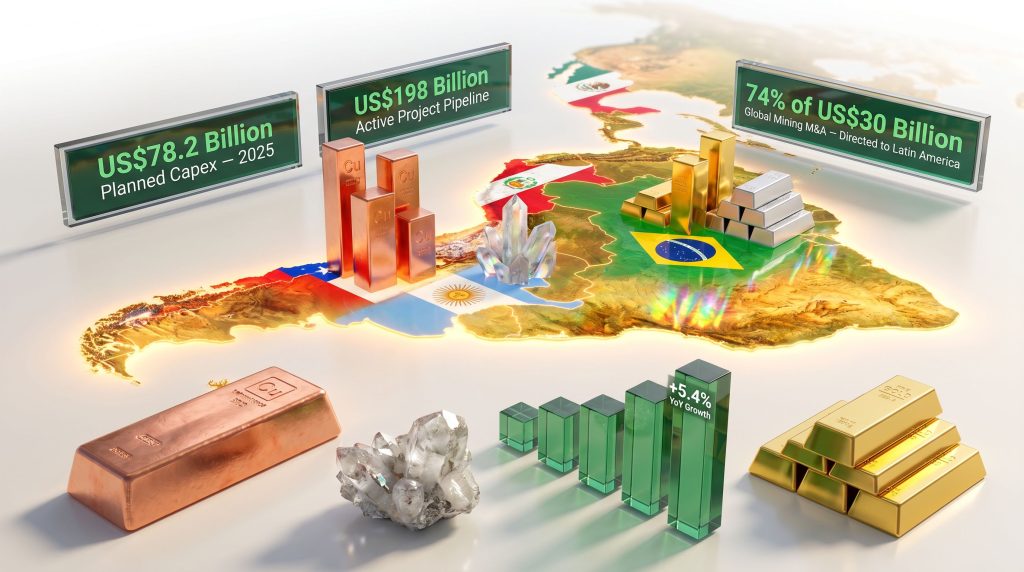
The scale of the regional investment pipeline in 2025 illustrates just how dramatically this dynamic is shifting:
| Metric | Detail |
|---|---|
| Planned capex by top 31 regional miners (2025) | US$78.2 billion |
| Year-on-year growth rate (2025 vs. 2024) | +5.4% |
| Active mining projects under development | 1,500+ |
| Estimated total project pipeline value | ~US$198 billion |
| Share of global mining M&A directed to Latin America (Q1-Q3 2025) | 74% of US$30 billion |
The deceleration in the headline growth rate compared to prior-year peaks is worth interpreting carefully. It does not signal a withdrawal of institutional confidence. Rather, it marks a transition from the broad-based expansion phase characteristic of early commodity cycles to a more disciplined, high-conviction deployment phase where capital chases quality over quantity.
Industrial metals capex is growing at a more conservative pace than precious metals allocations in the current environment, a pattern that reflects both commodity price dynamics and the longer development timelines associated with large-scale copper and lithium projects. Furthermore, according to BNamericas, capex among mining companies in Latin America is forecast to grow by 8.4% in 2026, underscoring the sustained momentum building across the region.
What Commodity Sectors Are Driving the Mining Capex Growth Cycle
Copper: The Foundational Driver of Regional Investment Expansion
Copper's central role in electrification infrastructure makes it the bedrock commodity of the energy transition, and Latin America remains the world's dominant supplier. Chile alone accounts for approximately 27% of global copper production, while Peru consistently ranks among the top five producing nations. Together, they anchor the region's position as the most consequential copper jurisdiction on Earth.
What is less commonly understood is the structural bottleneck emerging between exploration success and production reality. The average time from initial discovery to first production for a large copper deposit now commonly exceeds 16 years, accounting for feasibility studies, environmental assessments, permitting processes, and construction timelines. This extended development cycle means that copper projects approved today will not contribute meaningfully to global supply until the mid-2030s, creating a forward-looking supply deficit that is already visible to sophisticated capital allocators.
Porphyry copper deposits, which dominate the Andean copper landscape, present a specific set of geological characteristics that influence both capex intensity and production economics:
-
Ore grade considerations: Many of the highest-grade Andean copper deposits have already been mined. New projects increasingly work with lower average grades, often in the range of 0.4% to 0.6% copper, requiring higher throughput volumes and correspondingly larger capital expenditure to maintain economic viability.
-
Depth profiles: Deeper ore bodies are becoming more common as surface-accessible deposits deplete, increasing underground mining requirements and elevating capital intensity per tonne of copper produced.
-
Water management: Chile's northern mining regions are experiencing intensifying water scarcity, forcing major miners to invest heavily in seawater desalination infrastructure, a capex component that adds billions to project development costs but is not always fully reflected in headline investment figures.
Lithium: The Emerging Capital Magnet Reshaping Investment Geography
Argentina's emergence as a high-priority lithium investment destination represents one of the more significant shifts in regional mining capital geography over the past three years. The country's position within the Lithium Triangle, a geological formation spanning Argentina, Bolivia, and Chile that contains more than half of the world's known lithium reserves, has long been recognised. What has changed, however, is the investment climate surrounding it.
Argentina's lithium brine deposits differ fundamentally from hard-rock spodumene deposits found in Australia and elsewhere. Brine extraction involves pumping lithium-bearing saltwater from underground aquifers into evaporation ponds, a process that is typically lower in capital intensity per tonne of lithium carbonate equivalent produced but requires multi-year evaporation cycles before reaching production. This geological characteristic means that lithium brine projects carry significant working capital requirements during development, a nuance that influences how institutional capital approaches project financing in the region.
Brazil's rare earth and lithium endowment is attracting increasing attention from allocators seeking diversification beyond the traditional Andean corridors. Brazil's geological architecture differs markedly from the Andes, with mineralisation occurring across ancient Precambrian craton systems rather than the younger volcanic and hydrothermal systems characteristic of the Andean belt.
Gold, Silver, and Rare Earth Elements: Secondary but Significant Capital Flows
Precious metals miners have demonstrated stronger relative capex growth than industrial metals counterparts in the current cycle, a pattern consistent with elevated gold and silver price environments that improve project economics and lower the return hurdle for new investment decisions.
Rare earth element investment, particularly in Brazil, is gaining strategic momentum that extends well beyond conventional commercial considerations. The global effort to build non-Chinese rare earth supply chains has introduced a geopolitical dimension to REE project economics, with major economies actively seeking to incentivise production in jurisdictions outside of China's sphere of influence.
Which Countries Are Attracting the Largest Share of Regional Mining Capital
Country-by-Country Investment Profile
| Country | Primary Commodities | Investment Significance | Key Dynamics |
|---|---|---|---|
| Chile | Copper, Lithium | Highest by investment value | Mature project pipeline; water infrastructure costs rising |
| Peru | Copper, Gold, Silver, Zinc | Second-largest recipient | Political instability periodically disrupts momentum |
| Brazil | Iron Ore, Gold, Rare Earths, Lithium | Largest by project count | Scale and mineral diversity attract diversified capital |
| Argentina | Lithium, Copper, Gold | Fastest-growing investment attention | Regulatory reform improving investor sentiment |
| Mexico | Silver, Gold, Copper | Significant but contested | Security and permitting concerns weigh on deployment |
Why Chile and Peru Remain the Copper Investment Backbone
Both countries benefit from geological circumstances that are essentially irreplaceable. Chile's Atacama and Antofagasta regions contain porphyry copper systems of a scale and grade that have no equivalent outside of the Andean belt. Peru's polymetallic deposits, which often contain economically significant concentrations of zinc, silver, and molybdenum alongside copper, offer diversified revenue streams that improve project resilience across commodity price cycles.
Infrastructure maturity is a critical but frequently undervalued competitive advantage in both jurisdictions. Established port networks, power grid connectivity, water management systems developed over decades, and deep pools of experienced mining labour reduce the effective capital required to bring new projects into production compared to frontier jurisdictions where this infrastructure must be built from scratch.
Argentina's Lithium Opportunity: Reform-Driven Capital Attraction
Structural reforms targeting mining sector investment conditions have materially improved Argentina's competitive positioning within the regional landscape. The country's lithium brine deposits offer production cost profiles that are highly competitive globally, with operating costs that can be significantly lower than hard-rock lithium production once evaporation infrastructure is established.
However, investors approaching Argentina must carefully assess sovereign risk considerations that remain genuinely elevated by global standards. Argentina's history of currency controls, export taxes, and policy reversals creates a risk profile that requires careful structuring of investment agreements and financing arrangements to manage adequately.
What Structural Forces Are Accelerating Mining Capex Growth in Latin America
Force 1: The Critical Minerals Demand Supercycle
The global clean energy transition is not a policy aspiration but an active investment programme being executed at a scale that creates durable, multi-decade demand for specific commodities. Electric vehicle manufacturing requires approximately three to four times more copper per vehicle than a conventional internal combustion engine. Utility-scale battery storage systems require lithium at volumes that current global production cannot sustain without significant new project development. Grid modernisation programmes across North America, Europe, and Asia are creating copper demand independent of the EV transition.
Latin America's resource base sits at the precise intersection of this demand profile. This is not coincidence; it is geology meeting moment. In addition, Latin America's dominance in global mining investment reflects a broader recognition that the region's critical mineral endowment is unmatched at the scale required to satisfy accelerating global demand.
Force 2: Geopolitical Reconfiguration of Global Supply Chains
Major economies have moved decisively from rhetorical commitment to active capital deployment in their efforts to diversify critical mineral sourcing away from concentrated supply chains. The strategic prioritisation of supply chain security by the United States, the European Union, and Japan is generating capital flows toward Latin American producers that supplement purely commercial investment motivations.
The concentration of 74% of US$30 billion in global mining M&A during the first three quarters of 2025 toward Latin America reflects both the region's geological appeal and the geopolitical urgency of supply chain diversification that cannot be replicated elsewhere at comparable scale.
A less-discussed dimension of this geopolitical dynamic is the role of offtake agreements as quasi-financial instruments. Major economies and their state-aligned entities are increasingly structuring long-term purchase agreements that effectively pre-finance project development, reducing the commercial financing burden on project developers and accelerating the pace at which reserves move toward production.
Force 3: Project Pipeline Maturity and Scale
With more than 1,500 active mining projects representing approximately US$198 billion in development value, Latin America offers institutional investors a diversified pipeline of entry points across commodity types, development stages, and risk profiles that no other region can currently match at comparable scale.
This pipeline maturity matters for a reason that is not always apparent to investors approaching the region for the first time. Early-stage exploration assets carry different risk profiles than projects with completed feasibility studies, secured permits, and committed financing. The depth of Latin America's mid-stage project pipeline, assets that have moved beyond pure exploration but have not yet reached construction decision, provides a particularly attractive opportunity for capital that seeks de-risked exposure without the premium pricing associated with fully permitted, construction-ready assets.
What Are the Primary Constraints Limiting Faster Capex Deployment
Permitting and Regulatory Bottlenecks: The Most Persistent Structural Barrier
The single most consistently cited constraint on accelerating mining project development across Latin America is the permitting process. Timelines from exploration licence application to construction approval commonly extend across multiple years, and in several jurisdictions, the process lacks the procedural predictability that institutional capital requires to model project economics with confidence.
This permitting bottleneck has a compounding effect on the overall investment ecosystem that is worth understanding carefully:
-
Extended timelines increase capital cost: Every additional year of pre-production development adds carrying costs to project financing, reducing the effective internal rate of return and raising the commodity price threshold required for project economics to support a positive final investment decision.
-
Uncertainty suppresses exploration: When mining companies cannot predict how long permitting will take, they discount the value of exploration assets located in high-complexity jurisdictions, reducing early-stage investment in the discovery of new deposits.
-
First-mover disadvantages emerge: In jurisdictions where permitting is genuinely unpredictable, companies that invest early in project development cannot reliably predict when they will be able to monetise those investments, creating incentives to defer commitment in favour of more advanced assets.
Political Risk and Governance Uncertainty
Peru's recurring political instability illustrates a pattern that investors across the region must manage rather than avoid entirely. The country's geological endowment is too significant to exclude from a serious Latin American mining portfolio, yet the political environment creates genuine uncertainty around fiscal regimes, community relations frameworks, and project approval processes that must be priced into investment decisions.
The relationship between mining companies and indigenous communities deserves particular attention as an investment variable. Across multiple Latin American jurisdictions, indigenous consultation requirements have become critical path items in project development timelines. Companies that invest early in genuine community engagement and benefit-sharing frameworks consistently demonstrate shorter permitting timelines and lower operational disruption risk compared to those that treat consultation as a compliance checkbox.
Exploration Spending Deficits Relative to Future Demand Requirements
Current exploration budgets across Latin America fall materially short of the levels required to discover and develop the volume of new deposits needed to meet projected critical mineral demand through 2035 and beyond. This is a structural underfunding problem with a specific mechanism: the exploration-to-production cycle is so long that investment decisions made today determine supply availability more than a decade from now.
The implication for investors is counter-intuitive but important. The apparent abundance of Latin America's current project pipeline can create a false sense of supply security. Many of the projects currently in development were discovered and de-risked during exploration cycles that occurred years or decades ago. The pipeline being converted to production today reflects exploration investment made in the past, not current exploration rates.
The next major ASX story will hit our subscribers first
How the Mining Capex Growth Outlook Is Shaping Strategic Decisions for 2026 and Beyond
The Selective Capital Deployment Thesis
The moderation in aggregate capex growth rates from prior-year peaks reflects a maturing investment environment rather than a structural retreat. Capital is being deployed with greater selectivity and discipline, concentrating on assets with clearer permitting pathways, stronger commodity fundamentals, and more predictable development timelines.
This selective deployment dynamic has observable effects on project valuations across the development spectrum. Fully permitted, construction-ready projects in established jurisdictions are commanding significant valuation premiums relative to earlier-stage assets, as institutional capital prioritises execution certainty over exploration upside.
Scenario Analysis: Three Capex Trajectories for Latin America Through 2028
| Scenario | Key Assumption | Capex Implication |
|---|---|---|
| Accelerated Growth | Permitting reform accelerates; commodity prices remain elevated | Pipeline conversion rate increases; regional capex exceeds US$90 billion annually |
| Base Case | Incremental reform; stable commodity environment | Capex grows at 5-7% annually; pipeline progresses selectively |
| Constrained Growth | Political disruption; permitting delays worsen | Capex growth stalls below 3%; M&A replaces greenfield development |
Investment Implications for Sector Participants
Different categories of market participant face meaningfully different opportunity sets within this evolving landscape:
-
Contractors and service providers should position for sustained demand in established copper and lithium corridors, particularly in Chile, Peru, and Argentina, where project pipelines provide multi-year revenue visibility regardless of which specific projects advance first.
-
Institutional investors face a risk-adjusted opportunity in project-stage assets where permitting clarity has been achieved, particularly in Brazil and Chile, where the combination of geological quality and infrastructure maturity reduces execution risk relative to frontier jurisdictions.
-
Junior exploration companies operating in the region face the most complex environment, needing to balance the genuine geological prospectivity of underexplored areas against the capital efficiency demands of institutional investors who have become increasingly reluctant to fund pure exploration risk.
-
Policy stakeholders must address the permitting-to-production conversion gap as a matter of economic urgency, recognising that delays in project approval translate directly into foregone investment, employment, and government revenue that cannot be recovered once capital flows to competing jurisdictions.
Frequently Asked Questions: Mining Capex Growth in Latin America
What is the total value of Latin America's active mining project pipeline?
More than 1,500 active mining projects are currently under development across Latin America, with a combined estimated value of approximately US$198 billion. Chile, Brazil, and Peru account for the largest share of this pipeline by investment value.
Which commodity is attracting the most mining investment in Latin America?
Copper remains the dominant driver of mining capital expenditure in the region, followed by lithium. Together, these two commodities account for the majority of new project development activity and M&A transactions across Chile, Peru, Argentina, and Brazil.
Why does Latin America's share of global exploration budgets lag its geological potential?
Permitting delays, political risk, community relations complexity, and infrastructure gaps in frontier areas reduce the attractiveness of early-stage exploration investment relative to more advanced development projects. The compounding effect of these barriers suppresses exploration activity precisely in areas where the geological prospectivity is highest but institutional frameworks are least developed.
Is the slowdown in capex growth a negative signal for the region?
Not necessarily. The moderation in growth rates from prior-year peaks reflects a transition toward more disciplined capital allocation rather than a structural withdrawal. The underlying investment thesis, driven by critical mineral demand and geopolitical supply chain reconfiguration, remains intact across all three scenarios modelled for the period through 2028.
What role does geopolitical demand play in shaping Latin American mining investment?
Geopolitical supply chain priorities are now a primary driver of capital flows toward the region, supplementing and in some cases exceeding purely commercial investment motivations. The strategic classification of copper, lithium, and rare earth elements as critical minerals by major economies has introduced a sovereign urgency to mining capex growth in Latin America that was largely absent from prior commodity cycles.
Disclaimer: This article contains forward-looking analysis, scenario projections, and market commentary that are based on publicly available data and general industry knowledge. They do not constitute financial advice and should not be relied upon as the basis for investment decisions. All investment decisions should be made in consultation with qualified financial advisers with reference to current, verified source materials. Statistics and figures referenced in this article should be independently verified before use in financial modelling or investment analysis.
Want to Capitalise on the Next Major Mineral Discovery Before the Broader Market?
Discovery Alert's proprietary Discovery IQ model delivers real-time alerts on significant ASX mineral discoveries across copper, lithium, gold, and rare earth elements, instantly translating complex geological data into actionable investment insights — explore historic discoveries and their exceptional returns to understand what early positioning can mean for a portfolio, then begin a 14-day free trial to secure a market-leading edge as Latin America's critical mineral supercycle accelerates.