July 31, 2026
The mining sector stands at a pivotal juncture where scale, diversification, and market positioning determine long-term survival. Across global commodity markets, mining consolidation trends intensify as companies seek operational synergies, enhanced pricing power, and portfolio optimization to navigate volatile economic cycles. Against this backdrop, Rio Tinto and Glencore merger talks represent more than simple acquisitions – they constitute fundamental reshaping of industry competitive dynamics.
When examining potential mega-mergers in natural resources, investors must evaluate multiple interconnected factors: regulatory complexity, asset complementarity, operational integration challenges, and stakeholder alignment. The current environment presents unique conditions that make large-scale consolidation both more attractive and more complicated than in previous decades.
What Would a Rio Tinto-Glencore Merger Mean for Global Mining Markets?
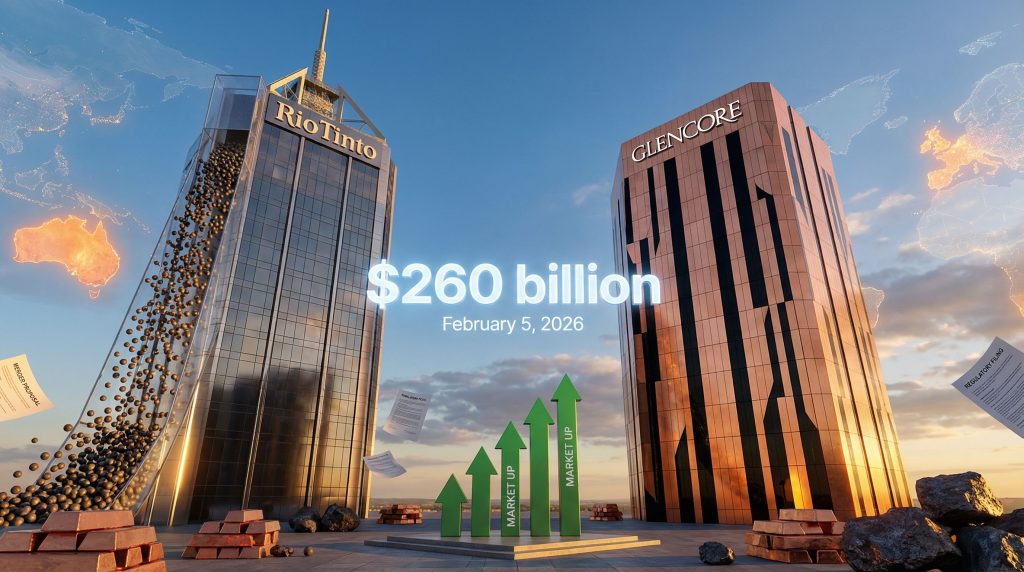
The potential combination of Rio Tinto and Glencore would fundamentally alter global mining market structure, creating an enterprise valued at approximately US$260 billion. This scale represents a transformative shift in commodity market concentration, positioning the merged entity among the world's largest natural resource companies.
Market Capitalisation and Scale Analysis
Current market valuations reveal significant asymmetry between the two companies. Rio Tinto's A$200 billion market capitalisation reflects its premium positioning in iron ore and diversified mining operations, while Glencore's £53 billion valuation incorporates both mining assets and extensive commodity trading operations.
The combined entity would achieve several strategic advantages:
• Market leadership in multiple commodity segments simultaneously
• Enhanced pricing influence across iron ore, copper, and aluminium markets
• Integrated value chain control from mine production through global distribution
• Diversified revenue streams reducing exposure to single-commodity volatility
• Operational scale economies in procurement, technology deployment, and capital allocation
Comparative analysis with existing mining majors demonstrates the transformative nature of this potential combination. BHP Group Limited, currently the sector's largest independent player, would face intensified competitive pressure from a merged entity with superior asset diversification and global reach. Furthermore, this mirrors the BHP strategic pivot currently reshaping competitive dynamics across the sector.
Strategic Asset Portfolio Complementarity
Rio Tinto's operational strengths centre on world-class iron ore production from Pilbara region operations, generating approximately 330 million tonnes per annum. This dominant position in seaborne iron ore markets provides stable cash flow generation and strategic leverage in steel industry supply chains.
Glencore's portfolio offers different but complementary advantages:
• Copper production capacity of approximately 1.3 million tonnes annually
• Integrated trading operations providing downstream market access
• Diversified commodity exposure across base metals, energy materials, and agricultural products
• Global logistics infrastructure supporting commodity marketing and distribution
The copper market represents particularly attractive synergy potential. Combined copper production would approach 1.9 million tonnes annually, creating substantial market influence in a commodity essential for electrification and renewable energy infrastructure development.
Energy transition commodities present the most compelling strategic rationale for combination. Copper demand projections indicate 40-50% growth through 2035, driven by electric vehicle adoption, renewable energy deployment, and grid modernisation requirements. A merged entity would capture premium positioning in these high-growth market segments.
When big ASX news breaks, our subscribers know first
Why Are Investors Reacting Differently to the Merger Proposal?
Market reactions to Rio Tinto and Glencore merger talks reveal fundamental differences in stakeholder perspectives. Glencore shares surged 10% following confirmation of preliminary discussions, while Rio Tinto shares declined 6%, creating a divergent pattern typical of acquisition scenarios but amplified by specific strategic concerns.
Glencore Shareholder Premium Expectations
The positive Glencore market response reflects established merger arbitrage dynamics. Target company shareholders typically benefit from acquisition premiums, with mining sector transactions historically delivering 25-40% premiums above pre-announcement trading levels. This follows patterns seen in the historic takeover premium recently observed in other mining consolidation deals.
Historical precedent supports premium expectations:
• Antofagasta-Antucoya (2016): 35% premium to market price
• Glencore-Xstrata (2013): 40% premium in all-stock transaction
• BHP-Billiton (2001): 30% average premium across dual-listed structure
Glencore's diversified asset base, particularly its 26 coal mining operations across Australia, Colombia, and South Africa, represents valuable production capacity that acquirers would need to properly value. With annual coal production of approximately 123 million tonnes, these assets generate substantial cash flows despite ESG-related concerns.
The company's trading operations add additional complexity to valuation methodologies. Unlike pure-play mining companies, Glencore's integrated commodity marketing generates 15-20% of total revenues through trading activities that provide market access and price optimisation capabilities.
Rio Tinto Investor Concerns and Risk Assessment
Rio Tinto's negative market reaction reflects multiple investor concerns about acquisition execution risks and strategic fit challenges. The 6% share price decline indicates market scepticism about value creation potential from the acquirer's perspective.
Primary investor concerns include:
• Cultural integration complexity between trading-focused and mining-focused operations
• Regulatory approval uncertainty across multiple jurisdictions
• ESG positioning deterioration through coal asset absorption
• Balance sheet impact from financing large-scale acquisition
• Management execution risk during extended integration process
Rio Tinto's current financial metrics suggest the company trades at reasonable valuations independent of merger activity. At approximately A$143 per share, the stock reflects 13x earnings multiples with 4.5% dividend yields that appeal to income-focused investors.
However, the market's negative reaction also incorporates lessons from previous negotiation failures. Similar discussions in late 2024 collapsed without reaching formal agreement, as reported by Reuters, suggesting structural obstacles to successful combination that may persist in current negotiations.
How Do Coal Assets Impact the Strategic Rationale?
Coal assets represent the most significant strategic complication in potential Rio Tinto and Glencore merger talks. This issue extends beyond simple asset valuation to encompass fundamental questions about corporate positioning, investor base management, and long-term strategic direction.
ESG Investment Fund Implications
Rio Tinto's 2018 coal asset divestiture strategy positioned the company as a "clean commodities" producer aligned with energy transition trends. This strategic pivot attracted ESG-focused institutional capital that comprises an estimated 25-35% of the company's shareholder base.
Incorporating Glencore's coal operations would reverse this positioning through several mechanisms:
Quantitative ESG Screen Violations:
| Screening Criteria | Rio Tinto (Current) | Combined Entity |
|---|---|---|
| Coal Revenue Exposure | 0% | 8-10% |
| ESG Fund Eligibility | ✓ Qualified | ✗ Disqualified |
| Carbon Intensity | Low | Moderate-High |
| Climate Alignment | Paris-Aligned | Non-Aligned |
Major institutional investors including CalPERS, GPIF, and Norwegian Government Pension Fund Global maintain exclusionary criteria that would automatically trigger divestment requirements. These forced selling pressures could create sustained downward pressure on share price performance.
ESG fund divestment typically occurs within 30-90 day windows following mandate violations, concentrating selling pressure during specific timeframes. Historical precedent from other sector transitions suggests 2-3% underperformance relative to benchmarks during divestment periods.
Asset Divestiture vs. Integration Scenarios
Alternative structural arrangements could potentially address coal asset concerns while preserving merger benefits. Several separation mechanisms warrant consideration:
Spin-Off Structure Options:
• Complete coal business separation prior to merger completion
• Conditional divestiture commitments with regulatory approval timelines
• Separate tracking stock creation for coal operations within combined entity
• Third-party sale processes for coal assets to specialised operators
Each separation approach presents distinct regulatory, tax, and operational challenges. Coal business spin-offs require standalone management teams, independent financing arrangements, and separate operational infrastructure that may reduce asset values relative to integrated operations.
The global coal market environment complicates divestiture execution. While thermal coal demand remains robust in certain regions, ESG-conscious capital availability limits potential buyer pools and may depress asset sale valuations.
Alternative buyers for coal assets include:
• Private equity firms focused on cashflow-generating assets
• Sovereign wealth funds from coal-dependent economies
• State-owned enterprises in developing markets
• Management buyout structures supported by debt financing
What Are the Regulatory and Timeline Challenges?
The regulatory approval process for Rio Tinto and Glencore merger talks would represent one of the most complex multi-jurisdictional reviews in mining industry history. The February 5, 2026 deadline under UK Takeover Code requirements creates immediate time pressure for preliminary decision-making.
UK Takeover Code Requirements
Under UK Takeover Panel Rule 2.7, Rio Tinto must announce firm intentions regarding formal offer proceedings by the specified deadline. This regulatory framework creates several procedural requirements:
Mandatory Disclosure Timeline:
• Initial announcement obligations within 28 days of market speculation
• Firm offer publication requirements including detailed terms and conditions
• Shareholder circular distribution with independent board recommendations
• Regulatory filing submissions across all relevant jurisdictions
• Conditional approval coordination between multiple regulatory bodies
The UK regulatory environment presents additional complexity through recent changes in foreign investment screening. The National Security and Investment Act 2021 grants government authorities broader powers to review transactions affecting critical infrastructure, including natural resource operations.
Multi-Jurisdictional Approval Complexity
Geographic asset distribution across both companies creates overlapping regulatory requirements in multiple jurisdictions:
Primary Regulatory Jurisdictions:
| Region | Key Assets | Regulatory Body | Typical Timeline |
|---|---|---|---|
| Australia | Iron ore, coal operations | ACCC, FIRB | 6-12 months |
| United Kingdom | Corporate domicile | CMA, Takeover Panel | 4-8 months |
| European Union | Aluminium smelting | European Commission | 6-18 months |
| Canada | Mining operations | Competition Bureau | 4-6 months |
| South Africa | Coal, platinum assets | Competition Commission | 8-12 months |
Chinese regulatory approval represents a particularly complex requirement due to the strategic nature of iron ore and copper supplies for Chinese industrial production. The State Administration for Market Regulation (SAMR) maintains authority over transactions affecting critical commodity supply chains. This complexity mirrors broader challenges seen across global trade impact patterns affecting international business combinations.
Competition Authority Concerns:
• Market concentration in copper and iron ore segments
• Vertical integration between production and trading operations
• Supply chain security for strategic industrial commodities
• Price coordination potential across integrated operations
• Barrier creation for smaller competitive participants
Historical merger approval timelines in the mining sector suggest 12-24 month processes for transactions of comparable scale and complexity. The 2013 Glencore-Xstrata combination required 18 months from announcement to completion, despite ultimately receiving approvals across all required jurisdictions.
Which Commodity Markets Would Be Most Affected?
A successful Rio Tinto-Glencore combination would reshape competitive dynamics across multiple commodity markets, with copper and iron ore segments experiencing the most significant structural changes.
Copper Market Concentration Analysis
Combined copper production capacity would approach 1.9 million tonnes annually, representing approximately 8-10% of global mine production. This scale creates substantial market influence during periods of supply-demand imbalance.
Global Copper Production Context:
• Total global production: ~22 million tonnes annually
• Top 5 producers control: ~35% of global supply
• Combined entity ranking: #2 globally after Codelco
• Geographic diversification: Operations across 4 continents
The energy transition amplifies copper's strategic importance. Electric vehicle production requires 3-4x more copper than conventional vehicles, while renewable energy infrastructure demands substantial copper-intensive grid improvements. Combined entity positioning would capture premium exposure to these growth trends.
Market concentration concerns centre on pricing power during supply constraints. Copper markets historically experience boom-bust cycles with 3-7 year duration patterns. Enhanced market share provides ability to influence spot pricing during tight supply conditions.
Iron Ore and Aluminium Market Dynamics
Rio Tinto's Pilbara operations represent world-class iron ore assets with production costs among the lowest globally. Annual production of 330 million tonnes positions the company as a tier-one supplier to global steel production.
Iron ore market structure already demonstrates high concentration:
Market Share Distribution:
• Vale S.A.: ~20% of seaborne trade
• Rio Tinto: ~18% of seaborne trade
• BHP Group: ~16% of seaborne trade
• Fortescue Metals: ~8% of seaborne trade
• Combined top 4: ~62% of global trade
A Rio Tinto-Glencore merger would not significantly alter iron ore concentration since Glencore maintains limited iron ore exposure. However, the combination would create cross-commodity leverage enabling coordinated supply management across multiple markets.
Aluminium operations present integration opportunities through smelting capacity optimisation. Rio Tinto's smelting operations in Australia, Iceland, and Canada could benefit from Glencore's bauxite and alumina supply chains, creating vertical integration advantages.
How Do Historical Merger Attempts Inform Current Negotiations?
Previous merger discussions between Rio Tinto and Glencore provide valuable insights into persistent obstacles and negotiation dynamics that continue to influence current talks.
2024 Failed Negotiations Analysis
The collapse of 2024 merger discussions reveals several structural challenges that remain unresolved in current negotiations:
Primary Negotiation Obstacles:
• Valuation methodology disagreements between trading-multiple and asset-based approaches
• Coal asset treatment without satisfactory resolution mechanisms
• Management structure conflicts between decentralised and centralised operating models
• Shareholder communication failures during preliminary discussions
• Regulatory complexity assessment differences between negotiating parties
The brief timeline of 2024 discussions suggests insufficient due diligence on integration planning and synergy quantification. Successful mining mergers typically require 6-12 months of detailed operational analysis before formal announcements.
Cultural integration challenges emerged as a significant concern during previous negotiations. Rio Tinto's engineering-focused culture contrasts with Glencore's trading-oriented approach, creating potential management conflicts during post-merger integration.
2014 Merger Proposal Comparison
A decade-long perspective reveals evolving market conditions that both support and complicate current merger rationale:
Market Evolution Factors (2014-2026):
| Factor | 2014 Environment | 2026 Environment |
|---|---|---|
| Commodity Prices | Post-cycle lows | Recovery phase |
| ESG Requirements | Minimal | Mandatory screening |
| Energy Transition | Early stage | Accelerating demand |
| Regulatory Scrutiny | Moderate | Intensive review |
| China Demand | Peak growth | Stabilising consumption |
The 2014 proposal occurred during a commodity price downturn that created financial stress across the mining sector. Current market conditions provide stronger balance sheets and improved cash flow generation, supporting more favourable negotiation positions.
However, increased ESG investment requirements create new obstacles absent from earlier discussions. The coal asset challenge represents a fundamental structural change in investment community expectations that did not exist during previous negotiations. These trends align with broader North American mining trends emphasising sustainability and environmental responsibility.
The next major ASX story will hit our subscribers first
What Investment Scenarios Should Shareholders Consider?
Shareholders in both companies face complex decision-making scenarios with multiple potential outcomes and varying probability assignments.
Deal Success Probability Assessment
Market-implied probabilities derived from current share price movements suggest moderate scepticism about successful completion:
Probability Framework Analysis:
• High probability (70-80%): Formal offer announcement by February deadline
• Medium probability (40-50%): Regulatory approval across all jurisdictions
• Low probability (25-35%): Transaction completion without major concessions
• Very low probability (10-15%): Integration execution without operational disruption
Risk factors affecting completion probability include:
• Regulatory coordination across 6+ jurisdictions simultaneously
• Shareholder approval requiring 75% support from each company
• Coal asset resolution satisfactory to ESG-focused investors
• Financing arrangements for all-stock or mixed consideration structure
• Management retention of key personnel during transition period
Standalone Company Performance Alternatives
Independent growth strategies for both companies provide alternative value creation pathways without merger execution risks:
Rio Tinto Standalone Strategy:
• Pilbara expansion through autonomous operations and productivity improvements
• Copper asset development at Oyu Tolgoi and Resolution Copper projects
• Battery materials exposure through lithium and rare earth investments
• Technology deployment across operations for cost reduction
• Capital discipline maintaining strong dividend policies
Rio Tinto's standalone valuation multiples suggest fair value pricing at current levels. The company's 4.5% dividend yield provides attractive income generation while maintaining exposure to commodity cycle upside.
Glencore Independent Pathway:
• Trading business optimisation through technology and market expansion
• Coal asset rationalisation focusing on highest-return operations
• Copper production growth through development projects and acquisitions
• Battery materials integration vertical supply chain development
• Debt reduction improving balance sheet flexibility
Glencore's trading operations provide unique value proposition not easily replicated by competitors. These activities generate stable cash flows during commodity price volatility and provide natural hedging benefits.
How Would This Merger Reshape Mining Industry Competition?
A successful Rio Tinto-Glencore combination would trigger industry-wide competitive responses and potentially accelerate consolidation trends across the mining sector.
BHP Competitive Response Implications
BHP Group Limited, currently the sector's largest diversified miner, would face intensified competitive pressure requiring strategic responses:
Potential BHP Response Options:
• Strategic acquisitions targeting copper and battery materials assets
• Joint venture formations with mid-tier producers for scale benefits
• Technology investments for operational efficiency advantages
• Geographic expansion into under-represented commodity regions
• Specialty metals focus on high-growth niche markets
The competitive dynamic would shift from two-tier competition (BHP/Rio Tinto/Vale) to head-to-head rivalry between mega-scale integrated operations. This concentration could result in:
• Enhanced pricing coordination capabilities across major commodities
• Capital allocation efficiency through reduced competitive investment
• Innovation acceleration in mining technology and processes
• Market share protection strategies by remaining independent producers
Mid-Tier Mining Company Consolidation Pressure
Industry consolidation pressure would intensify for mid-tier producers lacking scale advantages:
Vulnerable Company Categories:
| Company Type | Market Cap Range | Primary Risk Factors |
|---|---|---|
| Regional producers | $1-5 billion | Limited geographic diversification |
| Single-commodity focus | $500M-2 billion | Commodity price exposure |
| Development-stage | $100-500 million | Financing access constraints |
| High-cost operators | Various | Margin pressure scenarios |
Consolidation acceleration would likely target copper-focused producers given the strategic importance of energy transition metals. Companies with development-stage copper projects could attract premium valuations from major producers seeking growth options.
Private equity involvement in mining sector consolidation has increased substantially, with $15+ billion in available capital targeting natural resource investments. This capital availability supports continued M&A activity independent of mega-merger completion.
What Are the Key Financial Metrics Investors Should Monitor?
Several quantitative indicators will provide insight into merger progress, valuation reasonableness, and investment decision-making frameworks.
Valuation Methodology Comparison
Current financial metrics reveal valuation disparities that complicate merger exchange ratio negotiations:
Comparative Financial Analysis:
| Metric | Rio Tinto | Glencore | Industry Average |
|---|---|---|---|
| Market Capitalisation | A$200B | £53B | $85B USD |
| Enterprise Value | A$225B | £65B | $95B USD |
| P/E Ratio (TTM) | 13.2x | 11.8x | 12.5x |
| EV/EBITDA | 6.8x | 4.2x | 5.8x |
| Price/Book Value | 2.1x | 1.4x | 1.8x |
| Dividend Yield | 4.5% | 3.8% | 3.2% |
| Return on Assets | 12.3% | 8.7% | 9.5% |
| Debt/Equity Ratio | 0.25 | 0.35 | 0.30 |
The EV/EBITDA multiple disparity (6.8x vs 4.2x) suggests either Rio Tinto premium valuation or Glencore discount pricing relative to asset quality and cash flow generation capability.
Asset-Based Valuation Considerations:
• Net present value of proven and probable reserves
• Replacement cost methodology for processing infrastructure
• Strategic value premiums for market-leading asset positions
• Synergy value quantification through operational integration
• Risk-adjusted cash flow projections incorporating commodity price volatility
Synergy Value Creation Potential
Synergy quantification remains challenging without detailed operational integration analysis, but industry benchmarks provide directional guidance:
Synergy Category Estimates:
• Cost synergies: $2-4 billion annually through operational integration
• Revenue synergies: $1-2 billion annually through trading optimisation
• Capital synergies: $500M-1 billion annually through project coordination
• Tax synergies: $200-500 million annually through structure optimisation
• Working capital: $1-3 billion one-time through inventory management
These estimates require 3-5 year implementation periods and face execution risk during complex integration processes. Historical mining mergers achieve 60-75% of projected synergies within target timeframes.
Critical Success Factors:
• Management retention of operational expertise during transition
• Technology integration across different operational systems
• Cultural alignment between trading and mining-focused teams
• Regulatory cooperation facilitating operational consolidation
• Market conditions supporting synergy realisation assumptions
What Should Long-Term Investors Do Now?
Investment decision-making requires balancing multiple risk-return scenarios with varying probability outcomes and timeline considerations.
Risk-Adjusted Investment Strategies
The current environment presents several strategic approaches for different investor profiles:
Conservative Income Investors:
• Wait-and-see approach until February 5 deadline clarity
• Dividend focus on Rio Tinto's 4.5% current yield sustainability
• Risk mitigation through position sizing and diversification
• Alternative options in mining sector without merger exposure
Growth-Oriented Investors:
• Opportunistic entry during uncertainty-driven price volatility
• Copper exposure through combined entity energy transition positioning
• Synergy upside participation through successful integration execution
• Technology benefits from scale advantages in mining operations
ESG-Focused Investors:
• Coal concern evaluation regarding investment mandate compliance
• Alternative copper exposure through pure-play mining companies
• Impact assessment of potential coal asset separation structures
• Fund screening implications for portfolio inclusion requirements
Merger Arbitrage Specialists:
• Spread analysis between current pricing and implied deal terms
• Probability assessment updates based on regulatory and negotiation progress
• Risk management through hedging strategies and position limits
• Timeline monitoring for deal completion milestone achievement
Alternative Mining Sector Opportunities
Independent investment options provide exposure to similar commodity themes without merger execution risk:
Copper-Focused Alternatives:
• Freeport-McMoRan (FCX): Large-scale copper producer with US operations
• Southern Copper Corporation (SCCO): Integrated copper operations across Americas
• First Quantum Minerals (FM.TO): Development-stage copper projects with growth potential
• Antofagasta PLC (ANTO.L): Chilean copper operations with expansion plans
Diversified Mining Options:
• BHP Group Limited (BHP): Comparable scale and diversification profile
• Vale S.A. (VALE): Iron ore leadership with base metals exposure
• Anglo American PLC (AAL.L): Diversified commodity portfolio including platinum
• Teck Resources Limited (TECK-B.TO): North American mining operations
ETF Diversification Strategies:
• VanEck Vectors Gold Miners ETF (GDX): Precious metals sector exposure
• Materials Select Sector SPDR Fund (XLB): Broad materials sector diversification
• Global X Copper Miners ETF (COPX): Pure-play copper sector concentration
• iShares MSCI Global Metals & Mining Producers ETF (PICK): Global mining exposure
Investment Timing Considerations:
The February 5, 2026 deadline creates specific decision points for investment timing:
• Pre-deadline positioning captures uncertainty discount potential
• Post-announcement reactions may create entry opportunities regardless of outcome
• Completion timeline extends 12-24 months providing multiple entry points
• Integration period spans 2-3 years with ongoing synergy realisation
Long-term investors with 5+ year time horizons can weather short-term volatility while capturing structural growth in energy transition commodities. The fundamental investment thesis for copper and iron ore demand remains intact independent of specific corporate combinations. Consequently, the broader implications for Rio Tinto and Glencore merger talks extend well beyond immediate share price movements, as noted in analysis from the Financial Times.
Risk Management Protocols:
• Position sizing should reflect individual risk tolerance and portfolio concentration limits
• Diversification maintenance across multiple mining companies and commodities reduces specific merger risk
• Monitoring systems for regulatory developments and negotiation progress provide decision-making updates
• Exit strategies should be predetermined for various scenario outcomes
Disclaimer: This analysis is for informational purposes only and should not be considered personalised investment advice. Mining sector investments involve substantial risks including commodity price volatility, operational challenges, regulatory changes, and market conditions. Potential investors should conduct independent research and consult qualified financial advisors before making investment decisions. Past performance does not guarantee future results, and merger outcomes remain uncertain with multiple risk factors affecting successful completion.
Ready to Identify the Next Major Mining Discovery Before the Market Reacts?
With consolidation reshaping the mining landscape and giants like Rio Tinto and Glencore exploring combinations, smaller discoveries often present the most explosive opportunities for investors. Discovery Alert's proprietary Discovery IQ model instantly identifies significant ASX mineral discoveries, transforming complex geological data into actionable investment insights that can position you ahead of major market movements. Begin your 30-day free trial today to gain the edge that comes from being first to know about breakthrough discoveries in an increasingly concentrated mining sector.