May 18, 2026
The Hidden Fault Lines: Understanding Why Mining Disputes Are Structurally Inevitable
Commodity cycles come and go, but the legal and social conflicts that now define the global mining industry are something different entirely. They are not a byproduct of a temporary boom or a single policy shift. They are the accumulated result of deep structural tensions that have been building for decades and are now converging at a moment when the world needs minerals more urgently than at any point in modern history.
The clean energy transition has fundamentally changed what mining means geopolitically. Copper, lithium, cobalt, nickel, and rare earth elements are no longer just industrial inputs. They are strategic assets, and that reclassification has changed the behaviour of governments, communities, investors, and operators alike. When the stakes rise, so does the conflict.
Understanding why mining disputes are on the rise requires moving beyond headline cases and examining the structural mechanics that make conflict increasingly inevitable across the sector.
When big ASX news breaks, our subscribers know first
The Scale of the Problem: What the Data Actually Tells Us
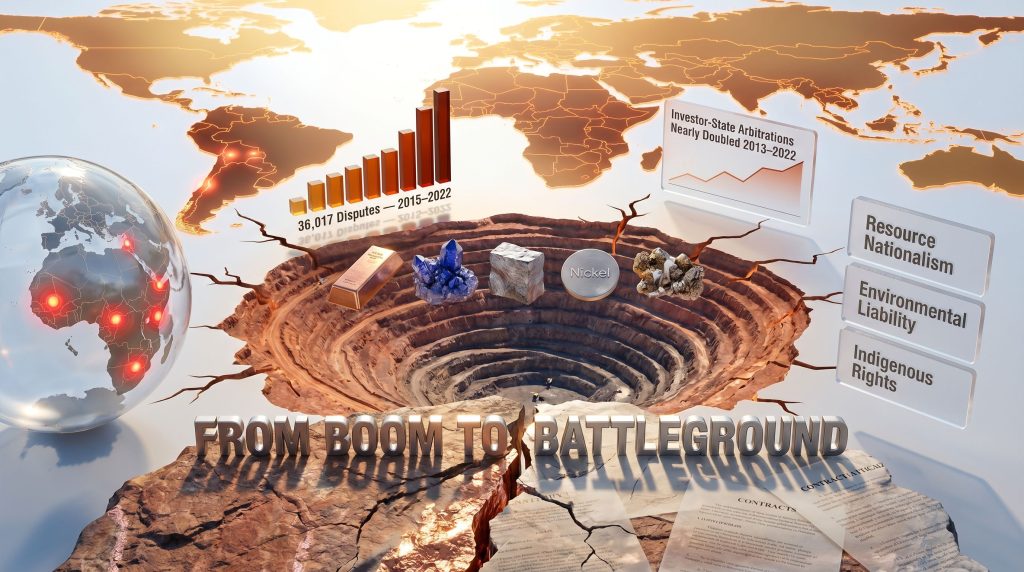
The numbers alone make a compelling case that something structural has shifted. Between 2015 and 2022, researchers tracking global mining-related conflicts recorded 36,017 separate disputes, establishing that opposition to mineral extraction is a pervasive global phenomenon rather than an isolated occurrence in a handful of contentious jurisdictions.
Equally striking is the trajectory of formal legal proceedings. Investor-state treaty arbitrations in the mining sector nearly doubled between 2013 and 2022, with the sharpest concentration of growth occurring in South America and Africa — precisely the two regions that hold the largest identified reserves of the critical minerals driving the clean energy transition. Indeed, resource disputes between investors and states have hit a 10-year high, underscoring the severity of this structural shift.
High-profile legal confrontations, such as the ongoing dispute between Barrick Gold and the government of Mali, and BHP's protracted litigation arising from the Mariana dam disaster in Brazil, are not outliers. They are emblematic of a conflict pattern that has become structurally embedded in how the mining industry operates globally.
The doubling of investor-state arbitrations over a single decade is not a cyclical spike. It reflects a permanent shift in the risk environment that mining companies must now treat as a baseline operating condition rather than an exceptional circumstance.
Where Disputes Are Most Concentrated
The geographic distribution of mining disputes maps closely onto the geography of critical mineral endowment:
- Africa: Governments across West and Central Africa have moved aggressively to renegotiate legacy mining agreements, particularly for cobalt, gold, and copper, seeking to capture a larger share of resource rents that were originally structured under far less favourable terms for the host state.
- South America: The lithium triangle nations of Chile, Argentina, and Bolivia are navigating the tension between attracting the foreign capital needed for large-scale extraction and asserting domestic control over resources increasingly regarded as sovereign strategic assets. Community opposition in water-stressed highland regions adds a further layer of complexity.
- Southeast Asia and the Pacific: Nickel and bauxite operations face mounting environmental scrutiny and escalating challenges from Indigenous communities asserting land rights under strengthened domestic legal frameworks.
- North America and Australia: While institutional frameworks are more mature, ESG-driven litigation and regulatory enforcement targeting historical contamination and operational compliance failures are generating a new wave of disputes even in established mining jurisdictions.
Six Structural Forces Driving the Surge in Mining Conflicts
Force 1: The Critical Minerals Supercycle Is Pushing Projects Into High-Risk Territory
The critical minerals demand surge is categorically different from previous commodity booms. Iron ore and coal cycles were driven primarily by industrialisation patterns in large emerging economies. The current critical minerals supercycle is driven by decarbonisation mandates, EV adoption targets, battery gigafactory construction, and national security imperatives — all of which impose political urgency on project timelines that did not exist in prior cycles.
The International Energy Agency has projected that demand for critical minerals could increase by as much as sixfold by 2040 under stated energy policies, creating intense pressure on project developers to compress development timelines significantly. This urgency directly reduces the time available for community consultation, environmental assessment, and social licence construction — all of which are primary determinants of whether a project becomes embroiled in disputes.
Critically, the geographic concentration of these resources creates a structural problem. Over 70% of identified lithium resources, approximately 65% of cobalt reserves, and the vast majority of rare earth elements are concentrated in a small number of countries, many of which feature weaker institutional frameworks, contested land tenure systems, or politically sensitive regulatory environments. Projects that would previously have been deferred on risk grounds are now being advanced because the strategic imperative overrides conventional risk calculations.
The faster a project moves from discovery to development, the less time operators have to build the social licence to operate. Research indicates that projects developed with insufficient community consultation are significantly more likely to face serious disputes than those with comprehensive engagement processes.
Force 2: Indigenous and Community Land Rights Are Legally Non-Negotiable
A growing proportion of economically significant mineral deposits are located on or adjacent to Indigenous territories, communal lands, or areas where local populations depend directly on land and water resources for their livelihoods. This overlap is not incidental. It reflects historical patterns of settlement and resource stewardship that pre-date modern mining law by centuries.
Community concerns in these contexts consistently centre on four core issues:
- Land access and displacement — physical restriction of access to ancestral territories used for agriculture, grazing, or cultural practices
- Water security — extraction operations competing with agricultural and domestic water needs, particularly acute in arid and semi-arid regions
- Deforestation and biodiversity loss — clearing of vegetation and disruption of ecosystems upon which communities depend for food security and cultural continuity
- Economic marginalisation — local populations bearing environmental and social costs without receiving proportionate economic benefits from extraction activities
International frameworks, including the UN Declaration on the Rights of Indigenous Peoples (UNDRIP) and the principle of Free, Prior and Informed Consent (FPIC), are now being routinely invoked in formal legal proceedings across multiple jurisdictions. Furthermore, indigenous people on the frontline of the green transition face mounting pressures as these frameworks become embedded in domestic legislation, raising the legal threshold for project approval and creating ongoing compliance obligations that extend throughout the operational life of a mine.
The mining claims framework in jurisdictions such as British Columbia illustrates how domestic legal systems are increasingly codifying Indigenous rights in ways that fundamentally reshape project approval processes.
Force 3: Resource Nationalism Is Accelerating, Not Moderating
Resource-rich nations are systematically reasserting sovereign control over critical mineral assets, deploying a widening range of policy instruments to do so. The mechanisms in use include:
- Retroactive revisions to royalty and taxation frameworks designed to capture a larger share of resource rents
- Licence revocations and demands for contract renegotiation, often targeting agreements executed during periods when host governments had weaker bargaining positions
- Export restrictions and mandatory domestic processing requirements intended to capture downstream value
- Nationalisation measures or forced equity dilution requirements that reduce foreign ownership of operating assets
This pattern is particularly pronounced in jurisdictions where historical mining agreements were structured during periods of institutional weakness, commodity price suppression, or limited state capacity to negotiate effectively. New governments in these countries frequently face domestic political pressure to demonstrate that resource extraction serves national interests rather than primarily enriching foreign operators and shareholders.
When governments alter the terms of mining agreements unilaterally, operators typically have recourse through bilateral investment treaties (BITs) or international arbitration forums such as ICSID. However, these processes are lengthy, expensive, and outcome-uncertain. An arbitration proceeding may run for five to ten years before a final award is rendered, creating substantial operational and financial disruption even when the mining company ultimately prevails.
Force 4: Environmental and ESG Liability Has Expanded Dramatically
Environmental compliance has evolved from a peripheral regulatory concern into a central legal and political battleground that now shapes the viability of mining operations from project inception through to post-closure management. The role of natural capital in mining is increasingly recognised as a core component of how environmental liability is assessed and priced.
Several environmental flashpoints have, consequently, become particularly prominent:
| Environmental Issue | Legal Mechanism | Financial Exposure |
|---|---|---|
| Tailings storage facility failures | Class actions, regulatory prosecution | Potentially billions of dollars |
| Water contamination | Civil litigation, regulatory enforcement | Hundreds of millions of dollars |
| Carbon and climate liability | Emerging climate litigation theories | Rapidly developing legal framework |
| Biodiversity destruction | Regulatory enforcement, NGO litigation | Growing under biodiversity frameworks |
| Acid mine drainage | Legacy contamination claims | Potentially multigenerational exposure |
The catastrophic tailings dam failures at Mariana in 2015 and Brumadinho in 2019 — both in Brazil — triggered not only multi-billion-dollar litigation but a comprehensive overhaul of international tailings management standards. BHP's ongoing legal proceedings related to Mariana remain among the most complex and financially significant mass tort cases in the mining industry's history, involving hundreds of thousands of plaintiffs and proceedings across multiple jurisdictions simultaneously.
A less widely appreciated development is the increasing use of environmental allegations as a tactical instrument in broader governmental disputes with mining operators. Legal analysts have noted that water management practices are being scrutinised not only on genuine environmental grounds but also as leverage in contract renegotiation disputes, creating a compounding risk exposure that combines regulatory and geopolitical dimensions.
Force 5: Geopolitical Competition Is Compounding Legal Complexity
The broader geopolitical mining landscape has shifted fundamentally, with critical minerals now central to great-power competition. The United States, European Union, China, Japan, South Korea, and other major economies are competing aggressively to secure supply chains for defence, technology, and clean energy industries. This geopolitical dimension adds entirely new layers of legal and regulatory complexity:
- National security investment screening through mechanisms such as the Committee on Foreign Investment in the United States (CFIUS) and Australia's Foreign Investment Review Board (FIRB) has created new barriers to cross-border mining investment, particularly where Chinese-linked capital is involved
- Export controls and trade restrictions on critical mineral concentrates and processed products are proliferating, creating compliance complexity for operators whose production crosses multiple jurisdictional boundaries in the supply chain
- Competing investment frameworks place mining companies caught between Western-aligned investment standards and alternative frameworks in a position of constant balancing between incompatible regulatory expectations
Mining companies operating in jurisdictions contested between major powers face a compounded risk profile. They must simultaneously manage host government relations, home country policy requirements, and the expectations of international financiers — all of which may pull in contradictory directions at any given point in a project's life cycle.
Force 6: Long Project Lifespans Create Compounding Exposure
Mining operations are uniquely long-lived assets. From exploration through to final closure, a single project may span 30 to 50 years or more. Over that timeframe, the regulatory environment, commodity prices, political leadership, community expectations, and environmental standards will all change, sometimes dramatically and multiple times.
This temporal exposure creates a distinctive category of risk that has no equivalent in most other industries. Agreements and approvals secured at project inception may become legally contested as circumstances evolve. A fiscal regime that seemed fair under the commodity price conditions of the approval year may appear exploitative when prices spike a decade later. Furthermore, environmental standards that were compliant at construction may fall below subsequently enacted requirements, creating retroactive liability.
Investor-state disputes are particularly likely to arise during periods of commodity price spikes, when the economic rents from mining operations become politically visible and governments face domestic pressure to increase their share. This counter-cyclical dynamic means that mining companies' periods of greatest financial success frequently coincide with their periods of greatest legal and political exposure.
What Types of Legal Disputes Are Mining Companies Actually Facing?
Investor-State Arbitration: The High-Stakes Arena
Investor-state dispute settlement (ISDS) mechanisms, embedded in bilateral investment treaties and free trade agreements, allow mining companies to bring formal claims against host governments for breaches of treaty-based investment protections. Common triggers include:
- Expropriation, whether direct nationalisation or indirect measures that effectively deprive an investor of the value of their investment
- Failure to provide fair and equitable treatment, including arbitrary or discriminatory regulatory actions
- Denial of justice through domestic legal systems that fail to provide adequate remedies
- Violations of specific contractual undertakings or stability guarantees embedded in investment agreements
Awards in significant mining arbitrations can reach into the hundreds of millions or billions of dollars, making these among the highest-stakes legal proceedings in international commerce. However, the costs and timelines involved are substantial for both parties, and the enforcement of awards against sovereign states is not always straightforward.
Class Actions and Mass Tort Litigation
Large-scale environmental events have generated class action litigation involving hundreds of thousands of plaintiffs, representing a category of legal exposure that has grown dramatically in scale and cross-jurisdictional reach over the past decade. These cases are notable for their complexity and duration, often running for ten to fifteen years from initial filing through final resolution.
The cross-jurisdictional character of modern mass tort mining litigation has become a defining feature, with plaintiffs' legal teams pursuing claims in multiple legal systems simultaneously to maximise pressure on defendants and exploit the most favourable procedural rules available in each jurisdiction.
Regulatory Enforcement and Criminal Liability
Environmental regulators in major mining jurisdictions are increasingly pursuing both substantial financial penalties and criminal charges against operators for compliance failures. Fines ranging from hundreds of thousands to tens of millions of dollars have become more common for serious safety and environmental breaches. A recent example in Australia saw Newcrest face a fine of approximately US$750,000 related to a safety incident at its Cadia operation, reflecting a broader trend toward stricter enforcement. Directors and executives now face growing personal liability exposure in some jurisdictions, creating individual risk for corporate decision-makers that did not exist under previous regulatory frameworks.
How Are Mining Companies and Governments Responding?
Risk Mitigation Strategies Adopted by Operators
Leading mining companies have developed a range of strategies to manage their expanding dispute exposure:
- Enhanced social licence frameworks that move beyond tokenistic consultation toward genuine benefit-sharing arrangements, Indigenous partnership structures, and long-term community development commitments
- Political risk insurance through instruments offered by agencies such as the Multilateral Investment Guarantee Agency (MIGA) and export credit agencies, providing financial hedging against sovereign risk scenarios
- Dispute avoidance mechanisms embedded in project agreements, including mediation provisions and early neutral evaluation processes designed to resolve disagreements before they escalate to formal proceedings
- ESG integration from project inception rather than treating environmental and social risk management as downstream compliance obligations, ensuring that potential conflict vectors are identified and addressed at the earliest possible stage
Government-Level Responses
Governments are, in addition, responding to the dispute landscape through several channels:
- Development of critical minerals strategies that attempt to balance resource nationalism with the continued need to attract foreign investment capital and technical expertise
- Establishment of dedicated mining courts and specialist arbitration frameworks in some jurisdictions, providing more predictable and faster dispute resolution than general commercial courts
- International negotiations on bilateral investment treaty reform, addressing asymmetries in the ISDS system that have attracted sustained criticism from both developing and developed nations
The relationship between critical minerals and energy security is increasingly shaping how governments structure these policy responses, particularly where national strategic interests intersect with the need to maintain investor confidence.
Emerging Dispute Trends to Watch Beyond 2025
The dispute landscape is not static. Several new conflict categories are developing rapidly and will likely become significant sources of litigation over the next decade:
| Emerging Dispute Category | Primary Driving Force | Trajectory |
|---|---|---|
| Climate liability claims | Carbon accounting, Scope 3 emissions | High growth, legal frameworks developing rapidly |
| Water rights disputes | Arid-region extraction, agricultural competition | Sustained growth, particularly in lithium-producing regions |
| Digital and data sovereignty | Mine automation, AI-driven operational data | Emerging, regulatory frameworks nascent |
| Supply chain due diligence liability | EU CSDDD, US forced labour legislation | Accelerating, compliance deadlines approaching |
| Biodiversity offsetting disputes | Global Biodiversity Framework obligations | Early stage, significant growth expected |
| ESG disclosure litigation | ISSB standards, EU CSRD, SEC climate rules | Rapidly developing across multiple jurisdictions |
The ESG Disclosure Dimension
Mandatory ESG disclosure requirements are creating a new and underappreciated category of legal exposure for mining companies. Disclosures that prove to be materially misleading, particularly around environmental performance, water management, or community relations, can trigger securities litigation, regulatory enforcement actions, and reputational damage that cascades across investor and stakeholder relationships simultaneously.
As disclosure becomes mandatory and standardised under frameworks like the International Sustainability Standards Board (ISSB) requirements and the EU's Corporate Sustainability Reporting Directive (CSRD), the gap between what companies report and what they actually deliver will become increasingly visible and legally actionable. Mining companies that have historically relied on the opacity of their environmental and social performance data to manage stakeholder expectations will face a fundamentally changed information environment.
As ESG disclosure becomes mandatory and standardised across major capital markets, the verifiable gap between reported commitments and operational reality will become a primary trigger for a new generation of shareholder and regulatory litigation.
The next major ASX story will hit our subscribers first
Key Takeaways for Industry Participants
The convergence of forces driving why mining disputes are on the rise is not temporary. Understanding the structural picture requires acknowledging several uncomfortable realities:
- 36,017 mining conflicts were recorded between 2015 and 2022, confirming that opposition to extraction is a systemic feature of the industry's operating environment
- Investor-state arbitrations in the sector nearly doubled over the decade to 2022, with South America and Africa generating the highest concentration of new proceedings
- Environmental issues, particularly water management practices, are emerging as flashpoints in both regulatory enforcement and investor-state arbitration, sometimes being deployed tactically rather than purely on environmental grounds
- The financial consequences of disputes have escalated dramatically, with class actions and arbitration awards regularly reaching into the billions of dollars and remaining active for over a decade
- Companies that embed genuine social licence management and rigorous environmental risk mitigation into the earliest stages of project design are structurally better positioned to navigate this more contested operating environment
- The emergence of ESG disclosure liability, climate litigation, and supply chain due diligence requirements will add further complexity to an already challenging dispute landscape over the coming decade
Disclaimer: This article is intended for informational purposes only and does not constitute legal or investment advice. Statistics and projections referenced are based on available research and industry analysis; readers should conduct independent verification before relying on any figures for operational or investment decision-making. Past dispute trends are not necessarily indicative of future outcomes in specific jurisdictions or for specific projects.
Readers seeking ongoing coverage of legal, operational, and ESG developments across the global mining sector can find further analysis and reporting at miningmagazine.com.
Want to Stay Ahead of Significant ASX Mineral Discoveries Before the Broader Market Reacts?
While mining disputes and structural risks reshape the global sector, Discovery Alert's proprietary Discovery IQ model delivers real-time alerts on significant ASX mineral discoveries, transforming complex mineral data into clear, actionable insights for investors at every experience level. Explore how major discoveries have historically generated substantial returns on Discovery Alert's dedicated discoveries page, and begin your 14-day free trial today to position yourself ahead of the market.