June 19, 2026
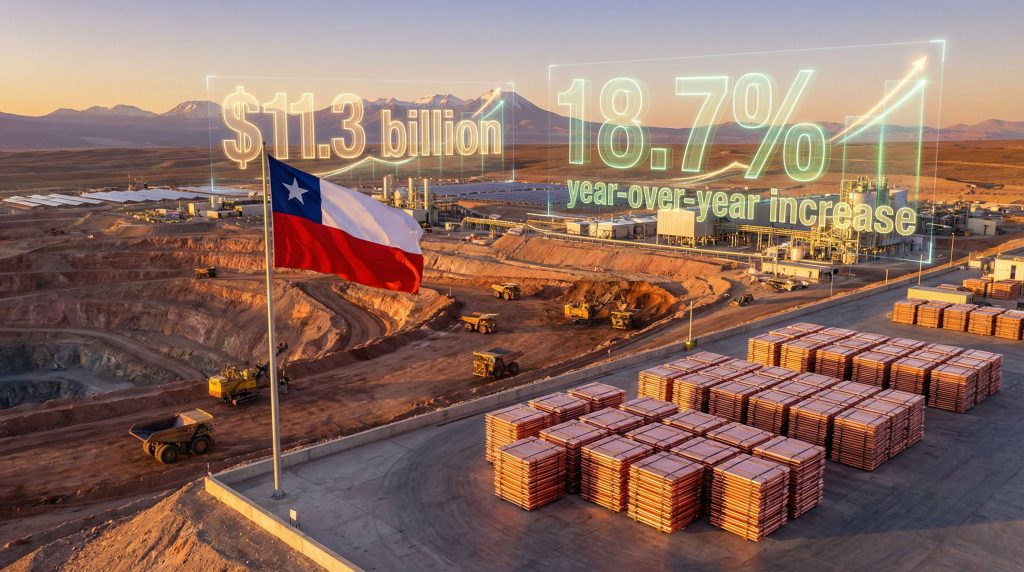
Chile's export economy demonstrates the profound impact of geological advantages and strategic infrastructure development as mining dominates Chile's exports in 2025. The nation's resource-driven growth model reflects decades of investment in extractive industries that generate substantial foreign exchange earnings. Furthermore, understanding these macro-economic forces becomes critical for evaluating how extractive industries sustain national economic foundations during periods of technological transformation.
Chile's Export Landscape: Understanding the Resource-Driven Economy
Chile's economy operates as a textbook example of resource-driven growth, where geological endowments translate directly into foreign exchange earnings and fiscal revenues. The nation's export composition reflects this reality, with extractive industries generating the majority of international trade revenues through commodity sales to global manufacturing centers.
Mining's contribution to Chile's GDP fluctuates between 8-12% depending on commodity price cycles and production volumes, according to Central Bank of Chile data. However, this understates mining's broader economic influence, as the sector generates cascading effects throughout transportation, logistics, equipment manufacturing, and professional services industries.
The relationship between commodity prices and export values creates inherent volatility in Chile's trade balance. When copper prices surge above $4.00 per pound, mining exports can represent over 50% of total merchandise exports. Consequently, during price downturns, this percentage contracts, forcing economic diversification discussions among policymakers.
Foreign exchange generation from mining operations provides the Chilean peso with stability relative to other Latin American currencies. Unlike economies dependent on agricultural exports or manufactured goods, mineral exports command premium pricing in international markets, particularly during global infrastructure expansion cycles.
Comparative Economic Structure Analysis
Chile's resource dependency contrasts sharply with regional neighbors pursuing different development strategies. While Brazil emphasizes manufacturing and services alongside commodity exports, and Colombia balances oil, coffee, and manufacturing, Chile maintains concentrated exposure to hard mineral extraction.
This concentration creates both advantages and vulnerabilities. Advantages include:
- Predictable revenue streams from long-term supply contracts
- Premium pricing for high-quality copper cathodes and concentrates
- Established trade relationships with major consuming nations
- Infrastructure investments that compound competitive advantages over time
Vulnerabilities encompass:
- Exposure to global commodity price volatility
- Environmental regulatory risks affecting production capacity
- Geopolitical tensions disrupting trade relationships
- Currency appreciation during commodity booms reducing export competitiveness
When big ASX news breaks, our subscribers know first
What Makes Chile a Global Mining Powerhouse?
Chile's mining dominance stems from geological formations created over millions of years, combined with deliberate infrastructure investments and regulatory frameworks designed to attract international capital. The nation's position along the Pacific Ring of Fire created unique mineral concentrations that remain unmatched globally in terms of both quality and accessibility.
The Atacama Desert provides optimal mining conditions with minimal precipitation, stable geological conditions, and proximity to Pacific shipping routes. These natural advantages reduce operational costs compared to mining operations in tropical climates or politically unstable regions.
Infrastructure supporting extraction includes specialised port facilities at Antofagasta, Iquique, and Mejillones designed specifically for bulk mineral handling. Railway networks connect inland mining operations to coastal export terminals, while dedicated power generation facilities ensure consistent electricity supply for energy-intensive mineral processing operations.
Technological Infrastructure Advantages
Chile's mining operations utilise advanced extraction technologies that maximise recovery rates while minimising environmental impact. Automation in mining, real-time ore grade monitoring, and precision blasting techniques allow operators to maintain production efficiency even as ore grades decline over time.
Water management infrastructure represents a critical competitive advantage in the arid Atacama region. Desalination plants, closed-loop water recycling systems, and underground aquifer management enable sustained operations despite regional water scarcity challenges.
Digital integration throughout Chilean mining operations includes predictive maintenance algorithms, autonomous equipment operation, and integrated supply chain management systems. These technological implementations reduce operational costs and improve safety metrics compared to international competitors.
Historical Development Timeline
Chile's transition from agricultural to mining-dominated exports occurred gradually between 1960-1990, accelerated by copper price increases and foreign investment liberalisation policies. The 1974 Mining Code established clear property rights and tax frameworks that attracted international mining companies while ensuring government revenue participation.
Key development milestones include:
- 1971: Copper industry nationalisation under Salvador Allende
- 1988: Private investment liberalisation and foreign ownership permissions
- 1993: Environmental impact assessment requirements implementation
- 2005: Lithium brine extraction commercialisation in Atacama salt flats
- 2010: Technology modernisation initiatives and automation investments
Key Geological Assets Driving Export Performance
Chile's geological advantages concentrate in three distinct mineral-rich zones, each contributing different commodities to the nation's export portfolio. The northern Atacama region contains world-class copper porphyry deposits alongside lithium-rich brine aquifers. Central Chile hosts additional copper operations and gold deposits, while southern regions contribute molybdenum and silver production.
Copper belt concentration in the Atacama region contains approximately 60-70% of Chile's total copper production capacity across major operations including Escondida, Collahuasi, Spence, and Los Pelambres mines. These deposits feature consistent ore grades and massive scale, allowing operators to achieve significant economies of scale.
Deposit Characteristics and Quality Metrics
Porphyry copper deposits dominate Chilean production, characterised by large tonnage and moderate copper content typically ranging from 0.4% to 1.2% copper by weight. While lower grade than some international competitors, Chilean deposits offer massive scale and consistent metallurgy that supports long-term planning and infrastructure investment.
Molybdenum co-production occurs naturally in Chilean copper deposits, providing additional revenue streams that improve overall project economics. Chile produces approximately 200,000 metric tonnes of molybdenum annually, representing roughly 40% of global supply according to USGS mineral commodity data.
Lithium resources in the Atacama Salt Flat represent a fundamentally different extraction model based on brine processing rather than hard rock mining. These deposits contain battery-grade lithium concentrations suitable for direct processing into lithium carbonate and lithium hydroxide for electric vehicle applications.
| Mineral | Global Reserve Share | Annual Production | Primary Locations |
|---|---|---|---|
| Copper | 28% | 5.3-5.8 million tonnes | Atacama, Antofagasta |
| Lithium | 30% | 180,000-200,000 tonnes LCE | Salar de Atacama |
| Molybdenum | 35% | 200,000 tonnes | Co-product with copper |
| Gold | 2% | 40,000-45,000 kg | Multiple regions |
Reserve Life and Sustainability Metrics
Reserve life calculations for Chilean copper deposits typically range from 15-25 years at current production rates, though exploration activities and technological improvements frequently extend operational timelines. Escondida mine, for example, has maintained production for over three decades while continuously expanding proven reserves through ongoing exploration.
Lithium reserve assessments in the Atacama region suggest multi-decade production potential at current extraction rates. However, environmental regulations and water usage restrictions may limit actual production capacity regardless of geological availability.
How Do Copper Markets Influence Chile's 2025 Export Performance?
Copper market dynamics directly determine Chile's export revenues and economic growth rates, as the metal represents the single largest export commodity by value. Global copper demand patterns from construction, renewable energy, and electric vehicle sectors create price volatility that immediately impacts Chilean fiscal revenues and currency stability.
Current production capacity across Chilean operations approaches 5.5-5.8 million metric tonnes annually, though actual output fluctuates based on operational efficiency, maintenance schedules, and market conditions. The relationship between production costs and copper prices determines whether marginal operations remain economically viable.
Supply and Demand Balance Dynamics
Renewable energy infrastructure development drives approximately 15-20% of incremental copper demand growth as wind turbines, solar installations, and grid infrastructure require substantial copper content. Each megawatt of wind generation capacity requires approximately 3-4 tonnes of copper for construction and electrical components.
Electric vehicle production creates additional copper demand estimated at 80-85 kg per vehicle compared to 20-25 kg in traditional internal combustion engines. With global EV production approaching 13-14 million vehicles annually, this sector represents significant incremental copper consumption.
Construction sector demand remains the largest end-use market, consuming approximately 45-50% of global copper production through building wiring, plumbing systems, and HVAC equipment. Economic growth in China and India particularly influences this demand category.
Furthermore, understanding these complex market dynamics requires examination of global copper supply forecast patterns that affect Chilean export competitiveness.
Price Mechanisms and Revenue Impact
Chilean copper exports utilise indexed pricing structures tied to London Metal Exchange (LME) and COMEX futures contracts, with monthly or quarterly price adjustments based on prevailing market conditions. This pricing approach provides revenue stability while ensuring Chilean producers receive fair market compensation.
Long-term supply agreements with major consumers typically include price floors and ceilings that limit extreme volatility while ensuring supply security. Chinese state-owned enterprises and Japanese trading companies represent significant contract counterparties for Chilean copper exports.
Transportation and logistics costs from Chilean mines to Asian consumption centres typically range from $150-200 per tonne, depending on shipping availability and fuel prices. These costs directly impact net realised prices for Chilean producers.
Strategic Positioning in Global Supply Chains
Chile maintains approximately 28% of global copper production, making it the world's largest copper producer by volume and the dominant force in international copper trade. This market position provides significant influence over global copper pricing and supply security for major consuming nations.
Competitive positioning relative to other major copper producers reveals distinct advantages in ore quality, infrastructure development, and political stability. While Peru produces approximately 2.1-2.3 million tonnes annually and the Democratic Republic of Congo contributes 1.1-1.3 million tonnes, neither matches Chile's combination of scale and operational consistency.
Supply Chain Resilience Factors
Port infrastructure capacity at Chilean export terminals can handle over 6 million tonnes of copper concentrate and cathode annually, providing sufficient logistical capacity for current production plus modest expansion. Dedicated copper handling facilities reduce loading times and minimise contamination risks.
Shipping route diversity from Chilean ports reaches major consumption centres in Asia, Europe, and North America through established maritime logistics networks. This geographical positioning provides supply chain flexibility compared to landlocked competitors requiring multi-modal transportation.
Processing capabilities within Chile include both smelting and refining operations that produce finished copper cathodes suitable for direct manufacturing applications. This value-added processing generates premium pricing compared to copper concentrate exports.
Competitive Analysis Framework
Peru's competitive position benefits from lower labour costs and expanding production capacity, though political instability and infrastructure constraints limit growth potential. Recent social unrest and mining permit delays have constrained Peruvian output expansion.
DRC copper production faces ongoing security challenges, infrastructure limitations, and cobalt co-production complexities that create supply uncertainty. Chinese investment in Congolese operations provides technical expertise but introduces geopolitical considerations for international buyers.
Australian copper operations offer political stability and advanced technology but face higher operational costs and declining ore grades at mature deposits. Transportation distances to Asian markets also create logistical disadvantages compared to Chilean exports.
What Role Do Alternative Minerals Play in Export Diversification?
Alternative mineral exports provide crucial diversification benefits that reduce Chile's dependence on copper price cycles while positioning the nation strategically in emerging technology supply chains. Lithium, gold, molybdenum, and silver production collectively represent 20-25% of total mining export value, creating revenue stability during copper market downturns.
Lithium production expansion represents the most significant diversification opportunity as global electric vehicle adoption accelerates. Chilean lithium operations in the Atacama region produce battery-grade lithium carbonate that commands premium pricing compared to lower-quality alternatives from other global sources.
Lithium Market Positioning and Growth
Electric vehicle market expansion drives lithium demand growth projections of 15-20% annually through 2030, creating substantial revenue opportunities for Chilean producers. Current Chilean lithium production approaches 180,000-200,000 tonnes LCE annually, representing approximately 30% of global supply.
Battery technology evolution toward lithium iron phosphate (LFP) and next-generation chemistries maintains lithium demand growth even as battery manufacturers improve energy density and reduce material requirements per kilowatt-hour of storage capacity.
Supply chain integration between Chilean lithium producers and battery manufacturers includes direct investment partnerships and long-term supply agreements that provide revenue stability and production planning certainty.
Precious Metals and Industrial Minerals
Gold production from Chilean operations contributes approximately 40,000-50,000 kg annually, primarily as a co-product from copper mining operations. Gold's counter-cyclical pricing behaviour relative to copper provides natural hedging benefits during economic uncertainty periods.
Molybdenum markets depend heavily on steel production and drilling equipment manufacturing, sectors that correlate with global infrastructure investment cycles. Chilean molybdenum production benefits from co-product economics that reduce extraction costs compared to dedicated molybdenum operations.
Silver production occurs primarily as a by-product of copper mining, generating approximately 1,200-1,500 tonnes annually. Industrial silver applications in electronics and solar panels create steady demand independent of precious metals investment cycles.
The next major ASX story will hit our subscribers first
Economic Multiplier Effects: How Mining Exports Drive Broader Growth
Mining exports generate substantial economic multiplier effects throughout Chilean society, creating employment opportunities, infrastructure development, and technological advancement that extend far beyond direct mining operations. Regional economic development in northern Chile particularly benefits from mining-related investment and employment.
Direct employment in Chilean mining operations encompasses approximately 250,000-300,000 workers including contractors and support services. These positions typically offer wages 2-3 times higher than national averages, creating significant purchasing power in mining-dependent communities.
Regional Development and Infrastructure
Infrastructure investment driven by mining operations includes road construction, power generation facilities, telecommunications networks, and housing developments that benefit entire regional economies. The Mejillones-Antofagasta industrial corridor exemplifies how mining investment catalyses broader economic development.
Educational institution development in northern Chile includes technical training programmes, university engineering departments, and research facilities focused on mining technology and geology. These institutions create human capital that supports continued mining sector competitiveness.
Healthcare and social infrastructure investments by mining companies extend beyond immediate workforce needs to serve broader community populations, improving quality of life indicators in historically underdeveloped regions.
Foreign Investment and Capital Formation
International mining investment in Chile approaches $3-5 billion annually across exploration, expansion, and modernisation projects. This capital formation supports equipment manufacturing, construction services, and professional services industries throughout the country.
Technology transfer from international mining companies introduces advanced operational techniques, environmental management practices, and safety protocols that improve overall mining sector productivity and sustainability metrics.
Supply chain development creates opportunities for Chilean companies to provide specialised services, equipment, and materials to mining operations while building expertise that can be exported to other mining regions globally.
Challenges Facing Chile's Mining Export Dominance
Chilean mining operations face mounting challenges that threaten long-term export competitiveness and social sustainability. Environmental concerns, water scarcity, and community relations require ongoing investment and operational modifications that increase production costs while potentially constraining expansion opportunities.
Water usage requirements for copper processing and lithium extraction create conflicts with agricultural communities and environmental groups in the arid Atacama region. Mining operations consume approximately 40-60 cubic metres of water per tonne of copper produced, straining limited regional water resources.
Environmental and Social Sustainability
Carbon footprint reduction initiatives require significant investment in renewable energy systems, electric vehicle fleets, and process optimisation technologies. Chilean mining companies face increasing pressure from international buyers to demonstrate environmental responsibility throughout supply chains.
However, these challenges also present opportunities as mining decarbonisation benefits become increasingly apparent to both operators and investors seeking sustainable investment options.
Community engagement programmes must address indigenous land rights, environmental impact concerns, and equitable benefit sharing arrangements. Social licence to operate becomes increasingly critical as communities demand greater participation in mining-related economic benefits.
Tailings management and mine closure planning require substantial financial provisions and technical expertise to ensure long-term environmental protection. Recent tailings dam failures globally have increased regulatory scrutiny and insurance requirements for Chilean operations.
Regulatory and Political Risks
Tax policy uncertainty regarding mining royalties and profit-sharing arrangements creates investment planning challenges for international mining companies. Political transitions can result in significant policy changes affecting operational economics and expansion decisions.
Environmental permitting processes have become increasingly complex and time-consuming, with approval timelines extending 5-7 years for major new projects. These delays increase development costs and create uncertainty for project financing.
Labour relations require ongoing negotiation with powerful mining unions that can significantly impact production costs and operational flexibility. Strike actions historically have disrupted production and export schedules during contract negotiations.
In addition, global trade tensions require careful consideration of trade war impact strategies that could affect Chilean export revenues and market access.
Future Outlook: Sustaining Export Leadership Through 2030
Chile's mining export leadership faces both significant opportunities and substantial challenges as global commodity demand evolves toward clean energy applications while environmental and social expectations intensify. Strategic investment decisions made during 2025-2030 will determine whether Chile maintains its dominant position in global mining exports.
Exploration investment trends indicate renewed focus on critical mineral discovery, particularly copper deposits suitable for renewable energy applications and lithium resources supporting electric vehicle production. Annual exploration spending approaches $500-700 million across Chilean operations, focusing on brownfield expansion and greenfield discovery.
Furthermore, according to recent reports on copper production records, Chile continues demonstrating its capacity to maintain production levels despite operational challenges.
Technology Adoption and Innovation
Automation initiatives throughout Chilean mining operations include autonomous hauling systems, remote-operated equipment, and artificial intelligence applications for ore grade optimisation. These technologies improve safety metrics while reducing operational costs as labour expenses continue increasing.
Processing technology advancement enables extraction of copper from lower-grade ores that previously were uneconomical, effectively extending mine life and maintaining production volumes despite resource depletion at mature operations.
Environmental technology integration includes carbon capture systems, renewable energy adoption, and water recycling technologies that address sustainability concerns while maintaining operational efficiency.
Market Diversification and Value Addition
Downstream processing development within Chile creates opportunities for value-added mineral exports including refined copper products, lithium compounds, and specialised alloys. These higher-value exports improve margins while creating domestic employment opportunities.
Strategic partnerships with consuming nations include technology sharing agreements, joint venture arrangements, and long-term supply contracts that provide revenue stability while ensuring market access during periods of global trade tension.
Critical mineral identification focuses on rare earth elements, cobalt, and other materials essential for renewable energy technologies. Chile's geological potential for these minerals could support further export diversification.
Investment Implications for Mining Sector Stakeholders
Mining sector investment decisions require comprehensive analysis of commodity price cycles, regulatory environments, and technological disruption patterns that affect long-term project economics. Risk assessment frameworks must account for environmental compliance costs, social sustainability requirements, and geopolitical factors affecting international trade relationships.
Portfolio construction for mining sector exposure should consider diversification across commodity types, geographic regions, and operational stages to minimise concentration risk while capturing growth opportunities in clean energy transition minerals.
Risk Evaluation Methodologies
Commodity price sensitivity analysis requires scenario modelling for different economic growth assumptions, technological adoption rates, and supply disruption possibilities. Copper price scenarios ranging from $2.50-6.00 per pound create vastly different project economics and investment returns.
Environmental compliance cost projections must account for evolving regulations regarding water usage, carbon emissions, and community impact mitigation. These costs can represent 10-15% of operational expenses at modern mining operations.
Geopolitical risk assessment includes evaluation of trade policy stability, currency volatility, and political transitions that could affect mining taxation or operational permissions. Political risk insurance provides partial protection but cannot eliminate all policy-related uncertainties.
Strategic Investment Considerations
ESG integration in mining investments reflects growing investor focus on environmental, social, and governance factors affecting long-term sustainability and social licence to operate. ESG-compliant operations command premium valuations and access to lower-cost capital.
Technology investment priorities should focus on automation, environmental management, and operational efficiency improvements that provide competitive advantages while addressing sustainability concerns.
Supply chain positioning considerations include proximity to consumption centres, transportation infrastructure quality, and processing capabilities that affect net realised prices and operational flexibility.
Chile's mining sector continues demonstrating remarkable adaptability, leveraging geological advantages and infrastructure investments to maintain global export leadership despite evolving market demands and sustainability expectations. The sector's ability to balance operational efficiency with environmental responsibility will determine long-term competitiveness in an increasingly selective global marketplace.
Forward-looking investment strategies must recognise that mining dominates Chile's exports in 2025 while preparing for technological disruptions, environmental regulations, and changing global demand patterns that will reshape the industry through 2030 and beyond. Success requires balancing immediate operational requirements with long-term strategic positioning in clean energy supply chains.
Looking for Opportunities in Resource-Rich Export Economies?
Discovery Alert's proprietary Discovery IQ model delivers instant notifications on significant ASX mineral discoveries, empowering subscribers to identify actionable investment opportunities ahead of the broader market. Explore Discovery Alert's dedicated discoveries page to understand how major mineral discoveries can generate substantial returns, then begin your 30-day free trial to position yourself strategically in the evolving mining sector.