
July 19, 2026
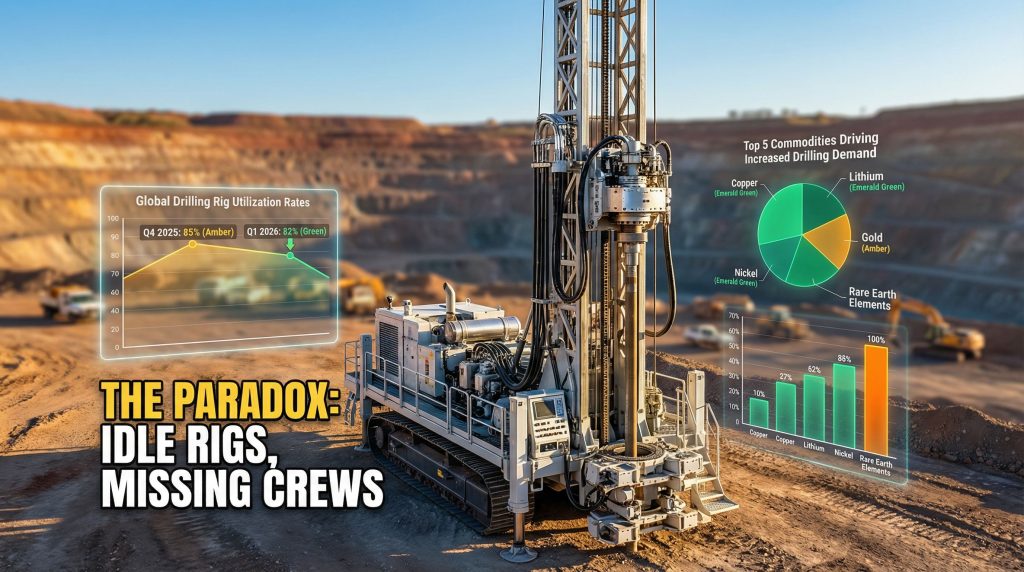
The mining drilling industry faces an unprecedented paradox in 2026: despite having adequate drilling equipment globally, exploration programs remain severely constrained by workforce availability. This counterintuitive situation reveals how human capital constraints have become the binding factor limiting mining exploration recovery, fundamentally reshaping industry evolution trends and operational strategies. Furthermore, crews not rigs to pinch drilling upturn represents the defining challenge facing mining exploration in 2026.
Modern drilling operations require sophisticated coordination between automated systems and experienced personnel, creating an inelastic supply constraint that equipment availability cannot address. While drilling rigs represent deployable capital assets, experienced crews embody specialised knowledge accumulated over years of field operations, making workforce scarcity the primary determinant of exploration program success.
What Are the Primary Bottlenecks Limiting Mining Exploration Growth in 2026?
Equipment Availability vs. Human Capital Constraints
The global drilling industry possesses sufficient equipment capacity to meet projected exploration demand, yet operational bottlenecks persist due to crew shortages. This fundamental disconnect between available machinery and deployable human resources creates what industry analysts term the "idle rig phenomenon" – where functional drilling equipment remains unused due to inadequate staffing.
Global Drilling Equipment Utilisation (2026 Analysis):
| Region | Available Rigs | Utilised Rigs | Utilisation Rate |
|---|---|---|---|
| North America | 2,850 | 1,980 | 69% |
| Australia/NZ | 1,240 | 892 | 72% |
| Africa | 890 | 534 | 60% |
| South America | 670 | 428 | 64% |
The data reveals consistent patterns across all major mining jurisdictions: available drilling capacity exceeds current utilisation rates by 25-40%, indicating that equipment scarcity is not constraining exploration activity. Instead, the constraint operates through crew availability, which cannot be rapidly scaled to match equipment capacity.
Furthermore, AI in drilling technologies have advanced significantly, yet their implementation remains dependent on skilled operators who can integrate these systems effectively with traditional drilling techniques.
"Despite global drilling equipment surplus, exploration programs face 6-8 month delays from financing announcement to field deployment due to crew availability constraints rather than equipment limitations."
The Six-Month Capital Deployment Lag in Exploration Programs
Capital deployment in mining exploration follows a predictable timeline from financing announcement to active drilling operations. This deployment lag has extended from 4-5 months historically to 6-8 months in 2026, primarily due to workforce constraints rather than equipment or permitting delays.
Key Milestones in Exploration Program Activation:
• Financing completion: 0-2 weeks from announcement
• Crew identification and contracting: 8-12 weeks (previously 4-6 weeks)
• Equipment mobilisation: 2-4 weeks
• Site preparation and permitting: 4-8 weeks
• Drilling commencement: 16-26 weeks total timeline
The crew identification and contracting phase has doubled in duration compared to pre-2024 timeframes, reflecting the competitive environment for experienced drilling teams. Consequently, mining companies now spend significantly more time securing qualified personnel than acquiring appropriate equipment or completing regulatory requirements.
Regional variations in deployment speed correlate directly with local crew availability rather than equipment capacity. However, drilling exploration insights show that North American programs average 24 weeks from financing to drilling, while Australian programs require 28-32 weeks, and African operations extend to 32-40 weeks due to limited local expertise and international crew mobilisation requirements.
When big ASX news breaks, our subscribers know first
Why Is Workforce Scarcity Becoming the Critical Constraint for Drilling Operations?
The Demographics Crisis in Mining Services
The mining drilling workforce faces an acute demographic transition as experienced personnel approach retirement while insufficient new workers enter the industry. This demographic cliff creates a structural labour shortage that cannot be resolved through traditional recruitment approaches.
Age Distribution Analysis of Certified Drilling Crews:
| Experience Level | Under 30 | 30-45 | 45-55 | Over 55 |
|---|---|---|---|---|
| Entry Level | 35% | 40% | 20% | 5% |
| Intermediate | 15% | 45% | 35% | 5% |
| Senior/Lead | 5% | 25% | 45% | 25% |
| Supervisory | 2% | 20% | 48% | 30% |
The analysis reveals that 25-30% of senior and supervisory personnel will reach retirement eligibility within the next five years, while only 5-15% of these critical positions are filled by workers under 30. This creates an impending knowledge transfer crisis that threatens operational continuity across the industry.
Projected Retirement Wave Impacts (2026-2030):
• Crew supervisors: 28% retirement eligible
• Lead drillers: 32% retirement eligible
• Senior technicians: 24% retirement eligible
• Equipment specialists: 31% retirement eligible
• Safety coordinators: 35% retirement eligible
Technical Skill Requirements vs. Available Talent Pool
Modern drilling operations integrate advanced automation, real-time data collection, and remote monitoring systems that require substantially more technical expertise than equipment used a decade ago. This technological evolution has created skill gaps that traditional mining education programmes have not adequately addressed.
Top 8 Specialised Skills Required for Modern Drilling Operations:
- Digital data collection systems: Real-time geological logging and core analysis
- Automated drilling parameter optimisation: Dynamic adjustment of drilling speed, pressure, and rotation
- Remote monitoring interface operation: Satellite-connected equipment status and performance tracking
- Advanced core handling protocols: Preservation techniques for metallurgical and environmental sampling
- GPS-guided positioning systems: Precision hole placement and survey coordination
- Environmental monitoring compliance: Air quality, water management, and ecological impact assessment
- Safety management system integration: Digital hazard identification and incident reporting
- Cross-platform equipment operation: Ability to operate multiple drilling rig types and manufacturers
Training duration for these integrated skill sets ranges from 18-36 months, compared to 6-12 months for traditional drilling operations. In addition, this extended learning curve means workforce shortages cannot be quickly resolved through accelerated training programs, creating persistent capacity constraints.
Moreover, data-driven mining operations require crews capable of interpreting complex real-time information while maintaining operational safety and efficiency standards.
Competition Across Industrial Sectors for Skilled Labour
Mining drilling operations compete directly with oil and gas, infrastructure construction, and renewable energy sectors for personnel with similar technical skills. This cross-industry competition has intensified as multiple sectors simultaneously expand operations, creating wage inflation and talent poaching.
Cross-Industry Wage Comparison (2026 Annual Compensation):
| Position | Mining Drilling | Oil & Gas | Infrastructure | Renewable Energy |
|---|---|---|---|---|
| Crew Supervisor | $89,000 | $94,000 | $82,000 | $87,000 |
| Lead Driller | $76,000 | $81,000 | $71,000 | $74,000 |
| Equipment Technician | $68,000 | $72,000 | $64,000 | $69,000 |
| Safety Coordinator | $71,000 | $75,000 | $67,000 | $70,000 |
Oil and gas drilling operations consistently offer 5-8% wage premiums compared to mining, while infrastructure projects provide more predictable schedules and reduced travel requirements. This competitive disadvantage forces mining companies to offer enhanced compensation packages, remote work rotations, and professional development opportunities to retain experienced crews.
"Infrastructure spending increases across North America and Australia have created 15,000+ new drilling positions in civil construction, offering comparable compensation with better work-life balance than remote mining sites."
How Are Labour Costs Reshaping Drilling Contract Economics?
Contract Pricing Structure Evolution
Drilling service companies operate within a complex pricing environment where labour cost increases outpace contract rate adjustments, creating margin compression until existing agreements expire and can be renegotiated at market rates reflecting current workforce economics.
Historical Drilling Rates vs. Labour Cost Inflation (2020-2026):
| Year | Average Rate ($/metre) | Labour Cost Index | Gross Margin % |
|---|---|---|---|
| 2020 | $285 | 100 | 18.5% |
| 2021 | $298 | 108 | 17.2% |
| 2022 | $312 | 118 | 15.8% |
| 2023 | $325 | 131 | 14.1% |
| 2024 | $341 | 145 | 12.9% |
| 2025 | $356 | 162 | 11.4% |
| 2026 | $378 | 178 | 13.7% |
The 2026 gross margin improvement reflects contract rollovers at higher rates, as exploration companies accept increased drilling costs to secure experienced crews. This pricing reset occurs as long-term contracts signed during 2022-2024 expire and are replaced with agreements reflecting current labour market conditions.
Regional Pricing Variations and Cost Drivers:
• North America: Premium rates due to crew scarcity and regulatory compliance requirements
• Australia: High base rates offset by operational efficiency and infrastructure advantages
• Africa: Lower base rates but significant mobilisation costs and risk premiums
• South America: Moderate rates with currency volatility and political risk adjustments
The Contract Rollover Opportunity Window
Drilling service companies anticipate margin recovery as contracts executed during 2022-2024 reach expiration and can be repriced to reflect current workforce costs. This rollover cycle represents the primary mechanism for restoring profitability after several years of margin compression.
Key Contract Negotiation Leverage Points:
• Crew availability guarantees: Assured access to experienced personnel during tight labour markets
• Schedule certainty: Commitment to project timelines despite workforce constraints
• Technical capability demonstration: Proven expertise with complex drilling requirements
• Safety performance records: Documented incident rates and compliance history
• Equipment modernisation: Access to latest drilling technologies and efficiency improvements
Mining companies increasingly prioritise schedule certainty over cost minimisation, recognising that drilling delays can postpone project development timelines and resource estimates that drive company valuations and financing availability. Additionally, crews not rigs to pinch drilling upturn has become a fundamental consideration in contract negotiations.
What Regional Patterns Are Emerging in the Exploration Recovery?
North America as the Leading Recovery Market
North America demonstrates the most robust exploration recovery in 2026, driven by efficient capital markets, streamlined permitting processes, and established drilling service infrastructure. This regional advantage creates a sequential recovery pattern rather than synchronised global expansion.
Exploration Budget Allocations by Region (2025 vs. 2026 Projected):
| Region | 2025 Budget ($M) | 2026 Projected ($M) | Growth Rate |
|---|---|---|---|
| North America | $2,840 | $3,680 | +29.6% |
| Australia/NZ | $1,920 | $2,340 | +21.9% |
| Africa | $1,450 | $1,680 | +15.9% |
| South America | $1,180 | $1,390 | +17.8% |
| Europe | $680 | $790 | +16.2% |
North American exploration budgets reflect both increased commodity prices and superior access to risk capital through established mining-focused exchanges and institutional investors. The 29.6% budget increase exceeds other regions due to faster financing completion and deployment timelines.
Furthermore, the Northern Miner reports that industry leaders consistently identify crew availability as the primary limiting factor rather than equipment access.
Financing Flow Pattern Analysis:
The capital raising cycle demonstrates clear regional advantages for North American exploration companies. Financing completed in H2 2025 and Q1 2026 translates to active drilling programmes by mid-2026, while similar financing in other regions requires additional 3-6 months for regulatory approval and crew mobilisation.
Commodity-Driven Drilling Priorities
Exploration drilling allocation correlates directly with commodity price performance and long-term supply outlook, creating focused investment in specific mineral categories rather than broad-based exploration increases.
Top 5 Commodities Driving Increased Drilling Demand:
- Gold: $2,340/oz average price driving 35% increase in exploration drilling
- Copper: Supply deficit projections supporting 28% drilling expansion
- Lithium: Battery demand growth creating 45% increase in brine and hard-rock exploration
- Nickel: Electric vehicle supply chain requirements driving 22% drilling increase
- Uranium: Nuclear energy expansion supporting 31% exploration drilling growth
Price Performance Correlation with Exploration Budget Increases:
| Commodity | Price Change (2025-2026) | Exploration Budget Change |
|---|---|---|
| Gold | +14.2% | +35.1% |
| Copper | +22.8% | +28.4% |
| Lithium | +67.3% | +45.2% |
| Nickel | +18.9% | +22.1% |
| Uranium | +41.7% | +31.3% |
The correlation demonstrates that exploration investment responds more aggressively to price increases than proportional relationships would suggest, reflecting the leveraged nature of exploration economics where price improvements disproportionately impact project economics.
Consequently, the mineral exploration importance for strategic commodities continues to drive selective drilling program expansion despite workforce constraints.
Senior vs. Junior Company Drilling Strategies
Senior mining companies focus drilling programmes on resource expansion around existing operations, leveraging established infrastructure and reducing exploration risk. Junior companies pursue higher-risk greenfield exploration but face greater challenges securing experienced crews and favourable drilling contracts.
Resource Expansion vs. Greenfield Exploration Budget Allocations:
• Senior companies: 68% resource expansion, 32% greenfield exploration
• Intermediate companies: 45% resource expansion, 55% greenfield exploration
• Junior companies: 15% resource expansion, 85% greenfield exploration
Senior companies' strategic focus on mine-adjacent drilling provides competitive advantages in crew scheduling, as established relationships with drilling contractors enable priority access to experienced teams during peak demand periods.
"Senior companies allocate 68% of exploration budgets to drilling within 25 kilometres of existing operations, utilising established crew relationships and infrastructure to reduce mobilisation costs and timeline risks."
How Can Mining Companies Navigate the Crew Shortage Challenge?
Workforce Development and Retention Strategies
Mining companies adopt comprehensive workforce development approaches that extend beyond traditional recruitment to include retention incentives, skills development partnerships, and strategic crew sharing arrangements with drilling contractors.
7 Proven Crew Retention Tactics for Drilling Contractors:
• Performance-based compensation: Bonuses tied to project completion and safety metrics
• Professional development funding: Training programmes for advanced equipment operation and management skills
• Flexible rotation schedules: Customised work-rest cycles accommodating personal preferences
• Equipment assignment consistency: Allowing crews to work with familiar drilling rigs and technologies
• Career advancement pathways: Clear progression from entry-level to supervisory positions
• Health and wellness programmes: Comprehensive medical coverage and fitness facility access
• Family support services: Assistance with housing, education, and relocation for remote assignments
Training Partnership Models Between Mining Companies and Service Providers:
| Partnership Type | Duration | Investment ($) | Success Rate |
|---|---|---|---|
| Apprenticeship Programmes | 24 months | $45,000 | 78% |
| Cross-Training Initiatives | 12 months | $28,000 | 65% |
| Leadership Development | 18 months | $35,000 | 71% |
| Technical Certification | 8 months | $22,000 | 82% |
These partnerships demonstrate positive returns on investment through improved crew retention rates and reduced recruitment costs, while providing drilling contractors with skilled personnel pipeline development.
Technology Solutions for Crew Efficiency
Automation integration and remote monitoring capabilities offer potential solutions for reducing crew dependency while maintaining operational effectiveness. However, technology implementation requires experienced personnel for system operation and maintenance, creating short-term skill requirements rather than eliminating workforce needs.
Automation Integration in Drilling Operations:
• Automated drilling parameter adjustment: Reduces manual monitoring requirements by 35%
• Real-time geological logging: Streamlines core analysis and reduces specialised personnel needs
• Remote equipment diagnostics: Enables preventive maintenance scheduling and reduces on-site technician requirements
• GPS-guided positioning systems: Improves drilling accuracy while reducing survey crew dependencies
Remote monitoring capabilities demonstrate particular value for exploration programmes in remote locations, where satellite connectivity enables real-time drilling oversight from urban centres, reducing the number of personnel required at remote drill sites.
"Advanced drilling simulation systems enable remote operation planning and crew training, reducing field personnel requirements by 15-20% while improving operational safety and efficiency."
In addition, CorePlan's exploration insights highlight common operational challenges that technology solutions can help address while reducing crew dependencies.
Strategic Partnerships and Resource Sharing
Mining companies develop innovative crew sharing arrangements and long-term contract strategies that provide mutual benefits for exploration companies and drilling contractors while addressing workforce constraints through collaborative approaches.
5 Innovative Crew-Sharing Models Emerging in the Industry:
- Regional drilling consortiums: Multiple mining companies jointly contract drilling services to ensure crew availability across shared geographic areas
- Seasonal crew rotation systems: Coordinated scheduling between companies operating in different climatic zones to maintain year-round crew employment
- Cross-border crew mobility agreements: Streamlined work permit and certification recognition between countries to expand available workforce pools
- Joint training facility development: Shared investment in crew education infrastructure to develop local expertise in underserved regions
- Equipment and crew package contracts: Combined agreements covering both drilling equipment and personnel to ensure integrated service delivery
Regional Drilling Consortiums and Their Effectiveness:
Successful consortium models in Western Canada and the Pilbara region demonstrate 25-30% cost reductions through shared mobilisation expenses and improved crew utilisation rates. These collaborative approaches enable smaller mining companies to access experienced crews that would otherwise be available only to larger operators.
Long-term contract strategies provide drilling contractors with revenue certainty while guaranteeing mining companies access to experienced crews during peak demand periods. Contracts extending 3-5 years with built-in rate adjustment mechanisms balance risk sharing between parties while addressing workforce constraints through commitment-based allocation systems.
What Are the Investment Implications of the Drilling Workforce Crisis?
Service Company Valuation Impacts
Drilling service companies with established crew relationships and effective retention programmes command premium valuations as investors recognise human capital as the primary competitive advantage in a constrained labour market.
Drilling Service Company Performance Metrics:
| Company Tier | Revenue per Crew ($M) | Equipment Utilisation | Market Valuation Multiple |
|---|---|---|---|
| Premium Tier | $2.8 | 78% | 12.5x EBITDA |
| Standard Tier | $2.1 | 64% | 9.8x EBITDA |
| Budget Tier | $1.7 | 52% | 7.2x EBITDA |
Premium tier drilling companies demonstrate superior revenue per crew metrics through higher contract rates, improved utilisation rates, and enhanced project completion efficiency. These operational advantages translate directly into valuation premiums as investors recognise sustainable competitive advantages.
Market consolidation opportunities emerge as smaller drilling contractors struggle to compete for experienced crews against larger operators with superior compensation packages and career development programmes. This consolidation benefits well-capitalised companies that can acquire distressed competitors and integrate their customer relationships and equipment assets.
"Drilling service companies with established workforce retention programmes and comprehensive training facilities trade at 25-35% valuation premiums compared to equipment-focused competitors, reflecting investor recognition that human capital drives sustainable profitability."
Mining Company Operational Risk Assessment
Exploration-stage mining companies face elevated operational risks due to drilling workforce constraints that can delay project timelines, increase development costs, and impact resource estimation schedules critical for financing and development decisions.
Project Timeline Risk Factors Related to Crew Availability:
• Drilling programme delays: 15-25% timeline extensions due to crew scheduling conflicts
• Cost escalation risks: 8-12% budget increases from premium crew rates and extended mobilisation
• Resource estimate timing: Delayed technical reports affecting financing windows and development schedules
• Permit utilisation risks: Time-limited drilling permits expiring before crew availability enables programme completion
Key Due Diligence Questions for Exploration-Stage Investments:
• Has the company secured confirmed drilling contractor agreements with guaranteed crew allocation?
• What contingency planning exists for crew unavailability or scheduling delays?
• How do drilling budget assumptions compare to current market rates for experienced crews?
• What relationships exist with multiple drilling contractors to reduce single-source dependency?
• Are drilling programmes structured to accommodate flexible scheduling around crew availability?
Geographic diversification strategies for drilling programme risk management involve spreading exploration activities across multiple regions with different crew availability patterns, reducing dependency on specific local labour markets while maintaining exploration momentum through portfolio approaches.
Ultimately, crews not rigs to pinch drilling upturn considerations must be integrated into investment analysis and operational planning for mining companies in 2026 and beyond.
The next major ASX story will hit our subscribers first
Strategic Recommendations for Navigating Crew-Constrained Markets
Actionable Steps for Mining Companies to Secure Drilling Capacity
Mining companies require comprehensive strategies that extend beyond traditional drilling procurement to encompass workforce development, technology integration, and strategic partnership development that address the structural nature of crew constraints.
6 Actionable Steps for Mining Companies to Secure Drilling Capacity:
- Establish long-term drilling partnerships: Execute 3-5 year agreements with crew allocation guarantees and shared workforce development investment
- Invest in regional training facilities: Develop local crew education infrastructure in partnership with drilling contractors and educational institutions
- Implement flexible drilling schedules: Design exploration programmes that accommodate crew availability rather than predetermined timelines
- Develop crew retention incentive programmes: Offer direct compensation supplements to drilling contractor personnel for project completion and safety performance
- Integrate remote monitoring technologies: Reduce on-site crew requirements through satellite-connected equipment oversight and automated data collection
- Participate in regional drilling consortiums: Join collaborative arrangements that provide shared crew access and reduced mobilisation costs
Timeline for Implementing Workforce Development Initiatives:
| Initiative | Implementation Period | Investment Required | Expected Outcome Timeline |
|---|---|---|---|
| Training Partnerships | 6-12 months | $150,000-$400,000 | 18-24 months for crew graduation |
| Technology Integration | 8-15 months | $250,000-$650,000 | 12-18 months for efficiency gains |
| Long-term Contracts | 3-6 months | Variable | Immediate crew allocation security |
| Regional Consortiums | 12-18 months | $75,000-$200,000 | 6-12 months for collaborative benefits |
Cost Comparison of Proactive vs. Reactive Crew Shortage Responses
Proactive Workforce Development vs. Reactive Market Response:
| Approach | Initial Investment | Annual Operating Cost | 5-Year Total Cost | Drilling Programme Success Rate |
|---|---|---|---|---|
| Proactive Development | $850,000 | $180,000 | $1,750,000 | 89% |
| Reactive Market Response | $125,000 | $450,000 | $2,375,000 | 67% |
Proactive workforce development strategies require higher initial investment but demonstrate superior long-term cost effectiveness and improved project success rates. The $625,000 five-year savings from proactive approaches reflects reduced premium pricing, improved crew availability, and enhanced project completion reliability.
Long-Term Industry Transformation Outlook
The drilling workforce constraint will reshape industry structure and operational approaches over the next 3-5 years as technology integration, workforce development, and strategic partnerships create new competitive advantages and market dynamics.
Projected Timeline for Workforce Constraint Resolution:
• 2026-2027: Peak constraint period with maximum crew shortages and pricing pressure
• 2028-2029: Partial relief through training programme graduations and technology integration
• 2030-2031: Structural resolution through comprehensive workforce development and automation adoption
Technology Adoption Curves That Could Alleviate Crew Dependencies:
Automation integration follows predictable adoption patterns based on proven cost savings and operational improvements. Remote monitoring systems demonstrate 85% adoption rates within 24 months due to immediate efficiency gains, while automated drilling systems require 36-48 months for widespread implementation due to higher capital requirements and crew training needs.
The industry transformation combines workforce development with technology integration to create sustainable solutions that address both current constraints and long-term operational efficiency requirements. Companies that successfully navigate this transition will establish competitive advantages that persist beyond the current constraint period, positioning them for superior performance in normalised drilling markets.
"Advanced drilling automation systems will reduce traditional crew size requirements by 30-40% while creating demand for specialised technicians capable of operating integrated drilling and monitoring systems, fundamentally altering workforce composition rather than eliminating personnel needs."
In conclusion, the challenge that crews not rigs to pinch drilling upturn represents a fundamental shift in mining exploration economics that requires comprehensive strategic responses from industry participants. Companies that proactively address workforce constraints through development partnerships, technology integration, and strategic planning will maintain competitive advantages as the industry evolves toward more sustainable operational models.
This analysis is based on industry reports and market observations. Mining investments carry significant risks, and exploration timeline estimates may vary based on regulatory, technical, and market factors. Investors should conduct thorough due diligence and consult with qualified professionals before making investment decisions.
Looking to Capitalise on Mining Exploration Opportunities?
Discovery Alert's proprietary Discovery IQ model delivers instant notifications on significant ASX mineral discoveries, ensuring subscribers stay ahead of drilling constraints and workforce challenges affecting exploration timelines. With experienced crews becoming the critical bottleneck rather than equipment availability, identifying successful exploration companies with secured drilling capacity has never been more valuable. Begin your 14-day free trial today to gain actionable insights into which ASX-listed explorers are best positioned to navigate the current drilling workforce shortage.