August 21, 2026
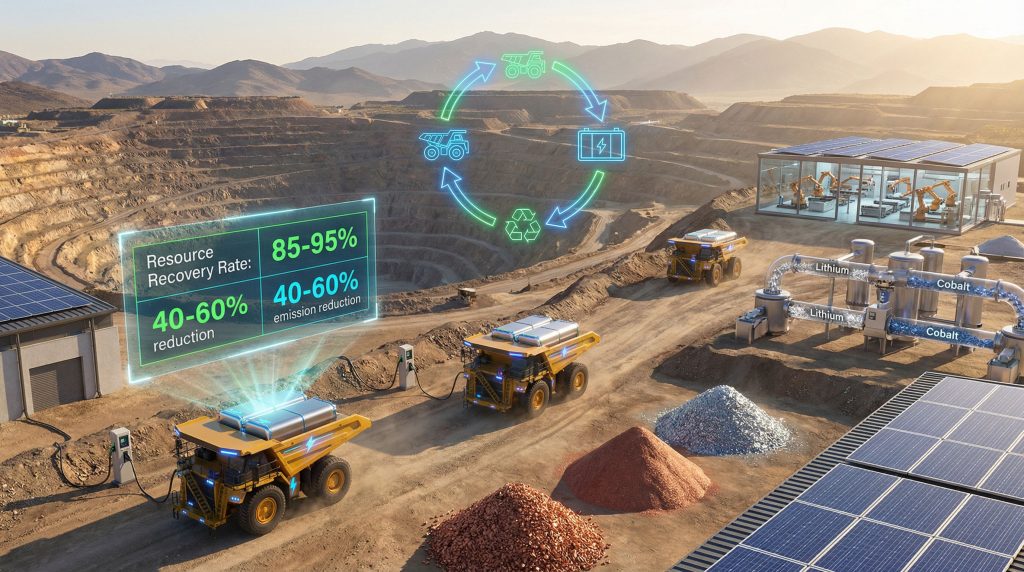
The global mining sector stands at a critical inflection point where operational efficiency demands increasingly intersect with environmental accountability requirements. As industrial operations face mounting pressure to reduce carbon emissions while maintaining competitive cost structures, the convergence of battery technology capabilities with resource extraction expertise represents a fundamental shift in how critical minerals supply chain operations function. The transformation extends beyond simple equipment electrification to encompass comprehensive circular economy models that could reshape resource utilisation patterns across multiple industrial sectors.
Decarbonisation Imperatives Driving Mining Sector Transformation
Mining operations face unprecedented pressure to reduce their environmental footprint while managing operational cost volatility in remote locations. The sector's heavy reliance on diesel fuel for equipment and transportation creates exposure to commodity price fluctuations that can significantly impact operational margins. Underground operations, surface mining facilities, and processing plants collectively consume substantial quantities of fossil fuels, making electrification strategies both an environmental imperative and an economic opportunity.
Key drivers pushing mining companies toward electrification partnerships include:
- Carbon emission reduction targets aligned with international climate commitments
- Operational cost pressures from volatile diesel pricing in remote locations
- Enhanced ESG credentials required for capital market access
- Competitive advantages through improved energy efficiency metrics
- Regulatory compliance with emerging carbon pricing mechanisms across major mining jurisdictions
The CATL and Rio Tinto electrification recycling partnership exemplifies how major industry participants are structuring collaborative approaches to address these challenges. The partnership focuses on promoting mining operations electrification while exploring comprehensive battery recycling breakthrough initiatives that could establish circular resource development models.
Battery technology companies are simultaneously recognising mining sector applications as strategic growth opportunities beyond traditional automotive markets. The scale of mining operations presents deployment opportunities for industrial-grade energy storage systems that dwarf typical commercial applications. Mining sites also offer controlled environments for testing advanced battery technologies under demanding operational conditions, providing valuable performance data for system optimisation.
When big ASX news breaks, our subscribers know first
Strategic Collaboration Models Reshaping Industry Partnerships
The evolution of mining-battery technology alliances demonstrates sophisticated partnership structures that extend beyond simple supplier-customer relationships. These collaborative frameworks address technology integration challenges, supply chain optimisation, and risk distribution across multiple operational dimensions.
Core partnership models emerging in the sector include:
Technology Integration Partnerships
Joint development initiatives focus on creating mining-specific battery systems capable of withstanding extreme environmental conditions while delivering consistent performance across extended duty cycles. These partnerships combine mining operational expertise with battery technology specialisation to address unique challenges including high-altitude operations, temperature extremes, and equipment vibration exposure.
Supply Chain Circularity Agreements
Comprehensive material flow agreements establish closed-loop systems connecting raw material extraction, battery manufacturing, deployment, and end-of-life recovery. These arrangements create vertical integration opportunities that can reduce material cost volatility while ensuring consistent supply access for both partners.
Infrastructure Development Ventures
Collaborative charging network and energy storage infrastructure projects address the unique requirements of remote mining operations. These ventures often involve shared investment in power generation, distribution systems, and backup capacity essential for maintaining operations in locations with limited grid connectivity.
Research and Development Consortiums
Multi-party innovation initiatives pool resources for developing next-generation electrification technologies specific to heavy industrial applications. These consortiums spread development costs across multiple participants while accelerating technology advancement timelines.
Critical success factors for mining electrification partnerships:
- Scalability across diverse equipment types: Battery systems must accommodate varying power requirements from compact underground loaders to massive haul trucks
- Cost competitiveness versus diesel alternatives: Total cost of ownership calculations must demonstrate clear economic advantages over traditional fuel systems
- Operational reliability in harsh conditions: Equipment must maintain performance standards in extreme temperatures, dust, vibration, and altitude conditions
- Integration with existing infrastructure: Electrification systems must interface effectively with current mining equipment and facility designs
- Workforce development capabilities: Technical training programmes must prepare maintenance and operations personnel for new technology requirements
Circular Economy Implementation and Resource Optimisation
The integration of mining operations with battery recycling initiatives creates opportunities for establishing comprehensive circular economy models that could transform critical mineral utilisation patterns. Furthermore, these systems address both resource security concerns and environmental impact reduction through structured material recovery and reprocessing capabilities.
Circular resource flow framework components:
- Primary Resource Extraction: Mining operations provide lithium, cobalt, nickel, and other critical materials for initial battery manufacturing
- Battery Manufacturing Integration: Technology partners convert raw materials into energy storage systems optimised for specific industrial applications
- End-of-Life Recovery Systems: Comprehensive recycling infrastructure captures valuable materials from spent batteries through mechanical and hydrometallurgical processing
- Secondary Resource Processing: Recovered materials undergo purification and refinement to meet specifications for new battery production cycles
The economic implications of circular partnership models demonstrate significant potential for resource efficiency improvements compared to traditional linear extraction approaches. However, implementation requires substantial infrastructure investment and coordination across multiple geographic regions where mining operations and recycling facilities may be separated by significant distances.
| Performance Metric | Traditional Approach | Circular Partnership Model | Improvement Potential |
|---|---|---|---|
| Material Recovery Efficiency | Limited recovery focus | Comprehensive material capture | 10-15x improvement factor |
| Supply Chain Flexibility | Single-source dependency | Multiple resource pathways | Enhanced security profile |
| Capital Deployment | Concentrated mining investment | Distributed infrastructure model | 25-35% optimisation potential |
| Environmental Impact Profile | High primary extraction focus | Reduced new mining requirement | 35-50% footprint reduction |
Note: Performance projections are based on theoretical models and require validation through operational implementation data.
Operational Transformation Scenarios and Market Evolution
The pace and scale of mining sector electrification will likely follow distinct pathways depending on technology advancement rates, regulatory pressures, and economic incentives. In addition, each scenario presents different implications for partnership structures, investment requirements, and competitive positioning.
Accelerated Deployment Scenario (2026-2030)
This pathway assumes rapid technology adoption driven by strong regulatory incentives and demonstrated economic advantages. Key characteristics include aggressive equipment replacement schedules and substantial infrastructure investment across major mining regions.
Projected outcomes:
- Equipment electrification penetration reaching 25-35% of heavy mining fleets by 2030
- Global infrastructure investment totalling $40-80 billion for charging and storage systems
- Employment generation of 150,000+ technical roles supporting electrification maintenance and operations
- Diesel consumption reduction of 12-18% across global mining operations
Gradual Integration Scenario (2026-2035)
A more conservative adoption pattern emphasising technology validation, cost optimisation, and phased equipment replacement aligned with normal capital cycles. This approach prioritises risk management and proven performance over rapid transformation.
Implementation characteristics:
- Initial electrification focus on specific equipment categories with favourable economics
- Technology development emphasis on battery longevity and performance optimisation under mining conditions
- Competitive differentiation emerging for early adopters in sustainability metrics and operational costs
- Steady annual capital allocation patterns supporting measured expansion
Circular Economy Leadership Scenario
An alternative pathway emphasising rapid development of recycling infrastructure and circular material flows as a competitive advantage strategy. This approach positions mining companies as integrated resource managers rather than traditional extractors.
Strategic implications:
- Regional battery processing centres establishing material recovery capabilities near major mining operations
- Direct material flow integration reducing dependence on external supply chains
- Market development for recycled battery materials creating new revenue streams estimated at $15-25 billion annually by 2035
- Resource independence objectives reducing primary mining requirements by 30-40% for established battery materials
Investment Framework and Market Dynamics
The emergence of mining-battery technology partnerships creates complex investment considerations that extend beyond traditional mining sector analysis. These collaborative structures generate value through multiple channels while introducing new risk categories that require sophisticated evaluation frameworks, particularly considering mining investment strategies.
Value creation opportunities:
Technology Development Synergies
Combined research and development initiatives distribute innovation costs across multiple participants while accelerating time-to-market for specialised solutions. Mining companies contribute operational expertise and testing environments, while battery technology partners provide technical capabilities and manufacturing scale.
Market Access Expansion
Mining companies gain entry to energy storage markets through technology partnerships, while battery manufacturers access industrial applications beyond automotive sectors. This cross-sector expansion provides revenue diversification opportunities for both partner categories.
Supply Chain Integration Benefits
Vertical integration across material extraction, processing, and recycling creates opportunities for cost optimisation and supply security. Integrated partnerships can reduce material cost volatility exposure while ensuring consistent access to critical inputs.
Risk assessment considerations:
Technical Implementation Risks:
- Battery performance degradation in demanding mining environments
- Integration complexity with existing equipment and infrastructure systems
- Charging infrastructure reliability in remote locations with limited grid connectivity
Commercial and Financial Risks:
- Extended payback periods for electrification capital investments
- Commodity price volatility affecting partnership economics and material valuations
- Technology obsolescence potential in rapidly evolving battery sector
Operational Transition Risks:
- Workforce training and capability development requirements
- Supply chain disruption during equipment and infrastructure conversion periods
- Regulatory framework changes affecting partnership structures and economics
Market Evolution Timeline and Strategic Implications
The transformation of mining operations through electrification partnerships will likely follow distinct phases, each presenting unique opportunities and challenges for market participants within the broader mining industry evolution.
Foundation Phase (2026-2030)
This period focuses on establishing partnership frameworks, completing pilot project implementations, and developing specialised technologies for mining applications. The CATL and Rio Tinto electrification recycling partnership represents an example of foundation-phase initiatives aimed at exploring comprehensive collaboration potential.
Key developments include partnership announcements, technology adaptation for mining-specific requirements, initial recycling infrastructure development, and regulatory framework establishment supporting circular economy models. Consequently, major mining operators are evaluating electrification strategies to enhance operational sustainability.
Scale Deployment Phase (2030-2035)
Large-scale implementation across major mining operations characterises this phase, with mature recycling networks processing significant material volumes. Competitive differentiation based on sustainability credentials becomes more pronounced, while artificial intelligence and automation integration enhance electrified mining operations efficiency.
Market Maturation Phase (Post-2035)
Industry-standard electrification across global mining operations represents the mature market state. Circular economy models achieve substantial material recovery rates, new partnership structures emerge for next-generation technologies, and integrated resource management optimises global supply chain efficiency.
The next major ASX story will hit our subscribers first
Strategic Recommendations for Market Participants
For Mining Companies:
- Develop comprehensive electrification strategies with clear return-on-investment metrics and timeline specifications
- Establish partnerships with multiple battery technology providers to maintain vendor diversity and avoid technology lock-in
- Invest in workforce development programmes preparing personnel for electrification support requirements
- Create dedicated sustainability reporting capabilities to capture and communicate ESG value creation
For Battery Technology Companies:
- Customise product offerings for harsh industrial mining environments with enhanced durability specifications
- Develop service models supporting remote operation requirements and maintenance logistics
- Establish recycling partnerships ensuring circular material flow integration
- Build regional technical support presence near major mining operational centres
For Investment Community and Policymakers:
- Support regulatory frameworks encouraging circular economy partnership development through battery metals investment incentives
- Provide financial incentives for industrial electrification capital investments
- Monitor supply chain security implications of increased recycling integration
- Evaluate long-term commodity market impacts from potential primary mining demand reduction
The convergence of mining operations with battery technology through structured partnerships represents a fundamental shift toward integrated resource management. Success will depend on addressing technical challenges, establishing economic viability, and creating regulatory frameworks supporting comprehensive transformation across the CATL and Rio Tinto electrification recycling partnership model and similar initiatives.
Disclaimer: This analysis involves projections and scenario modelling that are inherently uncertain. Investment decisions should be based on comprehensive due diligence and consultation with qualified financial advisors. Projected figures and timeline estimates are subject to significant variation based on technology advancement, regulatory changes, and market conditions.
Ready to Capitalise on Mining Electrification Opportunities?
Discovery Alert's proprietary Discovery IQ model delivers instant notifications on significant ASX mineral discoveries, empowering subscribers to identify actionable investment opportunities in mining companies pioneering electrification partnerships and sustainable operations ahead of the broader market. Begin your 14-day free trial today and position yourself to capture value from the mining sector's transformation towards electrification and circular economy models.