June 25, 2026
The Material Foundation of a Decarbonised World
Civilisations have always been defined by the materials they master. The Bronze Age, the Iron Age, the age of coal and steel: each era was shaped not just by energy sources but by the raw substances that made new systems physically possible. The current moment is no different. The transition toward decarbonised energy is, at its core, a materials challenge, and understanding that framing changes everything about how policymakers, investors, and operators should approach what is now being called mining and energy: a new conversation.
This is not a metaphor. The physical requirements of wind turbines, solar arrays, battery storage systems, and electric vehicles demand quantities of specific minerals that dwarf anything the clean energy narrative typically acknowledges. The industries responsible for producing those minerals, and the industries responsible for consuming them, can no longer be treated as separate domains. They are structurally coupled in ways that have profound consequences for capital allocation, geopolitical risk, environmental governance, and social equity.
When big ASX news breaks, our subscribers know first
From Industrial Input to Strategic Infrastructure
For most of industrial history, mining occupied a supporting role in the energy economy. Coal, oil, and gas powered the machinery that extracted metals and ores, and those metals fed construction, manufacturing, and electronics. Energy was the driver; mining was a downstream beneficiary.
That relationship has inverted. Copper, lithium, cobalt, graphite, nickel, and a range of other minerals are now the physical prerequisites for building the energy systems the world intends to rely on. Without them, electrification stalls. Without accelerated extraction, clean energy targets become numerically impossible rather than merely ambitious.
Governments and multilateral institutions have begun to formalise this reality. Critical minerals and energy security have been reclassified across multiple jurisdictions from ordinary industrial commodities into assets of strategic infrastructure significance, attracting new regulatory frameworks, supply chain scrutiny, and national security considerations that were never previously applied to copper cathodes or lithium brine.
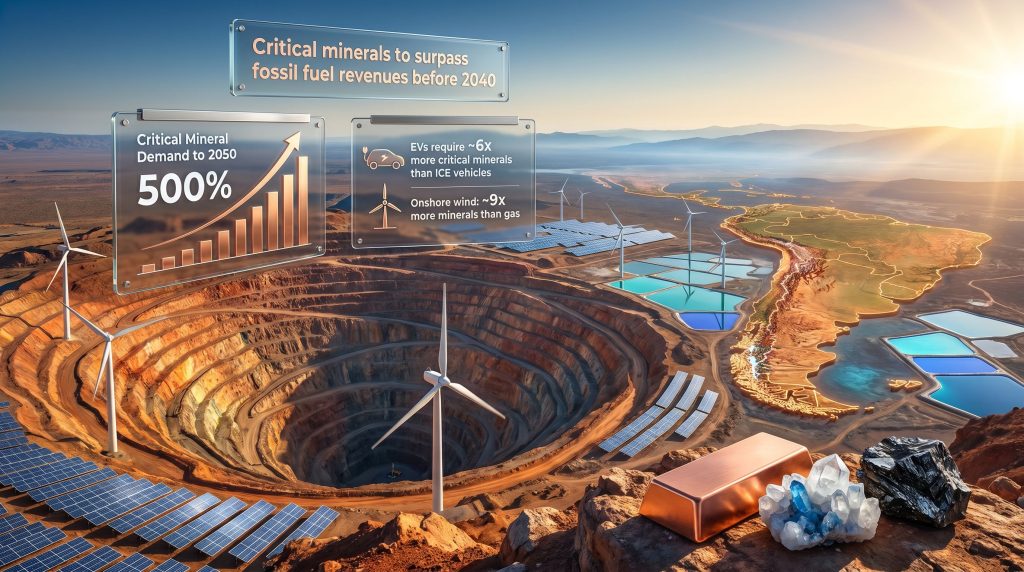
The International Energy Agency projects that revenues generated by critical minerals could surpass those from fossil fuels before 2040, a forecast that signals a fundamental reordering of the global resource economy. That projection is not simply a financial curiosity; it reshapes how mining assets are valued, how they are financed, and how the communities surrounding them should expect to be engaged.
Key Insight: The energy transition is not simply a shift in how power is generated. It is a wholesale restructuring of which raw materials underpin modern civilisation, and mining sits at the centre of that restructuring.
How Much Material Does the Clean Energy Transition Actually Require?
Quantifying the Mineral Demand Surge
The scale of critical minerals demand generated by clean energy technologies is routinely underestimated in public discourse. The IEA and the World Bank have both published data that makes the challenge concrete:
| Technology | Mineral Intensity vs. Fossil Fuel Equivalent |
|---|---|
| Electric vehicles | ~6x more critical minerals than internal combustion vehicles |
| Onshore wind plants | ~9x more minerals than gas-fired equivalents |
| Battery energy storage systems (BESS) | High lithium, cobalt, and nickel dependency |
| Solar PV infrastructure | Significant silicon, silver, and copper requirements |
The World Bank has projected that meeting global clean energy targets by 2050 would require a 500% increase in production of graphite, cobalt, and lithium compared to 2018 output levels. For copper, which is foundational to virtually every electrification pathway, demand projections from multiple research institutions suggest the world will need to produce more copper in the next 25 years than it has extracted across the entire history of mining.
Contextualising what a 500% production increase actually means operationally is sobering. It implies:
- Dozens of new large-scale mines entering production globally.
- Significant expansion of existing operations to extract lower-grade ore bodies.
- Accelerated permitting timelines in jurisdictions currently averaging 10 to 20 years from discovery to production.
- Sustained capital investment at a scale the junior mining sector alone cannot deliver.
The Depletion Problem: Deeper, Harder, Costlier
A factor that rarely receives adequate attention in mainstream energy transition commentary is the structural deterioration of mineral ore quality. The most accessible, near-surface, high-grade deposits for most critical minerals have been progressively depleted over decades of extraction. What remains is characteristically deeper, lower-grade, geologically more complex, and situated in jurisdictions with higher operational risk.
In copper mining, average ore grades have declined from roughly 1.5% copper in the 1990s to below 0.7% in many major producing regions today. Lower ore grades mean more rock must be processed per tonne of refined metal produced, which directly translates into higher energy consumption, greater water usage, and larger waste volumes per unit of output.
This creates a feedback dynamic that deserves more strategic attention: the energy-intensive process of extracting critical minerals for clean energy systems will itself demand increasing quantities of electricity as ore quality continues to decline. How that electricity is sourced, and at what cost, becomes a central variable in the economic viability of future mining operations.
What Are the Core Tensions in the Mining-Energy Nexus?
Environmental Risk Architecture
Expanding global mining output to the levels required by clean energy demand trajectories generates environmental risks that are not peripheral concerns but central governance challenges:
- Water systems: Large-scale mining operations in arid regions, including the Atacama Desert in Chile, which hosts a significant share of global lithium reserves, draw on hydrological systems shared by agriculture and Indigenous communities. Groundwater depletion and contamination risks in these zones are documented and contested.
- Biodiversity corridors: The geographic overlap between high-quality mineral deposit locations and ecologically sensitive or protected areas is substantial. Expansion of mining footprints frequently intersects with biodiversity corridors where species concentration and ecosystem fragility are highest.
- Carbon costs of extraction: Surface and near-surface mining in forested regions generates land clearing impacts and associated carbon emissions that partially offset the lifecycle emissions savings of the clean energy products downstream.
⚠️ Environmental Paradox Alert: Scaling up mining to enable clean energy can generate environmental harm that undermines the very sustainability goals the transition aims to achieve, making responsible extraction design a non-negotiable strategic priority rather than an optional consideration.
Social and Human Rights Risks
The geographic distribution of critical mineral deposits does not align neatly with the geography of economic prosperity. Many of the world's most significant lithium, cobalt, copper, and graphite reserves are located in regions where regulatory enforcement is limited, community consultations are historically weak, and labour protections are inconsistently applied.
Documented links between large-scale mineral extraction and labour rights violations, unsafe working conditions, and community displacement are well-established in the academic and investigative literature. The Democratic Republic of Congo's artisanal cobalt sector has attracted the most international attention, but analogous concerns exist across Latin America, Southeast Asia, and Sub-Saharan Africa.
Human rights due diligence (HRDD) has emerged as both an ethical obligation and a rapidly solidifying regulatory requirement. The European Union has been developing mandatory HRDD frameworks that would compel companies operating within its jurisdiction to formally assess, disclose, and remediate the human rights consequences of their mineral supply chains. Furthermore, if fully implemented, such frameworks would reshape sourcing practices for any mining operator seeking access to European markets.
The Just Transition Dilemma
The concept of a just transition is frequently invoked in climate policy discussions, but its operational complexity is underappreciated. As mining.com.au highlights, a genuinely just transition requires simultaneously managing two distinct forms of economic disruption:
- The decommissioning of fossil fuel infrastructure, which displaces workers and regional economies that have organised themselves around coal, oil, and gas production for generations.
- The activation of new mining operations in different geographies and communities, which brings its own displacement, environmental, and social impacts to different populations.
Without deliberate policy architecture, the clean energy transition risks redistributing economic harm across communities rather than eliminating it. Responsible outcomes require community benefit agreements, local employment mandates, revenue-sharing mechanisms, and credible environmental remediation commitments built into project approvals from the outset, not retrofitted after community opposition has already crystallised.
Strategic Pathways: How Can the Industry Meet Demand Responsibly?
Pathway 1: Optimising Existing Operations Before Opening New Ones
The fastest and lowest-risk route to increased critical mineral production runs through existing operations rather than new greenfield developments. Brownfield expansion avoids the multi-year permitting processes that can delay new mine development by a decade or more in many jurisdictions. Operational levers include:
- Improved ore processing efficiency to extract more refined metal from existing throughput.
- Tailings reprocessing, which applies modern metallurgical techniques to waste material from historical operations, often recovering economically significant mineral quantities that earlier technology could not capture.
- Technology-enabled extraction from sub-economic deposit zones that adjacent high-grade operations have historically bypassed.
Pathway 2: Circular Economy Integration
Mineral recycling should be understood not as an environmental gesture but as a strategic supply chain hedge against geopolitical concentration risk. Currently, recycling rates for most critical minerals remain far below the levels required to meaningfully offset primary extraction demand. The battery recycling process, for instance, is still a fraction of what is technically achievable, constrained by collection infrastructure, processing economics, and product design choices made by manufacturers.
Investment in urban mining, battery recycling infrastructure, and end-of-life EV processing represents a growing industrial sector with long-term strategic value. By mid-century, recycled material flows could meaningfully reduce pressure on primary extraction, but over the next two decades, recycling remains a necessary supplement rather than a substitute for new mine production.
Pathway 3: Regulatory Modernisation
Permitting reform is arguably the most consequential near-term lever available to governments seeking to close the gap between mineral demand projections and approved production capacity. In many developed jurisdictions, the time from mineral discovery to first production routinely exceeds 15 years, a timeline incompatible with the urgency of clean energy deployment schedules.
The EU's mandatory HRDD framework trajectory, if adopted at scale, would reshape global supply chain due diligence standards affecting mining companies operating across Latin America, Africa, and Southeast Asia. This creates both compliance pressure and commercial differentiation opportunities for operators who invest early in social and environmental governance infrastructure.
Pathway 4: Indigenous and Community Sovereignty as a Governance Model
Frameworks such as Free, Prior and Informed Consent (FPIC), codified in the UN Declaration on the Rights of Indigenous Peoples, establish that communities whose lands and livelihoods are materially affected by mining activities must have genuine decision-making power, not merely the appearance of consultation.
Evidence from project development across Latin America, Canada, and Australia consistently shows that mining projects proceeding with genuine community partnership face fewer legal challenges, less operational disruption, and shorter overall development timelines than projects that treat community engagement as a compliance formality. Consequently, FPIC is not only an ethical obligation but a pragmatic risk management tool for project developers and their financiers.
Pathway 5: Biodiversity-Positive Mining Design
Emerging frameworks for nature-positive mining propose operational designs that go beyond minimising biodiversity harm to actively restoring or offsetting ecosystem impacts. The Taskforce on Nature-related Financial Disclosures (TNFD) is increasingly influencing how institutional capital assesses and prices nature-related risks in mining portfolios, creating financial incentives for operators who can credibly demonstrate biodiversity commitments beyond standard regulatory compliance.
Where Does Latin America Fit in the Global Critical Minerals Equation?
Latin America's Strategic Position
Latin America's significance in the global critical minerals supply chain is difficult to overstate. Chile and Peru together account for roughly 40% of global copper production. Chile and Argentina, along with Bolivia, host the Lithium Triangle, which contains the largest known concentrations of lithium in brine form anywhere on Earth. Brazil holds significant nickel and graphite reserves.
Regional governments are navigating a tension that has no clean resolution: maximising state revenue and economic sovereignty from mineral wealth while simultaneously attracting the foreign investment and technical expertise needed to scale production at the pace global demand projections require. However, the policy instruments available — including royalty regimes, state ownership requirements, and environmental standards — each carry trade-offs that affect investment attractiveness. The Chile copper market outlook reflects precisely these competing pressures playing out in real time.
Energy Costs as a Competitive Variable
Electricity costs and reliability directly determine the economic viability of energy-intensive deep mining operations. In northern Chile, where copper grades are declining and operations are moving to greater depths, energy represents a growing share of total operating costs. The integration of renewable energy, particularly solar in the Atacama and wind in Patagonia, into mining operations is therefore both an environmental consideration and a cost competitiveness imperative.
Power Purchase Agreements (PPAs) between major mining companies and renewable energy developers have become a structural feature of the Chilean and Peruvian mining landscape. These arrangements create a direct operational link between clean energy deployment and mining output, embodying the mining and energy: a new conversation dynamic in contractual form. Technologies such as direct lithium extraction are further reshaping how energy and extraction interact across these regions.
The next major ASX story will hit our subscribers first
Key Metrics and Strategic Benchmarks at a Glance
| Indicator | Current Status or Projection |
|---|---|
| Critical mineral demand increase needed by 2050 | Up to 500% for graphite, cobalt, and lithium |
| Mineral intensity of EVs vs. ICE vehicles | Approximately 6x greater |
| Mineral intensity of onshore wind vs. gas | Approximately 9x greater |
| IEA forecast: critical minerals revenue vs. fossil fuels | Critical minerals projected to surpass fossil fuels before 2040 |
| Average copper ore grade decline | From ~1.5% in the 1990s to below 0.7% in major producing regions |
| EU HRDD regulatory trajectory | Mandatory frameworks under active development |
| Recycling as percentage of critical mineral supply | Significantly below levels needed to reduce primary extraction pressure before 2040 |
Frequently Asked Questions: Mining and Energy's New Conversation
What does "mining and energy: a new conversation" actually mean?
The phrase describes the structural realignment occurring as mining transitions from a peripheral industrial activity into a central pillar of the global clean energy system. Both sectors must now co-design solutions around supply adequacy, sustainability standards, and social responsibility because their operational and financial futures are inseparable.
Why do clean energy technologies require so many more minerals than fossil fuels?
Renewable energy systems and electric vehicles rely on electrochemical and electromagnetic processes that are inherently material-intensive. A wind turbine converts kinetic energy into electricity through electromagnetic induction in copper windings surrounded by rare earth permanent magnets. A battery stores and releases energy through electrochemical reactions in lithium, cobalt, and nickel compounds. These physical mechanisms require physical materials in quantities that combustion-based systems, which primarily consume fuel rather than embody materials, do not.
Can recycling alone meet the demand for critical minerals?
Recycling is a necessary but insufficient response over the near and medium term. Current recycling infrastructure and available end-of-life material volumes are far too small to offset primary extraction requirements through 2040. Long-term recycling rates, once large volumes of first-generation EV batteries and renewable installations begin reaching end-of-life at scale, could meaningfully reduce primary demand pressure by mid-century. The investment decisions made today in recycling infrastructure will determine how significant that contribution becomes.
What is human rights due diligence in the context of mining?
HRDD is the systematic process by which companies identify, prevent, mitigate, and account for human rights risks across their operations and supply chains. In the mining sector, this encompasses labour conditions in extraction operations, community displacement and consent processes, land rights for Indigenous peoples, and environmental impacts on communities dependent on affected water and land systems. It is increasingly a legal obligation rather than a voluntary practice, particularly for companies operating within or selling into European markets.
The Road Ahead: Three Scenarios for the Mining-Energy Relationship by 2040
Scenario 1: Accelerated but Unmanaged Expansion. Mining scales rapidly to meet demand, but social and environmental governance capacity lags behind operational growth. Community opposition, regulatory backlash in key jurisdictions, and reputational damage to the broader sector ultimately constrain supply below what demand projections require, delaying the energy transition rather than enabling it.
Scenario 2: Constrained Supply and Elevated Prices. Permitting delays, unresolved community conflicts, and ESG-driven capital withdrawal from mining assets slow production expansion below demand growth. The resulting persistent mineral price inflation raises the cost of clean energy deployment globally, slowing the pace of decarbonisation and concentrating its benefits in wealthier economies best able to absorb higher technology costs.
Scenario 3: Managed Co-Evolution. Mining and energy sectors co-design supply chains, regulatory frameworks, and community benefit models that enable production growth while meeting social and environmental standards. This pathway is the most technically and institutionally complex, but it is the only one that delivers both decarbonisation and equitable development outcomes simultaneously.
Strategic Takeaway: The outcome of the mining and energy: a new conversation will not be determined by geology or technology alone. It will be shaped by the quality of governance, the integrity of community partnerships, and the willingness of capital markets to price social and environmental risk accurately into asset valuations.
Synthesising the Strategic Imperative
The mining-energy nexus is not a theoretical future challenge. It is an active, present-tense structural transformation in which consequential decisions are being made now across boardrooms, government ministries, community assemblies, and capital markets. Those decisions will lock in outcomes for decades.
The energy transition and responsible mineral extraction are not competing priorities to be traded off against each other. They are mutually dependent conditions. As The Conversation notes, more clean energy inevitably means more mines, and communities must not be sacrificed in the name of climate action. Clean energy cannot be deployed at the scale required without critical minerals, and critical mineral extraction cannot be sustained at the scale required without legitimate social contracts, credible environmental governance, and financing structures that accurately price the full cost of extraction. The quality of the conversation between these two sectors, and the breadth of participation in that conversation, will determine whether the energy transition delivers on its foundational promise.
Disclaimer: This article contains forward-looking projections and demand forecasts sourced from multilateral institutions including the International Energy Agency and the World Bank. These projections involve significant uncertainty and should not be interpreted as guarantees of future outcomes. Readers should conduct independent analysis before making investment or strategic decisions based on any figures cited.
Want to Stay Ahead of the Next Major Critical Minerals Discovery?
As the energy transition reshapes global mineral demand at unprecedented scale, Discovery Alert's proprietary Discovery IQ model delivers real-time ASX alerts the moment significant mineral discoveries are announced, transforming complex geological data into clear, actionable investment insights — explore the historic returns major discoveries have generated and begin your 14-day free trial to position yourself ahead of the market.