June 25, 2026
The Geopolitical Architecture of the World's Most Congested Chokepoint
Every decade or so, global energy markets are forced to confront a structural vulnerability they had long chosen to underestimate. The U.S. and Iran peace deal to reopen the Strait of Hormuz is the latest attempt to address precisely this kind of vulnerability — a 33-kilometre-wide corridor through which roughly 20% of the world's total oil supply has historically flowed. When that corridor closes, the consequences reverberate across freight markets, refinery margins, airline balance sheets, and the inflation expectations of billions of people who have never once thought about a tanker route.
The three months following the February 28 U.S.-Israeli military campaign against Iran delivered the most acute demonstration of that vulnerability in modern history. Now, a digitally executed memorandum of understanding between Washington and Tehran is attempting to reverse those consequences. Whether it succeeds depends on a series of deeply contested interpretations, unresolved financial disputes, and the behaviour of actors on both sides who were not the primary signatories.
Furthermore, understanding the broader context of oil trade and geopolitics is essential to appreciating the full stakes of what this agreement represents for global energy architecture.
When big ASX news breaks, our subscribers know first
What the U.S. and Iran Peace Deal Actually Commits Each Side To
The U.S. and Iran peace deal to reopen the Strait of Hormuz was executed digitally on June 15, 2026. U.S. President Donald Trump and Vice President JD Vance signed virtually, while Iran's parliament speaker and chief negotiator Mohammad Baqer Qalibaf signed on behalf of Tehran. A formal in-person ceremony is scheduled for June 19 in Geneva, with the full text of the memorandum expected to be released publicly within 24 to 48 hours of the initial signing.
The framework is structured as a 60-day negotiating scaffold, not a finished peace treaty. Its primary function is to halt active hostilities and restore maritime traffic while both parties negotiate the substantive issues that remain unresolved.
Key Insight: Treating this memorandum as a final settlement significantly overstates its current legal and strategic weight. It is a ceasefire architecture with embedded negotiating deadlines, not a comprehensive resolution of the underlying disputes that produced the conflict.
The 14-point memorandum covers the following core commitments:
| Commitment | U.S. Position | Iranian Position |
|---|---|---|
| Strait of Hormuz access | Toll-free passage guaranteed for 60 days | Fees for maritime services may apply |
| Naval presence | Immediate lifting of naval blockade; 30-day force withdrawal | Safe passage contingent on U.S. compliance |
| Frozen assets | Zero assets released at signing | $25 billion in frozen assets to be unfrozen |
| Nuclear program | Verifiable dismantlement of enrichment capability required | Nuclear talks deferred to 60-day negotiation phase |
| Sanctions relief | Phased, tied to verifiable milestones | Full sanctions lifting stipulated in MoU |
| Lebanon/Hezbollah | Israeli withdrawals not a formal condition | Permanent cessation on all fronts including Lebanon |
Pakistan's Prime Minister Shehbaz Sharif, who served as a key mediator throughout the conflict, confirmed the agreement extends to an immediate and permanent cessation of military operations across all active fronts, including Lebanon.
The Conflict That Rewired Global Energy Trade
To understand what the agreement is attempting to undo, it is worth examining the scale of disruption the three-month conflict produced.
When the strait was effectively sealed following the February 28 military campaign, energy traders were forced to reroute shipments through longer, costlier alternative corridors. The knock-on effects were immediate and wide-ranging:
- Saudi Arabia turned to Russian fuel oil imports to compensate for disrupted domestic energy inputs, a geopolitical irony that deepened Russia's Gulf footprint at precisely the moment Washington was engaged in military operations next door
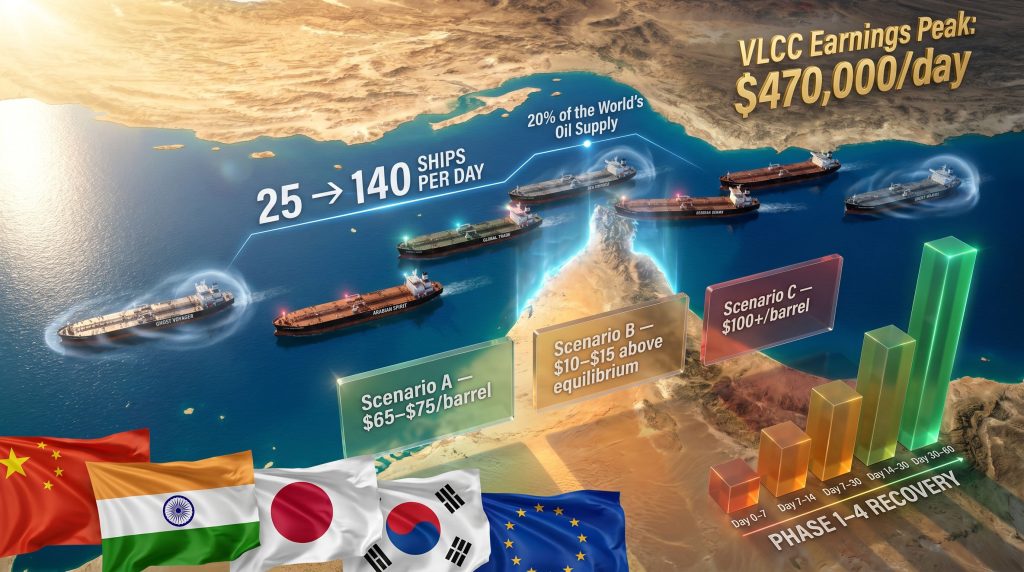
- VLCC (Very Large Crude Carrier) daily earnings surged to approximately $470,000 per day at the peak of the crisis, reflecting the acute scarcity of tanker operators willing to accept the risk of transiting a contested waterway
- Iran's own oil exports through Hormuz paradoxically reached wartime highs in the weeks before the agreement, suggesting continued shadow fleet activity despite the broader blockade conditions
- Qatar's LNG exports were disrupted, pushing European gas prices higher and compounding an already-stressed winter supply picture — indeed, the rise in European gas prices had already been a concern well before this conflict escalated
- At least one major international oil company's tanker tender came up entirely empty in the days preceding the deal, illustrating the depth of operator risk aversion the agreement must now overcome
The economies most exposed to Hormuz dependency include China, India, Japan, South Korea, and the European Union, collectively representing the majority of global oil demand growth. For these importers, the conflict was not an abstraction; it was an immediate and escalating cost pressure.
How the Strait Reopens: A Phased Traffic Recovery Model
At the time of signing, approximately 25 vessels per day were transiting the strait, compared to a pre-conflict baseline of roughly 140 ships per day. U.S. officials projected 40 to 50 daily transits by end of the first week, with full restoration targeted by June 19.
| Phase | Timeframe | Projected Daily Transits | Key Milestones |
|---|---|---|---|
| Phase 1 | Day 0–7 | 25 to 40–50 ships/day | Naval blockade lifted; initial commercial clearance |
| Phase 2 | Day 7–14 | 50 to 100 ships/day | Demining operations begin; tanker confidence returns |
| Phase 3 | Day 14–30 | 100 to 140 ships/day | Full pre-conflict traffic levels targeted |
| Phase 4 | Day 30–60 | 140+ ships/day | Sustained flow; long-term maritime governance negotiations underway |
A less-discussed but important indicator of market confidence restoration is the behaviour of tankers that had been operating in AIS transponder-off mode, colloquially known as "dark mode," to avoid targeting during the conflict. Reports confirm these vessels are progressively re-emerging as diplomatic signals improve.
Demining operations within the strait corridor are required to be completed within 30 days under the MoU's terms, a precondition that carries significant operational complexity.
The Maritime Fee Dispute: The Agreement's Most Dangerous Ambiguity
The most consequential unresolved tension within the current framework is not about nuclear enrichment timelines or frozen asset valuations. It is about who holds sovereign authority over the strait itself.
Washington's stated position is that passage will remain completely toll-free for the full 60-day period, with long-term maritime governance arrangements determined through subsequent regional negotiations. Iran's framing, communicated through Foreign Ministry spokesperson Esmail Baqaei, describes a system in which Iran will design and collect fees for maritime services it provides within the strait, including navigation assistance, environmental protection, and ship insurance.
The IRGC-aligned Fars News Agency went further, stating that maritime traffic will be regulated by Iran in coordination with Oman.
Why This Ambiguity Matters
Analytical Warning: The distinction between a "toll" and a "maritime service fee" is legally and diplomatically significant. If Iran begins levying charges on commercial vessels during the 60-day window, Washington may interpret this as a violation of the framework's terms, creating a potential flashpoint well before the June 19 Geneva ceremony consolidates the agreement.
The Frozen Assets Contradiction
Layered on top of the fee dispute is a fundamental disagreement about the financial terms of the deal itself. Iranian officials cited a $25 billion frozen asset release as a core element of the agreement. U.S. officials categorically denied any funds had changed hands at signing, with one senior official stating the released figure was simply zero.
Separately, Iran announced the U.S. had agreed to unblock $12 billion in frozen funds, a figure that contradicts both the $25 billion Iranian claim and the U.S. denial simultaneously.
This three-way contradiction is not a minor diplomatic miscommunication. It reflects a pattern in which both sides are communicating different versions of the deal to their domestic audiences, a dynamic that has historically preceded the collapse of frameworks of this type.
The next major ASX story will hit our subscribers first
Three Oil Market Scenarios for the Next 60 Days
The agreement's market implications depend entirely on which of the following scenarios materialises. These probability weightings reflect current diplomatic conditions and are subject to rapid revision as implementation proceeds.
Scenario A: Full Implementation (Base Case, ~55% Probability)
- Strait fully reopens to pre-conflict traffic volumes by late June
- Iranian crude re-enters Asian markets under U.S. sanctions waivers
- Global oil prices stabilise in the $65 to $75 per barrel range (WTI basis)
- OPEC+ faces renewed internal pressure as Iranian barrels compete with member quota allocations — a dynamic that intersects directly with the broader question of OPEC's market influence in the current environment
- ADNOC's decision to cut its Murban crude official selling price to $101.48 signals Gulf producers are already moving to reflect eased conditions
Scenario B: Partial Implementation / Stalled Negotiations (~30% Probability)
- Fee disputes and nuclear programme disagreements prevent full normalisation within 60 days
- Traffic recovers to 60 to 70% of pre-conflict levels; a residual risk premium persists
- Oil prices remain $10 to $15 per barrel above pre-conflict equilibrium
- VLCC earnings stabilise above $200,000 per day as operators continue pricing uncertainty
Scenario C: Deal Collapse / Renewed Escalation (~15% Probability)
- Hard-line IRGC elements or Israeli military actions derail the framework
- Strait re-closes or becomes operationally unreliable
- Oil prices spike to $100+ per barrel within weeks
- European gas prices re-test conflict-era highs driven by Qatar LNG disruption overlap
The immediate market reaction was consistent with Scenario A pricing: oil prices fell sharply upon confirmation of the agreement as markets unwound the geopolitical risk premium embedded since the strait's closure. U.S. airlines are projected to capture approximately $40 billion in savings as jet fuel prices decline from conflict-elevated levels, a downstream beneficiary effect that illustrates the breadth of the strait's economic reach.
The OPEC+ Dimension: Iran's Re-Entry as a Market Disruptor
One structural consequence of the deal that is receiving insufficient attention is the potential return of meaningful Iranian crude volumes to global markets. Iran holds the world's fourth-largest proven oil reserves and the second-largest proven natural gas reserves, resources that have been partially locked out of global trade by successive rounds of sanctions.
Under U.S. sanctions waivers, Iran is already moving to re-engage key Asian markets, particularly Chinese independent refineries and Indian state buyers. The volume of Iranian crude that ultimately re-enters global supply will depend on the pace of sanctions relief implementation.
However, even partial re-engagement creates a supply overhang problem for OPEC+ members who have been managing quota architecture around Iran's absence. In this context, OPEC demand forecasts become particularly relevant, as revised projections will need to account for Iran's potential re-entry into the supply picture.
Iraq, which has historically been among the least compliant OPEC+ members with respect to production ceilings, may face renewed pressure if Iranian barrels begin competing directly for the same Asian refinery slots. The internal OPEC+ dynamic that emerges from a successfully implemented deal could prove as consequential for long-term oil pricing as the deal itself.
Regional Spillovers: Lebanon, Pakistan, and the Emerging Diplomatic Architecture
The agreement does not exist in isolation. U.S. officials confirmed that direct talks between Israel and Lebanon are underway, describing them as historically significant. Israeli troop withdrawals from Lebanon are not a formal condition of the current MoU, but the deal is framed as part of a broader regional de-escalation architecture.
Washington was explicit that the framework is not a one-way ceasefire and that Israel retains the right to respond militarily if Hezbollah attacks continue.
Pakistan's mediation role throughout the conflict signals that a broader multilateral diplomatic framework is emerging — one that extends beyond the traditional U.S.-Gulf-Israel axis. The Geneva signing ceremony represents an attempt to institutionalise the agreement within a neutral European diplomatic setting, echoing structural elements of the 2015 JCPOA negotiations.
Qatar has already moved to restore LNG output, with exports projected to return to normal within weeks, a sign that the broader Gulf energy ecosystem is stabilising around the diplomatic breakthrough. The world's reaction to this deal has been broadly cautious but constructive, with most major economies welcoming the ceasefire architecture.
Domestic Iranian Politics and the Deal's Internal Vulnerability
While energy markets focus on barrels and basis points, the agreement's durability will partly depend on whether it generates sufficient domestic political legitimacy within Iran to survive the 60-day negotiation window. Ordinary Iranians who spoke to regional media expressed a spectrum of reactions, ranging from cautious relief at the cessation of hostilities to deep scepticism about whether the deal would produce meaningful economic improvement.
A recurring concern is that the agreement represents a short-term arrangement rather than a transformative shift. Hard-line elements within Iran, particularly those aligned with the IRGC, have expressed opposition to the framework. Their capacity to conduct maritime incidents or proxy attacks that could trigger the deal's collapse should not be underestimated.
Consequently, this domestic political dynamic represents one of the most structurally underpriced risks in current market positioning. The broader oil market impact of any renewed escalation would be swift and severe, given how deeply energy supply chains remain exposed to the strait's operational status.
The U.S. and Iran peace deal to reopen the Strait of Hormuz is, in the final analysis, a necessary but fragile first step — one that energy markets are pricing as a probable success while simultaneously underestimating the structural conditions that could unravel it.
Disclaimer: The scenario probabilities, oil price ranges, and market projections contained in this article represent analytical frameworks based on available information as of the date of publication. They do not constitute financial or investment advice. Energy markets are subject to rapid and unpredictable changes driven by geopolitical, operational, and macroeconomic factors. Readers should conduct independent research before making any investment decisions.
Want to Position Yourself Ahead of the Next Major Market-Moving Discovery?
The geopolitical volatility reshaping global energy markets underscores how rapidly commodity dynamics can shift — and how critical it is to act on high-impact information the moment it emerges. Discovery Alert's proprietary Discovery IQ model delivers real-time alerts on significant ASX mineral discoveries, transforming complex market data into actionable investment insights for traders and long-term investors alike — explore historic discoveries and their returns, then begin your 14-day free trial to ensure you're positioned before the broader market moves.