
June 25, 2026
When Infrastructure Becomes the Battlefield: Understanding Russia's Refinery Crisis
Modern conflict has always sought to sever the arteries that sustain an adversary's capacity to fight. From the Allied bombing campaigns against German synthetic fuel plants in World War II to the precision strikes on Iraqi power infrastructure in 1991, the logic is consistent: destroy the systems that convert raw resources into operational power, and the war machine begins to starve itself from within. What is unfolding across Russia in 2026 follows this same strategic logic, but with a technological twist that changes the economics of infrastructure warfare fundamentally.
Relatively low-cost autonomous drones are now capable of inflicting damage on multi-billion-dollar industrial facilities, and the cumulative effect of sustained, repeated strikes is something the historical record has rarely had to account for. Furthermore, the broader geopolitical landscape surrounding this conflict has accelerated the pace at which infrastructure has become a primary theatre of operations.
The Russia fuel crunch from Ukrainian drone strikes is not a story about a single dramatic attack. It is a story about systemic degradation, compounding losses, and the structural vulnerability that comes from concentrating critical industrial capacity in predictable, fixed locations.
When big ASX news breaks, our subscribers know first
A Crisis Defined by Scale, Not Isolated Incidents
There is an important distinction to draw between fuel shortages driven by price spikes, seasonal demand surges, or logistical bottlenecks, and those caused by the physical destruction of refining infrastructure. Russia is experiencing the latter. This is not a market correction or a supply chain inconvenience. It is a deliberate, sustained degradation of the industrial capacity required to convert crude oil into usable fuel products.
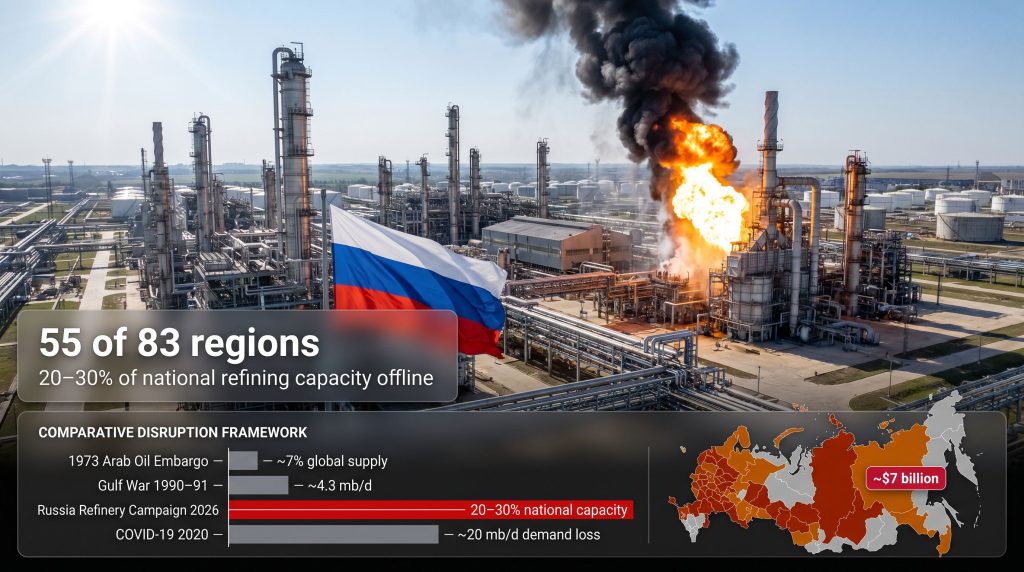
The numbers underscore the severity. As of late June 2026, at least 55 of Russia's 83 federal entities were reporting some form of fuel restriction, either through mandatory government-imposed rationing or limitations applied by private fuel companies operating retail stations. That represents more than two-thirds of Russia's administrative regions simultaneously reporting constrained access to gasoline and diesel.
| Metric | Figure |
|---|---|
| Russian federal regions reporting fuel restrictions | 55 of 83 |
| Estimated decline in domestic refining output | 20-30% below required levels |
| Offline secondary processing capacity above prior-year baseline | 1.2-1.3 million barrels per day |
| Major refineries struck since March | 8 of Russia's 10 largest |
| Estimated financial losses to Russia's oil sector (2026 YTD) | ~$7 billion |
| Moscow Kapotnya refinery offline until | At least end of 2026 |
When more than two-thirds of a nation's administrative regions simultaneously report restricted fuel access, the situation has crossed beyond logistical disruption into a condition that qualifies as a systemic economic threat with direct military consequences.
Analysts estimate that more than 20% of Russia's total refining capacity has been taken offline, with some assessments of secondary processing losses placing the figure at 1.2 to 1.3 million barrels per day above the prior-year baseline. For context, that volume is comparable to the entire refining output of a mid-sized OPEC member nation. The International Energy Agency, in its June 2026 Oil Market Report, characterised the cumulative disruption as unprecedented in the history of the Russia-Ukraine conflict.
How Ukraine's Drone Campaign Evolved Into an Energy War
Ukraine's long-range strike capability did not emerge overnight. Beginning in late 2022, Ukrainian engineers and defence planners began developing domestic drone and cruise missile programmes that progressively extended in both range and destructive capacity. Early iterations were effective but limited. By 2025 and into 2026, the technology had matured substantially, incorporating heavy explosive payloads, extended operational ranges, and, critically, anti-jamming navigation systems designed to defeat Russian electronic warfare countermeasures.
This technological evolution matters because it changed the target set that was realistically within reach. What had previously required ballistic or cruise missiles — expensive assets in limited supply — could now be accomplished with domestically produced drones manufactured at scale. The cost asymmetry is stark: a drone costing tens of thousands of dollars can disable a processing unit at a refinery worth hundreds of millions. Consequently, the oil price shock reverberating through global energy markets has been significantly shaped by this new asymmetric capability.
The targeting logic behind focusing on refining infrastructure rather than frontline military assets reflects a sophisticated understanding of how modern industrial economies sustain armed conflict:
- Refineries are irreplaceable in the short term. Unlike military equipment, they cannot be quickly sourced from a foreign supplier or reconstructed within weeks.
- Fuel shortages cascade through every dimension of the war effort simultaneously, degrading military logistics, constraining agricultural production, disrupting civilian transportation, and compressing export revenues.
- Oil terminals and export facilities on both the Baltic and Black Sea coasts represent additional chokepoints, limiting Russia's ability to monetise its crude reserves internationally.
- Inland pipeline infrastructure connects upstream production to downstream processing, creating additional interdiction opportunities.
More than two dozen Ukrainian strikes have targeted Russian refineries since March 2026, with eight of Russia's ten largest refineries sustaining damage. The breadth of the campaign signals a strategic intent to overwhelm Russia's repair capacity by attacking faster than reconstruction can occur. Ukraine strikes on oil facilities in Crimea and the Krasnodar region have further extended the geographic reach of this campaign.
The Kapotnya Case Study: Capital City Vulnerability Exposed
No single facility illustrates the strategic calculus of infrastructure targeting more clearly than the Kapotnya refinery, located within the Moscow metropolitan region. The plant was responsible for supplying an estimated 40% of the Moscow region's fuel requirements, making it not merely an industrial asset but a critical piece of capital city infrastructure.
Kapotnya was struck twice within the same month in June 2026. Both its primary and secondary distillation units were disabled in the attacks. Russian officials confirmed to Reuters that the facility would remain offline until at least the end of 2026, with some projections extending the outage into 2027.
The downstream effects were immediate and far-reaching. Fuel shortages cascaded across the capital and surrounding regions, exposing a structural vulnerability that concentrated infrastructure always carries: when a single facility accounts for a disproportionate share of a region's supply, its loss creates a gap that distributed alternatives cannot easily fill.
The Kapotnya strikes demonstrated that no geography within Russia, including the capital itself, should be considered insulated from the operational reach of Ukraine's long-range strike programme.
Rationing on the Ground: What Russians Are Actually Experiencing
The official framing of Russia's fuel situation as a temporary supply adjustment diverges significantly from documented ground-level conditions. Social media platforms including Telegram and VK have served as primary channels through which Russian citizens have documented the reality of shortages, given that state media coverage has been constrained.
Reported conditions across affected regions include:
- Queues at fuel stations extending up to 10 hours in the most severely affected areas
- Per-vehicle rationing caps, with limits of approximately 20 litres per fill imposed in hardest-hit regions
- In Crimea, a complete suspension of civilian gasoline sales following sustained drone strikes on highways, bridges, and supply routes connecting the peninsula to the Russian mainland
- Extended shortages across Russian-occupied Ukrainian territories, compounding the military logistics challenges in those zones
The Crimea situation deserves particular attention. As a peninsula connected to Russia primarily through the Kerch Bridge and a limited road network, it is logistically exposed. Sustained interdiction of its supply routes created conditions severe enough to warrant a total halt on civilian fuel sales — an extraordinary measure for any peacetime population to absorb, let alone one already under the pressures of prolonged conflict. Russia's gasoline crunch has, however, spread well beyond Crimea as refinery attacks multiply across the country.
Quantifying the Financial Damage
Russia's oil and gas revenues have historically served as the primary fiscal mechanism financing both government operations and military procurement. The disruption of refining capacity therefore creates a compounding financial pressure that operates alongside existing Russian oil sanctions imposed by Western governments.
| Impact Category | Estimated Scale |
|---|---|
| Total oil industry losses (2026 YTD) | ~$7 billion |
| Refining capacity offline | 20-30% of total national capacity |
| Gasoline export suspension period | Through at least July 2026 |
| Offline secondary processing vs. prior year | +1.2-1.3 million barrels per day |
Ukrainian President Volodymyr Zelenskyy has cited approximately $7 billion in losses inflicted on Russia's oil industry through the drone campaign in 2026 alone. Russia has suspended gasoline exports through at least July 2026 and has begun importing gasoline by sea from Asian suppliers — a reversal that carries both economic and strategic significance.
Sergei Vakulenko, an energy sector analyst with the Carnegie Russia Eurasia Centre, has noted that the Russian oil industry's resilience is being stretched to a dangerous threshold — a characterisation that implies the sector may be approaching limits beyond which improvised responses become insufficient. The feedback loop is self-reinforcing: reduced refining output lowers export volumes, which compresses fiscal headroom, which constrains the procurement of military equipment and personnel.
The next major ASX story will hit our subscribers first
Russia's Emergency Responses and Their Structural Limits
The Kremlin's response to the fuel crunch has been multi-pronged, drawing on both market interventions and administrative mechanisms:
- Nationwide rationing frameworks have been imposed across affected regions, with both government agencies and private fuel companies participating in quota systems
- Lowered environmental and quality standards for commercial-grade gasoline, allowing damaged and partially operational facilities to produce fuel that would not otherwise meet regulatory thresholds
- Rosneft's proposed 30% domestic refining mandate, which would require oil companies to process a minimum share of their crude within Russian territory, redirecting volumes that would otherwise flow to export markets
- Diesel export suspension under active consideration, with Deputy Prime Minister Alexander Novak publicly signalling that a complete ban on diesel exports may be necessary to protect domestic supply
Each of these measures carries limitations. Lowering fuel quality standards is a short-term fix with long-term industrial consequences, as sustained use of substandard fuel accelerates wear on vehicle fleets and industrial equipment. Import substitution from Asia is logistically constrained by tanker availability and turnaround times. Furthermore, the repair-destruction cycle — in which Russian crews work to restore damaged capacity only to have it struck again — fundamentally limits the effectiveness of reconstruction efforts while strikes continue at their current frequency.
Scenario Modelling: Three Paths Forward
Scenario A: Strike Pause or Ceasefire. Refinery repair programmes accelerate meaningfully. Kapotnya and other damaged facilities achieve partial restoration within six to twelve months. Domestic supply gradually normalises, but export capacity remains reduced through 2027 as prioritisation favours internal demand.
Scenario B: Continued or Escalating Strikes. Additional capacity is taken offline faster than repairs can be completed. Rationing deepens across more regions, diesel shortages penetrate agricultural and heavy industrial sectors, and Russia's fiscal position deteriorates at an accelerating pace.
Scenario C: Structural Import Dependency. Russia accelerates agreements with Asian fuel suppliers to bridge domestic deficits, but in doing so creates a structural dependence on foreign supply chains. This represents a profound strategic irony for a nation whose geopolitical identity has been built in significant part on energy self-sufficiency and its leverage as an exporter.
Global Market Implications of Russia's Refinery Losses
The Russia fuel crunch from Ukrainian drone strikes does not exist in a vacuum. Russia's reduced export capacity interacts with OPEC+ production decisions, shifts in global refined product balances, and the import strategies of nations that have relied on discounted Russian fuel — particularly India, China, and Turkey. In addition, the wider oil market impacts from this disruption are already registering across futures markets and refining margins globally.
Nations in this group face a narrowing discount window. As Russia's exportable surplus contracts and its own import requirements grow, the preferential pricing that made Russian crude and refined products attractive to Asian buyers is likely to compress. This dynamic subtly reshapes energy trade flows in the Indo-Pacific and reinforces the case for supply diversification among buyers who had grown comfortable with Russian dependency. The interplay of trade and geopolitics will consequently determine how quickly alternative supply arrangements can be secured.
How Russia's 2026 Crisis Compares to Historical Energy Disruptions
Placing the current situation in historical context clarifies its severity.
| Event | Cause | Capacity Disrupted | Duration |
|---|---|---|---|
| 1973 Arab Oil Embargo | Political export restriction | ~7% of global supply | ~6 months |
| Gulf War (1990-91) | Military conflict | ~4.3 mb/d (temporary) | Weeks to months |
| Russia-Ukraine Refinery Campaign (2026) | Drone strikes on infrastructure | ~20-30% of Russian refining capacity | Ongoing |
| COVID-19 Demand Collapse (2020) | Demand destruction | ~20 mb/d demand loss | 12-18 months |
What distinguishes the 2026 situation from prior conflict-related disruptions is the combination of scale, persistence, and the cost asymmetry of the attacking technology. The Gulf War disruptions, while dramatic in peak impact, were resolved within months through military victory and rapid restoration of output. The current campaign has no defined endpoint, and the repair-destruction dynamic means that recovery timelines are genuinely uncertain in ways that prior disruptions were not.
The Broader Doctrine Shift: Rethinking Energy Infrastructure Security
Perhaps the most consequential long-term implication of what is happening in Russia is the lesson it delivers to energy planners, governments, and corporations worldwide. Concentrated refining infrastructure, historically considered a stable long-term investment protected by geographic distance and national sovereignty, has been revealed as a strategic liability in an era of precision drone warfare.
The cost asymmetry favouring attackers is not a temporary condition. As drone technology continues to mature, becomes cheaper to produce, and spreads to more state and non-state actors, the vulnerability that Russia is experiencing today becomes a planning consideration for every nation with concentrated energy infrastructure. Distributed refining networks, hardened storage systems, and redundant supply chains will increasingly appear in national energy security frameworks — not because of abstract risk modelling, but because a real-world demonstration of concentrated infrastructure vulnerability is now playing out at scale.
The Russia fuel crunch from Ukrainian drone strikes is simultaneously a case study in strategic targeting, a test of industrial resilience, and a warning that the physical architecture of energy systems requires rethinking in an era where the barriers to precision infrastructure attack have been dramatically lowered.
This article is intended for informational purposes only and does not constitute financial, investment, or geopolitical advice. Figures relating to financial losses, refining capacity, and regional fuel restrictions are based on publicly available estimates and official statements current as of late June 2026. Forecasts and scenario projections represent analytical frameworks rather than confirmed outcomes. Readers should consult primary sources and professional advisers before drawing conclusions for investment or policy purposes.
Want to Track the Commodity and Energy Market Shifts Driving Today's Biggest Investment Opportunities?
Discovery Alert's proprietary Discovery IQ model delivers real-time alerts on significant ASX mineral discoveries, instantly translating complex market developments — including those shaped by global energy disruptions like Russia's refinery crisis — into actionable investment insights. Explore how historic mineral discoveries have generated substantial returns on Discovery Alert's discoveries page, and begin your 14-day free trial today to position yourself ahead of the market.