May 22, 2026
The global mining industry stands at an unprecedented technological crossroads where advanced mining environmental management services determine operational viability and market access. Modern mining operations face increasing pressure to demonstrate measurable environmental performance improvements while maintaining economic competitiveness across diverse geological and regulatory landscapes. This convergence has created a specialized services ecosystem focused on transforming environmental challenges into strategic operational advantages.
Mining environmental management services now integrate sophisticated monitoring networks, predictive analytics platforms, and automated compliance systems that fundamentally alter how extractive operations interact with surrounding ecosystems. Furthermore, the evolution from reactive environmental compliance to proactive ecosystem stewardship reflects broader industry innovation trends that emphasise technical innovation and comprehensive lifecycle planning.
Understanding Mining Environmental Management Services: A Strategic Overview
Defining Comprehensive Environmental Stewardship in Mining Operations
Modern mining environmental management services encompass integrated technical solutions addressing air quality control, water resource protection, waste valorization, and ecosystem restoration throughout project lifecycles. These services operate across multiple temporal scales, from real-time operational monitoring to decades-long post-closure environmental stewardship programs.
The Asia-Pacific region currently dominates mining waste management expenditures, driven by large-scale mineral extraction operations and increasingly stringent environmental performance requirements. Service providers deliver specialised expertise spanning geochemistry, hydrogeology, ecological restoration, and regulatory compliance management to ensure operations meet evolving environmental standards.
The Evolution from Compliance-Driven to Value-Creating Environmental Services
Traditional environmental management focused primarily on regulatory compliance and risk mitigation. Contemporary approaches emphasise resource recovery, operational efficiency optimisation, and community relationship maintenance as core value propositions. This transformation positions environmental management as integral to operational excellence rather than peripheral compliance burden.
Service providers now integrate circular economy principles that transform mining waste streams into secondary resource opportunities. However, water recycling systems achieve recovery rates exceeding 85%, while waste rock characterisation enables beneficial reuse applications in construction and industrial processes.
When big ASX news breaks, our subscribers know first
What Are the Core Service Categories in Mining Environmental Management?
Pre-Development Environmental Assessment and Planning Services
Environmental impact assessments represent foundational components of modern mining project development, requiring comprehensive baseline data collection across atmospheric, hydrological, geological, and biological parameters. These assessments typically span 12-24 months for major projects, involving extensive stakeholder consultation and regulatory agency coordination.
Key assessment components include:
- Baseline environmental monitoring across air quality, water chemistry, noise levels, and biodiversity indicators
- Geochemical characterisation of ore bodies and waste rock to predict acid rock drainage potential
- Hydrological modelling to assess groundwater and surface water interaction patterns
- Cultural heritage surveys and archaeological impact assessments
- Cumulative impact analysis considering existing industrial activities in regional context
Effective permitting strategies require detailed regulatory pathway mapping across multiple jurisdictions. Consequently, typical approval timelines range from 18 months to 5 years depending on project complexity and regulatory frameworks. Service providers coordinate with federal environmental agencies, state mining departments, and local planning authorities to streamline approval processes.
Operational Environmental Monitoring and Control Systems
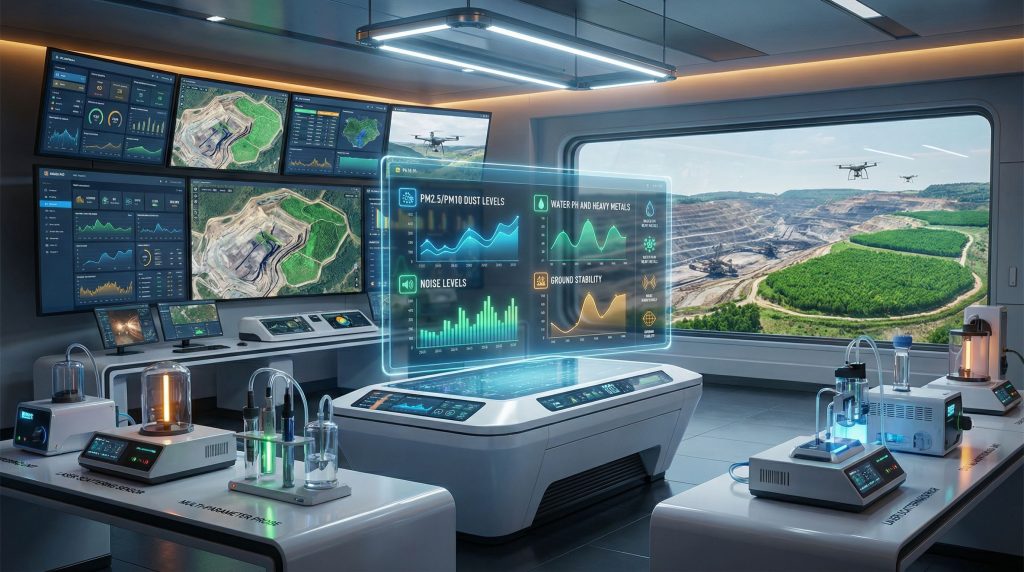
Real-time environmental monitoring networks deploy IoT sensor arrays measuring atmospheric particulates, water quality parameters, ground stability indicators, and noise emissions. These systems generate massive datasets requiring advanced analytics capabilities to identify trends and predict potential exceedances.
| Parameter | Monitoring Frequency | Technology Platform | Typical Alert Thresholds |
|---|---|---|---|
| PM2.5 Dust Levels | Continuous | Beta attenuation monitors | 35 μg/m³ (24-hour average) |
| Water pH Levels | Hourly | Multi-parameter sondes | pH 6.5-8.5 range |
| Heavy Metal Concentrations | Daily composite | ICP-MS analysis | Element-specific discharge limits |
| Ground Vibration | Real-time | Triaxial seismographs | 12.7 mm/s peak particle velocity |
Water quality management systems integrate treatment technologies including lime neutralisation, reverse osmosis, biological sulfate reduction, and constructed wetlands to achieve discharge permit compliance. Advanced treatment facilities process between 500-15,000 cubic metres of contaminated water daily, depending on operational scale.
Post-Mining Rehabilitation and Closure Services
Progressive rehabilitation programmes initiate concurrent reclamation activities during active mining phases to minimise final closure costs and accelerate ecosystem recovery timelines. These programmes typically reduce total rehabilitation expenses by 20-35% compared to end-of-life closure approaches.
Rehabilitation services encompass:
- Topsoil salvage and stockpiling with organic matter preservation techniques
- Landform reconstruction matching pre-mining drainage patterns and slope stability requirements
- Vegetation establishment using native species adapted to local climatic conditions
- Wildlife habitat creation including nesting sites, water sources, and migration corridors
Long-term monitoring protocols extend 15-30 years post-closure, focusing on water quality trends, vegetation establishment success, and ecosystem function recovery. In addition, mine reclamation innovations now incorporate advanced rehabilitation techniques that improve success rates whilst reducing costs.
How Do Technology Integration and Digital Solutions Transform Environmental Management?
IoT-Enabled Environmental Monitoring Networks
Internet of Things sensor deployments create comprehensive environmental surveillance systems capturing real-time data across multiple parameters simultaneously. These networks integrate wireless communication protocols, edge computing capabilities, and cloud-based analytics platforms to enable immediate response to environmental anomalies.
Modern monitoring networks achieve 99.5% data availability through redundant sensor configurations and automated calibration systems. Solar-powered monitoring stations operate continuously in remote locations, transmitting data via satellite links to central command centres for analysis and regulatory reporting.
Advanced sensor technologies include:
- Laser-based particulate monitors achieving ±5% accuracy for PM2.5 measurements
- Multi-parameter water quality probes measuring pH, dissolved oxygen, turbidity, and conductivity simultaneously
- Acoustic emission sensors detecting ground instability indicators months before visible surface changes
- Weather monitoring stations providing microclimate data for dust suppression optimisation
Artificial Intelligence and Predictive Environmental Analytics
Machine learning algorithms analyse historical environmental data to predict exceedance events 72-96 hours in advance, enabling proactive intervention strategies. Furthermore, AI technology in mining applications achieve prediction accuracy rates exceeding 85% for dust generation events and 90% for water quality parameter deviations.
AI applications include:
- Predictive dust modelling incorporating meteorological forecasts, equipment scheduling, and material moisture content
- Water treatment optimisation automatically adjusting chemical dosing rates based on influent quality variations
- Equipment maintenance scheduling predicting environmental control system failures before critical component degradation
- Automated regulatory reporting generating compliance submissions with minimal human intervention
Remote Sensing and Geospatial Environmental Analysis
Satellite-based monitoring systems provide comprehensive landscape-scale environmental assessment capabilities with spatial resolutions approaching 30 centimetres for high-resolution commercial platforms. These systems enable vegetation health monitoring, erosion pattern identification, and land use change detection across entire mining districts.
Drone-based surveys achieve ground sampling distances of 2-5 centimetres, enabling detailed infrastructure inspection, stockpile volume calculations, and rehabilitation progress monitoring. Multispectral and thermal imaging capabilities identify stressed vegetation, water quality variations, and equipment thermal signatures indicating potential failures.
Which Regulatory Frameworks Drive Environmental Management Service Demand?
International Environmental Standards and Certification Requirements
ISO 14001 Environmental Management System certification requires systematic environmental policy implementation, objective setting, performance measurement, and continuous improvement demonstration. Over 300,000 organisations worldwide maintain ISO 14001 certification, with mining companies representing significant adoption within extractive industries.
Implementation timelines typically require 12-18 months for comprehensive system development, including:
- Environmental aspect and impact identification across all operational activities
- Legal requirement registers maintained current with regulatory changes
- Environmental objective and target establishment with measurable performance indicators
- Internal audit programmes conducted by qualified environmental management system auditors
Global Reporting Initiative sustainability reporting frameworks require disclosure of environmental performance data including energy consumption, water usage, waste generation, and biodiversity impact metrics. Corporate sustainability reporting now influences investment decisions, with environmental performance data directly affecting capital access costs.
Regional Regulatory Compliance Landscapes
Critical Compliance Reality: Mining environmental management services must navigate complex regulatory environments including federal environmental protection laws, state-specific mining regulations, local air quality standards, and international ESG reporting requirements that vary significantly across jurisdictions.
Regulatory complexity varies dramatically across major mining jurisdictions:
- Australia requires comprehensive Environmental Impact Statements with 18-24 month assessment periods
- Canada implements federal-provincial joint review processes extending 30-42 months for major projects
- Peru mandates Environmental Impact Studies with community consultation requirements spanning 12-18 months
- Indonesia enforces PROPER environmental performance rating systems affecting operational permits
ESG Integration and Investor Due Diligence Requirements
Environmental, Social, and Governance integration now represents critical components of investment decision-making processes, with institutional investors managing $35+ trillion in assets incorporating ESG criteria into portfolio selection. Mining companies face increasing pressure to demonstrate measurable environmental performance improvements to maintain investment access.
Key ESG environmental metrics include:
- Scope 1, 2, and 3 carbon emissions with science-based target alignment
- Water consumption intensity per unit of mineral production
- Waste generation and recycling rates across operational waste streams
- Biodiversity offset ratios demonstrating net positive environmental outcomes
What Are the Specialised Technical Solutions for Mining Environmental Challenges?
Water Management and Treatment Technologies
Acid mine drainage represents one of mining's most persistent environmental challenges, with treatment systems requiring decades to centuries of active management. Modern neutralisation systems achieve pH stabilisation between 6.5-8.5 while removing heavy metals to levels below 0.01 mg/L for critical parameters like copper and zinc.
Advanced treatment technologies include:
- High-density sludge reactors processing up to 2,000 cubic metres of contaminated water daily
- Biological sulfate reduction systems achieving 90%+ sulfate removal using organic carbon substrates
- Reverse osmosis membrane systems producing potable water quality from highly contaminated sources
- Constructed wetlands providing long-term passive treatment with minimal operational requirements
Water recycling systems in modern mining operations achieve recycle rates exceeding 90%, dramatically reducing freshwater consumption and minimising discharge volumes. Closed-loop processing circuits eliminate external water discharge while maintaining operational efficiency.
Air Quality Control and Emissions Reduction Systems
Dust suppression technologies deploy multiple intervention strategies achieving particulate emission reductions of 70-95% depending on application methods and environmental conditions. Advanced suppression systems integrate meteorological monitoring, automated spraying systems, and chemical binding agents optimised for specific dust characteristics.
Emission control technologies include:
- Electrostatic precipitators achieving 99%+ particulate collection efficiency for stack emissions
- Fabric filter baghouses removing submicron particles from industrial processes
- Wet scrubbing systems simultaneously controlling particulates and acid gas emissions
- Enclosure and ventilation systems capturing emissions at source points before atmospheric release
Electric vehicle fleet deployments reduce Scope 1 emissions by 40-60% while improving local air quality around operational areas. Battery-electric haul trucks achieve operational cost reductions of 15-25% compared to diesel equivalents over 10-year operational periods.
Waste Rock and Tailings Management Solutions
Geochemical characterisation programmes classify waste rock according to acid generation potential using standardised test methodologies including Acid Base Accounting and Net Acid Generation tests. These assessments predict long-term environmental behaviour enabling appropriate disposal and treatment strategies.
Modern tailings storage facilities incorporate:
- Filtered tailings technology reducing water content from 35-40% to 12-18%, improving storage stability
- Geosynthetic liner systems providing multiple containment barriers preventing groundwater contamination
- Real-time instrumentation monitoring pore pressure, settlement, and seepage flow rates
- Progressive closure strategies eliminating final closure liability through concurrent rehabilitation
How Do Environmental Management Services Support Mine Closure and Legacy Site Remediation?
Progressive Rehabilitation Planning and Implementation
Progressive rehabilitation programmes initiate ecosystem restoration activities concurrent with mining operations, reducing final closure timeframes from 10-15 years to 3-5 years while improving environmental outcomes. These programmes achieve cost reductions of 25-40% compared to end-of-life closure approaches.
Implementation components include:
- Concurrent topsoil application on completed mining areas within 6-12 months of disturbance
- Native species propagation programmes establishing seed sources adapted to site-specific conditions
- Habitat connectivity planning maintaining wildlife movement corridors throughout operational phases
- Community engagement programmes incorporating traditional ecological knowledge into restoration designs
Post-Closure Monitoring and Maintenance Programmes
Long-term environmental monitoring networks operate for 20-100+ years following mine closure, depending on environmental sensitivity and regulatory requirements. These programmes cost $50,000-500,000 annually depending on site complexity and monitoring parameter requirements.
Monitoring protocols encompass:
- Water quality trend analysis detecting long-term changes in groundwater and surface water chemistry
- Vegetation establishment success assessment measuring species diversity, cover percentage, and biomass production
- Wildlife population monitoring documenting ecosystem recovery and habitat utilisation patterns
- Geotechnical stability evaluation ensuring long-term safety of rehabilitated landforms
Financial Assurance and Bonding Optimisation
Financial assurance calculations incorporate closure cost escalation, contingency allowances, and long-term care requirements. Bond amounts typically represent 110-140% of estimated closure costs with annual adjustments reflecting inflation and technical requirement changes.
Progressive bond release programmes enable partial financial assurance recovery upon successful completion of rehabilitation milestones, improving project economics while maintaining environmental protection standards.
The next major ASX story will hit our subscribers first
What Market Trends Are Shaping the Future of Mining Environmental Management Services?
Circular Economy Integration and Resource Recovery
Circular economy principles transform traditional waste streams into secondary resource opportunities, with mining waste valorisation markets growing at 8-12% annually. Resource recovery programmes extract valuable materials from historical tailings deposits, processing facilities, and waste rock stockpiles.
Emerging applications include:
- Critical mineral recovery from copper and zinc tailings containing rare earth elements
- Construction aggregate production from waste rock meeting engineering specifications
- Acid neutralising material extraction from alkaline waste streams for acid mine drainage treatment
- Industrial symbiosis programmes supplying mining waste as feedstock for cement, construction, and manufacturing industries
Climate Change Adaptation and Resilience Planning
Climate change adaptation requires environmental management systems capable of responding to increasing precipitation variability, extreme weather events, and temperature fluctuations affecting operational stability. Adaptation strategies incorporate scenario planning for 2°C and 4°C warming pathways over 50-100 year planning horizons.
Resilience planning addresses:
- Water security assessment under changed precipitation patterns and increased evaporation rates
- Extreme weather response protocols for flooding, drought, and severe storm events
- Temperature-sensitive infrastructure protection maintaining functionality under thermal stress
- Ecosystem migration assistance facilitating species adaptation to changing environmental conditions
Community Engagement and Social Impact Management
Social licence to operate maintenance requires transparent environmental performance communication and meaningful community participation in environmental decision-making processes. Digital platforms enable real-time environmental data sharing with community stakeholders, improving trust and reducing conflict potential.
Indigenous rights recognition programmes integrate traditional ecological knowledge into environmental management practices, improving restoration success rates whilst respecting cultural values and historical relationships with mining landscapes.
How Should Mining Companies Evaluate and Select Environmental Management Service Providers?
Technical Capability Assessment Criteria
Service Provider Evaluation Framework: Technical capability assessment should evaluate multi-disciplinary expertise, regulatory approval success rates, innovative technology deployment experience, and integration capabilities with existing mine management systems while considering long-term partnership potential and continuous improvement capacity.
Evaluation criteria include:
- Regulatory approval success rates exceeding 90% for Environmental Impact Assessment approvals
- Technology integration experience with IoT monitoring networks, predictive analytics, and automated reporting systems
- Multi-jurisdictional experience demonstrating adaptability across different regulatory environments
- Innovation capacity evidenced by proprietary technology development and industry thought leadership
Cost-Benefit Analysis Framework for Environmental Services
Total cost of ownership analysis incorporates service fees, technology deployment costs, operational efficiency improvements, and risk mitigation value over 10-20 year service relationships. Environmental service investments typically generate positive returns through:
- Regulatory compliance assurance avoiding penalty costs averaging $100,000-10,000,000 per incident
- Operational efficiency improvements reducing water treatment costs by 15-30% through optimisation
- Closure liability reduction decreasing long-term environmental obligations by 20-40% through progressive rehabilitation
- Insurance premium reductions reflecting improved environmental risk profiles
Performance Measurement and Continuous Improvement Systems
Key performance indicators for mining environmental management services include environmental outcome metrics, regulatory compliance rates, operational efficiency improvements, and stakeholder satisfaction measurements. Data-driven operations enable sophisticated performance measurement systems incorporating:
- Environmental outcome tracking measuring ecosystem recovery, emission reductions, and resource conservation
- Compliance performance monitoring documenting permit adherence and regulatory relationship quality
- Innovation implementation rates tracking new technology adoption and performance improvement initiatives
- Stakeholder engagement effectiveness assessing community satisfaction and regulatory agency relationships
Strategic Environmental Management as Operational Excellence
Integration of Environmental Performance with Business Objectives
Modern mining operations achieve competitive advantage through environmental management systems that deliver measurable operational improvements alongside ecosystem protection. This integration transforms environmental compliance from cost centre to value creation platform, generating returns through operational efficiency, risk mitigation, and market access maintenance.
Successful integration requires comprehensive performance measurement linking environmental outcomes to financial metrics, enabling data-driven optimisation of resource allocation across operational and environmental priorities.
Future-Proofing Mining Operations Through Proactive Environmental Stewardship
Mining environmental management services will continue evolving toward predictive, automated, and community-integrated approaches incorporating artificial intelligence, blockchain verification, and ecosystem service valuation methodologies. These developments will enable mining operations to demonstrate measurable positive environmental contributions while maintaining economic viability in increasingly competitive global markets.
Disclaimer: Environmental management service performance varies significantly across different geological, climatic, and regulatory contexts. Cost estimates and performance metrics presented reflect typical ranges but require site-specific evaluation for accurate project planning. Environmental management strategies should incorporate comprehensive risk assessment and adaptive management approaches to address uncertainty in long-term environmental outcomes.
Ready to Capitalise on the Next Major Mineral Discovery?
Discovery Alert instantly notifies investors of significant ASX mineral discoveries using its proprietary Discovery IQ model, transforming complex environmental and operational data into actionable investment insights. Understand why historic discoveries can generate substantial returns whilst staying ahead of market developments in mining environmental management and operational excellence—begin your 30-day free trial today to secure your competitive advantage.