August 6, 2026
The Hidden Architecture of Australia's Diesel Tax Debate
Every large-scale industrial economy faces a version of the same dilemma: how do you tax energy inputs fairly across industries that use fuel in fundamentally different ways? Road users consume public infrastructure. Remote mining operations do not. That distinction sits at the heart of Australia's mining fuel tax credits debate, and it has quietly grown into one of the most consequential and contested tax policy debates in the country's resource history.
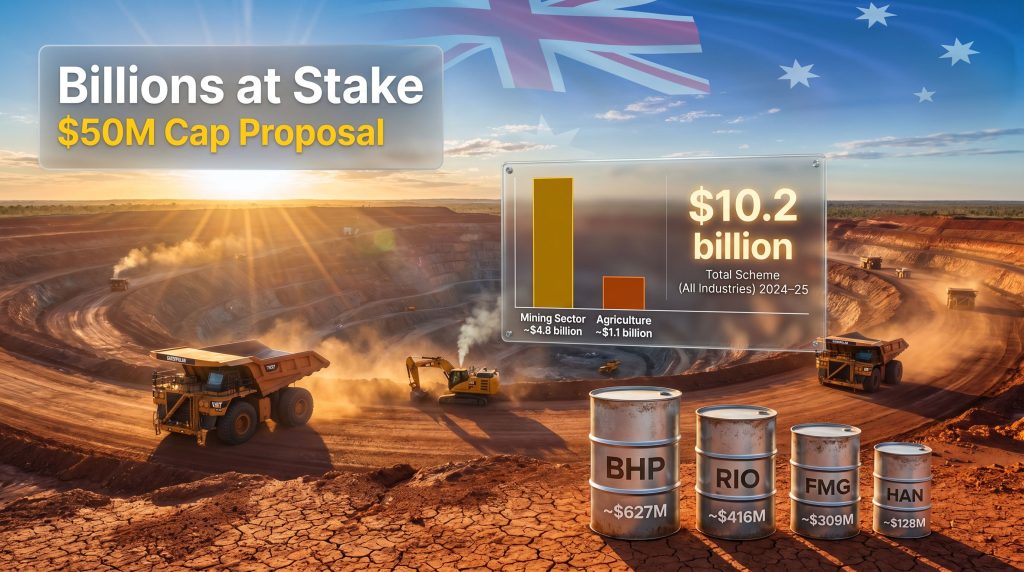
The scheme currently distributes more than $10 billion annually across qualifying industries, and over the next four years the forward estimate for total expenditure reaches approximately $45 billion. The question of who receives that money, how much, and under what conditions has moved from the margins of fiscal policy into the centre of Australia's energy transition conversation.
When big ASX news breaks, our subscribers know first
How Mining Fuel Tax Credits in Australia Actually Work
The Legislative Foundation and Mechanism
The Fuel Tax Credits Scheme operates under the Fuel Tax Act 2006 and is administered by the Australian Taxation Office. At its core, the scheme functions as a business input tax offset rather than a direct payment. When businesses purchase diesel or other qualifying fuels, they pay the fuel excise embedded in the pump price. The credits mechanism allows them to reclaim that excise for fuel consumed in off-road or non-public-road contexts.
Qualifying activities include:
- Off-road machinery such as excavators, haul trucks, and processing equipment
- Heavy vehicles operating exclusively on private roads within mine sites
- Industrial plant and equipment including generators and pumping systems
- Agricultural machinery used on private land
The ATO adjusts credit rates periodically in line with the prevailing fuel excise rate. Because the excise is embedded in the fuel price at the point of sale, the credit is effectively a retrospective correction applied through the business tax return cycle.
Why Mining Dominates the Claims Landscape
The structural characteristics of large-scale open-cut and underground mining make it uniquely positioned to generate enormous fuel tax credit claims. Consider the operational reality:
- A single ultra-class haul truck at a major iron ore operation can consume over 100,000 litres of diesel per year
- Large open-cut operations run fleets of 50 to 150 such vehicles simultaneously
- Processing facilities, draglines, and ancillary plant add further diesel consumption outside the haulage fleet
- Remote site logistics mean virtually all fuel consumed on site qualifies for credits, as there are no public roads within mine boundaries
By comparison, agriculture receives an estimated $1.1 billion annually from the scheme. Mining's share, at approximately $4.8 billion per year, is more than four times larger, and accounts for roughly 45% of all fuel tax credits claimed across the entire economy, according to Minerals Council data from 2020-21.
How Much Are Australia's Major Miners Actually Receiving?
Breaking Down the Numbers by Company
Estimates produced by Clean Energy Finance provide the most granular public breakdown of company-level receipts for the 2024 financial year:
| Company | Estimated Annual FTC Receipt | Exposure Under $50M Cap | Estimated Annual Reduction |
|---|---|---|---|
| BHP | ~$627 million | High | ~$577 million |
| Rio Tinto | ~$416 million | High | ~$366 million |
| Fortescue | ~$309 million | High | ~$259 million |
| Hancock Prospecting | ~$128 million | High | ~$78 million |
Those four companies alone account for an estimated $1.48 billion annually, drawn from a mining sector total of approximately $4.8 billion. Coal mining specifically represents around $1.4 billion per year, reflecting the diesel-intensive nature of thermal and metallurgical coal extraction, where large draglines and truck-and-shovel operations run continuously across vast open-cut footprints.
What these figures reveal is that the scheme's benefit is heavily concentrated. A relatively small number of large, profitable operations account for a disproportionate share of total credits paid, which is precisely why reform proposals have focused on the top-tier claimants rather than the scheme as a whole.
Is This a Tax Refund or a Fossil Fuel Subsidy? The Debate in Full
The Industry's Position: Correcting a Design Flaw
The mining industry's argument is grounded in the original intent of the fuel excise. The excise was designed to fund road infrastructure through a user-pays mechanism. Companies operating exclusively on private roads and remote mine sites argue they derive no benefit from public road funding and therefore should not bear the cost.
The Minerals Council articulated this position in its pre-budget submission, arguing that the scheme returns a charge that was never intended to apply to off-road industrial use and should not be characterised as industry support. The framing is one of tax design correction rather than government generosity.
International comparisons lend some credibility to this view. Canada, Chile, and South Africa all operate comparable concession frameworks for off-road industrial diesel use. Furthermore, removing the credit entirely would place Australian mining fuel tax credits claimants at a measurable cost disadvantage relative to peer jurisdictions competing for the same global capital.
The Reform Case: Structural Disincentives to Decarbonisation
The counter-argument draws on a different analytical framework entirely. The International Monetary Fund and the OECD have both developed classification systems that categorise schemes like Australia's fuel tax credits as implicit fossil fuel subsidies, even when the mechanism is technically a tax refund rather than a direct payment.
The logic is straightforward: if a tax is levied on a carbon-intensive fuel and then refunded to the user, the net effect on the incentive to use that fuel is the same as if the tax had never been applied. Consequently, the price signal that would otherwise encourage fuel efficiency or alternative energy investment is neutralised. This directly impacts mining cost performance across the sector.
This creates a structural paradox: a scheme designed to correct a tax design flaw simultaneously removes one of the most powerful financial levers available to accelerate fleet electrification in the mining sector.
Fortescue has been one of the most publicly vocal major miners on this point, with the company arguing that the current structure undermines the business case for green energy investment by effectively subsidising continued diesel consumption. This position is notable because it comes from within the industry itself, and from one of the scheme's largest beneficiaries.
Perhaps most revealing is the internal risk intelligence emerging from BHP's leaked documents, reported by ABC's Four Corners in May 2026. Those documents indicated that BHP's internal modelling flagged changes to diesel pricing or credit availability as a potential decarbonisation risk factor. The same company receiving an estimated $627 million annually from the scheme acknowledged internally that its continuation was a variable in its emissions trajectory calculations, with internal projections suggesting the company expected to cut emissions by just 1% by 2030.
The Four Reform Pathways Being Considered
Understanding the Policy Options in Detail
The debate has produced a spectrum of reform proposals, each with different fiscal, operational, and political implications:
Option 1: Full Status Quo
The Minerals Council and major resource companies support retaining the scheme unchanged, arguing any reduction raises operating costs and risks capital flight to lower-cost jurisdictions.
Option 2: Hard Cap Per Company
The proposal with the most political momentum: cap credits at $50 million per year for the 15 largest claimants. Based on Clean Energy Finance estimates, this would recover approximately $2.2 billion annually from coal miners alone. Excess funds would flow into a dedicated decarbonisation fund accessible only for clean energy transition projects. More than 250 Labor branches have formally supported this model through the party's environment action network.
Option 3: Sector-Specific Tiering
A middle-ground approach that would apply differentiated credit rates based on commodity type or emissions intensity. This could preserve credits for lower-emission operations while reducing benefits for high-carbon activities. However, the administrative complexity is significant, requiring ATO rule changes and potentially new legislative frameworks.
Option 4: Conditional Credit Access
Credits maintained but tied to verifiable decarbonisation milestones such as fleet electrification targets or renewable energy procurement thresholds. Precedent exists in the R&D tax incentive framework, though industry resistance around compliance burden and definitional disputes is anticipated. In addition, renewable mining solutions would become central to meeting any such thresholds.
Why the Middle East Conflict Changed the Policy Timeline
Geopolitical Disruption as a Domestic Policy Brake
The outbreak of conflict in the Middle East introduced acute fuel security concerns into Australia's domestic policy environment during early 2026. According to Labor and industry sources, ministerial discussions that had placed fuel tax credit reform on the table for the May 2026 federal budget were suspended in direct response to the geopolitical situation.
The reasoning reflects a broader principle in fiscal policy: amending tax mechanisms that directly affect fuel costs during a period of supply uncertainty and price volatility creates compounded political risk. Energy Minister Chris Bowen confirmed the government decided against making any change in this budget cycle, framing the decision as specific to the current financial year rather than a permanent rejection of reform.
The critical distinction is between deferral and abandonment. Government and industry sources indicated there remains an appetite within the Labor administration to revisit the issue once geopolitical conditions stabilise.
The Next Decision Windows
Two formal inflection points now define the reform timeline:
- Labor's National Conference, July 2026 — Labor MP Jerome Laxale has confirmed he will advocate for the cap proposal at the conference. A successful resolution would formally bind the party to a policy position, though the government retains discretion over implementation timing.
- Mid-Year Economic and Fiscal Outlook (MYEFO), late 2026 — If the conference produces a resolution without immediate implementation, MYEFO represents the next credible budget vehicle for translating policy commitment into legislative change.
There is also a political economy dimension worth understanding. Industry sources have suggested that tightening mining fuel tax credits could provide the government with an alternative fiscal lever, potentially reducing pressure to impose a flat 25% tax on gas export revenues. Resources Minister Madeleine King has publicly rejected a new gas export tax, but the trade-off dynamic between these two revenue measures is now part of the active negotiation landscape in Canberra.
The next major ASX story will hit our subscribers first
Operational and Investment Implications for Mining Companies
What a Cap Would Mean at the Site Level
Diesel typically represents 15 to 25% of total site operating costs in open-cut mining operations, depending on haulage distances and equipment fleet composition. A reduction in the effective rebate rate would compress operating margins most severely at lower-grade or higher-cost operations, where there is less buffer to absorb cost increases.
The competitive sensitivity is real. Australian iron ore, coal, and gold operations compete globally for capital allocation against projects in jurisdictions with different cost structures. Any increase in the effective cost of diesel consumption must be assessed against that competitive benchmark.
However, the reform scenario also creates a different kind of investment calculus. As the diesel rebate diminishes, the financial case for battery-electric haul trucks, hydrogen-powered haulage systems, and mining electrification becomes materially more attractive as the rebate floor drops. Technologies that currently struggle to compete on a levelised cost basis against subsidised diesel operations gain real ground under a capped model.
Fortescue's strategic positioning here is instructive. The company has publicly supported a cap, a position that aligns with its green energy investment thesis. Absorbing higher short-term diesel costs is a defensible position for a company that has already committed capital to alternative energy infrastructure. For companies further from that transition, the calculus is considerably less comfortable.
The Broader Fiscal and Climate Context
Where Fuel Tax Credit Reform Sits in Australia's Energy Transition
The federal government is actively pursuing structural savings to support medium-term fiscal consolidation. A $50 million per-company cap targeting the top 15 claimants would recover more than $2 billion annually without introducing new taxes or expanding the tax base. For a government seeking politically defensible savings measures, redirecting excess credits from highly profitable mining companies into a decarbonisation fund offers both fiscal and narrative advantages.
At the international level, Australia's continued operation of the scheme at current scale creates measurable tension with its climate commitments. The G20 has collectively committed to phasing out inefficient fossil fuel subsidies, and the fuel tax credit scheme is regularly cited by international bodies as an example of implicit fossil fuel support. Furthermore, mining decarbonisation economics are increasingly shaping how investors and policymakers assess Australia's long-term competitiveness. The UK, EU, and Canada are each developing or implementing frameworks that restrict comparable off-road diesel concessions for large industrial operators.
What makes Australia's situation distinctive is the scale concentration. A scheme that distributes $4.8 billion annually to a single sector, with the top four companies alone collecting $1.48 billion, is structurally different from a broad-based industrial concession. The energy transition demand for reform is ultimately a question of whether a tax correction designed for a different era of industrial policy remains appropriate as an instrument of national climate and fiscal strategy in 2026 and beyond. The IEEFA has noted that mining's costly diesel dependency must become a budget priority if Australia is serious about its emissions commitments.
Frequently Asked Questions: Mining Fuel Tax Credits in Australia
What is the fuel tax credit scheme in Australia?
The Fuel Tax Credits Scheme allows businesses to reclaim the fuel excise embedded in the price of diesel and other qualifying fuels used for off-road business activities. It is administered by the ATO under the Fuel Tax Act 2006 and covers mining machinery, heavy vehicles on private roads, and industrial equipment.
How much do mining companies receive in fuel tax credits each year?
The mining sector receives approximately $4.8 billion annually, representing roughly 45% of total scheme payments across all industries. Coal mining alone accounts for an estimated $1.4 billion per year.
Is the fuel tax credit a subsidy or a tax refund?
This is genuinely contested. The mining industry argues it corrects a tax never intended for off-road fuel use. International bodies including the IMF and OECD classify it as an implicit fossil fuel subsidy based on its net effect on fuel price signals and decarbonisation incentives. The Australia Institute has argued that credits for large mining companies should be scrapped while protecting farmers who rely on similar concessions.
What is the proposed reform?
The most prominent proposal is a $50 million annual cap on credits for the 15 largest claimants, with amounts above the cap redirected into an industry decarbonisation fund. This has been endorsed by more than 250 Labor branches.
When could reform happen?
The government deferred changes for the current financial year. Labor's national conference in July 2026 and the mid-year budget update later in 2026 are the next formal decision points.
Would a cap affect all mining operations equally?
No. Only the largest claimants receiving more than $50 million annually would be materially affected. Smaller mining operations, agriculture, construction, and transport logistics industries would be unaffected under the cap model.
This article contains forward-looking analysis and references to policy proposals that have not yet been legislated. Fiscal estimates and company-level credit figures are based on Clean Energy Finance modelling and publicly available data. Readers should not treat any content here as financial or investment advice.
Want to Know Which ASX Mining Companies Are Making Major Discoveries Right Now?
Discovery Alert's proprietary Discovery IQ model scans ASX announcements in real time, instantly identifying significant mineral discoveries and turning complex data into actionable investment insights — the same kind of edge that positioned early investors in transformative finds like those by De Grey Mining and WA1 Resources. Start your 14-day free trial today, or explore Discovery Alert's dedicated discoveries page to understand how historic ASX mineral discoveries have generated substantial returns for well-positioned investors.