June 14, 2026
The global energy transition has fundamentally altered industrial landscapes, forcing traditional heavy industry players to reimagine their operational models. Mining corporations, historically positioned as commodity producers, now face mounting pressure to decarbonise operations while simultaneously exploring new revenue streams in emerging clean energy markets. This transformation requires significant capital reallocation, technological innovation, and strategic repositioning within evolving supply chains, particularly as mining industry evolution accelerates.
Australia's mining sector exemplifies these challenges, where companies must balance maintaining profitable core operations with ambitious sustainability commitments. The intersection of renewable energy solutions deployment, hydrogen economy development, and green metal production represents a complex strategic puzzle requiring both technical expertise and market timing precision.
What Strategic Position Does Fortescue Hold in Australia's Green Industrial Revolution?
Mining Giant's Diversification Framework
Fortescue's strategic transformation reflects a calculated evolution from single-commodity dependence toward an integrated energy-metals portfolio. The company's Fortescue Future Industries green ambitions originated in 2020 as recognition that traditional iron ore operations faced long-term sustainability pressures from both regulatory frameworks and customer demand shifts.
The diversification framework addresses two fundamental strategic challenges: operational decarbonisation requirements and revenue stream expansion beyond volatile commodity markets. Rather than pursuing external acquisitions or partnerships, Fortescue chose vertical integration as the primary pathway to capture value across the renewable energy supply chain.
Strategic positioning elements include:
• Renewable energy generation capacity at existing mining sites
• Green hydrogen production for internal consumption and external sales
• Green metal processing capabilities targeting premium steel markets
• Technology development focused on cost reduction and process optimisation
• Geographic concentration in Western Australia's Pilbara region
This approach contrasts sharply with competitors like BHP Group and Rio Tinto, which have pursued more conservative decarbonisation strategies focused primarily on operational emissions reduction rather than business model transformation. Fortescue's aggressive timeline and scope represent a higher-risk, higher-reward positioning within the global mining sector's energy transition.
Green Hydrogen Market Entry Strategy
The hydrogen economy presented Fortescue with an opportunity to address hard-to-abate industrial sectors where electrification alone proves insufficient. Heavy industry applications including steel production, long-haul transport, and chemical processing require energy-dense fuels capable of supporting high-temperature processes and extended operational cycles.
Fortescue's market entry strategy evolved from broad global ambitions toward focused domestic and regional projects. Initially, the company announced plans for multiple international hydrogen developments across different continents, targeting tens of millions of tonnes of annual production capacity by 2030.
However, market realities necessitated strategic recalibration. By 2026, Fortescue Future Industries green ambitions had shifted toward internal R&D investment and selective project advancement rather than pursuing large-scale commercial deployment across multiple jurisdictions. This pivot reflected recognition that hydrogen production costs remained significantly above commercial viability thresholds for most applications.
Current strategic focus areas:
• Technology cost reduction through proprietary R&D programmes
• Integration with existing iron ore operations for operational synergies
• Demonstration projects proving technical feasibility at pilot scale
• Customer engagement targeting premium green metal markets
• Supply chain development within Australia's renewable energy ecosystem
When big ASX news breaks, our subscribers know first
How Does Fortescue's Decarbonisation Timeline Compare to Global Mining Standards?
Real Zero Emissions Pathway Analysis
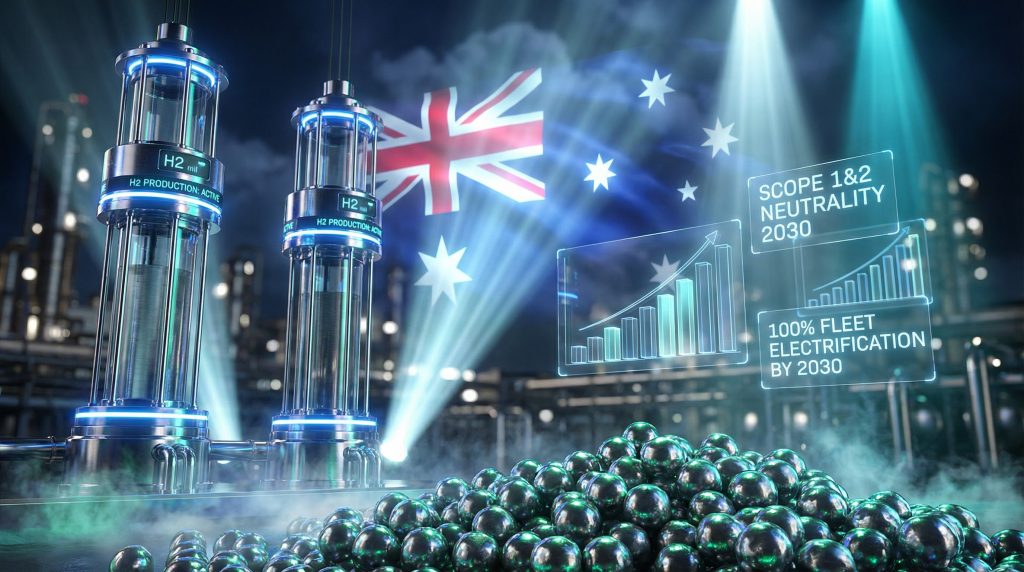
Fortescue's emissions reduction commitments establish aggressive timelines significantly ahead of industry peers. The company targets Scope 1 and 2 carbon neutrality by 2030 and net-zero Scope 3 emissions by 2040, representing timelines 10-20 years ahead of typical mining sector commitments established during the 2020-2021 period.
These targets encompass comprehensive operational transformation across multiple emission categories, furthermore supporting the broader mining sustainability transformation taking place across the industry:
Scope 1 Direct Emissions:
• Diesel fuel consumption in haul truck fleets
• Processing facility energy requirements
• Rail transport operations
• On-site machinery and equipment
Scope 2 Indirect Emissions:
• Purchased electricity for processing operations
• Grid-supplied energy at administrative facilities
• Third-party transportation services
Scope 3 Value Chain Emissions:
• Customer steel production using Fortescue iron ore
• Shipping and logistics throughout supply chain
• Supplier emissions from equipment and services
The technical feasibility of achieving 2030 carbon neutrality depends heavily on successful fleet electrification and renewable energy deployment. Fortescue's Christmas Creek Green Energy Hub serves as the primary testing ground for integrated technologies including solar generation, battery storage, and hydrogen production systems.
| Emissions Category | Fortescue Target | Industry Average | Timeline Advantage |
|---|---|---|---|
| Scope 1&2 Neutrality | 2030 | 2040-2050 | 10-20 years |
| Scope 3 Net Zero | 2040 | 2050+ | 10+ years |
| Fleet Electrification | 100% by 2030 | 20-40% by 2030 | Significantly ahead |
| Renewable Energy | 100% by 2030 | 30-60% by 2030 | Substantially ahead |
Operational Transformation Metrics
The practical implementation of Fortescue's decarbonisation timeline requires substantial capital investment in renewable energy infrastructure and fleet replacement programmes. The company's approach emphasises technology integration rather than purchasing carbon offsets or relying on external renewable energy certificates.
Key operational transformation components:
- Solar and Wind Integration: More than 160,000 solar panels already deployed at Christmas Creek, with expansion planned across multiple mining sites
- Battery Storage Systems: Grid-scale storage supporting 24-hour renewable energy availability for continuous mining operations
- Hydrogen Production: On-site electrolysis systems targeting both operational fuel requirements and external sales opportunities
- Fleet Electrification: Replacement of diesel-powered haul trucks with battery-electric and hydrogen fuel cell alternatives
The technical challenges include managing intermittent renewable energy supply for continuous mining operations, developing hydrogen storage and distribution infrastructure, and maintaining operational reliability during the transition period. These factors contribute significant execution risk to Fortescue's aggressive timeline commitments.
Cost implications remain substantial, with renewable energy infrastructure and fleet replacement requiring multi-billion dollar capital allocation over the 2024-2030 implementation period. Higher interest rates and supply chain cost inflation have increased project economics compared to initial feasibility assessments conducted during 2020-2021.
What Are the Commercial Viability Scenarios for Fortescue's Green Metal Projects?
Green Iron Production Economics
The Christmas Creek Green Metal facility represents Fortescue's most tangible progress in translating Fortescue Future Industries green ambitions into operational reality. With a capital investment of approximately USD $50 million and construction commencing in 2024, the facility demonstrates green iron metal project at pilot commercial scale.
Technical specifications:
• Annual production capacity: More than 1,500 tonnes of green iron metal
• Production method: Direct reduction using renewable hydrogen instead of fossil fuels
• Energy supply: Integration with 160,000+ solar panels at Christmas Creek Hub
• Operational timeline: Full renewable energy powering targeted by 2030
The facility employs hydrogen-based direct reduction technology, converting iron ore into metallic iron without traditional blast furnace processes that typically consume metallurgical coal. This approach eliminates carbon dioxide emissions during the reduction process while producing iron suitable for electric arc furnace steelmaking.
Production cost structure analysis:
Traditional blast furnace iron production costs approximately $300-400 per tonne including raw materials, energy, and operational expenses. Green iron production faces significantly higher costs due to:
• Hydrogen production: $4-8 per kilogram for green hydrogen versus $1-2 per kilogram for fossil-based alternatives
• Capital intensity: Higher upfront investment per tonne of production capacity
• Energy requirements: Electrolysis processes require 50-55 kWh per kilogram of hydrogen produced
• Scale disadvantages: Pilot-scale operations lack economies of scale available to large integrated steel mills
Current production costs for green iron likely exceed $800-1,200 per tonne, requiring substantial premium pricing or cost reduction breakthroughs to achieve commercial viability. Customer willingness to pay green premiums remains limited outside specific market segments with strong sustainability mandates.
Scale-Up Potential Assessment
The pathway from 1,500 tonnes annually to commercial-scale production presents significant technical and economic challenges. Large-scale green iron facilities would require production capacities of 100,000-500,000+ tonnes annually to compete effectively with integrated steel mills.
Scale-up requirements include:
Infrastructure Development:
• Multi-gigawatt renewable energy generation capacity
• Industrial-scale hydrogen production and storage systems
• Specialised logistics for green iron product handling and shipping
• Water supply systems for electrolysis operations
Capital Investment Analysis:
• Estimated $2-5 billion for 500,000 tonne annual capacity facility
• $4,000-10,000 per tonne of annual production capacity
• 8-12 year payback periods assuming premium pricing sustainability
Market Development:
• Customer contracts supporting long-term offtake commitments
• Premium pricing structures justifying higher production costs
• Regulatory frameworks supporting green steel market development
The demonstration facility serves multiple strategic purposes beyond immediate commercial returns. Technical data generation, customer engagement, and technology optimisation provide valuable foundation for future scale-up decisions while regulatory and market conditions continue evolving.
Green iron production represents a strategic hedge against future carbon border adjustments and steel industry decarbonisation requirements, despite current cost disadvantages compared to traditional production methods.
How Do Global Market Conditions Impact Fortescue's Green Strategy Execution?
Hydrogen Market Development Scenarios
Global hydrogen market development has proceeded more slowly than initial industry projections suggested during 2020-2021. Multiple factors contributed to delayed adoption across target industrial applications, creating headwinds for Fortescue's original strategic timeline.
Cost curve disappointments: Green hydrogen production costs declined less rapidly than projected, maintaining 3-5x cost premiums over fossil-based alternatives. Electrolyser manufacturing capacity expanded slowly, limiting equipment availability and maintaining high capital costs for production facilities.
Capital market conditions: Interest rate increases between 2022-2024 significantly impacted project economics for capital-intensive hydrogen developments. Higher weighted average cost of capital (WACC) reduced net present values for long-payback infrastructure projects, making financing more challenging and expensive.
Supply chain cost inflation: Equipment costs for renewable energy systems, electrolysers, and specialised piping increased substantially due to commodity price inflation, supply chain disruptions, and increased global demand for clean energy infrastructure.
These market headwinds contributed to Fortescue's strategic recalibration by 2024-2026, including reduction or exit from several large overseas hydrogen developments and scaling back ambitions around electrolyser manufacturing capabilities.
Customer Demand Risk Assessment
Industrial customer adoption of green hydrogen has proceeded more cautiously than initially anticipated. Several factors limit demand growth and offtake commitment willingness:
Price sensitivity: Industrial customers maintain strong cost focus, particularly in competitive global markets. Green hydrogen premiums of 200-400% over fossil alternatives require either strong regulatory mandates or premium product market positioning to justify adoption.
Technical integration challenges: Existing industrial processes often require significant modification to accommodate hydrogen fuel systems. Retrofit costs and operational risks discourage rapid adoption outside new facility construction.
Policy uncertainty: Regulatory frameworks supporting green hydrogen adoption developed more slowly and inconsistently than expected. Carbon pricing mechanisms, production subsidies, and industrial emissions standards vary significantly across jurisdictions, creating planning uncertainty for long-term investments.
Alternative technology competition: Direct electrification and other decarbonisation pathways often provide more cost-effective emissions reduction in many applications. Hydrogen faces competition from battery storage, synthetic fuels, and process efficiency improvements.
| Market Segment | Adoption Timeline | Cost Sensitivity | Policy Dependence |
|---|---|---|---|
| Steel Production | 2030-2040 | High | Critical |
| Shipping Fuel | 2035-2050 | Very High | Essential |
| Industrial Heat | 2025-2035 | High | Moderate |
| Chemical Feedstock | 2028-2040 | Moderate | High |
What Technology Development Pathways Could Accelerate Fortescue's Green Ambitions?
Internal R&D Investment Strategy
Fortescue's strategic pivot toward internal research and development reflects recognition that existing commercial technologies do not yet support large-scale green hydrogen deployment at competitive costs. The company's R&D investment focuses on proprietary technology development targeting specific cost reduction opportunities.
Primary R&D focus areas:
• Electrolyser efficiency improvement: Development of advanced electrolysis technologies achieving higher hydrogen output per unit of electrical input
• Process integration optimisation: Systems engineering approaches combining renewable energy generation, hydrogen production, and end-use applications
• Materials science advancement: Research into catalyst materials, membrane technologies, and equipment durability improvements
• Operational optimisation: Digital systems and automation technologies reducing operational costs and improving system reliability
The shift away from external partnership approaches toward proprietary technology development suggests Fortescue believes competitive advantages will emerge from technological innovation rather than scale economics alone. This approach requires substantial R&D investment with uncertain commercial returns but offers potential for differentiated market positioning.
Technology development timeline:
- 2024-2026: Demonstration and pilot testing at Christmas Creek facilities
- 2026-2028: Technology optimisation and cost reduction validation
- 2028-2030: Commercial-scale technology deployment decision points
- 2030+: Large-scale implementation contingent on economic viability
Electrolyser Manufacturing Capabilities
Fortescue initially considered vertical integration into electrolyser manufacturing but subsequently scaled back these ambitions as market conditions evolved. The company recognised that becoming a commodity equipment manufacturer would require different capabilities and market positioning than its core mining and energy development competencies.
Instead of manufacturing electrolyser systems, Fortescue's technology strategy emphasises:
Process Innovation: Developing proprietary applications and integration approaches rather than competing in equipment manufacturing markets
Technology Selection: Evaluating and selecting optimal electrolyser technologies from multiple suppliers based on specific application requirements
System Integration: Engineering expertise combining electrolysis with renewable energy systems and end-use applications
This strategic choice reflects market realities where electrolyser manufacturing requires substantial scale economies and specialised manufacturing capabilities. Multiple established technology providers including Nel Hydrogen, ITM Power, and others compete in commodity equipment markets with improving cost structures and technical performance.
Fortescue's focus on application development and system integration potentially offers higher-margin opportunities while avoiding direct competition in capital-intensive manufacturing sectors. The Christmas Creek facility serves as a technology validation platform for testing different electrolyser configurations and operational approaches.
How Does Fortescue's Green Strategy Address Long-Term Iron Ore Market Risks?
Commodity Price Hedging Through Diversification
Iron ore markets demonstrate significant price volatility driven by global steel demand cycles, Chinese construction activity, and supply-side disruptions. Fortescue's traditional business model exposes the company to commodity price fluctuations beyond management control, creating earnings volatility and strategic planning challenges.
The green transformation strategy addresses commodity exposure through multiple diversification mechanisms, particularly within the context of critical minerals energy transition:
Value Chain Integration: Moving beyond raw material supply toward processed products with higher margins and customer differentiation opportunities. Green iron production targets premium steel markets willing to pay sustainability premiums.
Revenue Stream Diversification: Hydrogen production, renewable energy sales, and technology licensing create income sources independent of iron ore pricing cycles. These businesses potentially offer more stable, contract-based revenue structures.
Customer Relationship Evolution: Transitioning from commodity supplier relationships toward integrated solutions provider positioning. Long-term partnerships around decarbonisation solutions create stronger customer retention and pricing power.
Geographic Market Expansion: Green hydrogen and renewable energy markets span different geographic regions and customer segments than traditional iron ore exports, reducing concentration risk in Chinese steel markets.
However, the diversification strategy faces significant execution risks. Green technology markets remain immature with uncertain demand patterns and competitive dynamics. Capital allocation toward unproven businesses may reduce returns compared to optimising traditional iron ore operations.
Green Premium Capture Opportunities
Steel industry decarbonisation creates potential market opportunities for zero-carbon iron ore products and processed materials. European and North American steel producers face increasing regulatory pressure through carbon border adjustment mechanisms and corporate sustainability commitments.
Market development factors:
• Carbon pricing: EU Emissions Trading System prices exceeding €80 per tonne CO2 make green steel alternatives more competitive
• Corporate procurement: Major steel consumers including automotive and construction companies establishing zero-carbon supply chain requirements
• Regulatory mandates: Government policies requiring green steel usage in public infrastructure and defence applications
• Brand positioning: Premium steel grades marketed to environmentally conscious consumer segments
Green iron pricing premiums currently range from 20-50% above traditional iron ore in limited pilot transactions. However, sustainable premium levels depend on several market development factors:
Cost competitiveness: Green iron must achieve cost structures supporting reasonable premiums rather than prohibitive pricing that limits market adoption
Supply availability: Sufficient production scale to meet meaningful portions of steel industry demand
Quality consistency: Technical specifications matching or exceeding traditional iron ore quality parameters
Certification standards: Third-party verification systems ensuring carbon intensity and sustainability claims
The Christmas Creek facility provides market testing opportunities for customer engagement and pricing discovery while production scales remain limited. Commercial success requires balancing premium pricing with volume growth as market conditions evolve.
The next major ASX story will hit our subscribers first
What Are the Key Success Metrics for Evaluating Fortescue's Green Transformation?
Financial Performance Indicators
Measuring Fortescue's green transformation success requires comprehensive financial metrics spanning traditional mining operations and emerging green technology businesses. The integrated approach makes isolating individual business segment performance challenging but essential for strategic evaluation.
Capital allocation efficiency metrics:
• Return on invested capital (ROIC): Comparing returns from green technology investments versus traditional iron ore capital deployment
• Capital intensity ratios: Investment per unit of production capacity for renewable energy, hydrogen, and green iron facilities
• Payback periods: Time required to recover initial capital investment across different technology applications
• Net present value (NPV): Long-term value creation from integrated green technology portfolio
Revenue diversification tracking:
| Revenue Source | 2024 Baseline | 2030 Target | Success Threshold |
|---|---|---|---|
| Iron Ore Sales | ~90% | 60-70% | <75% |
| Green Hydrogen | Minimal | 15-20% | >10% |
| Renewable Energy | <5% | 10-15% | >8% |
| Green Iron | Pilot scale | 5-10% | >5% |
Profitability analysis:
Green technology businesses currently operate at negative margins due to pilot-scale operations and high development costs. Success requires progression toward positive cash flow generation and competitive return profiles compared to traditional mining operations.
The timeline for achieving positive returns varies significantly across business segments. Renewable energy operations may achieve profitability within 3-5 years, while hydrogen and green iron businesses may require 8-12 years for commercial viability depending on market development pace.
Operational Milestone Tracking
Operational performance metrics provide leading indicators of strategic execution success ahead of financial returns. These metrics demonstrate technical feasibility and market traction across different technology applications.
Renewable energy deployment:
• Installed capacity: Megawatts of solar and wind generation capacity across mining operations
• Capacity factor: Actual energy generation as percentage of theoretical maximum output
• Grid integration: Percentage of mining operations powered by renewable energy sources
• Energy storage: Battery capacity supporting 24-hour renewable energy availability
Green hydrogen production metrics:
• Production volume: Annual tonnes of hydrogen produced through electrolysis systems
• Production cost: Cost per kilogram of hydrogen including capital recovery and operating expenses
• Utilisation rates: Operating hours as percentage of theoretical maximum production time
• Customer delivery: Volumes sold to external customers versus internal consumption
Fleet electrification progress:
• Vehicle conversion: Number and percentage of diesel vehicles replaced with electric alternatives
• Operational performance: Productivity and reliability metrics for electric vehicle fleet operations
• Infrastructure deployment: Charging stations and hydrogen refuelling facilities supporting fleet operations
• Emissions reduction: Quantified reduction in Scope 1 emissions from transportation activities
| Operational Metric | 2025 Baseline | 2030 Target | Critical Success Factor |
|---|---|---|---|
| Renewable Capacity (MW) | 200-300 | 2,000+ | >1,500 MW |
| Hydrogen Production (t/year) | Pilot scale | 15,000+ | >5,000 tonnes |
| Fleet Electrification (%) | 10-20% | 100% | >80% |
| Emissions Reduction (%) | 15-25% | 100% | >75% |
Strategic Outlook: Fortescue's Position in the Global Energy Transition
Scenario Planning for Green Industrial Success
Fortescue's green transformation faces multiple potential development pathways depending on technology cost evolution, policy support, and market demand development. Strategic scenario planning provides framework for evaluating different outcome probabilities and strategic positioning requirements.
Best-case scenario (25% probability):
Technology cost reduction accelerates beyond current projections, with green hydrogen achieving cost parity with fossil alternatives by 2028-2030. Strong policy support including carbon pricing, production subsidies, and green procurement requirements creates robust demand for zero-carbon industrial products. Fortescue achieves first-mover advantages in green iron markets and establishes leadership position in integrated renewable-hydrogen-metals value chain.
Base-case scenario (50% probability):
Gradual market development with selective project advancement as technology costs decline slowly but steadily. Policy frameworks develop inconsistently across different jurisdictions, creating mixed market conditions. Fortescue successfully decarbonises core operations while achieving modest commercial success in green metal markets. Hydrogen business remains focused on internal consumption with limited external sales growth.
Worst-case scenario (25% probability):
Technology cost reduction stalls due to material constraints, supply chain bottlenecks, or competing technology advancement. Weak policy support and limited customer demand growth force strategic recalibration toward traditional mining focus. Green technology investments generate poor returns, requiring asset write-downs and strategic timeline extensions.
Each scenario requires different strategic responses and capital allocation priorities. The base-case scenario aligns most closely with Fortescue's current strategic positioning, emphasising operational decarbonisation with selective green technology advancement rather than aggressive expansion across multiple markets.
Competitive Advantage Sustainability
Fortescue's current first-mover positioning in integrated mining-renewable energy applications provides temporary competitive advantages but faces multiple sustainability challenges as market conditions evolve.
Sustainable competitive advantages:
• Resource access: Control of high-grade iron ore resources in politically stable jurisdiction
• Infrastructure integration: Existing mining operations provide foundation for renewable energy and hydrogen integration
• Technical expertise: Operational experience combining mining, renewable energy, and hydrogen technologies
• Customer relationships: Established connections with global steel producers and industrial customers
Competitive threats:
• Technology commoditisation: Green hydrogen and renewable energy technologies becoming standardised with multiple capable suppliers
• Scale competition: Larger integrated mining companies with greater capital resources pursuing similar strategies
• Alternative pathways: Different decarbonisation approaches potentially offering superior cost-performance characteristics
• Market entry barriers: Regulatory, technical, or financial barriers potentially limiting market expansion opportunities
Long-term competitive positioning depends heavily on execution excellence and strategic timing rather than inherent structural advantages. Fortescue Future Industries green ambitions require maintaining technological innovation, cost leadership, and market development capabilities while larger competitors develop competing strategies.
The integrated mining-energy model creates operational complexity requiring diverse technical capabilities spanning multiple industries. This complexity represents both opportunity for differentiation and risk of execution challenges across multiple business segments simultaneously.
Investment Considerations:
Fortescue's green transformation represents a high-risk, high-reward strategic repositioning with uncertain timeline and returns. Investors should consider the company's traditional iron ore business strength as providing downside protection while green technology developments offer potential upside exposure to energy transition trends. Success requires patience for long development timelines and tolerance for earnings volatility during the transformation period.
Moreover, Fortescue's sustainability commitment demonstrates the company's determination to lead in zero-emissions mining operations, positioning it advantageously for regulatory changes and customer demands in the coming decade.
Disclaimer: This analysis contains forward-looking statements and projections based on current market conditions and technological assumptions. Actual results may differ materially from projected outcomes due to market, regulatory, technological, and competitive factors. Investment decisions should consider comprehensive due diligence and professional financial advice appropriate to individual circumstances.
Ready to Identify the Next Green Mining Transformation?
Fortescue's ambitious pivot from traditional mining to integrated renewable energy exemplifies how companies are navigating the energy transition, but spotting the next breakthrough requires staying ahead of significant discoveries. Discovery Alert's proprietary Discovery IQ model delivers instant notifications on major ASX mineral discoveries, empowering investors to identify actionable opportunities in the evolving clean energy landscape before the broader market responds. Start your 14-day free trial today and position yourself at the forefront of Australia's green industrial revolution.