July 25, 2026
The Infrastructure Gap That Determines Africa's Mining Future
Across the global commodities landscape, few dynamics are as structurally consequential as the relationship between mineral wealth and physical infrastructure. In Africa, this relationship operates differently than anywhere else on Earth. Rather than infrastructure preceding economic activity, the extraction sector routinely arrives first, often decades before governments or multilateral institutions have laid a single kilometre of sealed road or connected a single village to the national grid. Mining infrastructure in Africa is not merely a logistical consideration; it is the foundational mechanism through which remote resource endowments become viable economic assets, and through which entire regional economies are set in motion.
Understanding this dynamic requires moving beyond the conventional view of mining as purely extractive. In practice, across vast stretches of sub-Saharan Africa, mining companies function as surrogate infrastructure developers, financing roads, power lines, water treatment systems, and telecommunications networks that no other actor has yet had the incentive or capacity to build.
When big ASX news breaks, our subscribers know first
Why Mining Acts as Africa's Primary Infrastructure Pioneer
The frontier character of African mining shapes nearly every downstream outcome. When a large-scale mine is established in a remote region, the surrounding infrastructure deficit frequently means the operator must self-fund essential services before a single tonne of ore reaches a processing facility.
This bears a critical economic reality: historically, mining companies have borne much of the burden of funding rail, power, and water facilities they need to operate. While this initial capital outlay reduces short-term competitiveness, the alternative — attempting to operate without adequate infrastructure — makes most greenfield projects entirely non-viable. The cost of doing nothing is, in most cases, higher than the cost of building.
The multiplier effects that follow are substantial and often underappreciated:
- Transport corridors originally built to move ore become the arteries through which agricultural produce, consumer goods, and labour flow across regional boundaries
- Power infrastructure commissioned for mine operations frequently extends service access to surrounding communities, delivering health, sanitation, and economic co-benefits
- Water systems developed for mineral processing provide the foundation for urban sanitation in rapidly growing mine-adjacent settlements
- New business formation and service industries emerge organically from mine-driven urbanisation, often persisting long after commodity cycles have turned
Furthermore, there is growing recognition within investor communities that infrastructure commitment is increasingly treated as a prerequisite for capital allocation. As noted by African Mining, improving mining infrastructure remains one of the most direct levers for sustainable economic growth across the continent.
The catalytic effect of mining-led infrastructure investment is visible across the continent. In the Copperbelt of Zambia and the DRC, rapid mining expansion has driven urbanisation, new business formation, and service industries that now operate independently of the mines that originally created them. (SRK Consulting, African Mining Market, May 2026)
A mining project that demonstrates credible infrastructure planning attracts not only primary sector interest but also stimulates downstream investment from logistics operators, retailers, energy providers, and financial service firms. African mining finance trends in 2025 reflect this shift, with investors placing increasing weight on infrastructure readiness when evaluating project viability.
The Current State of Mining Infrastructure in Africa: A Continent of Contrasts
Describing African mining infrastructure as uniformly underdeveloped misses the complexity of a continent with radically different levels of logistical maturity across its 54 nations.
| Infrastructure Category | Relative Strength | Key Constraint |
|---|---|---|
| Rail networks | South Africa (most developed) | Ageing, underfunded elsewhere |
| Port capacity | Morocco, South Africa, Angola | Congestion, limited deepwater access |
| Power supply | North Africa, parts of Southern Africa | Unreliable grids in Central and East Africa |
| Road corridors | Fragmented cross-border coverage | Landlocked country bottlenecks |
| Water and sanitation | Urban centres only | Remote mine sites severely underserved |
The Landlocked Problem
Perhaps no single geographic factor amplifies infrastructure costs more significantly than landlocked status. Nations such as Zambia, Zimbabwe, and the DRC face compounding logistics expenses that coastal peers simply do not encounter. The relationship between distance to port and project feasibility in remote mineral-rich regions is not linear; it is exponential.
As transit distance increases, every additional kilometre of inadequate road or rail raises the breakeven ore grade required to justify extraction, effectively stranding otherwise economically viable mineral deposits. For many greenfield projects in landlocked jurisdictions, transport corridor investment represents the single largest non-extraction cost component, often exceeding the capital expenditure on processing infrastructure itself.
South Africa's Infrastructure Paradox
Africa's most industrially advanced mining nation illustrates a cautionary lesson that physical assets alone do not guarantee operational performance. South Africa possesses the continent's most developed rail network and port infrastructure, yet systemic failures at key state-owned logistics operators have materially suppressed coal and iron ore export volumes in recent years.
Locomotive shortages, infrastructure vandalism, cable theft, derailments, and chronic maintenance backlogs have collectively undermined the country's ability to translate mineral production into export revenue. The lesson for infrastructure-dependent mining economies across the continent is stark: the quality of governance and maintenance systems governing physical assets matters as much as the assets themselves.
Critical Minerals and the Reshaping of Infrastructure Investment Priorities
The global energy transition has fundamentally repositioned African mining infrastructure from a domestic development conversation to a matter of international supply chain security. Critical minerals demand is accelerating pressure on African nations to develop export corridors, expand port capacity, and resolve chronic power supply deficits, particularly for lithium, copper, cobalt, and nickel — the foundational inputs for electric vehicle batteries, grid storage systems, and renewable energy hardware.
Key Mining Infrastructure Corridors Across Africa
| Corridor / Project | Countries Involved | Commodity Focus | Infrastructure Type | Status |
|---|---|---|---|---|
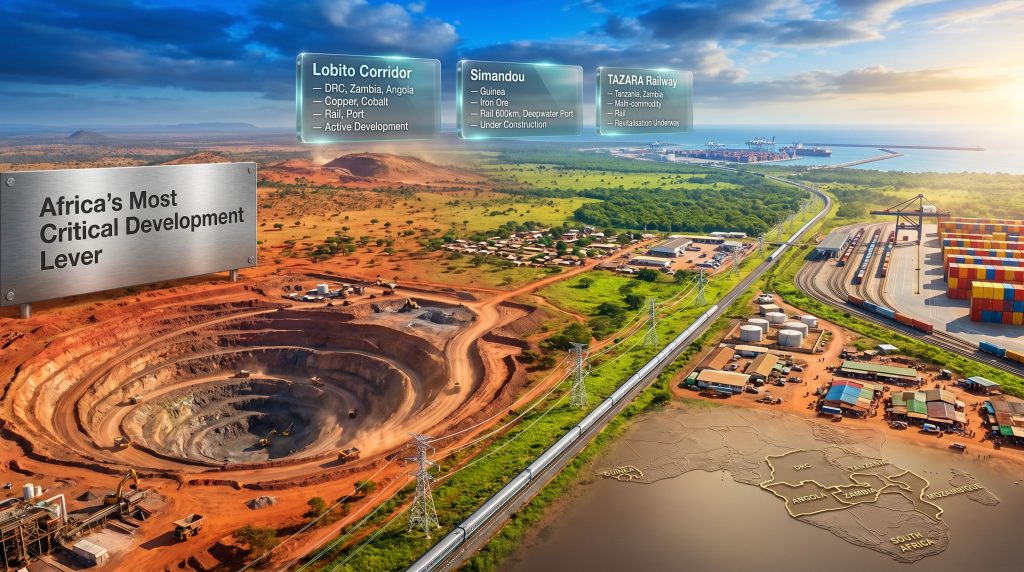
| Lobito Corridor | DRC, Zambia, Angola | Copper, Cobalt | Rail, Port | Active development |
| Simandou | Guinea | Iron Ore | Rail (approx. 600km), Deepwater Port | Under construction |
| TAZARA Railway | Tanzania, Zambia | Multi-commodity | Rail | Revitalisation underway |
| Macuse / Tete Railway | Mozambique | Coal | Rail, Port | Planned |
| Southern African Power Pool | Multi-country | Energy (all mining) | High-voltage transmission | Ongoing expansion |
The Lobito Corridor: Redefining Copperbelt Export Logic
The Lobito Corridor connects the copper and cobalt mining regions of the DRC and Zambia to Angola's Atlantic port at Lobito, providing a direct westward export route that reduces dependence on southern and eastern port alternatives. By shortening transit distances and diversifying export options, this corridor addresses one of the most persistent logistical constraints facing Copperbelt producers.
Consequently, its utility extends beyond mineral exports; the corridor creates a logistics backbone capable of supporting broader regional trade, agricultural movement, and cross-border commerce. The role of critical minerals supply chains in shaping such corridor investments cannot be overstated, particularly as European nations seek to diversify away from single-source dependencies.
Simandou: Africa's Most Ambitious Integrated Development
Guinea's Simandou iron ore project represents the continent's most complex example of integrated mine-infrastructure co-development. Combining multiple mining blocks with approximately 600 kilometres of new railway and a purpose-built deepwater port facility, Simandou has become a global benchmark for what integrated corridor-based infrastructure development can look like in a frontier market. Its financial and geopolitical complexity reflects the scale of ambition required when no pre-existing infrastructure exists to leverage.
The Three Structural Bottlenecks Holding Mining Infrastructure Back
1. Energy: The Bottleneck That Overrides All Others
Across the continent, unreliable and unaffordable power supply is the most pervasive constraint on mining development at scale. Without a steady supply of affordable energy, countries cannot develop at scale, and the compounding effect on energy-intensive processes such as smelting, beneficiation, and mineral processing is particularly severe.
Regional power integration initiatives, including the Southern African Power Pool, represent a structural response to cross-border energy deficits. High-voltage transmission projects capable of moving electricity across national boundaries are increasingly central to both mining sector viability and broader industrial growth. The challenge is not merely generating capacity; it is transmission infrastructure capable of delivering reliable power to remote mine sites that sit far beyond existing grid reach.
2. Transport: Where Mineral Wealth Meets Physical Constraint
Inadequate road, rail, and port networks create export bottlenecks that reduce the commercial viability of otherwise economically attractive ore bodies. Mozambique's planned Macuse project, which envisions a railway linking the coal-producing Tete Province to new coastal export infrastructure, illustrates how transport decisions determine whether mining expansion proceeds at all.
The recurring challenge across multiple jurisdictions is maintaining transport infrastructure in environments affected by conflict, climate-related damage, and chronically underfunded maintenance cycles. Infrastructure that exists on paper or was functional a decade ago frequently fails to deliver the reliability that mine operators require for consistent export performance. In fact, according to African Business, the infrastructure deficit continues to be one of the most persistent barriers to unlocking Africa's full mining potential.
3. Water and Environmental Infrastructure: The Underappreciated Constraint
Water access and wastewater management represent an increasingly critical operational requirement for large-scale mining, particularly in water-stressed regions of East and Southern Africa. As environmental and social impact assessments (ESIAs) grow in regulatory importance, they are directly shaping infrastructure investment decisions in ways that extend well beyond the mine fence.
Urban sanitation infrastructure adjacent to rapidly growing mine communities delivers co-benefits that include flood risk reduction, public health improvement, and climate resilience. These outcomes are not incidental; they are increasingly central to the social licence frameworks that determine whether large-scale projects retain community and regulatory support throughout their operational lives.
Localisation Policy and Its Operational Impact on Infrastructure Delivery
A significant and underappreciated shift is occurring across African mining jurisdictions: the systematic introduction of mandatory localisation requirements covering employment quotas, procurement preferences, and professional services participation thresholds.
Many African nations now impose restrictions on the number of days per year that expatriate professionals can work on site. This regulatory reality has profound implications for project continuity, particularly for international engineering and consulting firms that have historically relied on rotating teams of overseas specialists.
The operational advantage of maintaining in-country professional teams is substantial:
- Local professionals are not subject to expatriate day restrictions, enabling uninterrupted project momentum
- Embedded local teams bring direct knowledge of how regional economies, stakeholder ecosystems, and government engagement processes function in practice
- Proximity to regional mining hubs, including established presences in South Africa, Ghana, the DRC, and Zambia, enables faster engagement with clients, suppliers, government officials, and community representatives
- Local networks reduce the risk of information asymmetry when infrastructure decisions are being locked in during early project phases
Local expertise is increasingly recognised not as a regulatory compliance mechanism but as a genuine risk mitigation tool. Understanding stakeholder dynamics, community expectations, and government priorities in real time — rather than from a distance — fundamentally changes the quality of infrastructure decisions.
The next major ASX story will hit our subscribers first
ESG Frameworks: From Compliance Obligation to Investment Enabler
The scope of technical advisory work in African mining infrastructure has expanded substantially beyond geology and engineering. ESG considerations, water stewardship, energy planning, and governance systems are now core components of the infrastructure planning process, not optional additions applied at the permitting stage.
Projects seeking multilateral development finance are expected to align with the IFC Performance Standards and Good International Industry Practice (GIIP) frameworks, which establish comprehensive requirements for environmental and social impact assessment, stakeholder engagement, and ongoing management planning throughout the infrastructure lifecycle.
Environmental and Social Management Plans (ESMPs) translate directly into physical infrastructure decisions. Drainage design, community resettlement pathways, water treatment specifications, and noise barrier requirements all flow from ESMP obligations. Far from being administrative burdens, these plans are increasingly the mechanism through which concessional capital from multilateral development finance institutions is unlocked for large-scale projects. Mining decarbonisation in Africa is adding a further dimension to this process, with ESG frameworks now expected to address carbon reduction pathways alongside traditional environmental obligations.
Urban Co-Benefits: The Abidjan Case Study
In Abidjan, Côte d'Ivoire, the application of mining-sector environmental expertise to urban infrastructure challenges demonstrates how the sector's technical capabilities generate value well beyond mine sites. Stormwater drainage upgrades and wastewater treatment capacity expansion in Abidjan — including a new wastewater treatment plant planned for construction from early 2027 — are being developed through international engineering collaboration involving European partners.
This project, led in accordance with IFC Performance Standards and GIIP, is delivering flood risk reduction, sanitation improvement, and enhanced public health outcomes for communities in one of West Africa's fastest-urbanising cities. It illustrates a broader pattern: the methodologies and standards developed for mining infrastructure ESIAs are finding productive application in urban resilience planning across the continent.
The Decade Ahead: Three Forces That Will Define Mining Infrastructure in Africa
Looking forward, three structural forces will determine which projects advance, which corridors attract sustained capital, and which jurisdictions succeed in converting mineral endowment into lasting economic development.
-
Critical mineral demand acceleration will intensify pressure on export corridor development, port capacity, and power supply reliability across copper, cobalt, lithium, and nickel-producing regions. The energy transition minerals agenda is creating urgency that was absent from previous commodity cycles, with geopolitical supply security concerns accelerating timelines considerably.
-
Governance and localisation maturity will increasingly differentiate jurisdictions. The quality of regulatory frameworks governing local participation, environmental compliance, and infrastructure co-investment will determine which nations attract sustained private capital and which experience chronic project delays.
-
Cross-sector infrastructure convergence will blur the boundary between mining infrastructure and national development infrastructure. Projects designed from the outset to deliver multi-sector economic outcomes — rather than mine-specific logistics solutions — will attract broader financing coalitions and generate more durable development legacies.
The Beneficiation Imperative
A growing number of African governments are prioritising in-country mineral processing and beneficiation over the export of raw ore. This ambition carries profound infrastructure implications. Moving from ore export to refined product export requires substantially more power, more water, more sophisticated logistics, and more complex environmental management than conventional extraction and transport operations.
The infrastructure investment calculus for mining companies and development finance institutions alike is being reshaped by beneficiation ambitions. Projects that once required only a pit, a processing plant, and a haul road now need to be planned against industrial-scale power requirements, chemical processing infrastructure, waste treatment systems, and workforce housing and services that can sustain a manufacturing workforce rather than a construction workforce.
Frequently Asked Questions: Mining Infrastructure in Africa
What is the biggest infrastructure challenge facing African mining in 2026?
Unreliable energy supply and inadequate transport connectivity, particularly for landlocked mining nations, remain the most pervasive constraints. While corridor projects are advancing, power infrastructure deficits continue to suppress productivity and deter large-scale industrial investment across much of sub-Saharan Africa.
How does mining infrastructure benefit non-mining communities?
Transport corridors built to serve mineral export needs frequently become the primary logistics backbone for agricultural trade, regional commerce, and population movement. Water and power infrastructure developed for mine operations often extends service access to surrounding communities, delivering health, sanitation, and economic co-benefits that persist beyond the operational life of the mine itself.
What international standards govern mining infrastructure development in Africa?
Projects seeking multilateral development finance typically align with IFC Performance Standards and GIIP frameworks, which set requirements for environmental and social impact assessment, community engagement, and ongoing management planning throughout the infrastructure lifecycle.
Why is localisation important for mining infrastructure delivery?
Localisation requirements ensure that infrastructure projects build local professional capacity, support domestic supply chains, and maintain continuity of operations under regulatory restrictions on expatriate working arrangements. Beyond compliance, embedded local expertise materially improves the quality and speed of stakeholder engagement and risk management throughout the project lifecycle.
This article is intended for informational purposes only and does not constitute financial or investment advice. Forecasts, project timelines, and infrastructure development scenarios involve inherent uncertainty and should not be relied upon as the basis for investment decisions. Readers are encouraged to consult qualified professional advisers before making any investment or commercial decisions related to African mining or infrastructure sectors.
Want to Identify ASX-Listed Mineral Discoveries Before the Broader Market Does?
Discovery Alert's proprietary Discovery IQ model delivers real-time alerts on significant ASX mineral discoveries — turning complex mineral data into actionable insights for both short-term traders and long-term investors. Explore historic examples of exceptional discovery returns and begin your 14-day free trial today to position yourself ahead of the market.