July 19, 2026
Understanding the Fundamental Shift in Mining Intelligence
The mining industry stands at the threshold of a technological revolution that extends far beyond conventional automation approaches. While traditional mining systems have operated within rigid parameters for decades, a new class of intelligent systems is emerging that can adapt, learn, and make autonomous decisions in real-time operational environments.
Traditional automation in mining has relied heavily on rule-based systems that execute predetermined sequences without the ability to adapt to changing conditions. These legacy systems require extensive human programming for every possible scenario and struggle when confronted with novel situations or unexpected variables.
In contrast, agentic AI in mining represents autonomous systems capable of planning sequences of actions, learning from operational data, and executing complex workflows with minimal human intervention. Research from Boston Consulting Group indicates that organizations successfully implementing AI technologies have outperformed their peers by 10% to 20%, with this performance gap expected to widen annually.
Core Technological Differentiators
What distinguishes agentic systems is their ability to observe conditions across mining operations, analyze multiple data streams simultaneously, and intelligently execute portions of workflows while adapting to real-world variability. This capability transforms AI from a passive tool into an active operational partner.
The technology stack supporting these systems integrates machine learning algorithms with computer vision, IoT sensor networks, and real-time data processing architectures. Unlike traditional systems that follow static programming, agentic AI continuously refines its decision-making processes based on operational outcomes and environmental feedback.
Furthermore, sensor network advancements become particularly crucial in remote mining locations where connectivity limitations require autonomous systems to process data and make decisions locally. These systems must function reliably in harsh environments while maintaining communication with centralised management systems.
When big ASX news breaks, our subscribers know first
Market Forces Driving Immediate AI Adoption
The mining sector faces an unprecedented convergence of operational pressures that traditional approaches cannot adequately address. Rising operational costs, increasingly complex ore bodies, and elevated expectations for safety, emissions control, and water management are reshaping industry priorities.
Economic and Geological Pressures
Mining companies confront escalating costs as easily accessible, high-grade deposits become depleted. Operations must now extract value from more complex geological formations while managing higher labour costs and equipment maintenance expenses. Traditional operational models struggle to maintain profitability under these constraints.
Ore body complexity presents particular challenges as mining operations encounter increasingly irregular mineral distributions, varying grades, and unpredictable geological conditions. These factors require adaptive management approaches that can respond to real-time geological data and adjust operations accordingly.
Regulatory and Stakeholder Expectations
Environmental compliance requirements have intensified significantly, demanding more sophisticated monitoring and control systems. Mining operations must demonstrate measurable improvements in energy efficiency, water usage, and emissions reduction while maintaining production targets.
Safety regulations continue evolving toward zero-harm objectives, requiring predictive safety systems that can identify and mitigate risks before incidents occur. This shift demands intelligent systems capable of analysing multiple risk factors simultaneously and implementing preventive measures autonomously.
Competitive Landscape Transformation
Industry analysis reveals that only 30% of organisations have successfully generated value from AI implementations, yet those achieving success significantly outperform competitors. This performance disparity creates competitive pressure for adoption while highlighting implementation challenges.
The mining industry innovation cannot remain isolated from broader technological trends affecting all industrial sectors globally. Stakeholder expectations increasingly assume AI integration as a baseline capability rather than an optional enhancement.
Operational Applications Across Mining Value Chains
Agentic AI in mining demonstrates practical value across multiple stages of mining operations, from exploration and resource assessment through production optimisation and asset management.
Exploration and Resource Assessment
Advanced AI systems analyse geological data patterns, satellite imagery, and seismic information to identify prospective mining locations with greater accuracy than traditional methods. These systems can process vast datasets from multiple sources, identifying subtle correlations that human analysts might overlook.
Autonomous drilling optimisation uses real-time geological feedback to adjust drilling parameters, maximising core sample quality while minimising operational costs. Machine learning algorithms continuously refine drilling strategies based on geological conditions encountered during operations.
Production Optimisation and Process Control
Operations co-pilot systems integrate fleet data, plant conditions, maintenance priorities, and external factors such as weather conditions to optimise drill, haul, and processing routines. These systems maximise throughput while maintaining energy, water, and emissions within predetermined operational limits.
Real-time ore grade monitoring enables dynamic processing adjustments that optimise recovery rates and minimise waste. AI systems can detect grade variations instantaneously and adjust processing parameters to maintain optimal performance across varying input conditions.
| Application Area | Performance Improvement | Implementation Complexity |
|---|---|---|
| Fleet Optimisation | 15-30% efficiency gains | Medium |
| Process Control | 5-15% energy reduction | High |
| Ore Grade Monitoring | 10-25% recovery improvement | Medium |
| Predictive Maintenance | 50-70% downtime reduction | High |
Predictive Maintenance and Asset Management
Equipment failure prediction systems analyse multi-sensor data streams to identify potential failures before they occur. These systems account for the reality that equipment wears unevenly, operational conditions vary continuously, and maintenance requirements change based on usage patterns.
Autonomous maintenance scheduling optimises resource allocation by predicting when maintenance will be required and coordinating with production schedules to minimise operational disruption. This approach prevents both premature maintenance and unexpected failures.
Performance optimisation algorithms analyse entire equipment lifecycles to recommend operational adjustments that extend asset life while maximising productivity. These systems balance immediate production demands against long-term asset preservation objectives.
Implementation Strategy and Governance Framework
Successful agentic AI deployment in mining operations requires comprehensive frameworks that address technical, organisational, and governance challenges simultaneously.
Organisational Success Factors
Research indicates that algorithm quality accounts for only approximately 10% of AI implementation success. Technology and architecture contribute roughly 20%, while people, governance, and operational processes determine about 70% of outcomes.
This distribution emphasises that mining organisations must invest significantly in change management, staff training, and governance systems rather than focusing exclusively on technological capabilities.
Digital Employee Framework
Effective AI governance treats autonomous systems as digital employees with defined roles, supervisory relationships, operational boundaries, escalation procedures, and performance expectations. Just as mining operations would never place new personnel in critical workflows without structured onboarding and oversight, AI agents require similar discipline.
AI systems should begin operations with high levels of human oversight, gradually earning increased autonomy as they demonstrate reliability and understanding of operational constraints. This progressive trust model enables organisations to realise AI benefits while maintaining operational safety.
Cybersecurity Integration
The convergence of operational technology, information systems, personnel, and AI creates expanded cybersecurity risk surfaces. Leading mining operators now treat cybersecurity on par with physical security, implementing dedicated controls to protect AI models, restrict system access, and detect manipulation attempts.
Investment in cybersecurity must scale proportionally with digital adoption, requiring dedicated budget allocation and specialised expertise. Mining operations must protect against both external threats and internal system failures that could compromise autonomous operations.
Environmental Impact and Sustainability Considerations
The environmental implications of AI adoption in mining encompass both the computational infrastructure requirements and the operational efficiency improvements these systems enable.
Infrastructure Environmental Impact
AI systems require significant physical infrastructure including data centres that consume substantial land, water, energy, and material resources. According to UN Environment Programme estimates, AI-related infrastructure may soon consume six times more water than Denmark's entire population of six million people.
Data centres supporting AI operations require continuous cooling systems and substantial energy supplies. In some regions, these facilities may account for up to 35% of national energy consumption, raising questions about sustainable resource allocation.
Operational Efficiency Gains
Despite infrastructure requirements, AI systems can deliver significant environmental benefits through operational optimisation. Real-world implementations have demonstrated 5% to 15% improvements in electricity usage and overall process efficiency gains.
Furthermore, AI-powered mining efficiency reduces energy waste across grinding, flotation, pumping, and ventilation circuits, resulting in smaller environmental footprints per tonne of material processed. These systems minimise rehandling losses and optimise resource utilisation throughout mining operations.
Resource Infrastructure Coordination
Mining companies often serve as anchor customers for power and water infrastructure projects, with their long-term commitments enabling renewable energy projects and transmission systems that would otherwise be financially unviable.
As sustainable mining transformation grows, mining organisations can leverage their infrastructure partnerships to support data centre and AI computational demand while underwriting cleaner, more reliable infrastructure for broader economic benefit.
Economic Analysis and Performance Metrics
Quantifiable benefits from agentic AI in mining implementation span multiple operational areas, with measurable improvements achievable within specific timeframes depending on application complexity and organisational readiness.
Performance Improvement Ranges
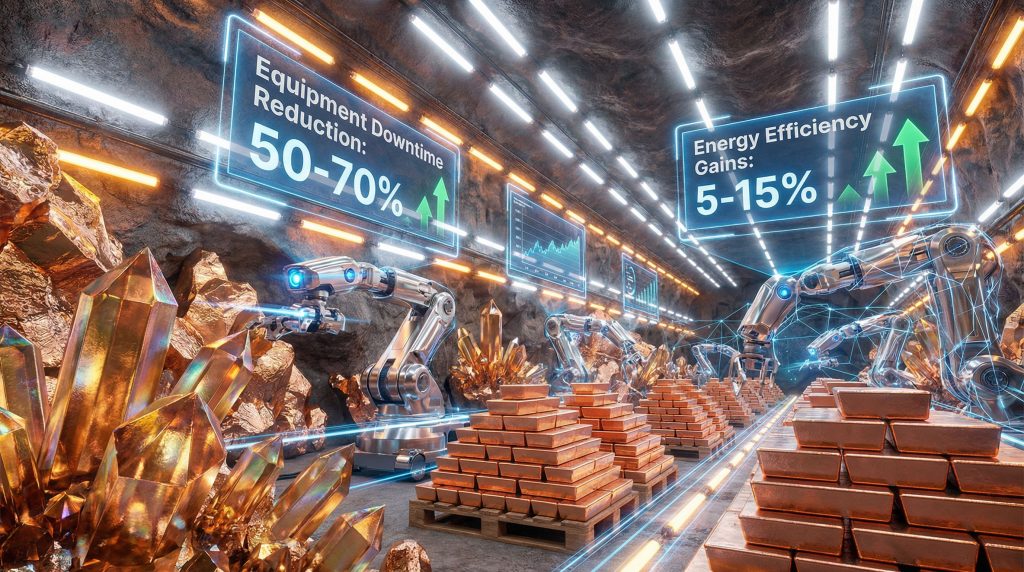
Equipment downtime reduction represents one of the most significant benefit categories, with implementations achieving 50-70% reductions through predictive maintenance systems. These improvements typically materialise within 6-12 months of deployment.
Energy efficiency gains range from 5-15% across various applications, often realised within 3-6 months as optimisation algorithms identify and eliminate waste in existing processes.
Processing throughput improvements of 10-25% require longer implementation periods of 12-18 months but deliver substantial long-term value through increased production capacity without corresponding increases in infrastructure investment.
Safety incident reductions of 30-60% demonstrate significant risk mitigation value, typically achieved within 6-12 months as predictive safety systems identify and prevent potential incidents.
Cost-Benefit Analysis Framework
Implementation Cost Considerations: Initial technology investments must be evaluated against long-term operational savings, productivity gains from autonomous decision-making, and risk mitigation value through enhanced safety and compliance.
Return on investment calculations should incorporate both direct cost savings and indirect benefits such as reduced regulatory compliance costs, improved worker safety outcomes, and enhanced operational resilience.
The next major ASX story will hit our subscribers first
Global Adoption Patterns and Market Dynamics
Regional variations in agentic AI adoption reflect different mining industry priorities, regulatory environments, and technological infrastructure capabilities.
Leading Implementation Markets
Australia has emerged as a leader in autonomous haulage and drilling programmes, with major mining operations demonstrating large-scale autonomous vehicle fleets and remote-controlled drilling systems.
North American mining operations focus heavily on predictive maintenance initiatives, leveraging extensive sensor networks and data analytics capabilities to optimise equipment performance and reduce operational disruption.
European mining companies emphasise environmental compliance automation, implementing AI systems that optimise operations for emissions reduction and environmental impact minimisation.
Emerging Market Opportunities
African mining sector digitalisation presents significant potential for AI implementation, particularly in operations where labour cost advantages make autonomous systems economically attractive.
South American copper and lithium extraction operations represent substantial opportunities for AI optimisation, especially as demand for battery materials drives production intensity requirements.
Asian rare earth element processing automation offers specialised applications where AI systems can optimise complex chemical processes and minimise environmental impact.
Future Technology Development Roadmap
The evolution of agentic AI in mining points toward increasingly sophisticated autonomous capabilities that will fundamentally reshape industry operations.
Next-Generation Capabilities
Fully autonomous mine-to-market operations represent the ultimate vision for AI integration, encompassing autonomous extraction, processing, transportation, and logistics coordination without human intervention in routine operations.
AI-driven exploration using satellite imagery, drone surveys, and ground-based sensor networks will enable more accurate resource identification and assessment before significant capital investment.
Integrated supply chain optimisation across multiple mining sites will coordinate production schedules, transportation logistics, and market demand to maximise overall system efficiency.
Emerging Technology Integration
5G connectivity infrastructure enables real-time remote operations with sufficient bandwidth and low latency for autonomous system coordination across large geographic areas.
Digital twin modelling for entire mining operations creates virtual environments where AI systems can simulate operational changes and optimise strategies before implementation. This approach supports data-driven operations across all operational areas.
Blockchain integration provides transparent resource tracking throughout supply chains, enabling verification of mining practices and environmental compliance for stakeholders according to Microsoft's industry insights.
Strategic Implementation Recommendations
Mining industry leadership must approach agentic AI implementation through structured, phased approaches that balance technological capability development with organisational readiness.
Short-Term Priorities (6-18 months)
Pilot programmes should focus on high-impact operational areas where AI can demonstrate clear value while building organisational confidence and expertise.
Staff training and change management initiatives must begin early to prepare personnel for AI-augmented workflows and new operational responsibilities.
Partnership development with AI technology providers enables access to specialised expertise while sharing implementation risks and costs.
Medium-Term Objectives (2-3 years)
Scalable AI deployment across multiple operational sites requires standardised platforms and governance frameworks that can be replicated efficiently.
Integration with existing enterprise resource planning systems ensures that AI capabilities enhance rather than disrupt established business processes.
Development of proprietary AI capabilities and intellectual property creates competitive advantages and reduces dependence on external technology providers.
Long-Term Vision (3-5 years)
Fully autonomous mining operations with minimal human intervention represent the ultimate goal, requiring comprehensive integration of AI systems across all operational areas.
AI-driven exploration and resource development programmes will transform how mining companies identify and evaluate new opportunities.
Industry leadership in sustainable, technology-enabled mining practices will become essential for regulatory compliance and stakeholder acceptance.
Preparing for the Autonomous Mining Era
The transformation toward AI-enabled mining operations represents both unprecedented opportunity and significant implementation challenges that will reshape industry competitive dynamics.
Critical Success Requirements
Leadership commitment to long-term digital transformation must extend beyond initial pilot programmes to encompass comprehensive organisational change.
Investment in both technology infrastructure and human capital development ensures that organisations can effectively deploy and manage AI systems while maintaining operational excellence.
Strategic partnerships with technology providers and research institutions provide access to cutting-edge capabilities while sharing risks and development costs.
Industry-Wide Implications
Competitive landscape shifts will favour AI-enabled operators as performance gaps widen between traditional and technology-enhanced operations.
Regulatory evolution must accommodate autonomous mining systems while maintaining safety and environmental protection standards.
Workforce transformation toward high-skilled technical roles will require significant retraining programmes and new educational partnerships.
The mining industry's embrace of agentic AI represents more than technological advancement; it signals a fundamental reimagining of how extraction operations can be conducted safely, efficiently, and sustainably. Organisations that successfully navigate this transformation will establish lasting competitive advantages in an increasingly complex operational environment.
Industry Perspective: The mining sector's adoption of agentic AI reflects broader industrial trends toward autonomous systems, yet the unique challenges of remote operations, harsh environments, and complex geological conditions create specialised implementation requirements that distinguish mining applications from other industrial AI deployments.
Ready to invest in the next major mineral discovery?
Discovery Alert instantly alerts investors to significant ASX mineral discoveries using its proprietary Discovery IQ model, turning complex mineral data into actionable insights whilst mining operations embrace AI transformation. Understand why historic discoveries can generate substantial returns by visiting Discovery Alert's dedicated discoveries page, then begin your 14-day free trial today to position yourself ahead of the market.