August 21, 2026
When Equity Markets Price the Future of Earth's Resources
Commodity cycles have always moved in long arcs, shaped by geology, geopolitics, and the shifting appetites of industrial civilisation. But in 2026, something more immediate is capturing the attention of institutional capital: the world's publicly listed mining companies, measured collectively, have become a multi-trillion-dollar asset class in their own right. Understanding how global mining majors reach combined US$2.17 trillion valuation, what sustains it, and where the fractures lie is essential for anyone tracking the intersection of natural resources and global capital markets.
When big ASX news breaks, our subscribers know first
What the US$2.17 Trillion Figure Actually Represents
The headline number demands careful interpretation. When global mining majors reach combined US$2.17 trillion valuation, as recorded at the end of July 2026 by MINING.COM's monthly Top 50 ranking, this reflects the aggregate stock market capitalisation of the world's 50 largest publicly listed mining companies, not the total output, asset base, or in-ground resource value of the global mining industry.
This distinction matters enormously. A company producing identical volumes of copper year-on-year can see its market capitalisation surge or collapse based entirely on forward earnings expectations, commodity price movements, and investor sentiment — none of which require a single additional tonne of metal to be extracted. The MINING.COM Top 50 is, at its core, a barometer of how institutional capital is pricing the future earnings potential of the sector's most investable public companies.
The Top 50 ranking tracks investable public companies, making it one of the most closely watched signals for institutional capital flows into the global mining sector.
Furthermore, production rankings and market capitalisation rankings frequently diverge in ways that surprise newcomers to the sector. A junior explorer holding a world-class undeveloped deposit in a favourable jurisdiction can command a valuation that dwarfs a mid-tier producer generating steady cash flows, simply because the market is pricing optionality on future discovery and development.
The Valuation Momentum: Numbers Behind the Milestone
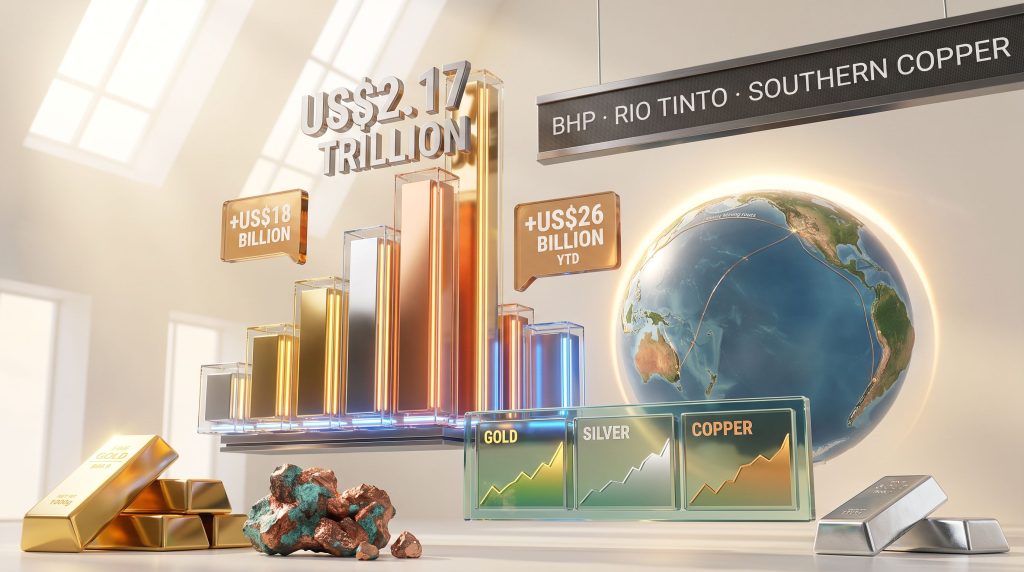
The pace at which this milestone was reached tells its own story. The sector added US$18 billion in a single month during July 2026, while the year-to-date gain from January through July reached US$26 billion. Crucially, the US$2 trillion threshold had already been crossed earlier in 2026, meaning the subsequent move to US$2.17 trillion represents acceleration within an already elevated cycle.
| Timeframe | Valuation Change |
|---|---|
| July 2026 (monthly gain) | +US$18 billion |
| January to July 2026 (YTD) | +US$26 billion |
| Milestone crossed earlier in 2026 | US$2 trillion threshold |
The month-on-month consistency of these gains is what distinguishes this rally from a brief repricing event. Sustained institutional appetite, rather than speculative retail momentum, tends to produce this type of measured but persistent accumulation. Several reinforcing factors are driving this dynamic simultaneously:
- Precious metals, particularly gold and silver, have maintained elevated price floors throughout 2025 and into 2026, directly amplifying earnings multiples for major producers. Understanding how gold prices affect miners helps explain much of this dynamic
- Structural demand signals from the global energy transition continue to underpin long-term investor confidence in copper, lithium, and battery-adjacent minerals
- Large-cap diversified miners are being re-rated by capital markets as evidence mounts that the commodity supercycle thesis has durability beyond a single price spike
Which Companies and Geographies Anchor the Valuation
The US$2.17 trillion figure is not evenly distributed. A relatively small number of companies command a disproportionate share of the total, reflecting the natural concentration of capital in large-cap diversified miners with multi-commodity earnings resilience.
BHP, Rio Tinto, and Southern Copper consistently occupy the upper tier of the MINING.COM Top 50. BHP and Rio Tinto's combined exposure to iron ore, copper, and coal provides an earnings diversification that smaller peers structurally cannot replicate. Southern Copper's position reflects the outsized importance of the Americas corridor in global copper supply, particularly as electrification demand accelerates.
| Country/Region | Key Players | Primary Commodities |
|---|---|---|
| Australia | BHP, Rio Tinto | Iron ore, copper, coal |
| Americas | Southern Copper | Copper |
| Canada | Multiple large-cap producers | Gold, silver, base metals |
| United Kingdom | Dual-listed majors | Diversified |
Canadian-listed gold and silver companies have been meaningful contributors to the valuation increase, riding precious metals price strength through 2025 and into 2026. The Americas corridor, spanning Canada through Mexico and into Peru, is increasingly where listed mining value is being created, particularly in precious metals jurisdictions that have benefited from sustained gold price appreciation. In addition, China iron ore demand continues to influence how Australian majors are priced by global institutional investors.
Precious Metals as the Primary Valuation Catalyst
The mechanics of how gold and silver prices feed into equity valuations are worth understanding in detail. Mining companies with relatively fixed cost bases experience operating leverage when commodity prices rise: a 20% increase in the gold price can translate into a 40% or greater increase in operating margins, which in turn drives significant re-ratings of equity valuations.
Fresnillo, Mexico's largest silver producer and one of the world's most significant precious metals miners, saw its profit triple during a recent reporting period as gold and silver prices rallied. This single example encapsulates the leverage dynamic that has been driving the broader sector's valuation expansion throughout 2026.
Silver's dual role deserves particular attention. Unlike gold, which functions primarily as a monetary asset and store of value, silver occupies a dual position as both a precious metal and an industrial input with growing strategic importance. Solar panel manufacturing consumes significant volumes of silver, and as photovoltaic capacity expands globally to meet decarbonisation targets, silver's industrial demand floor is structurally reinforced. This dual-demand dynamic has supported silver miner valuations in ways that are not immediately obvious from headline commodity price movements alone.
Mexico's Outsized Role in the Precious Metals Equation
Mexico ranks among the world's top silver-producing nations and hosts substantial gold operations across several states. Data from the Mexican Mining Chamber (CAMIMEX) reveals that the total value of Mexican mining production rose 21% in 2025 despite essentially flat physical production volumes, a direct demonstration of how commodity price appreciation inflates sector value independently of production growth.
This divergence between value and volume is one of the less appreciated dynamics in mining economics. An investor tracking production statistics alone would have missed the 21% value increase entirely. Meanwhile, mining investment in Mexico declined 3.3% in 2025, with an anticipated rebound expected through 2026, creating a meaningful tension between elevated equity valuations and constrained on-the-ground capital deployment.
Rising commodity prices can inflate sector market capitalisation even when physical investment and production volumes are stagnant. This divergence is one of the most important risk factors for investors to monitor in a valuation-driven cycle.
Gold miners operating in Mexico experienced a 20% equity price rally during a single week in mid-2026, even as permitting bottlenecks continued to constrain actual operational expansion. This disconnect between paper valuations and physical project advancement is a structural feature, not an anomaly, of the current cycle.
Technology as a Hidden Valuation Driver
One underappreciated dimension of the valuation milestone is the growing role that operational technology is playing in how institutional investors assess mining companies. ESG screening criteria, now standard among major institutional allocators, increasingly incorporate safety performance, environmental management, and digital governance as inputs into equity valuations.
Building the Digital Foundation Before Deploying AI
A critical but frequently overlooked reality in mining's digital transformation is that artificial intelligence tools cannot generate value in the absence of reliable underlying data. Elio Cespedes Bravo, Executive General Manager Hispanic Latam at Datamine, has articulated that successful AI in mineral exploration and broader operations depends fundamentally on first establishing robust data governance frameworks, system integration standards, and data quality protocols across the entire value chain. Deploying sophisticated algorithms onto poorly structured or inconsistent data simply amplifies existing problems rather than solving them.
The practical implication for investors is significant: mining companies that have invested in digital infrastructure at the data foundation level are positioned to extract genuine operational advantage from AI tools, while those that have pursued algorithmic solutions without this groundwork face execution risk that may not yet be visible in reported financial results.
A structured digital transformation pathway for a mining operation typically progresses through the following stages:
- Establish data governance standards — define data ownership, quality benchmarks, and access protocols across all operational systems
- Integrate disparate data sources — unify geological, operational, safety, and financial data into a single information ecosystem
- Deploy AI and machine learning tools — apply predictive analytics to ore body modelling, equipment maintenance scheduling, and safety monitoring
- Implement unified safety platforms — combine proximity detection, fatigue monitoring, and incident reporting into one real-time operational dashboard
- Measure and iterate — track KPIs including fatigue incident rates, equipment downtime, and extraction efficiency to validate performance improvements
Safety Technology and ESG Valuation Linkage
Ricardo Gutierrez, CEO of DEEPROC, has emphasised that combining AI-powered proximity detection, fatigue monitoring systems, and comprehensive safety data into a unified operational platform is critical to materially reducing fatalities in surface mining environments. DEEPROC's integrated safety model targets up to a 90% reduction in fatigue-related incidents, a metric that carries direct relevance to the ESG scoring frameworks applied by institutional investors to mining equities.
For companies within the Top 50, safety performance is no longer purely an operational or regulatory concern. It is increasingly a component of how equity is priced by the institutional capital that anchors these companies' valuations.
The next major ASX story will hit our subscribers first
Junior Miners and the Capital Rotation Beyond the Majors
The broader valuation milestone reflects more than just large-cap performance. Capital is actively rotating into earlier-stage mining exposure through the listing of junior explorers on major exchanges, a phenomenon that signals institutional confidence extending well beyond the established diversified miners. The junior mining investment landscape has consequently attracted significant attention from capital allocators seeking leverage on the commodity price cycle.
Sinda, a newly listed silver-gold explorer focused on the Guanajuato Sur project in central Mexico, completed its debut on the New York Stock Exchange on June 26, 2026, and closed its first public quarter holding US$331 million in cash. The company reported a net loss of US$16.6 million for the quarter ended June 30, 2026, compared with US$2.2 million in the same period a year earlier.
For junior exploration companies, widening losses attributable entirely to accelerated drilling expenditure are a signal of capital deployment, not operational failure. The market prices this distinction explicitly.
The Guanajuato district in central Mexico carries historical significance in global silver mining, having produced enormous quantities of silver during colonial-era and post-independence periods. Modern explorers targeting this district are leveraging both geological continuity from historical high-grade zones and improved geophysical interpretation techniques that allow deeper targeting than was previously possible. The district's prolific past production record provides a geological context that reduces exploration risk relative to greenfield targets, even as the depth and complexity of remaining mineralisation increases.
Risk Factors That Could Unwind the Valuation Milestone
The US$2.17 trillion milestone should not be interpreted as a ceiling or a guaranteed floor. However, several material risks have the potential to compress sector valuations from current levels.
Macro and commodity price risks:
- A meaningful shift in monetary policy, particularly if central banks move toward restrictive stances in response to inflation, could reduce safe-haven demand for gold and silver, removing the primary earnings driver that has propelled the current valuation cycle
- Iron ore pricing remains sensitive to Chinese construction and infrastructure demand, which has been a source of intermittent volatility for Australia's largest mining majors
- Commodity supercycles, while historically durable, have always eventually mean-reverted, and valuations built on elevated price assumptions carry embedded correction risk
Regulatory and permitting risks:
- Mexico's permitting environment has emerged as a structural constraint on mining investment, with legal disputes over concessions illustrating the gap between commodity price optimism and operational reality. DynaResource's recent legal victory over due process violations related to Sinaloa concessions demonstrates that regulatory disputes can absorb significant management attention and capital even when ultimately resolved in a company's favour
- Broader resource nationalism concerns across Latin America remain a background risk for companies whose valuations assume uninterrupted access to their asset base
Capital allocation risks:
- As sector valuations rise, boards face increasing pressure to deploy capital through acquisitions or greenfield development. Poorly executed M&A at cycle peaks has historically been one of the most reliable destroyers of mining equity value. Consequently, capital discipline in the mining sector remains a closely monitored indicator among analysts tracking the Top 50
FAQ: Understanding the US$2.17 Trillion Mining Valuation
What does the US$2.17 trillion figure include?
It represents the combined stock market capitalisation of the world's 50 largest publicly listed mining companies as measured at the end of July 2026. It excludes private mining companies and does not reflect the in-ground value of mineral reserves.
Which commodities have contributed most to the valuation increase?
Gold, silver, copper, and iron ore are the primary drivers. Precious metals price appreciation has been particularly influential through 2025 and 2026, while copper's long-term demand outlook tied to electrification supports base metal miner valuations.
Why did Sinda report a larger loss after listing on the NYSE?
The wider loss — US$16.6 million versus US$2.2 million a year earlier — reflects a deliberate decision to accelerate exploration drilling at Guanajuato Sur ahead of and following the NYSE listing. This is planned capital deployment by an exploration-stage company, not an operational setback.
How does Mexico's regulatory environment affect sector valuations?
Mexico hosts world-class silver and gold deposits, but permitting bottlenecks and concession disputes create a gap between commodity-price-driven valuation optimism and actual on-the-ground investment capacity. This tension is a key risk factor for companies with significant Mexican exposure.
Can the sector sustain growth beyond US$2.17 trillion?
Continued growth depends on commodity price trajectories, the pace of energy transition demand for critical minerals, and the ability of major miners to advance new supply without triggering cost overruns or regulatory delays. No forecast should be treated as reliable given the macro uncertainty embedded in all three of these variables.
This article contains forward-looking assessments and market analysis. Mining equity valuations are subject to commodity price volatility, regulatory changes, and macroeconomic conditions. Nothing in this article constitutes financial advice. Readers should conduct independent due diligence before making investment decisions.
Want to Capitalise on the Next Major Mineral Discovery Before the Broader Market?
Discovery Alert's proprietary Discovery IQ model delivers real-time alerts on significant ASX mineral discoveries, transforming complex geological and market data into actionable investment insights for both short-term traders and long-term investors. Explore historic discoveries and their exceptional returns, then begin your 14-day free trial to position yourself ahead of the market.