August 14, 2026
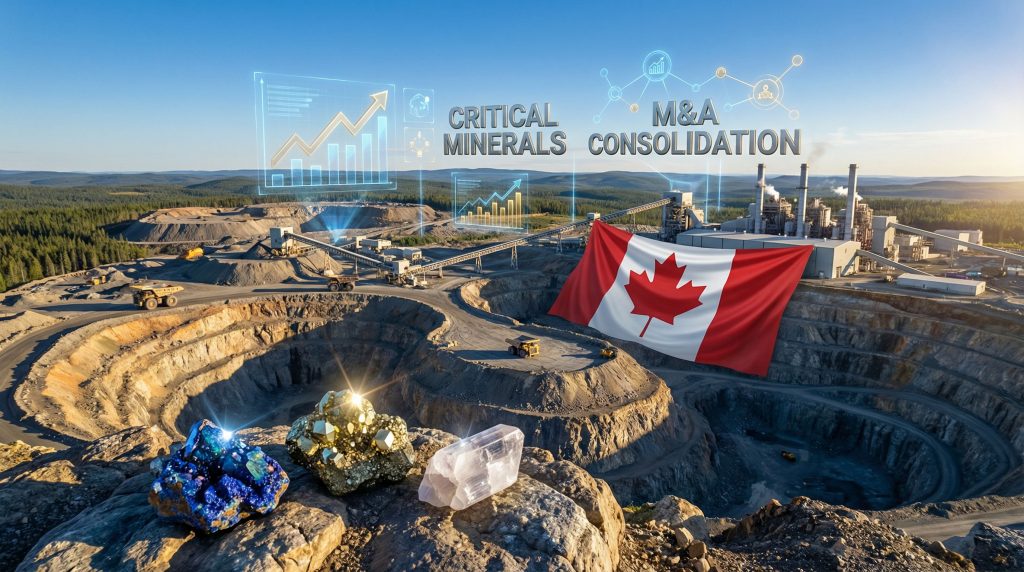
The Canadian resource sector faces unprecedented transformation as companies navigate rising capital costs, regulatory complexities, and intensifying competition for quality assets. Mining industry consolidation has emerged as the preferred growth strategy, with mining mergers and acquisitions in Canada reaching record-breaking valuations as companies prioritise acquisition-driven consolidation over uncertain exploration programs.
This strategic pivot reflects broader macroeconomic pressures extending beyond traditional commodity cycles. Environmental compliance costs have escalated dramatically across Canadian jurisdictions, creating economies of scale favouring consolidated operations. Simultaneously, geopolitical supply chain concerns have elevated the strategic value of domestically controlled critical minerals and energy security assets, positioning Canada as an essential hub for resource security.
The Strategic Context Behind Canada's M&A Explosion
The scale of mining mergers and acquisitions in Canada reached unprecedented levels in 2025, with global transactions valued above US$500 million increasing approximately 45% compared to the previous year. Furthermore, this surge represents structural changes in how mining companies evaluate capital allocation and growth strategies.
Canada's total M&A deal value rose 30% to US$178 billion in 2025, with strategic deal value jumping 57% year-over-year. The energy and natural resources sector led this explosive growth, recording a remarkable 133% increase in deal value. These figures underscore Canada's emergence as the epicentre of global mining consolidation activity.
Economic Forces Driving Consolidation Patterns
The preference for acquisition-based growth stems from three critical economic factors. First, rising capital costs have made long-duration greenfield projects significantly less attractive from a risk-adjusted return perspective. Extended development timelines often stretch 5-10 years from initial discovery to commercial production.
Second, environmental compliance requirements create substantial cost barriers disproportionately impacting smaller operations. Modern mining projects must navigate complex environmental impact assessment processes, comprehensive community consultation frameworks, and long-term remediation planning requirements.
Third, the global shift toward critical mineral security has elevated strategic premiums associated with proven reserves in stable jurisdictions. Companies willingly pay substantial premiums to secure immediate access to copper, lithium, nickel, and rare earth element deposits.
Geographic Clustering and Infrastructure Synergies
Regional consolidation strategies have emerged as particularly effective value creation mechanisms within Canada's mining sector. Companies systematically build operational hubs where adjacent properties share processing facilities, transportation networks, power infrastructure, and specialised workforce capabilities.
The hub model enables companies to achieve several strategic advantages:
• Infrastructure cost distribution across multiple production sources
• Operational expertise transfer between adjacent properties
• Supply chain optimisation through consolidated procurement and logistics
• Risk diversification across multiple ore bodies and mining methods
• Capital efficiency improvements through shared equipment and facilities
These regional clustering benefits prove particularly valuable in Canada's major mining districts, where geological formations often extend across multiple property boundaries.
When big ASX news breaks, our subscribers know first
Strategic Deal Architecture Analysis
Modern mining consolidation transactions focus primarily on operational transformation rather than simple financial engineering. However, the most successful mergers demonstrate value creation through genuine capability building and efficiency gains.
The Anglo American-Teck Resources merger, valued at nearly US$24 billion including debt, exemplifies this strategic approach. The transaction would create a combined entity with market value exceeding US$53 billion, positioning the merged company as a critical minerals champion headquartered in Canada.
Synergy Realisation Mechanisms and Timelines
| Synergy Category | Value Creation Mechanism | Realisation Timeline | Success Metrics |
|---|---|---|---|
| Infrastructure Integration | Shared processing facilities, transportation optimisation | 12-18 months | Cost per unit processed |
| Operational Excellence | Best practice transfer, workforce optimisation | 6-12 months | Production efficiency gains |
| Portfolio Rationalisation | Asset evaluation, strategic divestment | 18-24 months | Return on invested capital |
| Technology Deployment | Digitalisation, automation implementation | 12-24 months | Operational cost reduction |
The Agnico Eagle-Kirkland Lake Gold merger provides empirical evidence of successful integration execution. The US$10.7 billion transaction created the world's second-largest gold producer, with Agnico reporting early synergy achievements by Q2 2022.
By 2024, the merged entity achieved record gold production levels and free cash flow generation. These results validate the industry's shift toward consolidation as companies optimise existing assets rather than pursue higher-risk development programs.
Operational Excellence Transfer Methodologies
Successful mining mergers require sophisticated approaches to operational capability transfer between acquired entities. This process involves standardising mining methodologies across multiple sites and implementing advanced exploration techniques throughout combined property portfolios.
Evolution Mining has emerged as a leading example of repeatable strategic consolidation focused on building regional, long-life operating hubs. The company's approach emphasises:
• Operating leverage through shared infrastructure investments
• Transferable mining methods maintaining profitability across commodity cycles
• Adjacent asset integration to compound operational value
• Expertise consolidation optimising technical capabilities across multiple properties
Critical Minerals and Energy Transition Dynamics
The global transition toward electrification and renewable energy infrastructure has fundamentally transformed mining merger and acquisition priorities. Companies aggressively pursue assets containing copper, lithium, nickel, cobalt, and rare earth elements essential for electric vehicle manufacturing and battery production.
Canada's geological diversity positions the country as uniquely attractive for companies seeking critical mineral exposure. The nation hosts significant deposits of virtually every material required for energy transition technologies, combined with political stability and established regulatory frameworks.
Supply Chain Security and Geopolitical Considerations
Recent geopolitical tensions have elevated the strategic value of critical mineral assets located within allied jurisdictions. Mining companies and investors increasingly recognise that supply chain security represents a fundamental competitive advantage justifying substantial acquisition premiums.
The emphasis on domestic supply chain development has created additional consolidation incentives. Governments seek to ensure reliable access to materials essential for national security and economic competitiveness, particularly benefiting Canadian mining assets.
Commodity-Specific Consolidation Patterns
Different critical minerals exhibit distinct consolidation characteristics based on geological distribution, processing requirements, and market dynamics:
Lithium sector consolidation focuses on securing processing capacity and battery-grade material production capabilities alongside raw mineral reserves.
Copper consolidation emphasises large-scale, long-life assets capable of supporting decades of production to meet infrastructure development requirements.
Rare earth element transactions prioritise integrated supply chains including separation and refining capabilities rather than simple extraction operations.
Nickel sector mergers target high-grade sulfide deposits suitable for battery precursor material production.
Financial Engineering and Deal Structuring
Contemporary mining consolidation transactions rely heavily on share-based consideration and debt financing at historically attractive interest rates. This approach allows acquiring companies to preserve cash resources whilst accessing growth opportunities without excessive dilution.
The current financing environment enables strategic buyers to leverage strong balance sheets and favourable debt markets. Companies with investment-grade credit ratings can access long-term financing at rates making acquisition-based growth economically superior to internal development programs.
Valuation Methodologies and Strategic Premiums
Mining merger valuations increasingly emphasise several key factors beyond traditional asset-based assessments:
• Net present value calculations for proven and probable reserves using conservative commodity price assumptions
• Operational cash flow multiples based on sustainable production levels and cost structures
• Strategic premiums for critical mineral exposure and supply chain security benefits
• Synergy value quantification through detailed integration planning and operational modelling
The willingness to pay substantial strategic premiums reflects industry recognition that access to high-quality assets in stable jurisdictions has become increasingly scarce.
Risk-Adjusted Return Analysis
| Growth Strategy | Capital Requirements | Time to Production | Risk Profile | Return Potential |
|---|---|---|---|---|
| Greenfield Exploration | High upfront, uncertain total | 7-12 years | Very High | Variable |
| Brownfield Expansion | Moderate, predictable | 2-4 years | Medium | Moderate |
| Strategic Acquisition | High initial, known total | Immediate | Low-Medium | Predictable |
| Joint Venture Development | Shared, staged | 4-8 years | Medium-High | Shared |
This analysis demonstrates why acquisition strategies have become increasingly attractive relative to traditional development approaches, particularly in environments characterised by capital scarcity and shortened investment horizons.
Regulatory Framework and Government Policy Impact
Investment Canada Act reviews have become increasingly stringent for transactions involving critical minerals or assets deemed strategically important to national security. The government's emphasis on maintaining Canadian control over key resources influences deal structuring, timing, and completion probability.
The regulatory review process typically examines several key factors:
• Net benefit to Canada through job creation, technology transfer, and economic development
• National security implications for critical mineral supply chains and strategic infrastructure
• Foreign ownership concentration within specific commodity sectors or geographic regions
• Long-term commitment to Canadian operations and continued investment programs
Policy Developments Affecting M&A Activity
Recent policy initiatives could significantly accelerate or constrain future mining consolidation activity. Enhanced tax incentives for critical mineral development may reduce the relative attractiveness of acquisition strategies compared to internal development programs.
Moreover, streamlined environmental approval processes could make Canadian assets more valuable to international buyers. Foreign ownership restrictions on strategic assets represent potential constraints on cross-border transaction activity, though domestic consolidation among Canadian companies faces fewer regulatory obstacles.
The European Commission's pending decision on the Anglo American-Teck Resources merger, expected in February 2026, will provide important precedent for how international regulators evaluate large-scale mining consolidation transactions.
Risk Assessment and Integration Challenges
Despite strategic logic supporting mining consolidation, substantial execution risks can undermine transaction success. Historical analysis suggests realised synergies typically fall 20-40% short of announced targets, making conservative planning essential for investor confidence.
However, companies increasingly recognise that integration risk challenges require sophisticated project management capabilities. Meanwhile, Canada's energy transition challenges add complexity to merger execution timelines.
Primary Execution Risk Categories
| Risk Factor | Impact Severity | Probability | Mitigation Approaches |
|---|---|---|---|
| Operational Integration Delays | High | Medium | Phased integration, retained key personnel |
| Commodity Price Volatility | Very High | High | Hedging programmes, diversified exposure |
| Regulatory Approval Challenges | Medium | Low-Medium | Early stakeholder engagement, compliance planning |
| Cultural Integration Difficulties | Medium | Medium | Change management, unified leadership structure |
| Technology Integration Complexity | Medium-High | Medium-High | Standardisation programmes, expert consultation |
Successful integration requires substantial senior management attention over extended periods. Companies that underestimate complexity and resource requirements frequently fail to achieve projected synergy targets.
Post-Merger Performance Measurement
Mining companies typically evaluate consolidation success through several quantitative metrics:
• Production volume increases relative to pre-merger baseline levels
• Unit cost reductions through operational efficiency improvements
• Safety performance maintenance during integration processes
• Free cash flow generation improvements from synergy realisation
• Return on invested capital enhancement across the combined entity
The Agnico Eagle-Kirkland Lake Gold integration demonstrates how systematic performance tracking validates strategic consolidation decisions through measurable improvements.
The next major ASX story will hit our subscribers first
Future Market Scenarios and Strategic Implications
The next wave of mining consolidation will likely exhibit distinct characteristics compared to recent transaction activity. Mid-tier companies seeking scale to compete effectively with major producers represent the most probable source of additional consolidation activity during 2026-2027.
Geographic clustering around key Canadian mining districts will intensify as companies recognise operational advantages of regional hub development. The Timmins gold camp, Athabasca Basin uranium district, and various base metal mining regions offer substantial consolidation opportunities.
Emerging Consolidation Patterns
Several strategic trends are reshaping the mining mergers and acquisitions landscape:
Vertical Integration Initiatives: Companies increasingly pursue transactions providing control over entire supply chains, from extraction through processing to end-user delivery.
Joint Venture Proliferation: High-capital development projects generate increased interest in shared ownership structures distributing risk whilst maintaining operational control.
Technology-Driven Acquisitions: Mining companies acquire firms with specialised automation, digitalisation, or processing technologies enhancing operational efficiency across multiple assets.
ESG-Focused Transactions: Environmental, social, and governance considerations become primary drivers of acquisition decisions as companies optimise sustainability profiles.
Geopolitical Influence on Market Structure
Increasing trade tensions and supply chain security concerns could accelerate domestic consolidation as companies seek reduced exposure to international regulatory and political risks. Canadian mining consolidation may benefit from government policies designed to maintain domestic control over critical mineral resources.
The potential for additional trade restrictions or export controls on strategic materials could further enhance the value of Canadian assets. This encourages continued merger activity among domestic companies building resilient, domestically controlled supply chains.
Investment Implications and Market Outlook
Mining mergers and acquisitions in Canada represent structural transformation rather than temporary market phenomena. Companies with strong balance sheets, diversified asset portfolios, and proven integration capabilities are best positioned to capitalise on continued consolidation opportunities.
Nevertheless, companies pursuing growth strategies must carefully consider capital raising methods to fund acquisitions effectively. Investors should monitor several key indicators influencing future transaction activity:
• Commodity price trajectories and volatility patterns across critical minerals
• Regulatory policy developments affecting foreign investment and environmental compliance
• Capital market conditions including interest rates and debt availability
• Geopolitical tensions impacting global supply chain security considerations
The consolidation wave creates a more concentrated industry structure characterised by fewer, larger entities capable of developing complex projects and navigating volatile market conditions more effectively.
Long-Term Structural Implications
The ongoing transformation of Canada's mining sector through consolidation is fundamentally altering competitive dynamics, creating larger entities with enhanced operational capabilities and reduced exposure to individual project risks.
This structural evolution positions Canadian mining companies to compete more effectively in global markets whilst providing enhanced supply chain security for critical minerals essential to economic and national security objectives.
The success of early consolidation transactions, demonstrated through measurable operational improvements and financial returns, validates strategic logic underlying this transformation. According to industry analysts at Mining Journal, additional merger activity will continue reshaping Canada's resource sector throughout the remainder of the decade.
Companies that successfully execute consolidation strategies whilst maintaining operational excellence and stakeholder confidence will emerge as dominant players in an increasingly concentrated and strategically important industry sector. Furthermore, mining mergers and acquisitions in Canada will continue driving structural transformation as companies seek operational synergies, risk diversification, and enhanced competitive positioning in global markets.
Looking to Capitalise on Canada's Mining M&A Boom?
Discovery Alert's proprietary Discovery IQ model delivers real-time alerts on significant ASX mineral discoveries, instantly empowering subscribers to identify actionable opportunities ahead of the broader market during this unprecedented consolidation wave. Begin your 14-day free trial today and secure your market-leading advantage whilst Canadian mining giants reshape global resource markets.