June 9, 2026
The Structural Shift Rewriting the Rules of Mining Equipment Supply
For most of the twentieth century, competitive advantage in mining equipment was straightforward: build the most durable, highest-capacity machine at the most competitive price. Relationships between operators and original equipment manufacturers were transactional by nature, governed by capital expenditure cycles and warranty terms. That paradigm is now under significant pressure. The mining OEMs solutions revolution is not simply a product upgrade story. It represents a fundamental restructuring of what mining customers are actually buying, and what equipment suppliers must become to remain relevant.
Understanding why this shift is happening requires stepping back from individual product lines and looking at the broader forces converging on the sector simultaneously.
When big ASX news breaks, our subscribers know first
Four Forces Accelerating the Mining OEM Transformation
Workforce Constraints and the Safety Imperative
Mining has faced a structural labour challenge for over a decade. Skilled operators are retiring faster than they are being replaced, particularly in technically demanding underground and deep-open-pit environments. Rather than simply raising wages to compete, leading OEMs have responded by embedding automation in mining into their core product strategy.
Autonomous haulage systems, remote operation centres, and AI-driven mining systems all reduce the headcount required to operate a mine at full capacity. However, the workforce dimension extends beyond simple labour substitution. Safety performance has become a licence-to-operate issue for major mining companies. Regulatory scrutiny of fatalities and injuries is intensifying across jurisdictions, and institutional investors increasingly factor safety culture into ESG assessments.
This has created genuine commercial demand for virtual and extended reality training platforms. XR-based simulators allow operators to train on complex equipment in high-fidelity environments without exposure to live machinery or hazardous conditions. The cost benefits are significant: digital training programmes can reduce on-equipment training hours, lower consumable costs, and dramatically cut the risk of training-related incidents.
When digital twin technology is layered over simulation platforms, the same virtual environment used for workforce development can mirror the actual configuration of a live mine, creating continuity between training and production operations.
Productivity Demands and the Move Toward Predictive Operations
Unplanned equipment downtime is one of the most expensive problems in large-scale mining. A single haul truck sitting idle for 24 hours in a high-throughput operation can represent tens of thousands of dollars in lost productivity, compounded across a fleet of dozens of vehicles. The traditional response, reactive maintenance, involves waiting for a failure and dispatching a repair crew. This model is increasingly regarded as commercially indefensible.
IoT sensor networks embedded across modern mining equipment generate continuous streams of performance data covering vibration profiles, hydraulic pressures, thermal signatures, and fuel consumption patterns. Furthermore, predictive maintenance platforms process this data in real time, identifying anomalies that precede failure events before they occur.
The shift from reactive to predictive approaches is not theoretical. Studies across heavy industrial sectors have demonstrated that predictive maintenance programmes can reduce unplanned downtime by 30 to 50 percent while extending component lifespans significantly.
Real-time fleet monitoring also enables dynamic route optimisation and load management across haulage fleets, improving asset utilisation rates without adding physical capacity. For mining operators under margin pressure, this kind of software-driven productivity gain is increasingly more attractive than the capital expenditure required to deploy additional equipment.
ESG Commitments and the Decarbonisation Pressure
The electrification of heavy mining equipment was considered speculative as recently as five years ago. Today it represents one of the fastest-moving strategic priorities across the global industry. Battery-electric haul trucks, electric underground loaders, and trolley-assist haulage systems are all moving from pilot deployments toward production-scale adoption at major mining operations worldwide.
The business case for mining electrification and decarbonisation extends well beyond carbon accounting. Underground mines in particular stand to benefit substantially because diesel combustion in confined spaces requires enormous ventilation infrastructure. Reducing underground diesel usage can dramatically lower ventilation costs, which in some operations represent 25 to 40 percent of total energy expenditure.
OEMs that can offer credible electric drivetrain solutions alongside integrated energy management platforms are consequently positioning decarbonisation not as a compliance burden but as an operational efficiency lever. On-site renewable energy integration is emerging as a complementary capability area, with some OEMs beginning to offer hybrid energy system packages that combine solar, battery storage, and grid connection management for remote mine sites.
Data Complexity and the Rise of Integrated Management Platforms
A modern mining operation generates data from dozens of independent systems: fleet management software, blast monitoring tools, ore tracking platforms, maintenance records, shift productivity dashboards, and environmental monitoring networks. When these systems operate in isolation, the result is fragmented decision-making, duplicated data entry, and missed opportunities to identify performance patterns that cut across operational boundaries.
"Mining Operations Management platforms that unify disparate data sources into a single, real-time operational view are rapidly becoming one of the most strategically significant product categories in the mining technology landscape."
Data-driven mining operations represent the OEM response to this fragmentation problem. By creating a unified data environment that connects fleet management, processing performance, maintenance scheduling, and safety compliance into a single interface, Mining Operations Management (MOM) platforms give mine managers genuine decision-making capability that was previously unavailable. The concept of a single version of truth across a distributed, multi-site operation is technically complex to deliver, but commercially compelling for large mining groups managing portfolios of assets across multiple geographies.
What the Solutions-Led OEM Model Actually Looks Like
From Hardware Vendor to Operational Partner
The practical meaning of the mining OEMs solutions revolution becomes clearer when comparing commercial engagement models side by side:
| Engagement Model | Revenue Type | Customer Value | OEM Competitive Moat |
|---|---|---|---|
| Traditional Hardware Sale | One-time capital | Equipment ownership | Product specs, price |
| Service and Maintenance Contract | Recurring services | Uptime assurance | Technical expertise |
| Equipment-as-a-Service (EaaS) | Subscription/outcome | Operational certainty | Data integration, lock-in |
| Fully Integrated Solutions Partner | Bundled recurring | Productivity outcomes | Platform ecosystem, switching costs |
The progression from left to right in this table represents both increasing customer value and increasing OEM revenue quality. Subscription and outcome-based revenue streams are more predictable, higher-margin, and less cyclically volatile than capital equipment sales. For OEM investors, this transformation toward recurring revenue is not simply a business model preference. It is a fundamental improvement in earnings quality that warrants revaluation over time.
Equipment-as-a-Service, or EaaS, is the most structurally significant model in this progression. Under EaaS arrangements, the operator pays for a performance outcome, such as tonnes moved per hour or percentage fleet availability, rather than purchasing a capital asset. The OEM retains equipment ownership and assumes responsibility for maintenance, software updates, and performance delivery. This model transfers operational risk onto the OEM while simultaneously creating deep, long-duration customer relationships that are difficult to disrupt.
The Technology Stack Enabling the Revolution
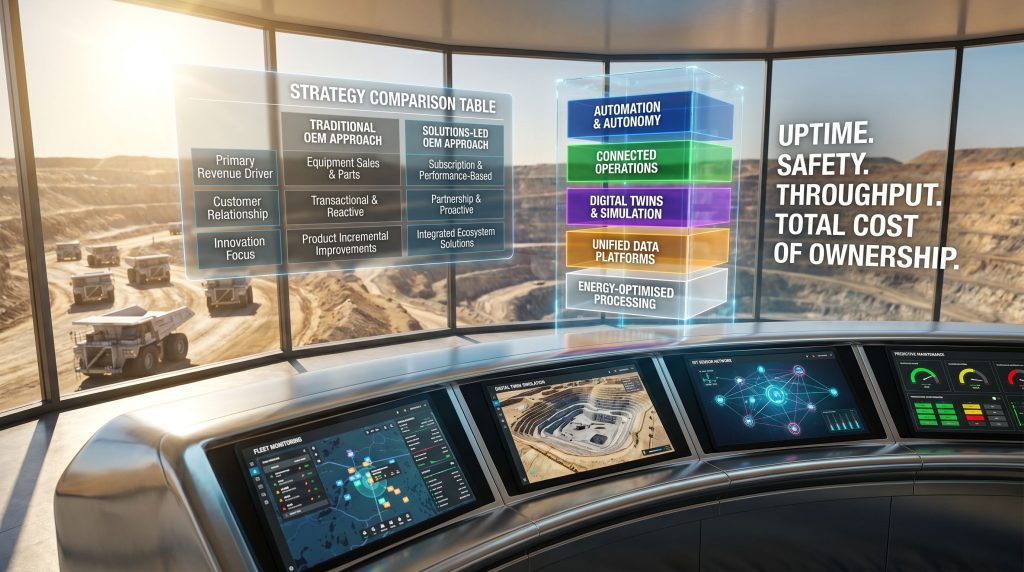
No single technology is responsible for the solutions revolution in mining. It is, however, the convergence of multiple capability layers that creates the transformative effect:
| Solution Layer | Technology Components | Operational Benefit |
|---|---|---|
| Automation and Autonomy | Autonomous vehicles, AI-driven controls, remote operation centres | Reduced human exposure, higher utilisation |
| Connected Operations | IoT sensors, real-time fleet monitoring, predictive maintenance | Lower unplanned downtime, extended asset life |
| Digital Twins and Simulation | Virtual mine models, XR training simulators | Faster workforce development, safer training |
| Unified Data Platforms | MOM systems, single-source operational dashboards | Real-time decisions, cross-system integration |
| Energy-Optimised Processing | RF/microwave ore treatment, electrified equipment fleets | Reduced energy intensity, lower emissions |
One area receiving growing attention is radiofrequency and microwave-based ore processing. Conventional comminution, the process of crushing and grinding ore to liberate minerals, is one of the most energy-intensive activities in mining, accounting for a substantial share of total site energy consumption. Microwave and RF treatment of ore can selectively heat and fracture mineral boundaries at the microscopic level, reducing the energy required for downstream grinding. According to Deloitte's analysis of future mining, such emerging technologies represent a potentially significant efficiency and emissions reduction lever that solutions-oriented OEMs are beginning to position within their broader energy management offerings.
Barriers to Adoption: Where the Revolution Meets Organisational Reality
The Readiness Gap Between OEM Ambition and Operator Capability
The pace at which leading OEMs are building and marketing integrated solutions capabilities is, in many cases, outrunning the organisational readiness of their customers. In addition, several structural barriers are slowing adoption across the sector:
-
Legacy infrastructure costs: Many operating mines were designed and built before IoT connectivity, autonomous systems, or digital twin platforms existed. Retrofitting these environments to accommodate integrated solutions requires capital investment and operational disruption that operators weigh carefully against projected returns.
-
Remote site connectivity: Reliable high-bandwidth data connectivity remains a practical constraint at many mine sites, particularly in remote regions of Africa, Latin America, and Central Asia. Real-time data platforms, autonomous vehicle management systems, and remote operation centres all depend on connectivity infrastructure that simply does not exist at scale in some of the world's most mineral-rich regions.
-
Cultural resistance: Mining has a deeply embedded operational culture built around physical expertise, mechanical intuition, and experience-based decision-making. The introduction of AI-driven analytics that challenge or override the judgements of experienced operators creates genuine organisational friction that no software platform alone can resolve.
-
Procurement misalignment: Traditional mining procurement frameworks are structured around capital expenditure approvals for discrete equipment purchases. Subscription-based, outcome-driven contracts cut across these frameworks in ways that require new financial approval processes, risk allocation frameworks, and contract structures that many procurement teams are not yet equipped to manage.
"The gap between what OEMs can now deliver and what operators are organisationally prepared to absorb is arguably the most underappreciated constraint on the pace of digital transformation across the mining sector."
Smaller Operators Face Greater Adoption Hurdles
The benefits of integrated solutions platforms scale most naturally to large, multi-asset mining groups with the IT infrastructure, talent, and balance sheet capacity to support complex technology deployments. Smaller and mid-tier operators face a more challenging adoption path. For these companies, pilot programme structures that allow phased deployment with defined performance milestones are increasingly important as a mechanism for de-risking the transition and building internal capability before committing to full-scale deployment.
The Competitive Landscape for Mining OEMs in 2026
From Product Catalogues to Platform Ecosystems
The strategic priorities of major equipment suppliers have shifted visibly over the past several years. Mergers and acquisitions activity in the mining technology sector has accelerated, with established OEMs acquiring software companies, data analytics firms, and specialist automation providers to build out platform capabilities that would take years to develop organically.
The competitive logic here is straightforward. Once an OEM's software platform is embedded deeply into a customer's operational workflow, connecting fleet management, maintenance scheduling, ore tracking, and safety compliance, the switching costs become substantial. A mining operator considering replacing an integrated solutions partner is not simply evaluating a new equipment manufacturer. They are evaluating a full operational migration that carries significant implementation risk, retraining requirements, and potential productivity disruption during the transition period.
This dynamic creates durable competitive moats for OEMs that successfully achieve deep platform integration with major customers, fundamentally altering the competitive economics of the sector relative to the traditional hardware sale model.
Emerging Technology Entrants and Niche Innovators
Established OEMs are not the only participants reshaping the sector. A growing cohort of specialist technology companies is entering mining through targeted automation, robotics, and data analytics offerings. Some are pursuing direct relationships with operators. Others are partnering with established OEMs to accelerate solutions delivery through existing customer relationships and distribution networks. As highlighted by IMARC's analysis of mining OEM strategies, this strategic repositioning is fundamentally altering how equipment suppliers compete for long-term market share.
| Strategic Dimension | Traditional OEM Approach | Solutions-Led OEM Approach |
|---|---|---|
| Primary Revenue Driver | Equipment sales | Software, services, outcomes |
| Customer Relationship | Transactional | Long-term partnership |
| Competitive Differentiation | Product specs, price | Platform depth, data integration |
| Innovation Focus | Mechanical engineering | AI, IoT, digital twins |
| ESG Positioning | Compliance-driven | Proactive sustainability leadership |
What This Means for Operators, Investors, and the Broader Industry
For Mining Operators
- Hardware procurement decisions are now functionally inseparable from software ecosystem and service partnership choices
- Total cost of ownership over the full asset lifecycle, not purchase price, is the primary evaluation metric for sophisticated operators
- Early adopters of integrated solutions are demonstrating measurable advantages in both productivity metrics and safety performance records
- Phased adoption programmes and pilot frameworks offer a practical pathway for operators not yet ready for full platform deployment
For OEM Investors and Strategists
- Revenue model transformation toward recurring, outcome-based streams represents a structural improvement in earnings quality and cyclical resilience
- Platform ecosystems and deep data integration create switching costs that translate into durable long-term customer retention
- ESG-aligned solution capabilities are becoming commercially necessary as customers face intensifying pressure on their own sustainability commitments
- Acquisition activity targeting software and analytics capabilities is likely to continue accelerating as OEMs compete to build or buy platform depth
For the Broader Industry
The convergence of AI, IoT, electrification, advanced ore processing, and immersive training technology is compressing the innovation cycle in mining in ways that have few historical precedents. The mining OEMs solutions revolution is not a forecast or a forward-looking ambition. It is an active structural transformation reshaping competitive dynamics, commercial relationships, and operational standards across the global mining industry today.
Disclaimer: This article is intended for informational and educational purposes only. It does not constitute financial advice or an investment recommendation. Readers should conduct their own due diligence and seek professional advice before making any investment decisions. Forward-looking statements involve inherent uncertainty and actual outcomes may differ materially from projections discussed.
The next major ASX story will hit our subscribers first
Frequently Asked Questions: Mining OEMs and the Solutions Revolution
What is the mining OEMs solutions revolution?
The mining OEMs solutions revolution describes the structural transformation of major mining equipment manufacturers from hardware-only suppliers into integrated technology and services partners, delivering automation systems, digital platforms, predictive maintenance programmes, workforce training solutions, and sustainability capabilities alongside physical equipment.
Why are mining OEMs moving beyond hardware?
Customers are demanding measurable operational outcomes including higher uptime rates, safer working environments, lower energy costs, and improved throughput productivity. These outcomes cannot be delivered by equipment specifications alone. Software, data analytics, and lifecycle services have consequently become essential components of a competitive OEM value proposition.
What technologies are central to the solutions revolution?
Key technology categories include autonomous vehicle systems, IoT sensor networks, AI-driven predictive maintenance platforms, digital twin environments, extended reality training simulators, mining operations management software, and electrified equipment solutions including battery-electric haul trucks and underground loaders.
What is Equipment-as-a-Service in mining?
Equipment-as-a-Service is an outcome-based commercial model under which mining operators pay for operational performance delivery rather than purchasing capital equipment outright. The OEM retains asset ownership and assumes responsibility for availability, maintenance, and performance outcomes, creating a fundamentally different risk allocation structure compared to traditional equipment procurement.
What are the biggest barriers to mining OEM solutions adoption?
The primary barriers include legacy infrastructure integration costs, remote site connectivity limitations, cultural resistance to data-driven decision frameworks within experienced mining workforces, misaligned procurement structures, and the organisational capability gap between what leading OEMs can now deliver and what many operators are currently positioned to absorb and operationalise effectively.
For further editorial analysis on the transformation of mining equipment suppliers and the progression of digital mine operations, readers can explore related commentary at The Intelligent Miner, including coverage of the mining OEMs solutions revolution at theintelligentminer.com.
Want to Capitalise on the Next Major Mineral Discovery Before the Broader Market Catches On?
As the mining sector undergoes a fundamental transformation driven by automation, electrification, and data-driven operations, the companies pioneering these shifts are also reshaping the ASX discovery landscape — and Discovery Alert's proprietary Discovery IQ model delivers real-time alerts the moment significant mineral discoveries are announced, turning complex ASX data into actionable investment insights for both short-term traders and long-term investors. Explore historic discovery returns on Discovery Alert's dedicated discoveries page and begin your 14-day free trial today to position yourself ahead of the market.