August 3, 2026
How Mining Operations Are Achieving Energy Independence Through Next-Generation Power Systems
Mining companies across Australia face mounting pressure to reduce operational costs while meeting increasingly stringent environmental targets. Traditional power solutions, whether through diesel generators or grid connections, present significant limitations for remote operations. The emergence of hybrid renewable energy systems represents a fundamental shift in how mining operations approach energy security and sustainability, particularly as the battery metals landscape continues to evolve.
These integrated power platforms combine solar photovoltaic arrays, battery storage systems, and thermal backup generation to deliver unprecedented operational flexibility. The model eliminates the substantial capital expenditure typically required for power infrastructure while transferring risk to specialised energy providers through long-term service agreements.
When big ASX news breaks, our subscribers know first
Revolutionary Technology Integration Transforming Remote Mining Power
Advanced Multi-Source Energy Management Systems
Modern Aggreko renewable hybrid power facility installations utilise sophisticated control algorithms to optimise energy dispatch between renewable and thermal sources. These systems analyse real-time demand patterns, weather forecasting data, and equipment performance metrics to maximise renewable energy utilisation while ensuring uninterrupted power supply for critical mining operations.
Furthermore, the integration architecture typically includes:
- Solar PV arrays sized according to site-specific irradiance measurements and load profiles
- Lithium-ion battery storage systems providing 2-6 hours of backup capacity during peak demand periods
- High-efficiency thermal generators using diesel or natural gas for extended backup requirements
- Smart inverter technology enabling seamless transitions between power sources without operational disruption
- Remote monitoring platforms providing 24/7 system visibility and predictive maintenance capabilities
Modular Design Enabling Scalable Power Solutions
Contemporary hybrid installations feature modular construction allowing capacity expansion from initial 1MW configurations to large-scale 100MW+ systems. This approach enables mining operations to match power capacity with production ramp-up schedules while avoiding over-investment in early project phases.
Battery storage systems can be configured for varying discharge durations, with typical installations providing 4-8 hours of storage capacity. This duration enables significant diesel generator runtime reduction during peak solar production periods, with some installations achieving 80-90% renewable penetration during daylight hours.
Financial Engineering Eliminating Capital Investment Barriers
Build-Own-Operate-Maintain Contract Structures
The Aggreko renewable hybrid power facility model transfers capital investment responsibility from mining companies to specialised energy providers. This arrangement eliminates the $2-5 million per kilometre infrastructure costs typically associated with grid connections to remote mine sites.
| Power Solution | Initial Capital | Annual Operating Cost | Typical Contract Term |
|---|---|---|---|
| Grid Extension | $2M-5M per km | Variable tariffs | Indefinite |
| Diesel Generation | $500K-2M | $1.2M per MW | Equipment purchase |
| Hybrid PPA | Zero CAPEX | Fixed pricing | 15-25 years |
Risk Transfer and Performance Guarantees
Power Purchase Agreements typically include comprehensive performance guarantees covering system availability, renewable energy penetration targets, and emissions reduction commitments. These contractual arrangements provide mining operations with predictable energy costs while ensuring service providers maintain optimal system performance throughout the contract term.
Take-or-pay provisions guarantee minimum revenue streams for energy providers while force majeure clauses address potential mining production variability. However, technology refresh schedules maintain system efficiency over extended contract periods, with equipment upgrades incorporated into long-term pricing structures.
Strategic Advantages Beyond Traditional Cost Reduction
Energy Security and Operational Resilience
Remote mining operations face significant reliability challenges when dependent on extended grid connections or single-source diesel generation. Hybrid renewable systems provide 98-99.5% availability ratings through redundant generation sources and intelligent load management.
The combination of renewable generation, battery storage, and thermal backup creates multiple layers of energy security:
- Primary renewable generation during optimal weather conditions
- Battery discharge during peak demand or temporary renewable shortfalls
- Thermal generator activation for extended backup requirements or maintenance periods
- System redundancy preventing single points of failure across the energy platform
ESG Compliance and Corporate Sustainability Targets
Mining companies increasingly face investor pressure to demonstrate measurable progress toward environmental sustainability targets. Hybrid renewable systems typically achieve 60-80% reductions in carbon emissions compared to diesel-only generation, supporting Scope 1 and 2 emissions reduction commitments.
In addition, the decarbonisation benefits extend beyond emissions reduction to include improved environmental permitting outcomes.
Industry Analysis: Leading mining companies report that hybrid power installations contribute significantly to corporate net-zero targets while improving environmental permitting outcomes for new projects.
Addressing Australia's Unique Geographic and Operational Challenges
Site-Specific Optimisation Strategies
Australia's mining regions offer exceptional solar resource potential, with many areas receiving 6.0-7.2 kWh/m²/day solar irradiance. However, successful hybrid installations require careful consideration of local environmental conditions including dust exposure, temperature extremes, and seasonal weather patterns.
Dust mitigation systems protect solar panel efficiency through automated cleaning mechanisms and specialised coatings. Battery thermal management systems maintain optimal performance despite ambient temperature variations exceeding 40°C in many mining regions.
Integration with Existing Mining Infrastructure
Successful hybrid installations require detailed load profiling analysis to match energy supply with processing plant demand patterns. Peak shaving capabilities reduce maximum demand charges while power quality management protects sensitive mining equipment from voltage fluctuations or harmonic distortion.
For instance, the Eva Copper Mine project in Northwest Queensland exemplifies this integration approach. Located near Mount Isa and Cloncurry, the facility will incorporate battery energy storage, solar arrays, and thermal generation with flexibility for future expansion including potential wind integration and transmission infrastructure connection.
Performance Metrics Driving Industry Adoption
Renewable Energy Penetration and Fuel Savings
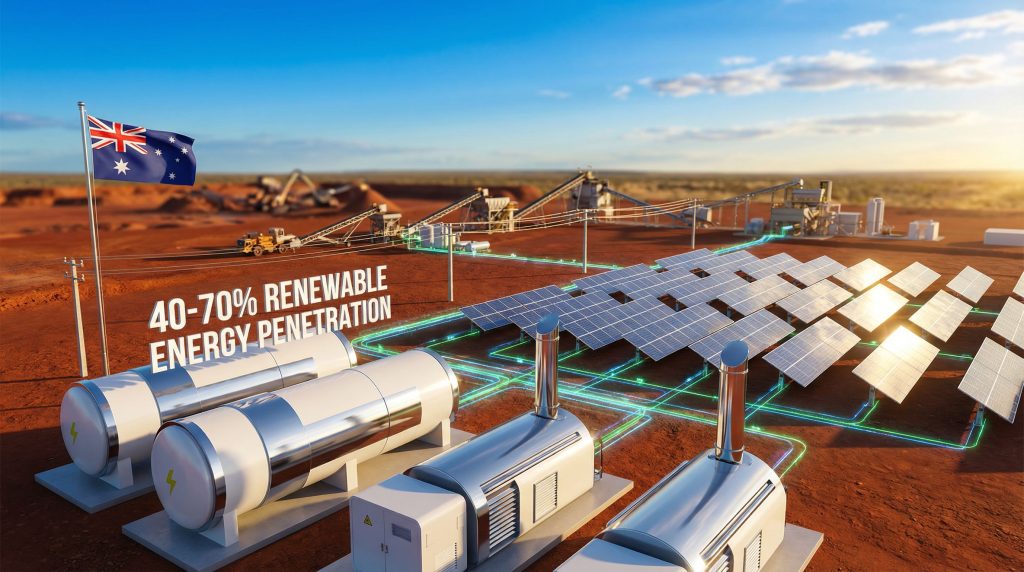
Leading hybrid installations consistently achieve 40-70% renewable energy penetration during optimal operating conditions. This performance translates to substantial fuel consumption reductions, with typical installations saving 1.5-2.5 million litres of diesel annually per MW of hybrid capacity.
Carbon footprint improvements range from 3,000-5,000 tonnes CO₂ reduction per MW annually, supporting corporate sustainability reporting requirements. System availability exceeds 99% through redundant generation sources and predictive maintenance protocols, which aligns with broader mining industry innovation trends.
Operational Efficiency Indicators
Consequently, key performance improvements include:
- Maintenance cost optimisation: 30-50% reduction in generator service requirements
- Fuel logistics simplification: Reduced diesel transport and storage infrastructure
- Remote monitoring capability: 60-80% reduction in on-site technical requirements
- Grid stability improvement: Enhanced power quality for sensitive processing equipment
The next major ASX story will hit our subscribers first
Regional Suitability Assessment for Hybrid Power Implementation
Solar Resource and Infrastructure Analysis
Australian mining regions demonstrate varying suitability for hybrid renewable development based on solar irradiance, commodity types, and infrastructure readiness:
| Mining Region | Solar Resource (kWh/m²/day) | Primary Commodities | Infrastructure Rating |
|---|---|---|---|
| Pilbara, WA | 6.5-7.2 | Iron ore, lithium | Excellent |
| Goldfields, WA | 6.0-6.8 | Gold, nickel | Excellent |
| Mount Isa, QLD | 5.8-6.5 | Copper, zinc, lead | Very Good |
| Broken Hill, NSW | 5.5-6.2 | Silver, lead, zinc | Good |
Distance from Grid Infrastructure
Remote mine sites located 50km+ from existing grid connections demonstrate the highest return on investment potential for hybrid power solutions. Road access quality significantly affects battery and solar panel transportation logistics, while local skilled workforce availability influences construction and maintenance cost structures.
Furthermore, the Eva Copper Mine project benefits from established regional infrastructure supporting the Mount Isa mining district, including transportation corridors and technical service providers. Construction activities are expected to generate regional employment opportunities while supporting local contracting and supply partnerships.
Power Purchase Agreement Architecture and Commercial Terms
Contract Structure and Risk Allocation
The Eva project's 15-year minimum term reflects industry standard PPA durations for major mining installations. These extended contract periods enable energy providers to amortise capital investments while providing mining operations with long-term cost predictability.
Technology refresh schedules maintain system efficiency over contract terms spanning 15-25 years. Equipment salvage value provisions enable potential relocation to alternative mining sites, supporting operational flexibility as resource development evolves.
Financial Modelling for Mine Life Cycle Integration
Net present value calculations must incorporate mine expansion scenarios, production ramp-up schedules, and commodity price volatility. Carbon credit monetisation provides additional revenue opportunities under Australian carbon markets, while fuel price hedging mechanisms protect against diesel cost fluctuations.
Performance guarantees typically include availability targets, renewable penetration commitments, and emissions reduction benchmarks. These contractual elements ensure service providers maintain optimal system performance while supporting mining company sustainability objectives.
Regulatory Framework and Environmental Considerations
ESG Compliance and Reporting Requirements
Mining companies face increasing investor scrutiny regarding environmental performance, particularly Scope 1 and 2 emissions reduction targets. Hybrid renewable systems significantly contribute to corporate sustainability metrics while simplifying environmental impact assessments for new project development.
Indigenous land use agreements may favour renewable energy solutions due to reduced environmental impact compared to traditional power infrastructure. Water usage minimisation through reduced diesel transport and storage requirements supports environmental permitting processes in water-scarce mining regions.
Policy Support and Incentive Mechanisms
Australian government initiatives support renewable energy adoption in mining through various mechanisms:
- Australian Renewable Energy Agency (ARENA) funding for demonstration projects
- Accelerated depreciation schedules for renewable energy infrastructure investments
- Clean Energy Finance Corporation debt financing for large-scale installations
- State government renewable energy targets creating favourable regulatory environments
These policy frameworks complement corporate sustainability drivers, though specific project support depends on individual circumstances and application processes. Moreover, these initiatives align with broader energy transition insights shaping the sector.
Future Technology Integration and Market Evolution
Emerging Innovation Pathways
Next-generation mining power systems will integrate advanced technologies beyond traditional solar-battery-thermal configurations. Green hydrogen production using excess renewable capacity during low-demand periods offers potential revenue diversification while supporting industrial decarbonisation objectives.
Electric vehicle charging infrastructure for autonomous mining equipment represents another integration opportunity. Microgrid interconnection between adjacent mining operations could enable power sharing and improved system resilience across regional mining districts.
Competitive Landscape Development
Independent Power Producer consolidation is creating larger, more sophisticated market participants capable of delivering complex hybrid installations. Technology cost reduction curves make hybrid solutions economically viable for smaller mining operations previously dependent on diesel generation.
In addition, energy storage duration extension through emerging battery technologies will enable higher renewable penetration rates. Grid-scale battery recycling programmes address end-of-life environmental concerns while supporting circular economy principles.
Investment Decision Framework for Mining Companies
Technology Selection and Due Diligence
Mining operators should prioritise proven technology combinations over experimental solutions to minimise operational risk during critical production phases. Vendor track records in similar mining environments provide valuable performance validation for major capital commitments.
Strategic Consideration: Due diligence should examine service provider financial stability, technical capabilities, and maintenance support infrastructure across project lifecycles spanning 15-25 years.
Implementation Timeline and Project Management
Typical project development requires 12-18 months from contract execution to commissioning. Staged deployment options allow gradual capacity expansion aligned with mining production schedules while minimising initial capital exposure.
Commissioning and testing protocols ensure seamless integration with existing operations. Training requirements for mine personnel operating hybrid power systems must be incorporated into project timelines and budgeting considerations.
Performance Monitoring and Optimisation
Real-time energy management dashboards provide operational visibility enabling data-driven optimisation decisions. Predictive analytics identify optimal renewable-thermal dispatch schedules while regular performance reviews ensure continued system efficiency improvements.
Benchmarking against industry best practices supports continuous improvement initiatives. Performance data sharing with service providers enables system optimisation and efficiency gains across the operational lifecycle.
What Are the Key Challenges in Hybrid Power Implementation?
However, mining companies must address several critical considerations when evaluating Aggreko renewable hybrid power facility implementations:
The primary challenge involves coordinating complex project timelines with mining production schedules. Construction activities must minimise operational disruption while ensuring power supply continuity throughout the transition period.
Furthermore, technical integration requires detailed analysis of existing electrical infrastructure and processing equipment compatibility. Legacy systems may require upgrades to accommodate hybrid power quality characteristics and switching protocols.
Additionally, workforce training programmes must address new operational procedures and safety protocols specific to hybrid energy systems. This includes emergency response procedures and routine maintenance requirements for both renewable and thermal generation components.
How Do Hybrid Solutions Address Energy Export Market Dynamics?
The energy exports challenges facing Australia's mining sector create additional value propositions for hybrid power adoption. Reduced reliance on fossil fuel imports improves project economics while supporting national energy security objectives.
Consequently, hybrid installations demonstrate resilience against global energy price volatility while providing mining companies with stable, predictable power costs throughout extended contract periods. This stability supports long-term project financing and improves overall investment certainty.
Disclaimer: This analysis is based on publicly available information and industry benchmarks. Specific project economics, performance metrics, and contractual terms may vary significantly based on site conditions, commodity types, and operational requirements. Mining companies should conduct detailed feasibility studies and engage qualified technical advisors before making investment decisions regarding hybrid renewable power systems.
Considering Hybrid Power Solutions for Your Mining Operations?
Discovery Alert's proprietary Discovery IQ model delivers real-time alerts on significant ASX mineral discoveries, instantly empowering subscribers to identify actionable opportunities in mining technology and energy infrastructure developments ahead of the broader market. Understand why major mining sector discoveries can lead to substantial returns by exploring Discovery Alert's dedicated discoveries page, showcasing historic examples of exceptional outcomes in the resources sector.