
May 13, 2026
The complex web of regulatory decisions surrounding mining operations often reveals tensions between economic stability, environmental commitments, and stakeholder obligations that extend far beyond individual project boundaries. When financial distress intersects with resource extraction licensing, the resulting policy choices can illuminate fundamental questions about how governments balance competing interests across multiple time horizons, particularly regarding the mining permitting process.
Strategic Framework for Mining License Extension Assessment
Mining license extensions in NSW operate within a sophisticated regulatory environment where economic, environmental, and social factors converge to influence decision-making processes. The assessment framework involves multiple stakeholders, each bringing distinct priorities to the evaluation process.
Regulatory Architecture and Assessment Protocols
The NSW Planning Department employs a multi-layered assessment approach for mining license extensions that balances operational continuity against environmental impact thresholds. This framework typically involves comprehensive technical reviews spanning 12-18 months, integrating existing coal lease obligations with mining lease requirements to ensure regulatory coherence.
Key Assessment Components:
- Environmental impact evaluation and compliance history
- Economic contribution analysis including employment and regional benefits
- Technical feasibility assessments for extended operations
- Community consultation outcomes and stakeholder feedback
- Integration with state energy transition planning
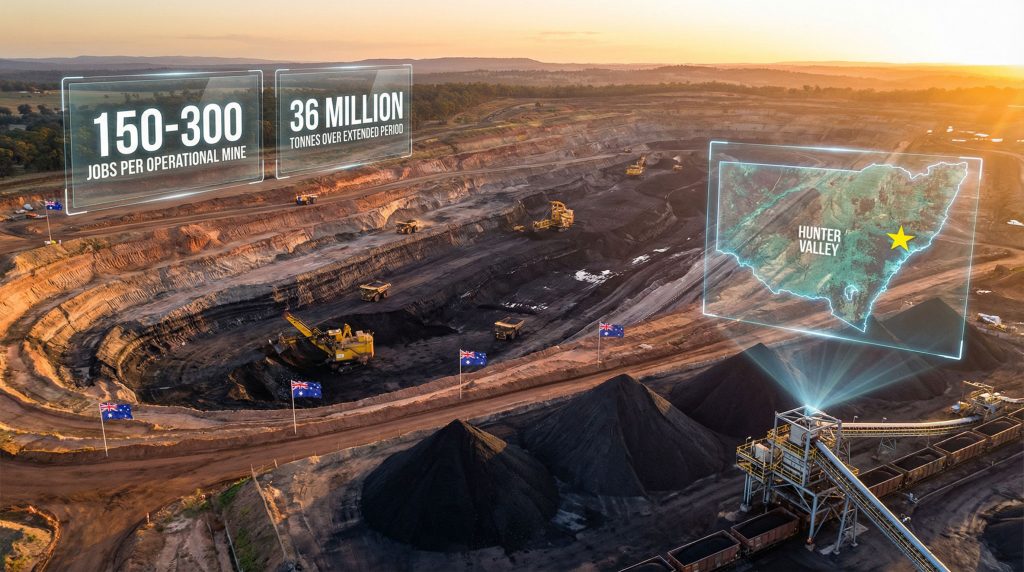
The recent six-year extension to Dartbrook coal mine demonstrates this framework in practice, where the operation received approval to continue until 2033 despite significant financial and operational challenges. This decision enables extraction of an additional 36 million tonnes of coal over the extended period, representing substantial resource access that influences both asset valuation and regional economic planning.
Economic Impact Modeling for Regional Communities
Mining operations generate complex economic multiplier effects that extend throughout regional supply chains and community structures. These impacts become particularly significant when operations face financial distress, as the cascading effects can influence entire regional economies.
Direct Economic Contributions:
- Primary employment: Current Dartbrook workforce of 150 employees (reduced from 450 pre-insolvency)
- Contractor networks: Local operators reporting hundreds of thousands in outstanding receivables
- Infrastructure utilisation: Coal handling plant operations and transport network capacity
- Local government revenue: Rates, development contributions, and regional development funding
The reduction in Dartbrook's workforce from 450 to 150 employees illustrates how financial distress can rapidly contract regional employment, while the $5 million owed to unsecured creditors demonstrates the broader supply chain exposure that accompanies mining insolvencies.
When big ASX news breaks, our subscribers know first
Financial Distress Patterns and Insolvency Mechanisms
Australian coal mining operations face distinct insolvency patterns that reflect the capital-intensive nature of resource extraction, commodity price volatility, and complex debt structures that characterise the sector. Furthermore, understanding management red flags can help investors identify potential issues before they escalate.
Default Triggers and Insolvency Cascades
Mining insolvencies typically emerge from loan covenant breaches or operational cash flow shortfalls that compromise debt serviceability. The Dartbrook case exemplifies this pattern, where the operation defaulted on a $202 million loan in mid-2025, triggering receivership proceedings that fundamentally altered operational parameters.
Insolvency Timeline Analysis:
- Initial distress signals: Operational challenges and cash flow constraints
- Covenant breach: Failure to meet debt service obligations ($202 million default)
- Receivership appointment: FTI Consulting assumes asset management
- Workforce reduction: 67% staff reduction from 450 to 150 employees
- Care and maintenance: Temporary operational suspension until restart attempts
Creditor Recovery Frameworks in Mining Insolvencies
The complexity of mining asset structures creates distinct recovery patterns for different creditor classes, with secured lenders typically achieving higher recovery rates than unsecured creditors or trade suppliers.
| Creditor Category | Typical Recovery Range | Recovery Timeline | Priority Status |
|---|---|---|---|
| Secured Lenders | 60-80% | 6-12 months | First priority |
| Equipment Lessors | 40-60% | 12-18 months | Second priority |
| Trade Creditors | 10-30% | 18-24 months | General unsecured |
| Employee Entitlements | 90-100% | 3-6 months | Statutory priority |
The Dartbrook insolvency reveals how unsecured creditor recovery can be severely compromised, with local operators facing potential bankruptcy due to unpaid invoices. As noted by Muswellbrook Chronicle, Mayor Jeff Drayton highlighted that the outstanding debts represent enough financial exposure to force small businesses into insolvency themselves.
Receivership Operations and Asset Preservation
Receivers balance asset preservation against operational continuity, often implementing care and maintenance protocols while pursuing asset sales to maximise creditor recovery. FTI Consulting's approach at Dartbrook demonstrates this balance, maintaining minimal operations with 150,000 tonnes of coal stockpiled while actively pursuing sale negotiations with multiple interested parties.
The receivership strategy prioritises extending operational licenses to enhance asset marketability, with the six-year extension to Dartbrook coal mine serving as a critical component in attracting buyer interest and maximising asset value for creditor recovery.
Asset Valuation Impact of Extended Licensing
Mining license extensions directly influence asset valuation by extending operational timelines, increasing recoverable reserves, and improving financing capacity for both existing operators and potential purchasers. Moreover, the mining claims framework provides essential structure for understanding tenure rights.
Net Present Value Enhancement Through License Extensions
Extended licensing periods fundamentally alter Net Present Value calculations by extending cash flow horizons and reducing stranded asset risk. The six-year extension to Dartbrook coal mine enables additional extraction of 36 million tonnes of coal, representing substantial value creation that enhances the asset's attractiveness to potential buyers.
Value Creation Mechanisms:
- Extended extraction period: Additional 6 years of operational capacity
- Reserve access: 36 million tonnes additional recoverable coal
- Buyer confidence: Reduced regulatory uncertainty for acquirers
- Financing capacity: Extended tenure improves debt serviceability projections
Market Positioning and Buyer Interest Correlation
License extensions directly correlate with buyer interest, as demonstrated by the emergence of two interested parties following Dartbrook's extension approval. This validates the theoretical framework linking tenure security with asset marketability and investment attractiveness.
Muswellbrook Shire Mayor Jeff Drayton emphasised this relationship, noting that the extension through 2033 would make Dartbrook "much more saleable" and enable restart of production and employment. This assessment reflects practical recognition that extended licenses reduce acquisition risk and improve operational planning horizons for potential buyers.
Infrastructure Optimisation and Production Capacity
Extended licenses enable infrastructure optimisation through longer amortisation periods and improved capacity utilisation. The existing coal handling plant and transport infrastructure at Dartbrook can be utilised more efficiently across extended operational timelines, improving overall project economics.
Operational Capacity Factors:
- Current stockpile: 150,000 tonnes of processed coal ready for sale
- Infrastructure assets: Coal handling plant, transport connections, processing facilities
- Production potential: Capacity to process millions of tonnes annually across extended license period
- Export positioning: Access to thermal coal export markets through established logistics networks
Stakeholder Interest Alignment in Extension Decisions
Mining extension decisions require balancing diverse stakeholder interests, from local communities and regional governments to state policy objectives and industry participants. The complexity of these relationships creates both opportunities and tensions in decision-making processes.
Local Government Economic Development Priorities
Regional governments face particular challenges in balancing economic development priorities against environmental commitments, especially when mining operations provide significant employment and revenue streams. The Muswellbrook Shire Council's position illustrates this tension, supporting the extension while demanding creditor payment resolution.
Local Government Considerations:
- Rate base preservation: Mining operations contribute substantial local government revenue
- Employment maintenance: Regional job security for affected communities
- Supply chain protection: Support for local contractors and service providers
- Community facility funding: Mining company contributions to regional infrastructure
Mayor Jeff Drayton's characterisation of creditor debts as sufficient to force small businesses into bankruptcy highlights the interconnected nature of regional mining economies, where operational disruptions can cascade through entire supply chains.
State Government Policy Balancing Framework
State government decision-making must integrate multiple policy objectives, including economic development, environmental commitments, energy transition planning, and regional stability considerations. This creates complex trade-offs between immediate economic benefits and longer-term strategic objectives.
Strategic Policy Tension: NSW government must balance coal industry employment preservation with net-zero emissions commitments by 2050, creating inherent tension between short-term economic stability and long-term environmental objectives.
Policy Integration Challenges:
- Transition timeline management: Balancing gradual versus accelerated coal sector phase-out
- Revenue dependency: Coal royalties funding state infrastructure and services
- Federal alignment: Coordinating with national energy security policies
- International commitments: Managing export relationships alongside climate commitments
Dave Layzell, State Member for Upper Hunter, characterised the extension decision as a "lost opportunity" for leveraging approval as a bargaining mechanism for creditor payment resolution. His perspective reflects broader concerns about conditional approval structures that could better protect stakeholder interests.
Risk Assessment Framework for Future Operations
Mining extension decisions must account for multiple risk categories, including corporate governance concerns, operational competency, market volatility, and regulatory uncertainty that can influence long-term project viability. Additionally, understanding industry consolidation insights helps investors navigate changing market dynamics.
Corporate Governance and Operational Risk Evaluation
The Dartbrook case illustrates the importance of corporate governance assessment in extension decisions, given the ongoing investigations into potential conflicts of interest and related party transactions. Whistleblower complaints regarding preferred supplier arrangements and senior management conflicts highlight governance risks that can influence operational sustainability.
Governance Risk Indicators:
- Management integrity: Investigation outcomes and whistleblower complaint resolution
- Related party transactions: Conflicts of interest in supplier selection and contract awards
- Financial transparency: Reporting standards and audit compliance
- Operational competency: Technical expertise and safety performance records
The preliminary investigation report detailing apparent conflicts of interest by senior managers demonstrates how governance issues can compound financial distress and undermine stakeholder confidence in operational management.
Market and Regulatory Risk Scenario Analysis
Future mining operations face significant uncertainty regarding energy transition timelines, coal demand patterns, and evolving regulatory frameworks that can influence project viability across extended operational periods.
Scenario 1: Accelerated Energy Transition (2027-2030)
- Demand decline: Rapid reduction in thermal coal demand from major importing nations
- Price impact: 40-60% reduction in thermal coal pricing affecting project economics
- Operational response: Early closure provisions and workforce transition planning
- Asset impact: Increased stranded asset risk requiring accelerated depreciation
Scenario 2: Extended Coal Demand (2027-2035)
- Market stability: Sustained Asian thermal coal demand supporting current pricing
- Investment opportunity: Infrastructure investment and workforce expansion potential
- Regional benefits: Continued employment and economic development in coal-dependent regions
- Policy tension: Conflict between market demand and emissions reduction commitments
The six-year extension to Dartbrook coal mine provides operational flexibility across both scenarios, enabling continued operations if demand persists while maintaining closure optionality if market conditions deteriorate.
Regional Economic Development and Transition Planning
Mining extension decisions significantly influence regional economic development trajectories, particularly in areas where coal operations represent primary economic drivers and employment sources. Consequently, recent examples like the mineral resources halt highlight the broader implications of project disruptions.
Workforce Transition and Skills Development
The reduction in Dartbrook's workforce from 450 to 150 employees demonstrates how financial distress can rapidly contract regional employment, while highlighting the importance of skills transferability and retraining programs for affected workers.
Workforce Transition Considerations:
- Current employment: 150 employees maintaining operations (down from 450 pre-insolvency)
- Skill transferability: Mining expertise applicable to renewable energy infrastructure projects
- Training programmes: Government-funded transition initiatives for coal workers
- Regional diversification: Development of tourism, agriculture, and renewable energy sectors
The anonymous local operator's observation that workers question future employment with operations facing such instability reflects broader workforce confidence issues that extend beyond immediate employment numbers.
Infrastructure Investment and Community Development
Extended mining licenses influence infrastructure investment decisions and community facility funding that can outlast specific operations, creating long-term regional development benefits that justify extension approvals despite short-term challenges.
Infrastructure Development Framework:
- Transport networks: Rail capacity and port access maintenance for multiple operations
- Utility infrastructure: Power, water, and telecommunications systems supporting regional development
- Community facilities: Mining company contributions to schools, hospitals, and recreational facilities
- Environmental rehabilitation: Post-closure land use planning and restoration programmes
The preservation of coal handling plant infrastructure and transport connections at Dartbrook maintains regional capacity for future operations while supporting broader Hunter Valley coal logistics networks.
The next major ASX story will hit our subscribers first
Best Practice Framework for Future Extension Decisions
The complexity of stakeholder interests and risk factors in mining extension decisions suggests the need for enhanced decision-making frameworks that better integrate economic, environmental, and social considerations. Furthermore, NSW planning portal guidelines provide regulatory clarity for such decisions.
Enhanced Due Diligence and Assessment Protocols
Future extension decisions could benefit from enhanced due diligence requirements that address financial stability, corporate governance, and stakeholder protection mechanisms more comprehensively.
Recommended Assessment Enhancements:
- Financial stability evaluation: Enhanced assessment of debt serviceability and operational cash flow
- Governance review: Investigation of management integrity and related party transaction protocols
- Stakeholder consultation: Structured community input processes with transparent reporting
- Economic impact measurement: Quantifiable metrics for regional economic contribution assessment
Conditional Approval Structures and Performance Requirements
The concept of conditional approvals, as suggested by Dave Layzell regarding creditor payment resolution, represents a potential mechanism for better protecting stakeholder interests while maintaining operational flexibility.
Conditional Framework Options:
- Performance-based extensions: Approval contingent on meeting operational and financial benchmarks
- Creditor protection requirements: Security deposits or guarantee structures for unsecured creditor protection
- Community benefit obligations: Mandatory contributions to regional development and transition planning
- Transparency requirements: Public reporting of operational and financial performance metrics
Such frameworks could address the tension between immediate extension approval and broader stakeholder protection, ensuring that license extensions contribute to sustainable regional development rather than simply extending operational uncertainty.
The six-year extension to Dartbrook coal mine illustrates both the potential benefits and risks of mining extension decisions, where asset preservation and regional economic considerations must be balanced against creditor protection and governance concerns. Future policy development can benefit from these practical experiences to create more robust frameworks that better serve all stakeholder interests while maintaining operational flexibility for viable mining operations.
The strategic implications of coal mine extension decisions extend far beyond individual operations, affecting regional economic stability, environmental planning, and energy transition management. Successful policy frameworks must integrate comprehensive risk assessment, stakeholder protection mechanisms, and long-term strategic planning to optimise outcomes across competing interests while maintaining operational viability for economically sustainable mining operations.
Ready to Stay Ahead of Market-Moving Mining Developments?
Discovery Alert's proprietary Discovery IQ model delivers real-time alerts on significant ASX mineral discoveries, enabling subscribers to identify actionable investment opportunities before they hit mainstream investor radar. Whether you're tracking exploration successes or monitoring corporate developments like the Dartbrook extension, begin your 14-day free trial at Discovery Alert today to gain essential market intelligence that positions you ahead of the curve.