June 17, 2026
Large-scale mining project cost escalations reflect systemic challenges within modern resource extraction operations, particularly when companies venture into emerging commodity markets. The intersection of complex geological conditions, remote infrastructure requirements, and volatile construction markets creates a perfect storm for capital expenditure overruns that can reshape entire project economics. Understanding these dynamics requires examining the fundamental drivers behind mining cost inflation and their cascading effects on project viability, while considering broader inflation and tariff pressures affecting global construction costs.
What Drives Major Mining Project Cost Escalations?
Mining project cost overruns stem from multiple interconnected factors that compound throughout lengthy development cycles. The BHP Jansen potash project cost increase exemplifies these challenges, with Stage 1 construction costs reaching USD 8.4 billion, representing a USD 1.2 billion increase from previous guidance that had already been revised upward from initial estimates of USD 5.7 billion.
Infrastructure Development Cost Variables in Resource Projects
Potash mining operations in Saskatchewan require extensive infrastructure investments that extend far beyond traditional mine development. The remote location necessitates comprehensive utility connections, transportation corridors, and specialised processing facilities designed for solution mining and evaporation processes. Unlike surface iron ore operations that can leverage existing infrastructure, greenfield potash developments must establish entirely new industrial ecosystems.
The specialised nature of potash extraction compounds infrastructure complexity. Solution mining requires sophisticated brine management systems, crystallisation facilities, and product handling infrastructure optimised for the unique properties of potassium chloride. These systems demand precision engineering and materials resistant to corrosive brine environments, significantly increasing both initial capital requirements and construction timelines.
Construction hour miscalculations frequently plague large-scale mining developments due to the specialised nature of mining infrastructure. Traditional construction productivity metrics often fail to account for the technical complexity of mining equipment installation, specialised ventilation systems, and safety infrastructure required in resource extraction operations.
Inflationary Pressures on Mining Capital Expenditure
The 2022-2026 period witnessed unprecedented inflation in construction materials, particularly affecting steel, concrete, and specialised mining equipment. Mining projects face additional inflationary pressure because they require highly specialised components with limited global suppliers, creating supply bottlenecks during periods of increased mining development activity.
Furthermore, skilled labour shortages represent a critical cost driver in Canadian mining developments. Saskatchewan's potash belt, while geologically advantageous, requires importing specialised mining construction workers, creating wage premiums and accommodation costs that compound project expenses. The technical nature of potash processing facility construction demands workers with specific experience in chemical processing and solution mining technologies.
In addition, currency fluctuation effects can be particularly pronounced for international mining companies. While BHP reports in USD, construction activities occur in Canadian dollars, creating exchange rate exposure throughout multi-year development timelines. The USD/CAD exchange rate volatility between initial project estimates and current guidance likely contributed to cost escalations beyond pure inflation effects.
When big ASX news breaks, our subscribers know first
How Do Potash Project Economics Compare to Traditional Mining Ventures?
Potash mining represents a distinct economic paradigm within the broader mining sector, characterised by higher capital intensity than iron ore operations but different risk profiles compared to underground copper developments. The capital requirements for greenfield potash projects typically range from USD 1,800-2,200 per tonne of annual production capacity, positioning them as moderately capital-intensive mining operations.
Capital Intensity Analysis: Potash vs Iron Ore vs Copper Operations
| Project Type | Typical CapEx per Tonne | Construction Timeline | Payback Period Range |
|---|---|---|---|
| Potash (Greenfield) | $1,800-2,200 | 6-8 years | 10-15 years |
| Iron Ore (Brownfield) | $400-800 | 3-5 years | 5-8 years |
| Copper (Underground) | $15,000-25,000 | 4-7 years | 8-12 years |
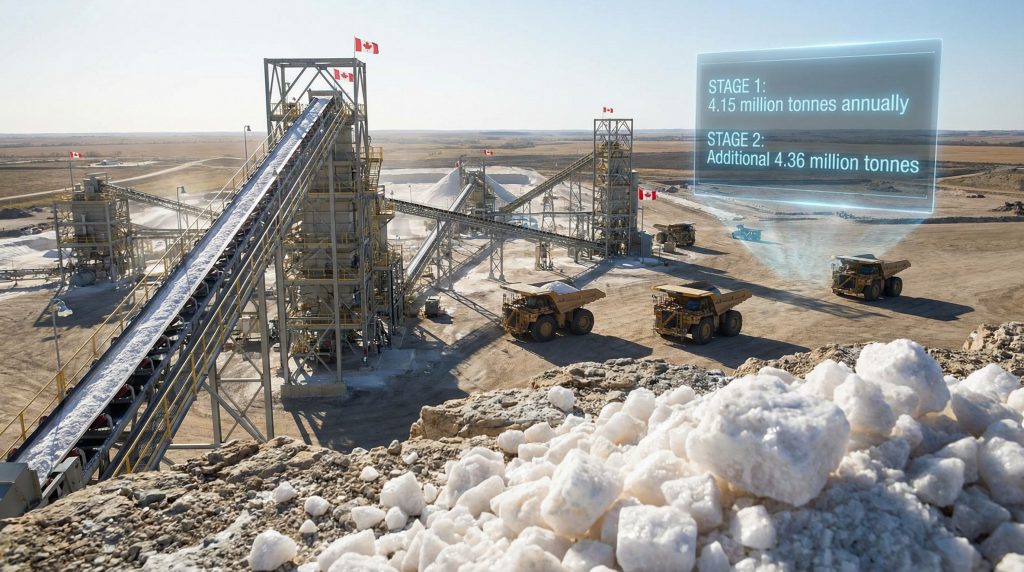
The Jansen project economics align closely with industry benchmarks for greenfield potash developments. Stage 1's revised capital expenditure of USD 8.4 billion divided by 4.15 million tonnes annual production capacity yields approximately USD 2,024 per tonne, falling within the expected range for potash operations. Notably, Stage 2 economics appear more favourable at approximately USD 1,376 per tonne, reflecting infrastructure synergies and learning curve benefits from Stage 1 development.
Iron ore operations benefit from relatively straightforward extraction and processing requirements, particularly in established mining regions like Western Australia's Pilbara. Surface mining operations with existing rail and port infrastructure can achieve substantially lower capital intensity, enabling shorter payback periods and higher returns on invested capital.
Meanwhile, underground copper mining commands the highest capital intensity due to complex shaft development, ore hoisting infrastructure, and extensive ventilation requirements. However, copper's higher unit value and processing margins can justify these elevated capital requirements, particularly in proven geological environments.
Production Ramp-Up Timelines in Fertiliser Mining
Potash operations typically experience extended ramp-up periods compared to hard rock mining. The Jansen project anticipates initial production by mid-2027 with full 4.15 million tonne annual capacity achieved by fiscal 2030, representing a three-year ramp-up timeline. This extended timeline reflects the complex nature of solution mining operations and the need to optimise brine concentration and crystallisation processes.
Stage 2 expansion, now projected for fiscal 2034, would add 4.36 million tonnes of additional capacity, creating a combined operation capable of 8.51 million tonnes of annual potash production. This phased approach allows operators to refine processes and establish market position before committing full capital to expansion phases.
Consequently, the extended timeline from construction to full production creates significant financing challenges for potash operations. Unlike iron ore projects that can achieve positive cash flow within 2-3 years, potash developments require patient capital capable of supporting 8-10 year development cycles before achieving target returns.
What Are the Strategic Implications for BHP's Portfolio Diversification?
BHP's entry into potash mining represents a calculated diversification strategy designed to reduce dependence on traditional commodity cycles while accessing growing agricultural markets. With iron ore comprising approximately 60% of current earnings, the company faces concentration risk in construction-dependent commodities subject to infrastructure spending cycles, particularly as the mining industry evolution continues reshaping sector dynamics.
Commodity Mix Optimisation in Major Mining Companies
The Jansen project, despite its substantial USD 14.4 billion total capital commitment (combining Stage 1 and Stage 2), represents approximately 6% of BHP's USD 44 per share fair value estimate. This relatively modest portfolio weighting suggests BHP views potash as a strategic diversification play rather than a transformative business pivot.
Potash markets operate on fundamentally different demand cycles compared to industrial metals. Agricultural demand for fertilisers correlates with population growth, crop yield requirements, and food security considerations rather than infrastructure spending or manufacturing activity. This demand profile potentially provides portfolio stability during industrial downturns while offering exposure to long-term demographic trends.
BHP's copper operations, generating substantial returns with unit cash costs at the lower end of the USD 1.20-1.50 per pound range, continue driving near-term value creation. Current copper prices around USD 6 per pound significantly exceed long-term assumptions of approximately USD 3.85 per pound, creating cyclical earnings strength that offsets potash development costs.
Geographic Risk Distribution Through Canadian Operations
The Saskatchewan location provides geographic diversification from BHP's concentrated Australian iron ore operations and Chilean copper assets. Canadian mining jurisdiction offers political stability, established regulatory frameworks, and predictable permitting processes that reduce sovereign risk compared to some emerging market mining locations.
Saskatchewan's potash belt represents one of the world's most favourable geological environments for potash extraction, with high-grade ore bodies and established transportation infrastructure connecting to global fertiliser markets. This geological advantage partially offsets the higher capital requirements associated with Canadian construction and labour costs.
Furthermore, the North American location provides advantageous access to major agricultural markets in the United States and Latin America, potentially reducing transportation costs and improving customer relationships compared to more distant potash producers.
How Do Investors Evaluate Mining Project Cost Overruns?
Mining project cost escalations trigger systematic investor evaluation processes focused on revised project economics, management credibility, and portfolio impact assessment. The BHP Jansen potash project cost increase exemplifies how investors must recalibrate expectations while assessing whether cost overruns reflect company-specific execution challenges or broader industry trends.
Understanding key risk assessment red flags becomes crucial when evaluating such situations. However, the complexity extends beyond simple cost comparisons to encompass fundamental project viability analysis.
Financial Impact Assessment Methodology
Net present value calculations require comprehensive revision when project costs increase substantially. The USD 1.2 billion Stage 1 cost increase necessitates updated discount rate assumptions, revised production timelines, and sensitivity analysis around commodity price assumptions. Internal rate of return calculations for Jansen likely now fall within a 7.9-9.1% range, reflecting the higher capital base against unchanged production targets.
Project economics evaluation must consider the time value of money impact from cost escalations. Funds allocated to cost overruns represent opportunity costs that could generate returns in alternative projects or shareholder distributions. The extended development timeline compounds this effect, as capital remains tied up in non-productive assets for longer periods.
Fair value adjustments for diversified mining companies require isolating project-specific impacts from broader portfolio performance. BHP's maintained USD 44 per share fair value estimate despite Jansen cost increases suggests that elevated copper prices and strong iron ore performance offset potash-related headwinds.
Market Response Patterns to Capital Expenditure Increases
"Mining companies typically experience 2-5% share price volatility following major project cost revisions, with recovery dependent on commodity price trajectories and production timeline certainty."
Investor psychology around mining project cost overruns often reflects broader concerns about management execution capability and project selection discipline. Companies with histories of cost control demonstrate greater market resilience when facing individual project challenges, while those with patterns of overruns face more severe valuation penalties.
The timing of cost revision announcements relative to commodity cycles significantly influences market response. Cost increases announced during strong commodity price environments typically receive more favourable investor reception than those disclosed during cyclical downturns when capital allocation scrutiny intensifies.
Market analysis suggests that investors differentiate between cost overruns attributable to external factors (inflation, regulatory changes) versus internal execution failures. BHP's ability to maintain production timelines despite cost increases signals project control capabilities that may mitigate investor concerns about management competency.
What Does Potash Market Positioning Mean for Long-Term Returns?
Potash market dynamics present unique investment characteristics that differ substantially from traditional mining commodities, offering exposure to agricultural demand growth while facing distinct competitive and cyclical challenges. Understanding these market fundamentals becomes crucial for evaluating long-term return potential from major potash investments like the Jansen project.
Global Fertiliser Demand Fundamentals
Population growth trajectories indicate continued expansion in global food requirements, driving structural demand for fertilisers that enhance crop yields. Potassium chloride represents an essential macronutrient that cannot be substituted in agricultural applications, creating relatively inelastic demand characteristics compared to industrial metals subject to technological substitution.
Emerging market agricultural development presents significant growth opportunities for potash consumption. Countries with expanding middle-class populations require increased food security, driving agricultural intensification that depends heavily on fertiliser applications. This demographic trend provides long-term demand visibility that differs from cyclical infrastructure-dependent commodities.
Food security considerations at the national level create strategic importance for potash supply chains. Countries seeking agricultural self-sufficiency must maintain reliable fertiliser access, potentially supporting premium pricing for secure supply relationships. This dynamic may benefit new entrants like BHP that can offer diversified supply sources.
Competitive Landscape Analysis in Potash Production
The global potash industry remains relatively concentrated amongst established producers with significant production capacity and established distribution networks. New entrants face challenges in establishing customer relationships and competing against producers with lower-cost, established operations.
Existing producer market share distribution favours companies with large-scale, low-cost operations that can weather commodity price cycles. BHP's entry represents a significant new production source that could influence market dynamics, particularly given the company's financial strength and marketing capabilities.
Price cycle characteristics in fertiliser markets tend to be less volatile than metals markets but can experience severe disruptions during agricultural crisis periods or geopolitical events affecting major producing regions. Understanding these cycles becomes critical for timing market entry and expansion decisions.
Entry barriers for new potash operations include substantial capital requirements, lengthy permitting processes, and the need for specialised extraction expertise. However, these same barriers protect established producers and potentially support long-term pricing power for successful operations.
How Should Investors Approach Mining Project Risk Assessment?
Systematic risk assessment frameworks for mining projects must account for technical, financial, and market uncertainties that can significantly impact project returns. The BHP Jansen experience illustrates the importance of comprehensive due diligence processes that anticipate potential cost escalations and timeline delays.
Construction Risk Evaluation Framework
Project completion percentages provide important progress indicators, with Jansen's 75% Stage 1 completion and 14% Stage 2 completion offering insight into construction risk exposure. Earlier-stage projects face greater uncertainty from unforeseen technical challenges, regulatory changes, and market condition shifts.
Critical path milestone identification helps investors understand key project dependencies and potential delay sources. Potash operations face unique technical milestones related to solution mining optimisation, brine processing efficiency, and product quality achievement that differ from traditional mining operations. Understanding project permitting challenges becomes essential for timeline assessment.
Contingency planning assessment becomes crucial given the history of mining project cost escalations. Companies with robust scenario planning and adequate financial flexibility demonstrate better capability to navigate unexpected challenges without compromising project viability.
Management track records in similar project types provide important guidance for risk assessment. Companies with demonstrated expertise in potash development may face lower execution risk than those entering new commodity markets, though external factors can affect even experienced operators.
Operational Risk Mitigation Strategies
Production target achievement probability analysis requires examining geological data, technical feasibility studies, and comparable project performance. Jansen's 4.15 million tonne Stage 1 capacity represents a significant production target that must be achieved for project economics to meet expectations.
Market timing considerations for first production in mid-2027 involve assessing potash price cycle positioning and competitive landscape evolution. Projects that achieve production during favourable market conditions benefit from enhanced early cash flows that improve overall project returns.
Expansion optionality represents valuable strategic positioning for mining assets. Stage 2's 4.36 million tonne expansion potential provides BHP with growth options that can be exercised based on market conditions and Stage 1 operational experience, creating additional value beyond initial development.
The next major ASX story will hit our subscribers first
What Are the Broader Mining Industry Cost Trend Implications?
The BHP Jansen potash project cost increase reflects broader mining industry challenges that extend beyond individual company execution issues. Understanding these systemic trends becomes essential for evaluating mining investments and anticipating future project development costs across the resource sector. Companies facing such challenges often explore various capital raising methods to maintain project viability.
Capital Efficiency Benchmarking Across Resource Sectors
Mining project delivery performance metrics across the industry indicate widespread challenges in maintaining original cost estimates throughout multi-year development cycles. Inflationary pressures, skilled labour shortages, and increasingly complex environmental requirements contribute to systematic cost escalation trends affecting most major mining developments.
Cost control best practices from successful mining developments emphasise the importance of comprehensive feasibility studies, conservative initial estimates, and robust project management systems. Companies that consistently deliver projects within budget typically employ phased development approaches, extensive pre-construction planning, and experienced project management teams.
Lessons learned from comparable potash project developments globally suggest that geological complexity, infrastructure requirements, and regulatory compliance represent the most significant cost risk factors. Projects that adequately account for these challenges in initial estimates demonstrate better cost control throughout development phases.
Investment Decision Framework for Resource Project Evaluation
Due diligence checklists for mining project cost estimates should include sensitivity analysis for construction inflation, labour cost escalation, and regulatory requirement changes. Historical analysis of similar projects provides important benchmarking data for assessing estimate reliability and identifying potential cost risk sources.
Risk-adjusted return calculation methodologies must account for the probability of cost overruns and timeline delays when evaluating mining project investments. Monte Carlo analysis and scenario modelling help investors understand the range of potential outcomes and assess whether expected returns justify the risk exposure.
Portfolio allocation considerations for mining equity investments should recognise the correlation between different mining projects during cost inflation periods. Diversification across commodity types, geographic regions, and development stages can help mitigate exposure to systematic cost escalation trends affecting the entire mining sector. Recent mining production updates highlight how these trends continue affecting major producers globally.
Disclaimer: Mining project investments involve substantial risks including cost overruns, production delays, commodity price volatility, and regulatory changes. The information presented reflects current guidance and market conditions that may change materially. Investors should conduct thorough due diligence and consider professional advice before making investment decisions. Past performance does not guarantee future results, and all investments carry the risk of loss.
Ready to Capitalise on the Next Major Mineral Discovery?
Discovery Alert's proprietary Discovery IQ model delivers real-time alerts on significant ASX mineral discoveries, instantly empowering subscribers to identify actionable opportunities ahead of the broader market. Understand why historic discoveries can generate substantial returns by exploring major mineral finds that have transformed investor portfolios, then begin your 30-day free trial today to position yourself ahead of the market.