May 26, 2026
Mining rare earths with microbes represents a paradigm shift in extractive metallurgy that challenges decades of chemical-intensive processing protocols. Traditional approaches to critical raw materials supply rely on aggressive acid leaching systems that create environmental liabilities extending far beyond operational timelines. Recent advances in biohydrometallurgical engineering demonstrate that microbial metabolism can achieve comparable recovery rates while operating within ecological tolerance windows that preserve soil chemistry and groundwater systems.
The intersection of biotechnology and mineral processing has evolved from laboratory curiosity to industrial-scale demonstration, driven by regulatory pressures and supply chain security imperatives. As global demand for heavy rare earth elements intensifies through renewable energy deployment and advanced manufacturing requirements, the technical limitations of conventional extraction methods become increasingly apparent. Furthermore, biohydrometallurgical pathways offer process chemistry advantages that extend beyond environmental compliance to encompass operational efficiency and resource selectivity.
Understanding Biohydrometallurgical Processes for Critical Mineral Recovery
Biohydrometallurgical processes operate through fundamentally different mechanisms compared to conventional chemical leaching systems. Rather than forcing ion exchange through pH manipulation and chemical oxidation, mining rare earths with microbes relies on metabolic precision to create selective binding environments for target elements.
Fundamental Mechanisms of Microbial Metal Extraction
Biosorption and bioleaching represent distinct pathways for metal recovery through biological systems. Biosorption involves passive metal binding through cell surface chemistry, where polysaccharides, proteins, and lipopolysaccharides on bacterial cell walls physically attract and accumulate metal ions without requiring metabolic energy input. This process occurs rapidly over hours to days but remains reversible and non-selective.
Bioleaching employs active metabolic processes where microorganisms metabolise organic substrates and produce organic acids such as citric acid and oxalic acid, amino acids, and siderophores that form stable complexes with rare earth elements. The metabolic intermediates create pH-buffering environments and enable selective chelation, which proves critical for rare earth extraction where selectivity determines commercial viability.
Recent industrial-scale trials demonstrate the practical effectiveness of these mechanisms. A comprehensive study involving 3,000 tons of ore achieved 95% total rare earth recovery in 60 days, with heavy rare earth yield improvements of 50% compared to ammonium sulfate leaching methods. The process operated at near-neutral pH levels between 5.0 and 8.0, maintaining compatibility with natural soil systems.
Protein-Mediated Chelation and pH Optimisation
The protein-mediated chelation process enables bacterial metabolites to form complexes with rare earth ions, facilitating extraction while maintaining soil integrity. This mechanism operates through bacterial cell surface proteins and metabolic byproducts that demonstrate preferential affinity for specific lanthanide ions.
pH optimisation windows reveal significant operational advantages:
- Traditional acid leaching: pH 1.5-3.0 requiring continuous acid input
- Biohydrometallurgical processes: pH 5.0-8.0 maintaining natural soil compatibility
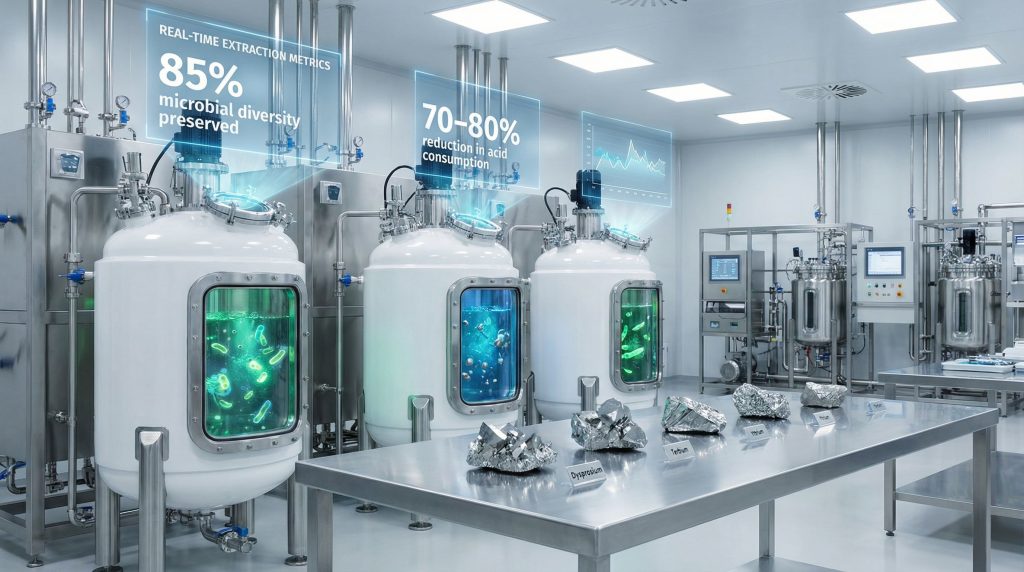
- Acid consumption reduction: 70-80% decrease compared to conventional methods
- Long-term soil acidification prevention through near-neutral operating conditions
Microorganism Selection and Engineering Criteria
Post-treatment microbial community analysis reveals the resilience of biological systems under biohydrometallurgical conditions. DNA sequencing analysis identifies dominant bacterial phyla including Clostridia and Proteobacteria, which fulfil functional roles in organic matter decomposition and carbon-nitrogen cycling.
The selection criteria for effective microorganisms encompass several technical parameters:
- Temperature tolerance: Operating range of 25-45°C for industrial applications
- pH adaptability: Functional capacity across neutral to slightly alkaline conditions
- Metabolic efficiency: Organic acid and siderophore production rates
- Ecosystem compatibility: Minimal disruption to native microbial communities
When big ASX news breaks, our subscribers know first
What Are the Key Technical Advantages Over Conventional Extraction Methods?
The technical advantages of microbial extraction extend across multiple operational parameters, creating compound benefits for process economics and environmental compliance. In addition, comparative analysis reveals systematic improvements in energy efficiency, chemical consumption, and operational complexity.
Process Chemistry Comparisons
Operational Parameter Comparison:
| Parameter | Acid Leaching | Microbial Extraction |
|---|---|---|
| Operating pH | 1.5-3.0 | 5.0-8.0 |
| Temperature | 60-90°C | 25-45°C |
| Pressure Requirements | Atmospheric to 5 bar | Atmospheric |
| Chemical Consumption | High (H₂SO₄, HCl) | Minimal (nutrients only) |
| Energy Intensity | 150-200 kWh/tonne | 50-80 kWh/tonne |
Energy efficiency represents a primary competitive advantage. Microbial extraction operates at ambient-to-moderate temperatures, eliminating the energy-intensive heating required for acid leaching operations. This thermodynamic efficiency translates to 60-67% energy reduction per unit of ore processed, directly impacting operational costs and carbon footprint calculations.
Chemical input minimisation reduces hazardous material inventory. Rather than requiring continuous strong acid maintenance, bioleaching relies on microbial metabolism sustained through simple nutrient inputs including nitrogen, phosphorus, and carbon sources. This approach aligns with sustainable mining practices by reducing hazardous chemical inventory, associated containment infrastructure, and worker safety risks.
Selectivity and Recovery Efficiency Metrics
The selectivity advantage of microbial systems enables preferential extraction of high-value heavy rare earth elements while maintaining lower extraction rates for abundant light rare earths. Industrial trial data demonstrates 50% yield improvements for heavy rare earth elements including dysprosium, terbium, and erbium compared to non-selective chemical leaching methods.
Recovery kinetics and separation factors:
- Heavy rare earth preferential extraction: Enhanced affinity for dysprosium, terbium, erbium
- Processing timeline: 60-day extraction cycles for industrial-scale operations
- Recovery efficiency: 95% total rare earth recovery achieved in controlled trials
- Separation factor improvements: Elevated selectivity ratios compared to conventional methods
Economic impact calculations demonstrate substantial operational savings. For a hypothetical 10,000-tonne annual operation:
- Acid leaching energy consumption: 1,750,000 kWh annually
- Bioleaching energy consumption: 650,000 kWh annually
- Annual energy savings: 1,100,000 kWh
- Cost reduction: $110,000 annually at average industrial electricity rates
Which Rare Earth Elements Respond Best to Microbial Processing?
Rare earth elements demonstrate variable responses to microbial processing, with distinct patterns emerging across the lanthanide series. The preferential extraction of heavy rare earth elements represents a significant commercial advantage due to supply constraints and elevated market pricing for these critical materials. Furthermore, this selectivity directly supports critical minerals energy transition objectives.
Heavy Rare Earth Element Recovery Performance
Dysprosium and terbium extraction shows enhanced efficiency under microbial processing conditions. These elements serve critical functions in high-temperature permanent magnets for wind turbine generators and aerospace applications. The 50% yield improvement for heavy rare earth elements indicates stronger microbial cell-surface binding affinity or more favourable equilibrium kinetics for heavier lanthanides.
Erbium processing addresses telecommunications infrastructure demands. Erbium serves essential roles in fibre optic amplifiers supporting data centre infrastructure growth. The preferential extraction capability demonstrated in industrial trials positions biohydrometallurgical processing as particularly valuable for telecommunications-grade rare earth supply chains.
Market value considerations amplify the economic significance of heavy rare earth selectivity:
- Heavy rare earth pricing: 5-10 times higher than light rare earth elements
- Supply constraint factors: Limited global production capacity outside China
- Strategic importance: Critical for defence and renewable energy applications
- Processing efficiency: Higher yields per unit of processing effort and energy input
Light Rare Earth Element Processing Challenges
Neodymium and praseodymium represent high-volume applications but present distinct scaling challenges for microbial systems. Their abundance in ore deposits creates high throughput requirements that may challenge bioreactor capacity and residence time economics. However, these materials remain essential for renewable energy integration in electric motors and wind turbines.
Volume considerations for light rare earth processing:
- Electric vehicle demand: Neodymium permanent magnet motors driving volume requirements
- Wind energy applications: Praseodymium usage in generator magnetic assemblies
- Throughput challenges: High-volume production scaling for microbial systems
- Economic thresholds: Processing economics influenced by lower per-kilogram values
Cerium applications and processing economics present additional considerations. Cerium ranks as the most abundant rare earth element and serves primarily in industrial catalyst applications including catalytic converters and petroleum refining. High natural abundance creates thin profit margins that may limit the economic advantages of selective microbial processing.
What Are the Current Scalability Limitations and Solutions?
Industrial implementation of mining rare earths with microbes faces systematic challenges related to biological system complexity, process control requirements, and capital investment considerations. Current pilot-scale demonstrations provide validated pathways while highlighting areas requiring further development.
Industrial Implementation Barriers
Bioreactor design requirements for commercial-scale operations extend beyond laboratory optimisation to encompass process control, contamination prevention, and operational reliability. Scaling from 3,000-ton trials to operations exceeding 100,000 tons annually requires systematic engineering solutions.
Critical scaling parameters include:
- Microbial culture maintenance: Consistent biological activity across large-volume systems
- Contamination prevention: Sterile operating protocols for industrial environments
- Quality control protocols: Biological system monitoring and adjustment capabilities
- Residence time optimisation: Balancing extraction efficiency with throughput requirements
Process Integration Strategies
Hybrid approaches combining microbial pre-treatment with conventional finishing offer practical implementation pathways. These systems leverage the selectivity advantages of biological processing while maintaining established downstream processing capabilities.
Modular deployment strategies enable remote mining operations to implement biohydrometallurgical processing without extensive infrastructure development. Standardised bioreactor modules can be transported to mining sites and operated with minimal local expertise requirements.
Waste stream valorisation through sequential biological processing creates additional value streams from mining operations. Secondary processing of tailings and low-grade ores through biological methods can recover residual rare earth content whilst supporting land remediation objectives.
How Do Environmental Impacts Compare to Traditional Mining Methods?
Environmental performance represents a fundamental differentiator for biohydrometallurgical processing compared to conventional extraction methods. Quantitative metrics demonstrate measurable improvements across multiple environmental indicators.
Soil Chemistry and Ecosystem Effects
Soil quality improvements following bioleaching operations contrast sharply with the environmental degradation typical of acid leaching sites. Post-treatment analysis reveals systematic benefits:
- pH elevation: 2-3 point increase compared to acid-leached soils
- Organic matter retention: Enhanced soil organic content supporting biological activity
- Nitrogen availability: Improved nutrient cycling through microbial community preservation
- Microbial diversity: 85% survival rates compared to 15% under conventional processing
Research demonstrates that microbial extraction maintains soil pH levels 2-3 points higher than acid leaching methods, whilst preserving 85% of native microbial diversity compared to 15% survival rates under conventional processing.
Ecosystem resilience indicators show biological communities adapting to organic inputs from bioleaching rather than experiencing chemical sterilisation. Advanced DNA sequencing reveals shifts toward bacteria involved in organic matter decomposition and carbon-nitrogen cycling, particularly members of the Clostridia and Proteobacteria groups.
Water Usage and Contamination Prevention
Groundwater protection through neutral pH operations eliminates the long-term contamination risks associated with acid drainage from conventional mining operations. Near-neutral operating conditions prevent the mobilisation of heavy metals and maintain groundwater chemistry within natural variation ranges.
Reduced chemical reagent requirements translate to lower environmental risk:
- Acid consumption reduction: 70-80% decrease compared to conventional methods
- Hazardous waste generation: Minimal compared to acid-contaminated tailings
- Chemical transportation: Reduced logistics and spill risk exposure
- Long-term remediation costs: Lower liability for site restoration
Water consumption patterns show favourable comparison to conventional processing. Whilst specific consumption data requires additional research, the elimination of continuous acid makeup and neutralisation reduces overall process water requirements.
What Investment and Development Opportunities Exist in Microbial Mining?
Investment opportunities in biohydrometallurgical processing span technology development, infrastructure deployment, and intellectual property portfolios. The demonstrated technical viability creates multiple pathways for commercial development and strategic positioning.
Technology Commercialisation Pathways
Pilot plant development timelines typically require 3-5 year demonstration phases for technology validation and regulatory approval. Capital expenditure requirements for biological processing facilities show favourable comparison to conventional chemical processing infrastructure due to reduced pressure and temperature requirements.
Operating cost structures reflect systematic advantages:
- Energy costs: 60-67% reduction compared to conventional processing
- Chemical consumption: 70-80% decrease in reagent costs
- Labour requirements: Comparable to conventional operations with specialised biological monitoring
- Maintenance costs: Reduced due to lower operating temperatures and pressures
Intellectual Property and Competitive Landscape
Patent portfolios in biohydrometallurgy encompass microbial strain development, process optimisation, and reactor design innovations. Key players include academic institutions, biotechnology companies, and established mining corporations seeking competitive advantages.
University research partnerships drive fundamental advances in biohydrometallurgical science. Central South University maintains leadership in biohydrometallurgy research connected to prominent figures in the field. Their research demonstrates industrial-scale viability and provides foundational intellectual property for commercial development.
Government funding initiatives support critical minerals security programmes recognising biohydrometallurgy as strategically important for domestic supply chain development. National Natural Science Foundation of China and similar programmes globally provide research funding for biological extraction technologies.
The next major ASX story will hit our subscribers first
Which Geographic Regions Show Greatest Potential for Microbial Extraction?
Geographic potential for microbial extraction correlates with ore geology, regulatory environment, and infrastructure accessibility. Ion-adsorption deposits demonstrate particular compatibility with biological processing methods due to their clay mineral composition and naturally occurring microbial communities.
Ion-Adsorption Deposit Characteristics
Southern China clay formations provide optimal geological conditions for biological processing. These deposits contain rare earth elements bound to clay minerals through ion exchange mechanisms that respond favourably to microbial metabolic products. The successful 3,000-ton industrial trial demonstrates technical viability in these geological settings.
Australian heavy rare earth prospects offer potential expansion opportunities subject to regulatory and technical considerations. The geological similarity of ion-adsorption deposits across different geographic regions suggests transferable technology applications with site-specific optimisation. Australian critical minerals reserve development could benefit significantly from these biological processing approaches.
North American opportunities support domestic supply chain development objectives. Integration of biohydrometallurgical processing with existing mineral processing infrastructure could enable strategic mineral independence whilst meeting environmental compliance requirements.
Regulatory Environment and Permitting Advantages
Environmental approval pathways for biological processing demonstrate advantages over conventional chemical methods. The reduced environmental impact profile creates favourable conditions for regulatory approval and community acceptance.
Community acceptance factors include:
- Reduced environmental footprint: Minimal long-term ecological damage
- Lower accident risk: Elimination of hazardous chemical handling
- Water protection: Prevention of acid drainage contamination
- Economic development: Job creation in rural mining regions
International trade implications include cleaner production certifications that may provide competitive advantages in environmentally conscious markets. Products derived from biological extraction processes may qualify for premium pricing or preferential trade treatment.
What Does the Future Hold for Microbial Rare Earth Mining?
The future trajectory of mining rare earths with microbes depends on technological advancement, economic validation, and regulatory acceptance. Current demonstration successes provide foundation for expanded commercial deployment whilst identifying areas requiring continued development.
Technology Development Roadmap
Next-generation engineered microorganisms offer potential for enhanced selectivity and processing rates. Genetic engineering approaches may optimise microbial metabolic pathways for specific rare earth elements, improving recovery efficiency and reducing processing time.
Automation and remote monitoring capabilities reduce operational complexity and enable deployment in remote locations. Advanced sensor systems and automated control protocols allow biological systems to operate with minimal human intervention whilst maintaining quality standards.
Integration with renewable energy systems creates opportunities for carbon-neutral rare earth production. Solar and wind-powered bioreactors align with sustainability objectives whilst reducing operational costs in favourable climatic conditions.
Market Transformation Timeline
Short-term applications focus on waste processing and low-grade ore treatment where environmental advantages outweigh any processing efficiency limitations. These applications provide revenue generation whilst building operational experience and technological refinement.
Medium-term deployment targets primary extraction for specific rare earth elements where biological selectivity provides competitive advantages. Heavy rare earth elements represent priority applications due to supply constraints and elevated pricing.
Long-term vision encompasses fully biological critical mineral supply chains integrated with circular economy principles. Biological processing may extend to electronic waste recycling and urban mining applications where selectivity advantages prove economically viable.
Disclaimer: This analysis contains forward-looking statements and projections based on current research and industry trends. Actual commercial development may differ significantly from projected timelines. Investment decisions should consider multiple risk factors including technological uncertainty, regulatory changes, and market conditions.
Frequently Asked Questions About Microbial Rare Earth Extraction
Technical Implementation Questions
How long does microbial extraction take compared to acid leaching?
Microbial extraction typically requires 60-day processing cycles for complete rare earth recovery compared to continuous processing capabilities of acid leaching systems. However, the superior selectivity for heavy rare earth elements and reduced environmental impact often justify extended processing timelines, particularly for high-value applications.
Can biological methods process all types of rare earth ores?
Current validation focuses on ion-adsorption deposits in clay mineral formations. Hard rock deposits containing rare earth minerals in crystalline structures may require hybrid approaches combining physical liberation with biological processing. Research continues on expanding biological processing to diverse ore types.
What happens to the microorganisms after extraction is complete?
Microorganisms remain in the soil system where they adapt to post-processing conditions and contribute to ecosystem recovery. DNA sequencing analysis shows bacterial communities shifting toward organic matter decomposition and carbon-nitrogen cycling functions, supporting long-term soil health and biological activity.
Economic and Environmental Considerations
Are microbial methods cost-competitive with traditional mining?
Energy cost reductions of 60-67% and chemical consumption decreases of 70-80% provide significant operational savings. Capital expenditure requirements may be comparable or lower due to reduced temperature and pressure requirements. Overall economics depend on specific site conditions, ore characteristics, and environmental compliance costs.
How does biological extraction affect local ecosystems long-term?
Current evidence indicates beneficial long-term effects including improved soil pH, enhanced organic matter content, and preserved microbial diversity. However, comprehensive long-term studies spanning multiple years remain necessary for complete environmental impact assessment across different geological and climatic conditions.
What regulatory approvals are needed for microbial mining operations?
Regulatory requirements vary by jurisdiction but typically include environmental impact assessments, water protection permits, and biological safety evaluations. The reduced environmental impact profile of biological processing may expedite approval processes compared to conventional chemical leaching operations, though specific requirements depend on local regulatory frameworks.
Ready to Invest in the Next Revolutionary Mining Technology?
Discovery Alert provides instant notifications on significant ASX mineral discoveries, powered by its proprietary Discovery IQ model, delivering real-time insights into breakthrough opportunities like emerging biohydrometallurgical technologies. Explore Discovery Alert's dedicated discoveries page to understand how historic mineral innovations have generated substantial returns, then begin your 30-day free trial today to position yourself ahead of technological transformations in the mining sector.