
August 6, 2026
What Economic Forces Are Driving Mining's Renewable Energy Transition?
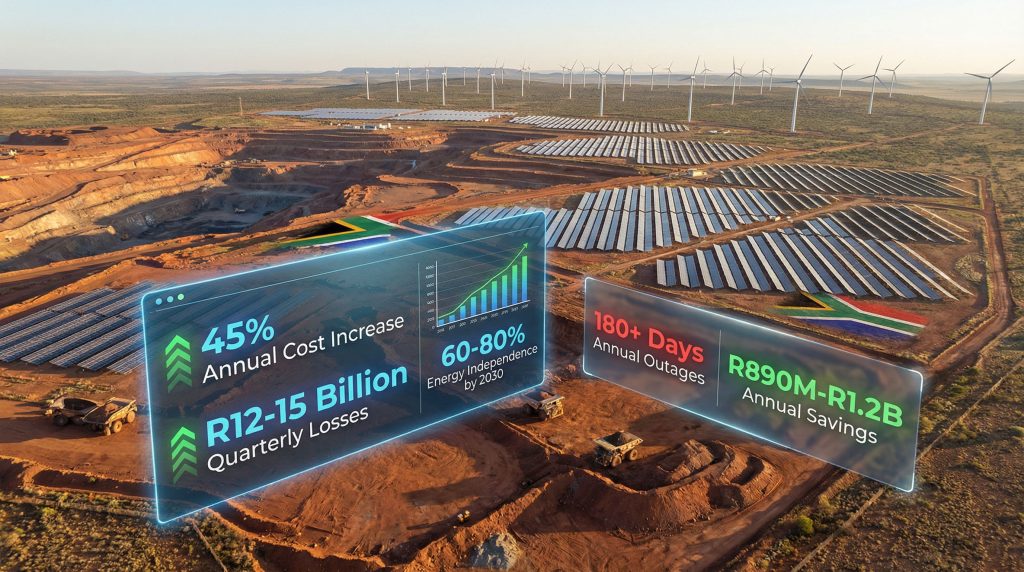
South Africa's mining sector confronts an unprecedented transformation as more renewable power for South Africa's platinum iron-ore diamond mines becomes essential due to decades of coal-dependent operations colliding with renewable energy economics reaching cost parity. The industry's vulnerability to grid instability creates a compelling business case for energy independence, particularly as operational disruptions from Eskom's infrastructure challenges compound annually.
The Koruson 2 cluster, comprising 520 MW of renewable capacity, demonstrates how mining companies are responding to these pressures through strategic energy partnerships. When fully operational, this project will displace 2.2 million tonnes of CO₂ annually while supplying Valterra's platinum group metals operations, Kumba's iron ore facilities, and De Beers' diamond mining sites.
Grid Dependency Creates Operational Vulnerability
Mining operations across South Africa face mounting costs from grid unreliability, with companies increasingly viewing renewable energy as operational insurance rather than merely environmental compliance. The 140 MW Umsobomvu Wind Farm and 240 MW Mooi Plaats Solar PV facility represent more than capacity additions; they signal a fundamental shift toward energy security. Furthermore, these developments align with broader industry evolution trends shaping the sector's future.
The Koruson 400 kV main transmission substation, described as South Africa's largest privately constructed transmission facility, was specifically designed to accommodate up to 1.5 GW of renewable energy capacity. This infrastructure demonstrates the scale of transformation required to support mining sector energy independence.
When big ASX news breaks, our subscribers know first
Which Mining Sectors Will Benefit Most From Renewable Power Adoption?
Platinum Group Metals: Strategic Energy Positioning
PGM operations require consistent baseload power for energy-intensive refining processes, making them ideal candidates for renewable-plus-storage solutions. The sector's global market position enables companies to capture green premium pricing as automotive manufacturers increasingly demand sustainably-sourced materials for fuel cells and catalytic converters.
Valterra's participation in the Koruson 2 cluster positions the company to leverage renewable energy across multiple operational sites through Envusa's portfolio wheeling framework. This aggregation model allows mining companies to optimise renewable generation across geographically dispersed operations while maintaining operational flexibility.
| Mining Sector | Energy Intensity | Renewable Suitability | Market Premium Potential |
|---|---|---|---|
| Platinum Group Metals | High baseload demand | Excellent with storage | 5-12% for green certification |
| Iron Ore | Variable processing loads | Good for hybrid systems | $8-12 per tonne in Asian markets |
| Diamond Mining | Moderate consumption | Suitable for solar integration | 15-25% luxury market premium |
Iron Ore: Export Competitiveness Through Clean Energy
International steel producers increasingly scrutinise supply chain emissions to meet Scope 3 carbon reduction targets. South African iron ore producers implementing renewable energy can command significant premiums in Asian markets, particularly with Japanese and Korean steel manufacturers prioritising low-carbon feedstock. These developments contribute to energy transition insights across the broader commodities landscape.
Kumba's involvement in the Koruson cluster reflects this strategic positioning, as global steel producers face mounting pressure to decarbonise their operations. The renewable energy displacement not only reduces operational costs but positions South African iron ore as a preferred feedstock for sustainability-focused steel production.
Diamond Mining: Luxury Market Sustainability Demands
The luxury goods sector experiences unprecedented consumer scrutiny regarding supply chain sustainability. De Beers' participation in renewable energy projects aligns with consumer expectations, as premium buyers increasingly demand verified low-carbon diamonds with transparent sourcing credentials.
Diamond mining operations benefit from renewable energy's predictable cost structure, enabling long-term pricing strategies that capture sustainability premiums while maintaining operational margins. Carbon-neutral certification becomes achievable within 24-36 months of comprehensive renewable energy implementation.
What Financial Models Enable Large-Scale Renewable Deployment?
Partnership Structures Drive Capital Efficiency
The Anglo American and EDF joint venture through Envusa demonstrates how mining companies can access renewable development expertise while sharing capital requirements and technical risks. This partnership model combines mining sector knowledge with renewable energy development capabilities to accelerate project deployment. Additionally, these initiatives support broader electrification & decarbonisation efforts across the mining industry.
Pele Green Energy's 20% equity stake in the Koruson 2 project companies exemplifies black economic empowerment integration within renewable energy development. Community trusts established for each project ensure local participation in 20-year financial benefits, creating sustainable economic development aligned with operational timelines.
Portfolio Wheeling Framework
Envusa's aggregation model enables mining companies to share renewable generation across multiple operational sites through sophisticated grid management. This approach, developed in collaboration with Eskom, allows companies to optimise renewable energy utilisation regardless of geographic constraints between generation and consumption sites.
The framework currently supplies electricity to more than ten mining sites, demonstrating scalability beyond anchor clients. This aggregation reduces individual project risks while enabling mining companies to access renewable energy without developing internal expertise in power generation and grid management.
How Do Regulatory Changes Accelerate Mining Renewable Adoption?
Licensing Reform Reduces Development Timeline
Recent regulatory changes eliminating 100 MW licensing thresholds enable mining companies to develop utility-scale renewable projects without National Energy Regulator approval. This streamlined process reduces development timelines by 18-24 months while eliminating regulatory approval costs.
The rapid back-to-back execution model demonstrated by Envusa reflects these regulatory improvements, with Mooi Plaats and Umsobomvu reaching commercial operation dates within weeks of each other. Hartebeesthoek Wind Farm's June 2026 commercial operation target continues this accelerated deployment pattern.
Transmission Infrastructure Access
New wheeling regulations allow mining companies to aggregate renewable generation across provinces while sharing transmission infrastructure costs. This regulatory framework enables optimal renewable resource site selection independent of mining operation locations, significantly improving project economics.
The Koruson transmission substation infrastructure exemplifies this approach, designed to accommodate multiple projects and developers while providing grid access for up to 1.5 GW of renewable capacity. This shared infrastructure model reduces individual project transmission costs while enabling rapid scaling.
What Technology Combinations Optimise Mining Operations?
Hybrid Renewable Systems
Mining operations benefit from hybrid renewable systems that combine solar, wind, and battery storage to provide consistent power supply. These systems enable mining companies to maintain operational flexibility while reducing dependence on grid electricity during peak demand periods. However, the success of such systems often depends on advances in battery recycling breakthrough technologies.
The Koruson 2 cluster combines 280 MW of wind capacity (Umsobomvu and Hartebeesthoek) with 240 MW of solar capacity (Mooi Plaats) to provide complementary generation profiles. Wind resources in the Eastern Cape complement solar resources in the Northern Cape, creating a balanced renewable portfolio.
Smart Grid Integration
Advanced mining operations can optimise energy-intensive processes based on renewable generation patterns through demand response systems. This integration enables companies to align ore processing schedules with peak renewable generation while reducing power consumption during low renewable periods.
The portfolio wheeling framework enables real-time optimisation across multiple mining sites, allowing companies to balance renewable generation with operational requirements. This flexibility maximises renewable energy utilisation while maintaining production schedules.
Which Geographic Regions Offer Optimal Renewable-Mining Synergies?
Northern Cape: Solar Resource Excellence
The Northern Cape province offers world-class solar resources with global horizontal irradiance exceeding 2,200 kWh/m²/year. These conditions enable solar photovoltaic systems to achieve capacity factors of 28-32% with single-axis tracking technology.
Mooi Plaats Solar PV's 240 MW facility demonstrates the region's renewable energy potential, positioned within one of South Africa's richest renewable energy corridors. Existing transmission infrastructure supporting heavy industrial loads enables efficient grid integration for large-scale solar deployment.
Eastern Cape: Wind Resource Optimisation
The Eastern Cape provides exceptional wind resources with average wind speeds of 8.5-10.2 m/s at 100-metre height. Modern wind turbines achieve capacity factors of 42-48% in these conditions, enabling highly competitive electricity generation costs.
Umsobomvu and Hartebeesthoek wind farms capitalise on these wind resources while benefiting from existing 400kV transmission infrastructure. The region's wind resource quality enables consistent power generation that complements solar resources from other provinces.
The next major ASX story will hit our subscribers first
How Do Community Development Requirements Shape Project Economics?
Socioeconomic Development Integration
Renewable energy projects must allocate 2-3% of total project value to community development initiatives, creating sustainable economic benefits for local communities. The Koruson 2 cluster generated thousands of direct and indirect jobs across the Eastern Cape and Northern Cape during construction phases.
Envusa's R20 million commitment to socioeconomic development for Inxuba Yethemba and Umsobomvu communities demonstrates long-term community engagement beyond construction employment. These investments create lasting economic benefits aligned with operational timelines.
Local Procurement Requirements
Construction contracts embedded local procurement targets to maximise economic benefits within project communities. This approach creates supply chain opportunities for local small, medium, and micro enterprises while building technical capabilities within renewable energy development.
The community trust structure ensures local communities participate directly in financial benefits generated over each asset's 20-year operating life. This model creates incentive alignment between project success and community economic development.
What Investment Scenarios Drive Optimal Returns?
Conservative Growth Projections
Envusa's ambitious pipeline targeting 3-5 GW of renewable capacity by 2030 reflects conservative growth assumptions based on demonstrated execution capability. This expansion extends beyond mining sector clients to supply other hard-to-abate industries requiring cost-competitive clean energy.
The rapid project execution model demonstrated through the Koruson 2 cluster provides a foundation for scaled deployment across Southern Africa. Each successful project creates operational expertise and financial track record supporting pipeline advancement.
Market Expansion Strategy
The company's strategy to extend beyond current mining sector clients indicates broader market opportunity across industrial sectors. Hard-to-abate industries face similar energy security challenges and cost pressures, creating addressable market expansion beyond mining operations.
This diversification strategy reduces concentration risk while leveraging renewable energy development expertise across multiple industrial applications. The wheeling framework developed for mining applications applies to diverse industrial electricity consumers.
What Risks Require Strategic Mitigation?
Technical Integration Challenges
Grid integration of large-scale renewable capacity requires sophisticated management of frequency regulation and voltage control systems. The complex grid environment referenced by project execution teams highlights technical challenges associated with variable renewable generation. Furthermore, the broader decarbonisation benefits must be weighed against these technical complexities.
System inertia reduction from conventional generation displacement creates grid stability challenges requiring advanced control systems. Mining operations must invest in grid management capabilities or partner with experienced renewable energy aggregators to navigate these technical requirements.
Regulatory Evolution Uncertainty
Policy changes affecting wheeling tariffs, grid access arrangements, and environmental compliance requirements create ongoing regulatory risk for long-term renewable energy investments. Companies must structure agreements to accommodate potential policy evolution over 20-year operational periods.
Carbon reporting requirements continue evolving as international climate frameworks develop, requiring flexible compliance systems that accommodate changing measurement and verification standards.
How Will This Transformation Reshape South Africa's Mining Competitiveness?
Sustainable Supply Chain Leadership
South African mining companies implementing comprehensive renewable strategies position themselves as preferred suppliers for ESG-focused buyers globally. This positioning enables premium pricing and market share growth as international manufacturers prioritise supply chain decarbonisation. The increasing focus on more renewable power for South Africa's platinum iron-ore diamond mines creates significant competitive advantages.
The demonstrated execution capability through projects like the Koruson 2 cluster creates competitive advantages in securing long-term supply contracts with sustainability requirements. Mining companies with energy independence achieve operational resilience and cost predictability supporting expansion projects.
Long-term Strategic Advantages
By 2030, leading mining companies could achieve significant energy independence through renewable energy deployment, providing operational resilience against grid failures and predictable electricity costs over extended periods. This energy security enables growth projects and international competitiveness. Moreover, the transformation to more renewable power for South Africa's platinum iron-ore diamond mines will fundamentally reshape the sector's global positioning.
Investment attraction from sustainability-focused funds reduces cost of capital for mining companies demonstrating comprehensive renewable energy strategies. This financial advantage compounds over time as ESG criteria become increasingly important in capital allocation decisions. The strategic deployment of more renewable power for South Africa's platinum iron-ore diamond mines represents a critical juncture in the industry's evolution.
This analysis is based on publicly available information and should not be considered investment advice. Readers should conduct their own research and consult qualified professionals before making investment decisions.
Ready to Capitalise on Mining's Renewable Energy Revolution?
Discovery Alert's proprietary Discovery IQ model delivers real-time alerts on significant ASX mineral discoveries, instantly identifying companies positioned to benefit from the renewable energy transition sweeping through global mining operations. Begin your 14-day free trial today and discover why historic mineral discoveries have generated exceptional returns for early investors.