May 21, 2026
Understanding the Technical Infrastructure Behind Mining Safety Excellence
The Australian mining industry operates within a complex framework of regulatory requirements, operational challenges, and technological innovations that demand sophisticated safety management approaches. While many mining companies achieve acceptable safety outcomes, understanding how leading organizations maintain consistently superior Mineral Resources safety performance requires examination of the underlying technical and operational mechanisms that drive safety excellence. The systematic integration of risk management protocols, digital monitoring systems, and structured compliance frameworks represents a fundamental shift from reactive safety measures toward predictive risk mitigation strategies.
When big ASX news breaks, our subscribers know first
What Defines Advanced Mining Safety Management Architecture?
Core Regulatory Compliance Integration
Modern mining safety frameworks operate through multi-layered compliance structures designed to address both regulatory requirements and operational realities. The integration of health and safety management systems with state-based legislation, particularly the Western Australian Work Health and Safety Act 2020, establishes baseline performance standards that extend beyond simple regulatory adherence. Furthermore, companies implementing boosting safety measures have demonstrated significant improvements in their overall safety performance.
Enterprise risk platforms now serve as central nervous systems for safety management, providing real-time data integration across multiple operational sites. These systems enable systematic hazard identification through trained facilitator networks that conduct regular safety assessments using standardized protocols. The implementation of Principal Mining Hazard Management Plans creates structured approaches to addressing the most significant risk categories within mining operations.
Key Technical Components:
• Integrated health and safety management system compliance monitoring
• Enterprise-wide risk platform deployment across all operational sites
• Dedicated safety professional placement at each operational location
• Systematic psychosocial risk management program implementation
Risk Assessment and Prevention Protocol Development
The development of comprehensive risk appetite statements governs decision-making processes at multiple organizational levels. These frameworks establish clear parameters for acceptable risk thresholds while providing structured methodologies for evaluating potential hazards. Hazard and Risk Management Procedures create systematic identification protocols that move beyond traditional reactive approaches toward predictive risk modeling.
Trained facilitator networks represent a critical component of modern safety infrastructure, conducting regular assessments that integrate technical expertise with operational knowledge. In addition, these networks enable consistent application of safety standards across diverse operational environments while maintaining flexibility for site-specific risk factors. Moreover, professionals seeking to enhance their qualifications can benefit from safety interview prep resources to better understand industry requirements.
How Do Advanced Safety Metrics Drive Performance Measurement?
Quantitative Performance Analysis Framework
The measurement of safety performance through sophisticated metrics provides insight into both immediate outcomes and long-term trends. Recent industry performance demonstrates the potential for achieving exceptional safety outcomes even during periods of high operational intensity. However, Mineral Resources safety performance analysis reveals that data-driven operations are increasingly becoming the foundation for sustained safety excellence.
| Safety Metric Category | Performance Indicator | Measurement Methodology |
|---|---|---|
| Lost Time Injury Frequency Rate | Zero incidents per reporting period | Rolling 12-month calculation basis |
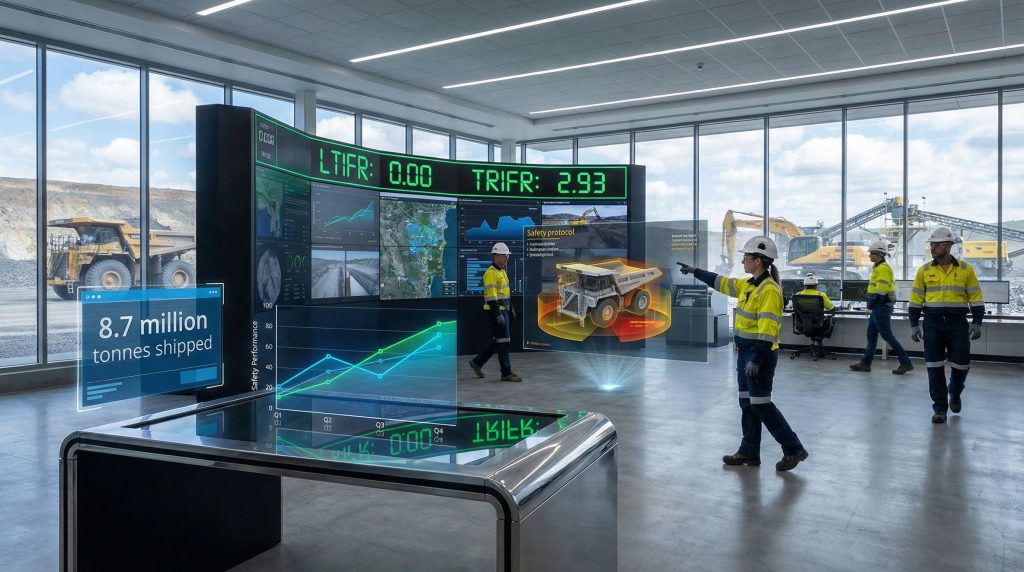
| Total Recordable Injury Frequency Rate | 2.93 with 13% quarterly improvement | Quarter-on-quarter comparative analysis |
| Operational Context Integration | High-output production maintenance | Safety performance during scaling periods |
Operational Scaling and Safety Performance Correlation
The relationship between operational intensity and safety outcomes presents unique challenges for mining organizations. Analysis of recent performance data reveals that maintaining safety standards during high-output periods requires sophisticated coordination between production and safety systems. For instance, operations achieving 8.7 million tonnes of iron ore shipments on a 100% basis during a single quarter while maintaining zero lost time injury rates demonstrate the potential for concurrent operational and safety excellence.
The transition from construction phases to steady-state operations creates specific risk profiles that require targeted management approaches. Construction-to-operations transitions typically involve:
• Workforce composition changes affecting safety culture dynamics
• Equipment transition from construction to production configurations
• Process standardization following project completion phases
• Integration of new operational procedures with existing safety protocols
What Industry-Wide Challenges Shape Modern Safety Approaches?
Fatality Prevention and Critical Risk Management
The mining industry faces persistent challenges related to fatality prevention, with mobile equipment operations and fall-of-ground incidents representing primary risk categories. According to the Minerals Council of Australia's safety and health policies, the industry continues to focus on comprehensive risk management approaches. Furthermore, global mining safety data indicates ongoing concerns, with International Council on Mining and Metals member companies reporting fluctuating fatality rates that underscore the need for systematic prevention approaches.
Primary Fatality Risk Categories:
• Mobile equipment incidents (representing the leading cause of mining fatalities)
• Fall of ground events in underground operations
• Contractor-related safety incidents during integrated operations
• Process safety failures in complex operational environments
The development of comprehensive fatality prevention programs requires integration of multiple risk management strategies. Mobile equipment safety protocols must address vehicle interaction zones, operator training standardization, and technology-assisted collision avoidance systems. Underground operations demand specialized fall-of-ground prevention measures that combine geological assessment with engineering controls.
Contractor Management and Third-Party Safety Integration
The complexity of modern mining operations necessitates extensive contractor engagement, creating additional safety management challenges. Contractor management systems must ensure third-party compliance with primary operator safety standards while maintaining operational efficiency. This requires development of:
• Standardized contractor safety assessment protocols
• Integrated training programs covering site-specific hazards
• Real-time performance monitoring across contractor activities
• Incident investigation procedures that address contractor involvement
How Do Digital Technologies Enable Safety Innovation?
Enterprise Risk Platform Integration
The deployment of sophisticated digital platforms transforms traditional safety management from paper-based systems toward real-time monitoring and predictive analytics. Enterprise risk platforms provide centralized data collection, analysis, and reporting capabilities that enable proactive hazard identification and response coordination. Consequently, companies are increasingly adopting AI-driven innovations to enhance their safety management capabilities.
These systems integrate multiple data streams including:
• Environmental monitoring sensors providing atmospheric and geological data
• Equipment performance monitoring systems detecting mechanical anomalies
• Personnel tracking systems enabling rapid emergency response
• Incident reporting platforms facilitating systematic investigation protocols
Communication Systems and Leadership Engagement
Technology-enabled communication systems facilitate enhanced consultation frameworks across all operational levels. These platforms enable leadership engagement in safety decision-making processes while maintaining open communication channels between management and workforce representatives. Moreover, the broader industry evolution trends demonstrate how technology integration is reshaping safety management approaches.
Digital safety management integration supports:
• Real-time hazard reporting and response coordination
• Data-driven safety performance tracking and trend analysis
• Systematic incident investigation with digital documentation
• Continuous improvement culture development through technology adoption
What Comparative Benchmarks Define Industry Safety Standards?
Global Mining Safety Performance Context
Understanding safety performance requires evaluation within broader industry contexts. Global mining safety statistics indicate varying performance levels across different jurisdictions and operational types. While specific regional variations exist, the overall industry trend demonstrates both challenges and opportunities for safety improvement. For instance, the Western Australian mining industry's annual safety performance reports provide comprehensive benchmarking data for comparative analysis.
Industry Performance Indicators:
| Performance Category | Measurement Range | Key Performance Drivers |
|---|---|---|
| Fatality Rates | Varies by jurisdiction and commodity | Mobile equipment management, fall prevention |
| Injury Frequency | Declining trends in developed markets | Systematic prevention program adoption |
| Regulatory Compliance | Enhanced enforcement across regions | Technology adoption and cultural change |
Australian Mining Safety Standards Evolution
The Australian mining industry operates within increasingly sophisticated regulatory frameworks that demand enhanced safety performance. New South Wales has demonstrated declining safety incident trends since 2014-15, indicating the potential for systematic industry improvement through coordinated regulatory and industry initiatives. However, Mineral Resources safety performance continues to face scrutiny, as recent incidents have highlighted the need for ongoing vigilance in safety management.
Performance Characteristics:
• Zero harm objective alignment across major mining operations
• Enhanced regulatory frameworks incorporating advanced risk management
• Technology adoption enabling predictive safety management
• Cultural transformation supporting safety-first operational philosophies
The next major ASX story will hit our subscribers first
What Future Developments Will Transform Mining Safety?
Advanced Technology Integration Strategies
The future of mining safety depends on continued integration of advanced technologies that enhance hazard identification and prevention capabilities. Investment in sophisticated monitoring systems, automated risk assessment tools, and predictive analytics platforms will enable more proactive safety management approaches.
Emerging Technology Applications:
• Artificial intelligence systems for predictive risk modeling
• IoT sensor networks providing comprehensive environmental monitoring
• Automated incident investigation systems reducing response times
• Virtual reality training platforms enhancing safety education effectiveness
Sustainable Safety Culture Development
Long-term safety excellence requires sustained investment in cultural development programs that extend beyond regulatory compliance toward intrinsic safety values. This involves continuous professional development for safety personnel, enhanced consultation mechanisms across diverse operations, and innovation in safety training methodologies.
The development of sustainable safety performance during business growth phases presents ongoing challenges that require systematic approaches to:
• Workforce development during operational scaling
• Contractor integration with primary operator safety cultures
• Technology adoption without compromising operational effectiveness
• Continuous improvement processes that adapt to changing operational contexts
Strategic Investment Areas for Enhanced Safety Performance
Infrastructure and Technology Enhancement
Future safety investment priorities focus on advanced hazard identification technology deployment that enables earlier risk detection and prevention. Enhanced psychosocial risk management programs address the broader wellness factors that influence safety performance, while expanded contractor safety management systems ensure comprehensive risk control across all operational activities.
Integrated health and safety performance monitoring systems provide the data analytics capabilities necessary for evidence-based decision making and continuous improvement processes. These investments support:
• Real-time risk assessment and response coordination
• Predictive maintenance scheduling reducing equipment-related safety risks
• Enhanced emergency response capabilities through improved communication systems
• Data-driven safety training program development and effectiveness measurement
Organizational Development and Cultural Evolution
The transformation of Mineral Resources safety performance requires sustained organizational development efforts that address both technical and cultural factors. Innovation in safety training and communication methods enables more effective knowledge transfer and behavior modification, while sustainable safety performance systems support long-term operational excellence.
Key Development Areas:
• Leadership development programs emphasizing safety-first decision making
• Cross-functional team integration supporting comprehensive risk management
• Performance measurement systems that reward proactive safety behaviors
• Continuous learning cultures that adapt to emerging safety challenges and opportunities
"This analysis is based on publicly available information and industry trends. Safety performance can vary significantly based on specific operational conditions, regulatory changes, and implementation effectiveness. Organizations should conduct their own detailed risk assessments and consult with qualified safety professionals when developing safety management strategies."
The evolution of mining safety standards demonstrates both the challenges and opportunities facing the industry. Through systematic integration of advanced technologies, comprehensive risk management frameworks, and sustained cultural development initiatives, mining organizations can achieve safety performance levels that protect workers while supporting operational excellence. Understanding these technical and operational mechanisms provides insight into the sophisticated approaches required for sustained safety leadership in the modern mining industry.
Ready to Capitalise on Mining Safety Technology Investments?
Discovery Alert's proprietary Discovery IQ model delivers instant notifications when mining companies announce significant safety technology investments and operational improvements, helping you identify actionable opportunities before broader market recognition. Start your 14-day free trial today and discover why historic discoveries have generated substantial returns for informed investors.