July 27, 2026
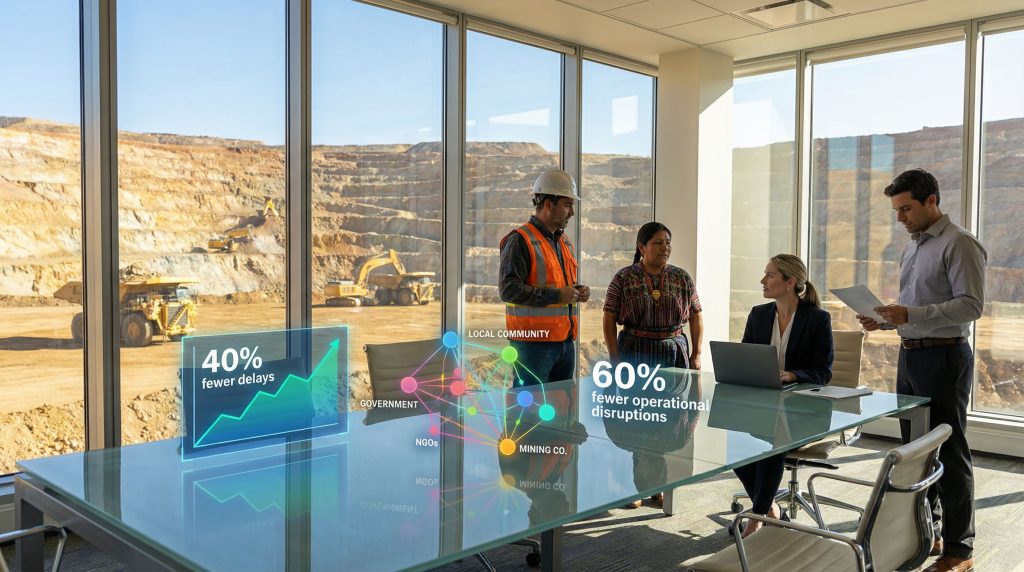
Mining stakeholder engagement has become a cornerstone of successful resource extraction operations in today's complex regulatory and social environment. This proactive relationship-building framework extends far beyond traditional compliance requirements, prioritising mutual respect, transparency, and meaningful dialogue as foundational elements for sustainable operations. Understanding this evolution requires examining how modern mining companies structure their stakeholder engagement frameworks and measure success across diverse stakeholder categories.
The relationship between mining operations and their surrounding communities has evolved from simple transactional engagement to complex, multi-layered partnerships that determine project viability. Furthermore, this transformation reflects a fundamental reassessment of how mining projects integrate with broader stakeholder ecosystems.
What Makes Mining Stakeholder Engagement Critical for Project Success?
The Strategic Foundation of Sustainable Mining Operations
Mining stakeholder engagement operates as a proactive relationship-building framework that extends far beyond regulatory compliance requirements. This systematic approach prioritises mutual respect, transparency, and meaningful dialogue as foundational elements for sustainable operations.
The principle underlying effective engagement centres on establishing credible communication channels before operational conflicts emerge. Industry analysis suggests that companies implementing comprehensive digital mining operations experience significantly fewer operational disruptions and faster project approval timelines compared to reactive approaches.
Modern mining operations recognise that social licence to operate represents an asset as valuable as geological resources themselves. This implicit community acceptance functions independently of legal permits, creating or destroying value through community support or opposition.
Economic Impact of Effective Stakeholder Management
The financial implications of structured stakeholder engagement manifest through multiple channels. Proactive community relations reduce capital expenditure through streamlined permitting processes, with industry practitioners reporting meaningful cost reductions when engagement begins during exploration phases rather than development stages.
Risk mitigation benefits extend beyond immediate cost savings. Companies with established stakeholder engagement protocols report reduced legal disputes, fewer operational shutdowns, and stronger protection of their social licence to operate. This protection becomes particularly valuable during commodity price downturns when community support provides operational stability.
Revenue protection through maintained community relationships creates sustainable competitive advantages. Mining operations with strong stakeholder engagement frameworks demonstrate greater resilience during political transitions, regulatory changes, and community leadership succession.
When big ASX news breaks, our subscribers know first
Who Are the Primary Stakeholders in Modern Mining Operations?
Community-Level Stakeholder Categories
Local Communities represent residents within operational impact zones, typically encompassing areas directly affected by mining activities. These stakeholders experience immediate exposure to environmental changes, infrastructure modifications, and economic impacts from mining operations.
Indigenous Peoples occupy a distinct stakeholder category with recognised territorial rights and legal protections in many jurisdictions. Their engagement requires adherence to Free, Prior, and Informed Consent (FPIC) protocols, establishing consultation frameworks that respect traditional governance structures and decision-making processes.
Vulnerable Groups including women, elderly populations, and youth require specialised consultation approaches recognising differential impacts and participation barriers. However, effective engagement strategies incorporate accessibility accommodations, translated materials, and culturally appropriate communication methods.
Institutional and Regulatory Stakeholders
Government Entities across federal, state, and local levels maintain distinct authorisation powers over project approval and modification. These relationships require understanding of regulatory hierarchies, permitting sequences, and political dynamics affecting decision-making timelines.
NGOs and Advocacy Groups encompass environmental organisations, social justice advocates, and religious institutions with varying geographical focus and influence levels. Distinguishing between locally-based groups representing immediate community interests and international organisations advancing global policy agendas helps tailor engagement approaches.
Industry Partners include competing mining operations, supply chain vendors, logistics providers, and peer companies participating in industry associations. These relationships involve balancing competitive dynamics with collaborative opportunities for infrastructure sharing and best practice development.
Financial and Investment Stakeholders
Institutional Investors increasingly demand ESG compliance and transparency regarding stakeholder engagement practices. Investment funds adhering to UN Sustainable Development Goals, Paris Agreement climate targets, and other sustainability frameworks evaluate mining companies based on documented stakeholder relationship quality.
Local Business Networks comprising supply chain partners and service providers create economic interdependencies affecting community support for mining operations. These relationships often determine local employment generation, procurement opportunities, and economic multiplier effects.
International Bodies including the International Council on Mining and Metals (ICMM), World Gold Council, and Extractive Industries Transparency Initiative (EITI) establish voluntary standards influencing industry evolution trends and investor expectations.
How Do Mining Companies Structure Their Engagement Strategies?
Pre-Development Engagement Framework
Early consultation protocols beginning at exploration phases establish foundational relationships before significant capital commitments occur. This approach allows identification of community concerns, environmental sensitivities, and regulatory requirements that influence project design and implementation strategies.
Baseline social impact assessments provide documented conditions against which future changes can be evaluated. These assessments serve dual purposes: establishing accountability frameworks for impact monitoring and creating defensive records regarding pre-existing conditions.
Stakeholder identification matrices employing influence-interest analysis categorise stakeholder groups requiring varied engagement intensities. High-influence, high-interest parties receive direct consultation; high-influence, low-interest groups receive formal reporting and information provisioning; lower-influence stakeholders access general information channels.
Operational Engagement Mechanisms
| Engagement Method | Frequency | Primary Stakeholders | Success Metrics |
|---|---|---|---|
| Community Dialogue Groups | Monthly | Local residents | Attendance rates, issue resolution |
| Mine Site Tours | Quarterly | All stakeholder groups | Feedback scores, transparency ratings |
| Grievance Mechanisms | Ongoing | Community members | Response time, resolution rate |
| Partnership Programs | Annual | Indigenous groups, NGOs | Project completion, benefit sharing |
Community dialogue structures typically include mixed participant composition representing company officials, community members, government representatives, and occasionally independent facilitators. These forums address operational concerns, development planning, and benefit-sharing implementation through documented proceedings with action item tracking.
Mine site tours provide stakeholder education regarding operational practices, environmental management systems, and safety protocols. Participant feedback captured through surveys helps companies assess transparency perceptions and identify areas requiring effective communication strategies.
Digital and Technology-Enhanced Engagement
Online consultation platforms expand participation opportunities for stakeholders unable to attend physical meetings. These systems require multi-language support, accessibility compliance, data security standards, and offline functionality for remote areas with limited connectivity.
Real-time environmental monitoring data sharing demonstrates operational transparency and provides communities with independent verification of environmental compliance. Public access to air quality, water monitoring, and noise level data builds trust through verifiable performance disclosure.
Mobile applications for grievance reporting and operational updates enable immediate communication between communities and mining operations. These platforms track complaint resolution timelines and maintain historical records of stakeholder concerns and company responses.
What Are the Regulatory Requirements for Mining Stakeholder Engagement?
International Standards and Compliance Frameworks
ICMM Principle 10 establishes commitments to transparency, reporting, and mining stakeholder engagement through continual improvement and accountability frameworks. Member companies commit to public reporting of sustainability performance and stakeholder consultation processes.
GRI Standards provide comprehensive sustainability reporting frameworks requiring stakeholder input into materiality assessments and performance indicators. These standards specify consultation processes for identifying stakeholder concerns and incorporating feedback into operational planning.
EITI Compliance operates at country level, requiring participating governments to publish detailed breakdowns of extractive industry revenue. While not directly binding on individual companies, EITI frameworks influence transparency expectations and community benefit disclosure practices.
Regional Regulatory Variations
Australian Requirements under the Native Title Act establish protocols requiring mining companies to negotiate with indigenous stakeholders holding recognised native title over mining areas. The framework specifies consultation requirements and benefit-sharing obligations through legally binding agreements.
Canadian Standards reflect court decisions establishing Crown obligations to consult with indigenous groups regarding decisions potentially affecting aboriginal rights. Provincial mining regulations and federal Environmental Assessment processes implement these obligations through specific consultation protocols.
African Frameworks vary significantly across jurisdictions, with countries like Tanzania, Ghana, and South Africa employing distinct approaches to community participation in mining permitting and benefit-sharing. Some jurisdictions mandate community development agreements as permit conditions.
Performance Monitoring and Validation
Independent third-party assurance processes verify stakeholder engagement practices through recognised sustainability verification programs. Organisations like SGS, DNV, and specialised bodies like the Responsible Mining Foundation provide validation services for company sustainability claims.
Stakeholder feedback integration into operational planning demonstrates meaningful consultation beyond information sharing. Companies document how community input influences project design, environmental management plans, and community investment priorities.
Regular compliance audits and public reporting create accountability frameworks for stakeholder engagement commitments. These processes typically involve annual sustainability reporting with third-party verification of stakeholder consultation processes and outcome indicators.
How Can Mining Companies Measure Stakeholder Engagement Success?
Quantitative Performance Indicators
Engagement Frequency metrics track the number of meetings, consultations, and stakeholder touchpoints across different categories and time periods. These measurements provide baseline data for engagement intensity and stakeholder access to company representatives.
Response Rates evaluate participation levels in surveys, public meetings, and consultation processes. High participation rates indicate stakeholder willingness to engage, while declining participation may signal trust issues or consultation fatigue.
Resolution Metrics measure grievance response times and closure rates, providing concrete indicators of company responsiveness to stakeholder concerns. Industry standard practice establishes acknowledgment timeframes (typically 5 business days) and investigation completion periods (30 days for standard complaints).
Investment Returns quantify cost savings from improved permitting timelines and reduced project delays. These metrics demonstrate financial value of stakeholder engagement investments and inform budget allocation decisions.
Qualitative Assessment Methods
Stakeholder satisfaction surveys and trust indices provide subjective evaluation of relationship quality and company credibility. These assessments identify areas requiring enhanced communication or policy modification based on stakeholder perceptions.
Community perception studies and reputation monitoring track broader public sentiment regarding mining operations and company performance. These studies often employ independent research organisations to ensure credibility and reduce response bias.
Social licence strength evaluation through third-party assessment provides external validation of community support levels and identifies potential risks to operational continuity. These assessments typically involve community interviews, stakeholder group consultations, and policy analysis.
Long-term relationship quality tracking monitors stakeholder engagement effectiveness across political cycles, leadership changes, and operational phases. This longitudinal approach identifies relationship sustainability factors and early warning indicators for community tensions.
Business Impact Correlation Analysis
Industry analysis indicates that mining companies with comprehensive stakeholder engagement programs demonstrate measurably better operational performance and reduced project risk exposure compared to reactive engagement approaches.
Correlation analysis between engagement investment and operational outcomes helps companies optimise stakeholder engagement budgets and resource allocation. These analyses examine relationships between engagement spending, community satisfaction scores, and operational disruption frequency.
Financial performance correlation studies evaluate whether enhanced stakeholder engagement translates into superior market performance, lower risk premiums, and improved access to capital. Consequently, these studies increasingly show positive correlations between ESG performance and financial returns.
What Challenges Do Mining Companies Face in Stakeholder Engagement?
Resource and Capacity Constraints
Budget allocation for comprehensive engagement programs requires balancing stakeholder engagement investments against other operational priorities. Companies must justify engagement spending through demonstrated risk reduction and operational benefits.
Staff training requirements for cultural sensitivity and communication skills demand ongoing investment in human capital development. Effective engagement requires personnel with language skills, cultural competency, and conflict resolution capabilities.
Geographic challenges in reaching remote communities create logistical complexities and cost pressures. Companies operating in isolated regions must develop creative solutions for maintaining regular stakeholder contact and participation opportunities.
Conflicting Stakeholder Interests
Balancing economic development priorities with environmental protection creates inherent tensions requiring careful navigation. Companies must address competing demands while maintaining credibility with diverse stakeholder groups holding conflicting priorities.
Managing competing community priorities and expectations involves understanding internal community dynamics and avoiding favouritism that could exacerbate local tensions. Effective engagement recognises community heterogeneity rather than assuming uniform interests.
Navigating political tensions and historical grievances requires understanding local context, past conflicts, and sensitive issues affecting stakeholder relationships. Companies must acknowledge historical context while focusing on forward-looking partnership development.
Trust and Credibility Building
Overcoming industry reputation challenges reflects broader public perceptions of mining sector environmental and social performance. Companies must address scepticism through demonstrated commitment and transparent performance disclosure.
Addressing past negative experiences with mining operations involves acknowledging historical problems while demonstrating changed practices and improved standards. This requires honest assessment of industry legacy issues and credible commitment to different approaches.
Maintaining consistency across leadership changes and market cycles demonstrates institutional commitment beyond individual personalities. Stakeholder engagement frameworks must survive personnel transitions and economic pressures to maintain credibility.
The next major ASX story will hit our subscribers first
How Is Technology Transforming Mining Stakeholder Engagement?
Digital Consultation Platforms
Virtual reality mine tours enable stakeholder education for remote participants unable to visit operations physically. These immersive experiences provide detailed understanding of operational practices, safety procedures, and environmental management systems.
Blockchain-based benefit sharing and transparency systems create immutable records of community investment and revenue sharing. These technologies enable real-time tracking of benefit distribution and reduce disputes over payment allocation.
AI-powered sentiment analysis processes community feedback from multiple sources, identifying emerging concerns before they escalate into conflicts. These systems analyse social media, meeting transcripts, and survey responses for trend identification.
Data-Driven Engagement Strategies
Predictive analytics for stakeholder concern identification uses historical data patterns to anticipate community issues and optimise engagement timing. These systems help companies address concerns proactively rather than reactively.
Real-time environmental monitoring with public data access demonstrates operational transparency and enables community verification of environmental compliance. Automated data sharing builds trust through continuous performance disclosure.
Social media monitoring for early issue detection identifies community concerns emerging through digital channels. This early warning capability enables rapid response to misinformation or emerging conflicts.
Mobile and Accessibility Solutions
Multi-language mobile applications accommodate diverse communities with appropriate linguistic support and cultural considerations. These platforms ensure equitable access to engagement opportunities regardless of language barriers.
Offline-capable systems function in areas with limited connectivity, ensuring consistent stakeholder engagement regardless of infrastructure limitations. These solutions maintain functionality during network outages or in remote locations.
Accessibility features for stakeholders with disabilities ensure inclusive participation through screen readers, alternative input methods, and accommodation for various impairments. These features demonstrate commitment to equitable engagement.
What Does the Future Hold for Mining Stakeholder Engagement?
Emerging Regulatory Trends
Mandatory human rights due diligence requirements increasingly appear in mining legislation across jurisdictions. These regulations require systematic assessment and mitigation of human rights impacts throughout project lifecycles.
Enhanced indigenous rights recognition in mining legislation reflects growing political awareness of historical injustices and contemporary sovereignty issues. Future regulations likely will strengthen FPIC requirements and indigenous consultation protocols.
Stricter ESG reporting standards from financial regulators create compliance obligations for publicly traded mining companies. These requirements increasingly include specific mining stakeholder engagement disclosure requirements and performance metrics.
Investor-Driven Evolution
ESG-focused investment criteria requiring stakeholder engagement documentation influence capital access and project financing conditions. Investors increasingly evaluate investment strategy in mining based on social performance alongside geological potential.
Co-ownership models with community equity participation represent emerging approaches to benefit sharing and risk distribution. These structures create alignment between community interests and project success while providing communities with direct financial participation.
Long-term sustainability planning beyond mine life addresses community concerns about post-closure economic transitions. These frameworks consider community development pathways independent of mining operations and legacy site management.
Industry Best Practice Development
Sector-wide standardisation of engagement protocols reduces variation in stakeholder experience across different mining companies. Industry associations increasingly develop common standards for engagement quality and performance measurement.
Peer learning networks and knowledge sharing platforms enable companies to share effective practices and learn from stakeholder engagement innovations. These networks accelerate industry-wide improvement in stakeholder relationship management.
Integration with circular economy and climate adaptation strategies addresses stakeholder concerns about environmental sustainability and community resilience. These approaches align mining operations with broader sustainability objectives.
Implementing Effective Stakeholder Engagement: A Strategic Roadmap
Phase 1: Foundation Building (Months 1-6)
Stakeholder mapping and prioritisation exercises identify all potentially affected parties and assess their influence, interests, and engagement requirements. This systematic approach ensures comprehensive coverage and appropriate resource allocation across stakeholder categories.
Cultural competency training for engagement teams develops necessary skills for effective cross-cultural communication and conflict resolution. This training addresses cultural sensitivity, language considerations, and appropriate engagement protocols for different stakeholder groups.
Establishment of governance structures and budget allocation creates institutional framework for sustained engagement. These structures define decision-making authority, resource allocation, and accountability mechanisms for engagement program implementation.
Phase 2: Relationship Development (Months 6-18)
Initial consultation rounds and trust-building activities establish foundation relationships with identified stakeholders. These activities focus on mutual understanding, expectation setting, and collaborative problem-solving rather than information dissemination.
Development of formal agreements and protocols documents engagement processes, decision-making procedures, and conflict resolution mechanisms. These frameworks provide stability and predictability for stakeholder relationships across operational phases.
Implementation of feedback mechanisms and grievance systems creates structured channels for stakeholder concerns and suggestions. These systems demonstrate company responsiveness and provide early warning for emerging issues requiring management attention.
Phase 3: Continuous Improvement (Ongoing)
Regular performance assessment and strategy refinement ensures engagement effectiveness adapts to changing circumstances and stakeholder needs. These assessments evaluate both quantitative metrics and qualitative relationship indicators.
Innovation adoption for enhanced engagement effectiveness incorporates new technologies, methodologies, and best practices as they emerge. This continuous improvement approach maintains engagement relevance and effectiveness.
Long-term partnership development and legacy planning addresses stakeholder relationships beyond immediate operational needs. Furthermore, these frameworks consider community development objectives, capacity building, and sustainable economic transitions.
The strategic imperative for mining stakeholder engagement continues evolving as industry recognition grows regarding community relationships as fundamental business assets. Companies investing in comprehensive engagement frameworks position themselves for sustainable operations and reduced risk exposure in an increasingly scrutinised industry environment.
Ready to Capitalise on the Next Major Mineral Discovery?
Discovery Alert's proprietary Discovery IQ model delivers real-time notifications on significant ASX mineral discoveries, empowering investors to identify actionable opportunities ahead of the broader market. Understand why historic discoveries can generate substantial returns by exploring Discovery Alert's dedicated discoveries page, showcasing exceptional outcomes from major finds, and begin your 14-day free trial today to position yourself ahead of the market.