
August 12, 2026
The Structural Forces Reshaping Global Mining in One Remarkable Week
Commodity supply chains have always been vulnerable to the same forces that built them: geographic concentration, geopolitical alignment, and the assumption that yesterday's trade flows will continue tomorrow. When those assumptions fracture simultaneously across multiple dimensions, the result is not a correction but a structural reset. That is precisely what the week ending May 2, 2026 delivered to the global mining industry, making the top five mining stories this week a compelling read for anyone tracking resource markets.
Five distinct developments, each significant in isolation, converged to reveal a sector undergoing simultaneous technological, geopolitical, regulatory, and operational transformation. From an Oxford University spinout targeting the chemistry of rare earth recovery, to a US presidential signature reopening contested mineral lands in Minnesota, these stories collectively map the fault lines that will define resource extraction for the decade ahead.
Understanding these stories not as isolated events but as interconnected signals is the analytical task that separates informed investors and operators from reactive ones.
When big ASX news breaks, our subscribers know first
Critical Minerals at the Extraction Frontier: Oxford Spinout Ascension Raises £1.7M
There is a persistent misconception embedded in the phrase "rare earth elements." These materials are not geologically scarce. Cerium, lanthanum, neodymium, and their chemical relatives exist in the Earth's crust at concentrations that would surprise most observers. The challenge has never been finding them. It has always been separating them.
Rare earth elements occur in complex mineral matrices, chemically entangled with one another and with host rock in ways that resist conventional processing. The solvent extraction circuits used to isolate individual rare earths are multi-stage, reagent-intensive, and extraordinarily capital-demanding. This technical complexity, not geological scarcity, is what makes rare earth supply chains fragile and expensive to build outside of established processing hubs.
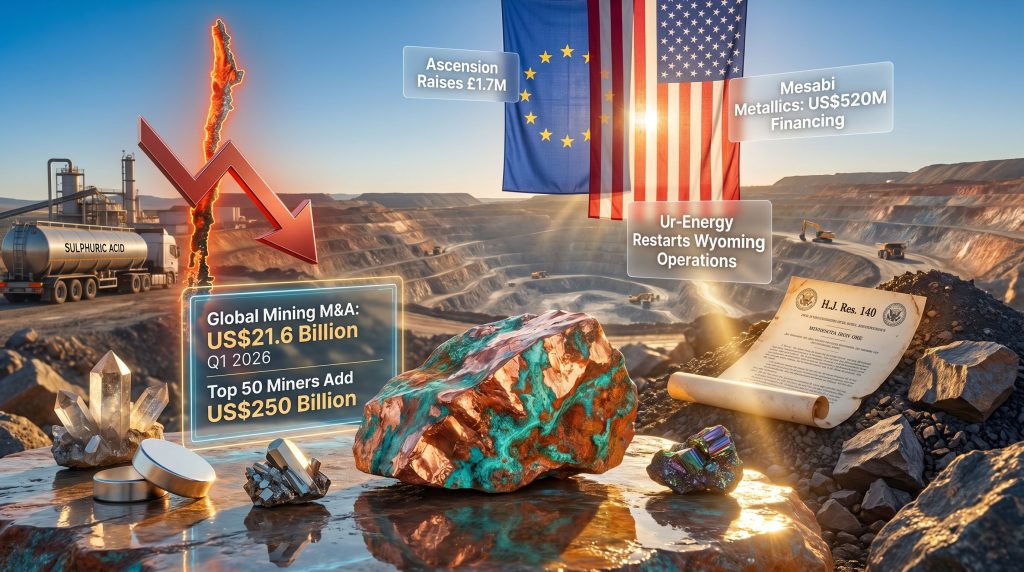
It is into this technical gap that Oxford University spinout Ascension has positioned itself. The company secured £1.7 million (approximately US$2.3 million) in seed-stage funding to advance its proprietary critical mineral recovery technology, co-founded by Prof. Mike Kendall, Motoaki Sumi, and Prof. Jon Blundy. The Oxford institutional pedigree matters here not merely as a credibility signal, but because the university's earth science and materials research departments have been at the forefront of mineral systems research globally.
Recovery-focused approaches represent a fundamentally different value proposition compared to conventional primary extraction:
| Factor | Conventional Mining | Recovery Technology |
|---|---|---|
| Capital intensity | Very high | Moderate at early stage |
| Environmental footprint | High | Potentially lower |
| Time to production | 10 to 15+ years | Shorter development cycle |
| Supply chain role | Primary source | Secondary and supplementary |
| Key investor risk | Resource risk plus capex | Technology commercialisation risk |
The investment case for early-stage recovery ventures is structurally appealing precisely because the demand side is locked in. Neodymium and dysprosium are non-substitutable inputs for the permanent magnets inside EV motors and wind turbines. Furthermore, critical minerals demand scales directly with energy transition targets. What recovery technology companies like Ascension are betting on is that the supply side can be disrupted not through new mines, but through smarter chemistry applied to existing material streams.
University spinouts entering the critical minerals space represent a distinct risk category for investors: technology commercialisation risk rather than traditional resource risk. The upside is a potentially shorter path from development to deployment, but the downside is the uncertainty inherent in scaling laboratory processes to industrial volumes.
China's Sulphuric Acid Export Restriction: A Chemical Input Shock Hitting Copper at Its Core
Chile produces more copper than any other country on Earth. Its dominance in the global copper market is not solely a function of ore grade or geological endowment. It is also a function of access to the chemical inputs that make processing economically viable. That input dependency has now become a critical vulnerability, and the Chilean copper outlook has shifted considerably as a result.
Sulphuric acid is the cornerstone reagent for oxide copper processing via solvent extraction-electrowinning, commonly known as SX-EW. In this leaching process, dilute sulphuric acid is applied to crushed oxide ore, dissolving copper ions into solution before electrowinning cells deposit refined copper metal onto cathodes. For a significant portion of Chilean copper output, this chemistry is the only viable processing pathway. There is no ready substitute.
China's anticipated restriction on sulphuric acid exports delivers a dual shock to Chilean operators. The first is a sourcing problem: where does replacement acid come from, and how quickly can alternative supply chains be established? The second is a cost problem: acid from alternative suppliers, with different freight distances and logistics profiles, will arrive at materially higher delivered prices. Both pressures hit simultaneously, and neither resolves quickly.
The strategic implication extends beyond copper pricing. A constrained Chilean copper supply, driven by input scarcity rather than ore depletion, is a category of supply disruption that markets have limited historical experience pricing. It is fundamentally different from a strike, a weather event, or a grade decline.
The broader significance of this development lies in what it reveals about commodity supply chain architecture. Mining companies and analysts have long focused on the geology of output, assessing ore grades, reserve life, and processing recoveries. However, the acid supply story forces a different analytical lens: the geology of inputs. The key questions for Chilean operators now include:
- Which operations are most dependent on leaching for their copper output?
- What is the current acid inventory position at major sites?
- Which alternative suppliers can realistically cover the volume gap, and at what premium?
- What is the lead time for redirecting acid shipments from India, the Middle East, or European smelter sources?
Reports indicate that Teck Resources has already moved to lower its Chilean copper production guidance, providing an early quantitative signal of how operators are adjusting expectations in response to this input shock. For downstream industries, including electric vehicle manufacturers, grid infrastructure developers, and electronics producers, this represents a fresh upstream cost pressure arriving at an already complicated moment for supply chain planning.
Western Geopolitical Realignment: What the EU-US Critical Minerals MoU Actually Commits To
The structural dependency of Western economies on Chinese-controlled critical mineral supply chains has been a known strategic vulnerability for years. Policy responses have been incremental, frequently announced but unevenly implemented. The signing of a Memorandum of Understanding between the United States and European Union on April 24, 2026 represents the most visible recent step in formalising that response.
US Secretary of State Marco Rubio and EU Trade Commissioner Maros Sefcovic signed the agreement, establishing a strategic coordination framework for critical mineral supply chain development across Western-aligned markets. The MoU covers sourcing diversification, processing capacity investment, and trade facilitation as its primary pillars.
Investors and mining executives should, however, approach this development with calibrated expectations. An MoU establishes intent, not obligation. Its strategic value is determined entirely by the institutional follow-through it generates: funded projects, procurement commitments, and regulatory alignment that creates genuine market access for non-Chinese suppliers.
How Does This MoU Fit Within Existing Western Supply Chain Initiatives?
| Initiative | Parties | Year | Binding | Primary Focus |
|---|---|---|---|---|
| EU-US Critical Minerals MoU | EU plus USA | 2026 | No | Supply chain coordination |
| Minerals Security Partnership | USA plus 13 allies | 2022 | No | Investment facilitation |
| EU Critical Raw Materials Act | EU internal | 2024 | Yes | Domestic production benchmarks |
| US-Ukraine Minerals Agreement | USA plus Ukraine | 2025 | Partial | Resource access rights |
The pattern across these initiatives is notable: the more politically ambitious the partnership, the less binding its commitments tend to be. This does not make the EU-US MoU irrelevant, but it does mean the market-moving value will come from the specific projects and procurement frameworks that flow from it, not from the agreement itself.
For mining companies operating outside China's orbit, specifically Australian, Canadian, African, and Latin American producers, the emerging Western supply architecture creates a set of conditional opportunities. Preferential treatment in project financing and offtake arrangements is likely to come with requirements around ESG compliance, environmental permitting standards, and geopolitical alignment. Companies positioned well on those dimensions stand to benefit as Western governments move from coordination frameworks toward actual procurement decisions.
Freeport-McMoRan's Water Strategy: When Operational Survival Becomes an ESG Narrative
Water has long been treated by the mining industry as an operational input, managed alongside reagents, energy, and labour. The accelerating realities of climate variability are forcing a reclassification. In copper-producing regions across the Americas and Central Africa, water is transitioning from a managed input to a constrained resource. That transition changes the economics of mining in ways that financial models built on historical assumptions do not yet fully capture.
Copper extraction is water-intensive at every stage of the processing circuit. Grinding, flotation, leaching, and tailings management all require significant water volumes. When regional hydrology shifts, when aquifer recharge rates decline, or when community water needs intensify competition for surface water rights, mining operations face constraints that no amount of capital expenditure on ore processing can resolve.
Freeport-McMoRan operates across multiple geographies where these pressures are already active. The company's approach treats water stewardship as a core operational continuity mechanism rather than a compliance function. Each mine site operates under a tailored water management framework calibrated to local hydrology, regulatory requirements, and community dynamics. This site-specific philosophy reflects a recognition that water risk is highly localised and cannot be managed through centralised corporate policy alone.
What Is the Business Case for Proactive Water Stewardship?
The business case for proactive water stewardship in mining rests on four interconnected pillars:
- Operational continuity: Processing circuits that lose water access face partial or complete production suspension with no rapid recovery pathway.
- Social licence to operate: Communities adjacent to water-stressed mining operations are increasingly organised, legally empowered, and vocal. Litigation risk is rising across multiple jurisdictions.
- Investor scrutiny: Institutional capital allocators are incorporating water risk into ESG scoring at the portfolio level, with consequences for both cost of capital and index inclusion.
- Regulatory trajectory: Water use permits in key mining jurisdictions are becoming progressively more restrictive as climate adaptation frameworks tighten allocation rules.
Freeport-McMoRan's Q1 2026 sustainability disclosures frame water stewardship not as a reporting obligation but as a strategic operating discipline, an approach that is becoming a competitive differentiator as water constraints intensify across the copper belt.
The contrast offered by Kinross Gold's Q1 2026 performance is instructive. The company reported nearly US$850 million in quarterly cash flows, a record result, demonstrating what disciplined operational management delivers at the financial level. The connection between resource stewardship, operational efficiency, and financial outperformance is not coincidental. Miners that manage their input constraints proactively, whether those inputs are water, energy, or reagents, build more resilient cost structures over time.
H.J. Res. 140 and the Mesabi Iron Range: Federal Resource Nationalism Meets Environmental Reality
Northern Minnesota has been contested terrain for natural resource development for decades. The region sits at the intersection of genuinely significant mineral endowment and genuinely significant ecological value, a combination that has produced sustained regulatory and political conflict.
Minnesota's legislative history on energy and environment provides essential context. The state's 2007 Next Generation Energy Act established an 80% greenhouse gas reduction target from 2005 levels by 2050. A 2023 update aligned state policy with the Climate Action Framework, tightening the interim target to a 50% emissions reduction by 2030 with net-zero by 2050. These are among the more ambitious state-level climate commitments in the United States.
Against this backdrop, President Trump signed H.J. Res. 140 into law, reversing a prior federal mineral withdrawal that had restricted development activity on certain lands in northern Minnesota. The resolution reopens these areas to mineral development consideration and the environmental review processes that would precede any actual mining activity. Simultaneously, the US Senate voted to reverse a separate mineral withdrawal near the Boundary Waters Canoe Area, signalling coordinated legislative intent rather than an isolated executive action.
H.J. Res. 140 does not authorise mining. It removes a prior restriction and reinitiates the environmental review pathway. The distinction matters for investors assessing timelines: there remains a material gap between land reopening and permitted production.
The Mesabi Iron Range, the geological formation at the centre of this debate, carries enormous historical weight in American industrial history. It was the foundational source of iron ore that fed US steel production through the 20th century. The region's revival is central to the federal push for domestic mineral self-sufficiency, and the financing signals are substantive. Mesabi Metallics has secured US$520 million in project financing, representing one of the most significant regional mining investment commitments in recent years.
The fault line running through this story is sharp. The Boundary Waters Canoe Area Wilderness is one of the most visited wilderness areas in the United States, with exceptional ecological value and a constituency of recreational users, environmental advocates, and Indigenous communities with significant political and legal standing. Sulphide mining near watershed-sensitive areas carries specific contamination risks, particularly acid mine drainage, that have been central to legal challenges in this region.
The tension between federal resource nationalism and Minnesota's own climate commitments is not easily resolved. H.J. Res. 140 moves the policy dial toward development, but the environmental review processes it reinstates will be contested, detailed, and lengthy.
The next major ASX story will hit our subscribers first
The Broader Picture: Mining's Market Momentum and Emerging Frontiers
The five stories above do not exist in a vacuum. They emerge from a sector experiencing unusual convergence between structural demand growth and investment confidence.
Despite geopolitical turbulence, including ongoing Iran tensions and persistent trade disruptions, the top 50 global mining companies collectively added approximately US$250 billion in market capitalisation in early 2026. This figure reflects something important: investor confidence in the structural demand thesis for critical and base metals is proving resilient to near-term noise. The energy transition's material requirements are not policy-dependent in the short term. They are engineering-dependent, and the engineering requirements for lithium batteries, copper wiring, and permanent magnets are fixed.
Global mining mergers and acquisitions reached US$21.6 billion in Q1 2026, the strongest opening quarter since 2023. The drivers are consistent: larger players are acquiring access to critical mineral assets before regulatory and geopolitical windows narrow further. Resource nationalism, rising permitting barriers, and Western government incentives for domestic supply chains are all compressing the window for opportunistic asset acquisition. For further context on deal flow and sector movements, Australian Mining provides ongoing coverage of regional and global transactions.
Two additional developments deserve attention as emerging frontiers:
- Deep-sea mining: The US National Oceanic and Atmospheric Administration has deemed TMC's seabed mining application compliant under federal law. A potential permit by 2027 would mark a historic milestone for commercial extraction of polymetallic nodules from the ocean floor. TMC's share price responded sharply to the announcement, reflecting market anticipation of a genuinely new mineral extraction category. In addition, the evolving deep-sea mining regulations framework will be central to determining how quickly commercial projects can advance. The environmental debate around deep-sea mining remains highly active and unresolved.
- Uranium's resurgence: Ur-Energy has restarted uranium mining operations in Wyoming after a multi-decade hiatus. The restart reflects rising uranium market trends driven by nuclear energy's re-emergence as a low-carbon baseload power source. Within the critical minerals framework, uranium occupies a unique position: its demand is driven not by the energy transition's material requirements for batteries and magnets, but by the energy transition's need for dispatchable zero-carbon electricity.
What Five Stories Tell Us About One Industry
Reading the top five mining stories this week as a coherent narrative rather than a collection of separate news items reveals a sector being reshaped by forces that reinforce each other. Consequently, the interconnections between these developments carry as much analytical weight as the individual stories themselves:
| Theme | Story This Week | Broader Implication |
|---|---|---|
| Critical mineral tech innovation | Ascension's £1.7M raise | Recovery technology as supply chain diversification |
| China supply chain leverage | Sulphuric acid export restrictions | Input dependency as systemic mining risk |
| Western resource geopolitics | EU-US Critical Minerals MoU | Alliance-based supply chain architecture forming |
| Climate-driven operational risk | Freeport-McMoRan water strategy | Water as a tier-one operational continuity factor |
| US domestic resource nationalism | H.J. Res. 140 and Mesabi financing | Federal policy actively reshaping US mining geography |
The common thread is critical minerals, and more specifically, the global contest over who controls the extraction, processing, and distribution of the materials that the energy transition requires. China's acid export restriction, the EU-US MoU, Ascension's recovery technology, and H.J. Res. 140 are all different expressions of the same underlying dynamic: every major economy is simultaneously recognising that critical mineral supply chains are strategic infrastructure and acting to reshape those chains in its own interest.
For investors, the implication is a sustained period of elevated activity across the mining sector, not despite geopolitical turbulence, but partly because of it. For operators, the implication is that operational resilience, whether measured in water management, input security, or regulatory positioning, is becoming a determinant of competitive advantage in a way it has not been in previous commodity cycles. Broader market intelligence and sector analysis is also available through Stockhead's resources coverage, which tracks junior and mid-tier mining developments across key commodity themes.
This article draws on publicly available information and company announcements. References to financial figures, production guidance, and legislative details reflect information reported as of the date of publication. Readers should conduct their own due diligence before making investment decisions. Market projections and forward-looking statements involve uncertainty, and actual outcomes may differ materially from those described.
Want to Identify the Next Major ASX Mineral Discovery Before the Broader Market?
Discovery Alert's proprietary Discovery IQ model delivers real-time alerts on significant ASX mineral discoveries — cutting through the complexity of 30+ commodities to surface actionable investment opportunities the moment they are announced. Explore historic examples of major discoveries and their returns, then start your 14-day free trial to position yourself ahead of the market.