August 25, 2026
Global mining operations face unprecedented pressure to reconcile traditional extraction economics with evolving environmental stewardship demands. This transformation represents more than regulatory compliance; it fundamentally reshapes how mining enterprises evaluate resource development, allocate capital, and position themselves for long-term competitiveness across diverse geopolitical landscapes.
Strategic scenario modeling reveals multiple pathways through which mining and sustainability integration will evolve, each carrying distinct implications for operational design, investment priorities, and stakeholder engagement protocols.
What Strategic Scenarios Define Mining's Sustainability Transformation?
Mining enterprises operate within an increasingly complex decision matrix where technically viable projects can rapidly become economically unfeasible due to regulatory shifts or community opposition. The industry evolution trends must develop sophisticated scenario planning frameworks that integrate political, environmental, and social variables alongside traditional geological and economic assessments.
The Three-Horizon Sustainability Framework for Mining Operations
Contemporary mining strategy requires multi-timeframe planning that addresses immediate compliance requirements while positioning for long-term industry evolution. The three-horizon framework provides structured approach to sustainability integration:
Horizon 1 (0-3 years) focuses on immediate regulatory compliance and operational efficiency improvements. Mining operations implement existing technologies for energy optimization, waste reduction, and water recycling to meet current environmental standards while maintaining production targets.
Horizon 2 (3-7 years) emphasizes infrastructure transformation toward renewable energy integration and advanced environmental management systems. This phase requires substantial capital deployment for renewable energy infrastructure, closed-loop water systems, and precision extraction technologies.
Horizon 3 (7+ years) represents complete business model transformation toward circular economy principles, ecosystem service monetization, and urban mining integration. Operations evolve from pure extraction enterprises to integrated resource stewardship organizations.
Critical Decision Points That Determine Long-Term Industry Viability
Mining enterprises face several strategic inflection points that will determine their competitive positioning in sustainability-focused markets. Capital allocation decisions made today will determine which operations can access ESG-focused investment capital, secure community acceptance, and maintain operational continuity under tightening environmental regulations.
The International Energy Agency projects mineral demand will double by 2040 to meet energy transition targets, with critical minerals such as lithium, cobalt, and nickel experiencing even steeper growth trajectories. Solar photovoltaic installations require 10 times more mineral inputs per unit of energy compared to fossil fuel power plants, creating unprecedented demand pressure on mining operations.
However, this demand growth occurs alongside increasingly stringent environmental performance requirements. Over 180 countries have adopted or are developing ESG-related regulations and reporting standards as of 2025, fundamentally altering the operating environment for global mining enterprises.
How Regulatory Convergence Creates New Competitive Landscapes
Regulatory harmonisation across jurisdictions creates distinct advantages for mining operations that proactively implement sustainability frameworks. The European Union's Carbon Border Adjustment Mechanism transitional phase concluded in 2025, with full compliance requirements taking effect in 2026. This mechanism directly impacts mining operations in non-EU jurisdictions that export to European markets.
Mining enterprises that achieve early compliance with international sustainable mining standards secure preferential access to capital markets, reduced regulatory risk, and enhanced community acceptance. These competitive advantages compound over time, creating substantial barriers for traditional extraction-focused operations.
When big ASX news breaks, our subscribers know first
Why Traditional Mining Economics Must Evolve Beyond Pure Extraction Models?
Contemporary mining economics requires fundamental restructuring to account for environmental restoration costs, community benefit programs, and technology infrastructure investments. Traditional cost-plus pricing models fail to capture the full value proposition demanded by modern capital markets and regulatory frameworks.
The Capital Allocation Shift Toward Integrated Resource Stewardship
Modern mining operations must transition from viewing sustainability initiatives as cost centres to recognising them as revenue-generating assets that deliver measurable returns through regulatory risk mitigation, operational efficiency improvements, and enhanced access to capital markets.
The average greenfield mining project now requires 7-10 years from discovery to first production, with capital costs increasing 15-25% annually due to sustainability and regulatory requirements. However, ESG-integrated mining operations command 12-18% valuation premiums in public markets compared to operations without comprehensive sustainability frameworks.
This valuation differential reflects fundamental changes in investor priorities. Global ESG-focused investment funds managing sustainable mining assets reached $2.3 trillion in assets under management in 2025, representing a 340% increase from 2018. Major institutional investors controlling over $130 trillion in assets have committed to climate-aligned investment strategies, directly impacting mining capital allocation decisions.
Risk Premium Calculations in ESG-Driven Investment Environments
Mining operations failing to achieve net-zero alignment face estimated asset impairment risks of 20-45% of enterprise value by 2035. This stranded asset risk necessitates comprehensive risk-adjusted return calculations that incorporate regulatory, environmental, and social factors alongside traditional geological and commodity price variables.
Enhanced pricing mechanisms must reflect the true cost of sustainable extraction, including environmental restoration, community benefits, and technological innovation. Market participants increasingly recognise that elevated metal prices provide essential signals for enabling development of new mining projects in an environment where deposits are more complex, regulations more demanding, and environmental performance expectations higher than ever.
Technology ROI Models That Balance Sustainability and Profitability
Integrated sustainability-focused technology deployments generate measurable returns through multiple value creation mechanisms. Advanced mining economics must account for these multi-dimensional benefits rather than traditional single-variable cost reduction models.
| Investment Category | Traditional Focus | Sustainability-Integrated Approach | 10-Year ROI Impact |
|---|---|---|---|
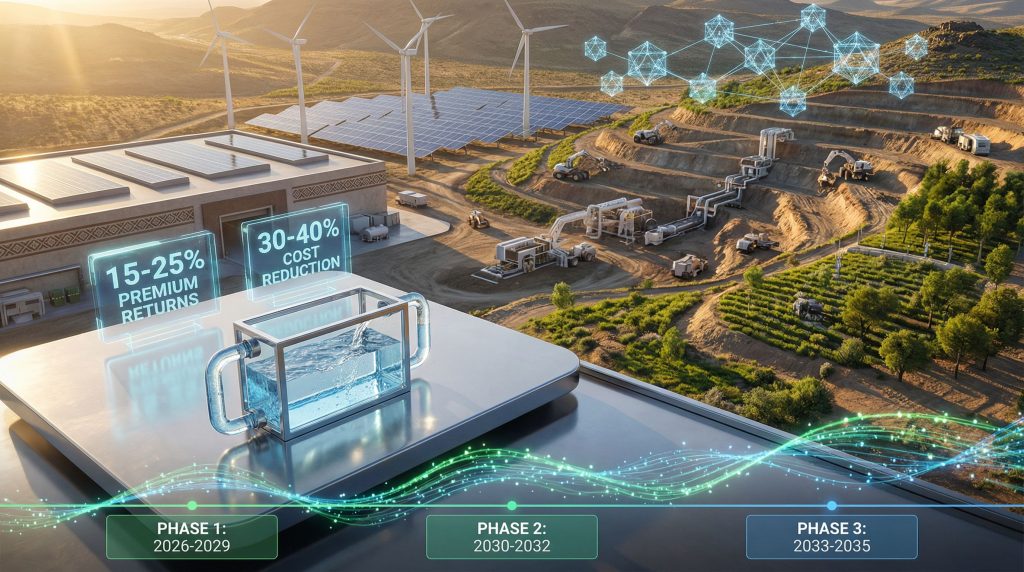
| Extraction Technology | Maximum throughput | Selective, low-impact methods | 15-25% premium returns |
| Energy Infrastructure | Lowest cost power | Renewable integration | 30-40% cost reduction |
| Waste Management | Compliance minimum | Circular economy design | 20-35% value recovery |
Renewable energy strategies deliver 30-40% operational cost reduction within five-year implementation horizons with 2-3 year payback periods. Advanced water recycling systems achieve 25-35% water cost reduction while generating secondary revenue from processed minerals recovered from wastewater streams.
How Do Renewable Energy Transitions Reshape Mining's Strategic Value Chain?
Mining operations consume approximately 5-7% of global electricity production, with fossil fuel-based generation comprising 60-70% of mining energy inputs. This energy dependency creates both significant cost exposure and transformation opportunities as renewable energy technologies achieve cost competitiveness with traditional grid electricity.
Grid Independence Strategies for Remote Mining Operations
Remote mining sites face particularly acute energy security challenges due to logistical constraints and grid infrastructure limitations. Renewable energy systems with integrated battery storage eliminate reliance on diesel logistics while reducing effective energy costs from $0.25-0.35 per kWh to $0.08-0.12 per kWh.
Solar and wind power generation costs have declined 89% and 70% respectively since 2010, making renewable energy competitive with grid electricity in most mining jurisdictions. This cost reduction enables comprehensive energy infrastructure transformation that delivers both operational savings and environmental performance improvements.
Battery Storage Integration Models for 24/7 Renewable Operations
Advanced battery storage systems enable mining operations to achieve renewable energy penetration levels of 60-80% while maintaining operational reliability. Different storage technologies serve specific operational requirements:
- Lithium-ion systems: Most common for 2-8 hour storage duration, deployed in 50-70% of mining renewable energy projects
- Iron-air batteries: Emerging for 12+ hour duration storage with growing adoption in remote operations
- Flow batteries: Specialised applications for extreme climate mining environments
- Compressed air energy storage: Large-scale deployment for remote operations requiring extended energy security
Battery storage deployment for mining applications grew 480% in 2023-2024, with costs declining to $75-95 per kWh from $200-250 per kWh in 2018. This cost reduction enables economically viable energy storage systems that support high renewable energy penetration.
Power Purchase Agreement Structures That Lock in Competitive Advantages
Long-term corporate renewable power purchase agreements for mining operations increased 320% between 2018 and 2024, with average contract prices 15-25% below grid electricity rates. Modern mining PPAs incorporate sophisticated structural innovations that maximise renewable energy value:
- Flexible off-take provisions accommodating variable renewable generation patterns
- Demand-response mechanisms that shift production scheduling to high-renewable availability windows
- Revenue-sharing structures where mining operations benefit from surplus generation sales
- Integrated energy storage procurement with bundled financing arrangements
Key Insight: Mining operations achieving 60%+ renewable energy integration report 25-30% lower operational costs within five years, while securing preferential access to ESG-focused capital markets.
What Water Security Strategies Determine Future Mining Feasibility?
Water scarcity represents an existential threat to mining operations, with approximately 75% of global mining operations located in water-stressed regions. By 2035, this proportion is projected to reach 85-90%, making advanced water management capabilities essential for operational continuity.
Zero Liquid Discharge Implementation Across Different Geological Contexts
Zero Liquid Discharge requirements have been adopted in 45+ jurisdictions as of 2025, with compliance mandatory for new mining permits in Australia, Canada, the European Union, Chile, and increasingly in Mexico. These regulations fundamentally alter mining water economics and operational design requirements.
Copper mining consumes 150-200 million litres per ton of copper produced, while gold mining consumes 250-500 million litres per ton, making water one of the largest operational inputs. Water pricing in mining jurisdictions has increased 30-50% since 2020, with further escalation expected as scarcity intensifies.
Implementation of Zero Liquid Discharge systems requires systematic approach across multiple phases:
Stage 1 – Water Balance Optimisation (Months 1-6):
- Comprehensive audit of water inputs, consumption points, and discharge pathways
- Identification of recycling opportunities in ore processing and tailings management
- Wastewater characterisation for downstream processing and valorisation potential
Stage 2 – Treatment Infrastructure Deployment (Months 6-24):
- Advanced oxidation processes for pollutant removal
- Reverse osmosis and membrane technologies for water recovery
- Evaporation ponds or thermal crystallisation for zero-discharge waste management
- Brine concentration and mineral recovery systems
Closed-Loop Water Systems That Transform Waste into Resource Streams
Mining operations implementing closed-loop water systems achieve 80-95% water recycling rates, reducing freshwater intake by 70-85%. Capital costs for closed-loop systems average $15-25 million for mid-sized operations but generate payback periods of 5-8 years through water cost avoidance and regulatory risk mitigation.
Advanced closed-loop systems create secondary revenue streams through mineral recovery from wastewater. Tailings water often contains valuable metals that can be recovered through specialised processing techniques, transforming waste streams into profit centres.
Regional Water Stress Mapping for Strategic Site Selection
Future mining project development must incorporate comprehensive water stress analysis alongside traditional geological and economic assessments. Regional water availability projections, competing demand from agriculture and municipal users, and climate change impact scenarios determine long-term operational viability.
Mining enterprises that proactively secure water rights and implement advanced recycling systems achieve competitive advantages in water-stressed regions while reducing exposure to regulatory restrictions and community opposition.
Which Technology Integration Pathways Deliver Measurable Sustainability Outcomes?
Technology deployment in modern mining operations must deliver quantifiable environmental performance improvements while maintaining or enhancing operational efficiency. Strategic technology roadmaps require coordination across multiple systems to achieve integrated sustainability outcomes.
Precision Extraction Technologies That Minimise Surface Disruption
Advanced extraction technologies enable selective mining that reduces environmental impact while improving ore recovery rates. Precision extraction methods deliver 15-25% ore recovery improvements with 40-50% less land disturbance compared to conventional techniques.
These technologies include AI-driven mining technology for real-time geological analysis, selective extraction equipment that minimises waste rock generation, and in-situ processing techniques that reduce surface infrastructure requirements.
Real-Time Environmental Monitoring Systems for Proactive Management
Integrated sensor networks provide continuous monitoring of air quality, water chemistry, noise levels, and ecosystem health indicators. Real-time data enables proactive environmental management that prevents regulatory violations while optimising operational parameters.
Advanced monitoring systems incorporate artificial intelligence algorithms that predict environmental impacts before they occur, enabling preventive interventions that maintain regulatory compliance while optimising production efficiency.
Automated Rehabilitation Systems That Accelerate Land Recovery
Technology integration across the mining lifecycle includes automated systems for progressive rehabilitation and ecosystem restoration. These systems deploy during active mining phases to minimise environmental disruption and accelerate post-mining land recovery through mine reclamation innovation.
Technology Adoption Timeline:
- Phase 1 (2026-2028): Selective mining and renewable energy integration
- Phase 2 (2029-2031): Advanced water recycling and waste valorisation
- Phase 3 (2032-2035): Fully automated environmental restoration systems
How Does Community Integration Strategy Impact Long-Term Operational Sustainability?
Community acceptance represents a critical success factor for mining operations, with social licence to operate increasingly dependent on demonstrable community benefits and cultural sensitivity. Modern mining enterprises must develop integrated community engagement strategies that create shared value propositions extending beyond traditional employment and tax revenue.
Stakeholder Engagement Models That Create Shared Value Propositions
Effective community engagement requires genuine partnership structures that provide communities with meaningful participation in project development and ongoing operations. Successful models include community equity participation, local supply chain development, and revenue-sharing mechanisms tied to operational performance.
Mining enterprises must transition from viewing community engagement as risk mitigation to recognising it as value creation opportunity. Community partnerships can reduce operational costs through local sourcing, enhance security through community support, and provide valuable local knowledge for environmental management.
Local Economic Development Programs That Outlast Mining Operations
Sustainable community integration requires economic development programs that create lasting benefits extending beyond mine life. These programs include skills development for transferable trades, infrastructure investments with multi-use applications, and business development support for local entrepreneurs.
Education and training programs must focus on capabilities that remain valuable after mining operations conclude. Technical training in renewable energy systems, environmental monitoring, and advanced manufacturing provides communities with economic opportunities that align with post-mining land use planning.
Indigenous Partnership Frameworks for Culturally Sensitive Resource Development
Indigenous communities hold traditional rights to lands containing significant mineral resources in many jurisdictions. Respectful partnership requires recognition of traditional knowledge, cultural protocols, and community governance structures. Successful partnerships provide Indigenous communities with meaningful economic participation while respecting cultural values and traditional land management practices.
These partnerships often include traditional knowledge integration in environmental monitoring, cultural site protection protocols, and Indigenous enterprise development programs that create sustainable economic opportunities.
The next major ASX story will hit our subscribers first
What Supply Chain Transparency Requirements Are Reshaping Market Access?
Global supply chains increasingly demand comprehensive traceability and ethical sourcing verification from mining operations. This transparency requirement creates both compliance costs and competitive differentiation opportunities for mining enterprises that implement robust tracking and verification systems.
Blockchain Implementation for End-to-End Material Traceability
Blockchain technology enables immutable record-keeping for mineral extraction, processing, and transportation. This technology provides downstream customers with verified information about environmental performance, labour practices, and community engagement throughout the supply chain.
Implementation of blockchain traceability systems requires coordination across multiple stakeholders, including mining operators, processing facilities, transportation providers, and end customers. Successful systems provide real-time visibility into material origins while protecting proprietary operational information.
Ethical Sourcing Certification Systems and Their Market Premium
Third-party certification systems provide independent verification of sustainable mining practices and ethical sourcing standards. Certified operations often command premium pricing from downstream customers seeking to meet their own sustainability commitments.
Market premiums for certified sustainable minerals range from 3-8% depending on commodity type and certification standard. These premiums provide direct financial incentives for sustainability investment while helping to offset the additional costs of responsible mining practices.
Downstream Integration Strategies That Capture Value-Added Processing
Mining enterprises increasingly pursue vertical integration strategies that capture additional value through downstream processing while maintaining control over sustainability standards throughout the value chain. This integration enables mining companies to directly serve end customers while capturing processing margins.
Downstream integration also provides mining enterprises with enhanced market intelligence, customer relationship development, and reduced exposure to commodity price volatility through diversified revenue streams.
Which Regulatory Scenarios Present the Greatest Strategic Opportunities?
Regulatory evolution creates both compliance challenges and competitive opportunities for mining enterprises that anticipate and proactively address emerging requirements. Early compliance with anticipated standards provides first-mover advantages in accessing new markets and capital sources.
Carbon Border Adjustment Mechanisms and Their Competitive Implications
Carbon Border Adjustment Mechanisms create competitive advantages for low-carbon mining operations while imposing costs on high-emission producers. These mechanisms effectively level the playing field between operations in different regulatory jurisdictions while providing financial incentives for emission reduction.
Mining operations that achieve significant emission reductions through renewable energy adoption and process optimisation gain cost advantages when exporting to markets with carbon border adjustments. This regulatory trend accelerates investment in clean technology while potentially reshaping global trade patterns.
Critical Mineral Security Policies That Favour Sustainable Producers
Governments increasingly prioritise supply chain security for critical minerals essential to energy transition and technological advancement. These policies often include preferences for domestic production or imports from allied nations with strong environmental and labour standards.
Sustainable mining operations in politically stable jurisdictions with robust regulatory frameworks benefit from these security considerations through preferential trade terms, government purchase commitments, and diplomatic support for international operations.
International Standards Harmonisation and First-Mover Advantages
International harmonisation of environmental and social standards creates opportunities for mining enterprises that exceed current requirements to benefit from streamlined regulatory approval processes across multiple jurisdictions.
Operations that achieve certification under emerging international standards gain competitive advantages through reduced permitting timelines, enhanced access to international capital markets, and preferential treatment from multinational customers seeking standardised supplier qualifications.
How Do Circular Economy Principles Transform Mining Business Models?
Circular economy integration enables mining enterprises to extract value from previously considered waste streams while reducing environmental impact through resource optimisation and material recovery. This transformation requires fundamental reconsideration of traditional linear extraction models.
Tailings Reprocessing Technologies That Generate Secondary Revenue Streams
Historical tailings deposits contain significant quantities of valuable minerals that can be recovered using modern processing technologies. Tailings reprocessing provides secondary revenue streams while reducing environmental liabilities associated with waste storage facilities.
Advanced processing techniques can recover 60-80% of remaining valuable minerals from tailings deposits while reducing physical footprint and environmental impact. These operations often achieve faster permitting approval due to their environmental remediation benefits.
End-of-Life Product Recovery Systems for Urban Mining Integration
Urban mining represents emerging opportunity for mineral recovery from electronic waste, construction materials, and industrial equipment. Mining enterprises can leverage existing mineral processing expertise to capture value from urban waste streams while contributing to circular economy objectives.
Electronic waste contains higher concentrations of valuable metals than many primary ore deposits. Integrated urban mining operations can achieve higher margins than traditional extraction while reducing demand for primary mineral production.
Industrial Symbiosis Networks That Optimise Regional Resource Flows
Industrial symbiosis creates value through coordinated resource sharing between mining operations and other industrial facilities. Waste heat from mining processing can support greenhouse agriculture, whilst tailings materials can provide inputs for construction material production.
These networks optimise regional resource efficiency while creating additional revenue streams for mining operations through waste monetisation and shared infrastructure development.
Circular Economy Value Creation:
- Primary Extraction: Traditional mining with sustainability enhancements
- Secondary Recovery: Tailings and waste stream valorisation
- Tertiary Processing: Urban mining and recycling integration
- Quaternary Services: Environmental restoration and ecosystem services
What Investment Thesis Supports Sustainable Mining's Long-Term Outperformance?
Investment analysis increasingly favours mining enterprises that demonstrate sustainable operating practices, advanced environmental management, and strong community relationships. These factors reduce operational risk while enhancing access to growth capital and premium market positioning.
ESG Premium Valuations in Public and Private Market Transactions
Public market valuations for ESG-leading mining enterprises command consistent premiums compared to industry averages. Private market transactions also reflect sustainability performance through higher enterprise multiples and reduced investor due diligence requirements.
ESG performance metrics correlate with operational efficiency, regulatory compliance, and stakeholder relationship quality. These factors translate into reduced operational disruption risk and enhanced predictability of financial performance over time.
Risk-Adjusted Returns for Sustainability-Integrated Operations
Comprehensive risk assessment reveals that sustainability-integrated mining operations demonstrate superior risk-adjusted returns through reduced regulatory, environmental, and social risks. These operations experience fewer operational disruptions, lower insurance costs, and enhanced access to capital markets.
Quantitative analysis shows that mining operations with comprehensive ESG frameworks achieve 15-25% lower operational risk premiums while maintaining comparable production efficiency and cost competitiveness.
Portfolio Diversification Benefits of Future-Proofed Mining Assets
Mining assets that meet emerging sustainability standards provide portfolio diversification benefits through reduced exposure to regulatory changes, resource availability constraints, and social licence challenges that affect traditional extraction operations.
Investment portfolios incorporating sustainable mining assets demonstrate enhanced stability during periods of regulatory uncertainty while capturing upside potential from growing demand for responsibly produced minerals.
Which Emerging Markets Offer the Most Attractive Sustainable Mining Opportunities?
Emerging markets with developing regulatory frameworks and abundant natural resources present significant opportunities for sustainable mining development. Success requires careful assessment of regulatory environment, infrastructure readiness, and local capacity building requirements.
Regulatory Environment Assessment for Sustainable Mining Development
Emerging markets with clear environmental regulations and transparent permitting processes provide attractive opportunities for sustainable mining investment. Regulatory clarity enables long-term planning while reducing political and compliance risks.
Jurisdictions that actively encourage sustainable mining through tax incentives, streamlined permitting, and infrastructure support create competitive advantages for environmentally focused mining enterprises according to sustainable mining guidelines.
Infrastructure Readiness for Renewable-Powered Mining Operations
Renewable energy infrastructure availability significantly impacts the feasibility of sustainable mining development in emerging markets. Regions with abundant solar and wind resources combined with supportive grid infrastructure provide optimal conditions for renewable-powered mining operations.
Emerging markets often provide opportunities for integrated infrastructure development where mining enterprises can develop renewable energy capacity that serves both operational requirements and broader regional energy needs.
Local Capacity Building Requirements for Long-Term Success
Sustainable mining success in emerging markets requires comprehensive local capacity building that develops technical skills, environmental management capabilities, and business development expertise within local communities.
Investment in local capacity building creates operational benefits through skilled workforce development while generating community support and regulatory approval for mining activities. These programs must focus on transferable skills that provide long-term economic opportunities beyond mine life.
This analysis is for informational purposes only. Mining investments carry inherent risks including regulatory changes, commodity price volatility, environmental liabilities, and operational challenges. Prospective investors should conduct thorough due diligence and consult qualified professionals before making investment decisions. Forward-looking statements regarding technology development, regulatory changes, and market conditions are based on current information and involve uncertainties that may cause actual results to differ materially from projections.
Ready to Capitalise on Sustainable Mining's Transformation?
Discovery Alert's proprietary Discovery IQ model delivers instant notifications on significant ASX mineral discoveries, including those from companies pioneering sustainable mining practices and environmental innovations. Start your 14-day free trial today to position yourself ahead of the market as the mining industry undergoes this unprecedented sustainability-driven evolution.