August 22, 2026
The Structural Forces Rewriting Mining Talent Markets Across the Americas
Across the global resources sector, a quiet but consequential transformation is underway. The technologies enabling modern mine operations have never been more sophisticated, the demand signal for critical minerals demand has never been stronger, and the pipeline of capital chasing new discoveries has rarely been deeper. Yet beneath this expansionary surface, a constraint is hardening that no amount of investment capital can immediately resolve: the people required to build, operate, and sustain these mines are becoming increasingly difficult to find.
Mining workforce challenges in the Americas have crossed a threshold. They are no longer an operational inconvenience to be managed through a recruitment cycle. They have become a structural constraint on project feasibility, sitting alongside geology, mining permitting timelines, and capital availability as a primary determinant of whether a mine advances or stalls. Understanding the depth and complexity of this shift is essential for any operator, investor, or project developer with exposure to US, Canadian, or Latin American mining.
When big ASX news breaks, our subscribers know first
Why Workforce Availability Has Become a Project-Viability Variable
The conventional framing of mining labor shortages treats them as cyclical: demand rises during boom periods, wages climb, and eventually the market self-corrects. That model no longer applies. What the Americas are experiencing today is the convergence of two long-cycle forces moving simultaneously in the wrong direction.
On one side, an aging workforce is approaching a demographic cliff. On the other, the entry-level talent pipeline that should be replenishing experienced cohorts has contracted significantly. The result is not a temporary tightening but a widening structural gap that will take years of deliberate intervention to close.
Adding pressure from above, the energy transition and critical minerals strategy are simultaneously accelerating mine development timelines and intensifying competition for the same finite pool of qualified specialists. The Americas are central to global supply chains for copper, lithium, cobalt, nickel, and graphite — commodities whose demand trajectories are tied directly to battery technology, clean energy infrastructure, and defense applications. Workforce constraints that slow mine development in this region carry downstream consequences that extend well beyond individual project budgets.
Critically, US, Canadian, and Latin American operators are not drawing from separate talent pools. They are competing for the same continental cohort of experienced engineers, geologists, and technical specialists. Every new project announcement in Chile or Peru competes with openings in Nevada or British Columbia for the same shortlist of qualified candidates. This zero-sum dynamic in specialist hiring is one of the less-discussed realities of the current market.
How Deep Is the Talent Shortage? Quantifying the Mining Workforce Gap
The Retirement Wave: A Demographic Cliff Approaching Rapidly
The scale of anticipated workforce exits is significant enough to warrant treating it as a project risk factor, not merely an HR concern.
| Country | Projected Workforce Exit Scale | Timeline |
|---|---|---|
| United States | ~221,000 workers (50%+ of workforce) | By 2029 |
| Canada | 1 in 5 workers already aged 55+ | As of 2023 |
| Canada (projected shortage) | 80,000–120,000 workers | By 2030 |
| Canada (critical minerals demand) | 100,000–220,000 additional workers needed | By 2033 |
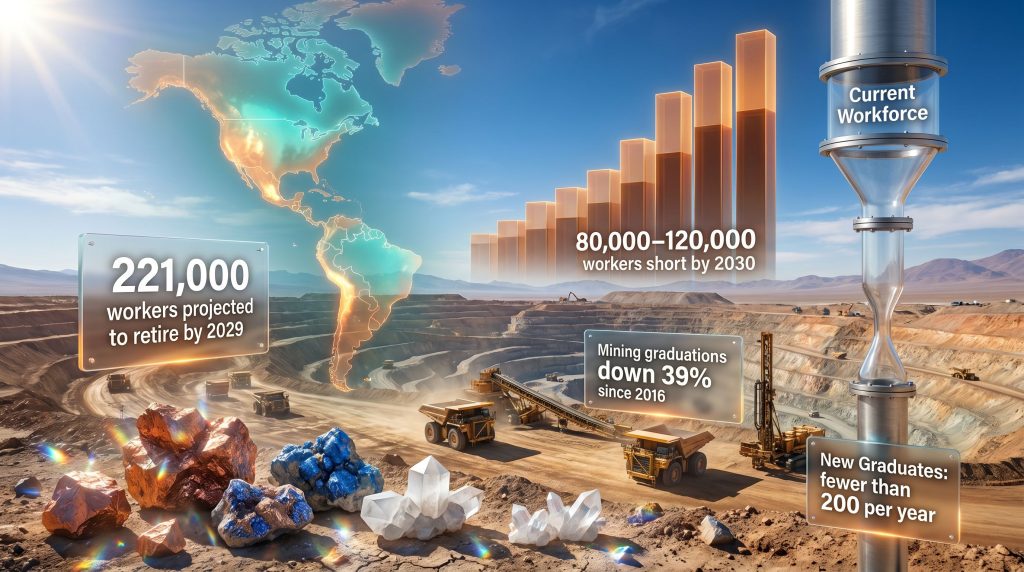
According to data cited by the Center for Strategic and International Studies, more than half of the US mining workforce, approximately 221,000 workers, is projected to reach retirement age by 2029. In Canada, the Mining Industry Human Resources Council (MiHR) projects an average workforce exit rate exceeding 2% per year through 2034, compounding a shortfall that already exceeds 80,000 workers by some estimates and could reach 120,000 before the end of the decade.
The International Energy Agency has highlighted that Canada alone may require between 100,000 and 220,000 additional workers by 2033 to both replace retiring employees and staff the new mines, smelters, and refineries needed to meet critical minerals demand. Latin American mining faces parallel demographic pressures, compounded by operational complexity in high-altitude, remote, and multi-jurisdictional environments.
"What makes this a structural problem rather than a cyclical one is that retirements are accelerating precisely when new entrant pipelines are contracting. The gap does not close without deliberate, multi-year action."
The Graduate Pipeline Is Running Dry
The entry-level side of this equation offers equally concerning data. The number of accredited mining and mineral engineering programs in the United States declined from approximately 25 in 1982 to around 14 to 15 programs by the mid-2010s, and enrollment has remained persistently low. Spring 2023 data shows only 590 undergraduate students enrolled across all US mining engineering programs, with fewer than 200 mining engineers graduating that year.
According to McKinsey research on the mining talent gap, mining graduations in the US have fallen by 39% since 2016, a compounding shortfall that arrives precisely as the retirement wave accelerates. The Mining Association of Canada has flagged declining enrollment trends across geological, metallurgical, and mining engineering disciplines, reinforcing that this is not a US-specific phenomenon.
The arithmetic is unfavourable. The industry is losing experienced workers at a rate that entry-level pipelines are structurally unable to offset. This reality requires a fundamental rethinking of how the industry sources, develops, and retains human capital.
Why Aren't Younger Workers Choosing Mining Careers?
The Perception Problem Driving Recruitment Failures
Surveys indicate that approximately 70% of individuals aged 15 to 30 would not seriously consider a career in mining. The deterrents identified consistently across research include:
- Safety and environmental reputation concerns rooted in historical industry practices
- A perceived lack of purpose or alignment with sustainability values
- Remote location requirements that conflict with lifestyle preferences
- Limited visibility of technology-forward or innovation-oriented career pathways
This perception gap is particularly acute with Gen Z cohorts, who place high value on purpose-driven work, career development transparency, and work-life balance — areas where mining has historically underinvested in its employer narrative. The sector's failure to communicate how profoundly it is changing, through automation, digitisation, and ESG integration, means that many of the characteristics that would resonate with younger professionals are simply not reaching them.
Remote Location Barriers: A Geographic Constraint on Talent Access
The geography of active mining in the Americas creates a structural recruitment handicap that financial incentives alone cannot fully overcome. The most productive US mining states — Nevada, Alaska, Arizona, and Wyoming — present significant relocation challenges for professionals accustomed to metropolitan environments. Northern and rural Canadian operations face similar resistance, particularly among early-career engineers and geoscientists who have built social and professional networks in urban centres.
Latin American projects frequently require rotational schedules or extended periods away from home, a model that remains unappealing to younger talent prioritising stability and predictability. Remote location premiums can attract experienced workers in the short term, but they do not resolve the fundamental supply constraint.
How Is the Required Skills Profile in Mining Changing?
Digital Transformation Is Raising the Technical Baseline
The skills required across mining roles are evolving faster than training institutions are adapting their curricula. Automation, autonomous haulage systems, remote operations centres, and AI in mining are no longer experimental — they are becoming operational standards across major projects in all three regions.
Deloitte's mining and metals industry outlook identifies AI literacy as an emerging baseline requirement across a growing range of operational and technical roles. The practical implications for hiring include rapidly rising demand for:
- Mine planners proficient in optimisation, simulation, and AI-assisted scheduling platforms
- Maintenance specialists trained to service autonomous and semi-autonomous equipment
- Remote operations centre technicians managing fleets and processes from centralised facilities
- Operations leaders with demonstrable data analytics fluency alongside traditional operational experience
ESG Integration Is Creating Entirely New Role Categories
Environmental, social, and governance responsibilities are no longer peripheral compliance functions managed by small specialist teams. They are embedded into core operations, influencing permitting timelines, project approvals, and social licence to operate.
The following role categories are now in active and growing demand across the Americas:
- Environmental specialists and water management professionals
- Permitting and regulatory affairs experts navigating complex multi-jurisdictional frameworks
- Community relations coordinators and Indigenous engagement specialists
- Sustainability reporting analysts and ESG data professionals
This shift is particularly pronounced in Canada and Alaska, where environmental stewardship and meaningful Indigenous community engagement are central to project viability, not optional enhancements. Companies that underestimate the workforce requirements of genuine ESG integration risk both operational and reputational exposure.
In-Demand Skills and Roles: A Comparative Overview
| Role Category | Primary Driver | Priority Region |
|---|---|---|
| Mine Planners (digital/AI-enabled) | Automation and optimisation | US, Canada |
| Maintenance Specialists (autonomous systems) | Equipment technology evolution | Pan-Americas |
| Environmental and Permitting Specialists | ESG compliance and project approvals | Canada, Alaska, LATAM |
| Community Relations and Indigenous Engagement | Social licence requirements | Canada, LATAM |
| Geoscientists and Exploration Geologists | Critical minerals expansion | LATAM, Canada, US |
| Project Controls and Commissioning Talent | Capital project delivery | Pan-Americas |
| Operations Leaders (data-literate) | Digital mine transformation | Pan-Americas |
What Are the Business Risks If These Challenges Go Unaddressed?
Talent shortages at critical project phases — feasibility, construction, commissioning — directly extend timelines and inflate capital costs. The reactive approach to talent gaps, mobilising an emergency search when a key position becomes vacant, is significantly more expensive and disruptive than proactive pipeline development.
For critical minerals specifically, the stakes extend beyond individual project economics. Workforce constraints that delay mine development in the Americas have downstream consequences for EV supply chains, energy storage deployment, and national resource security objectives. Both the US and Canada have embedded mining workforce development within their national critical minerals strategies, a signal of how elevated the policy stakes have become — though this reflects broad national priorities rather than project-specific commitments.
Competitive dynamics are also accelerating compensation inflation. As operators across three regions compete for the same continental pool of experienced professionals, companies without proactive workforce strategies face not only vacancy risk but the active risk of losing existing high performers to better-positioned competitors.
The next major ASX story will hit our subscribers first
Strategic Responses: What Leading Mining Companies Are Doing
Building Long-Term Talent Pipelines Through Education and Community Partnerships
Forward-thinking operators are investing in demand creation at the entry level, partnering with community colleges, technical institutes, and universities to build direct pipelines into mining roles. Scholarship programmes and early-career engagement initiatives are gradually shifting awareness among secondary school students who might otherwise never consider the sector.
In Canada, programmes including the Sectoral Workforce Solutions Programme and the Indigenous Skills and Employment Training Programme are building foundational skills and what the IEA describes as mineral literacy for critical minerals roles. Indigenous employment represents both an equity imperative and a practical workforce expansion opportunity, with more than 12,000 Indigenous workers currently active in Canadian mining and quarrying — a foundation with significant potential for further growth.
Workforce Diversification as a Structural Solution
Furthermore, women in mining, visible minorities, and young workers remain underrepresented across most mining disciplines. The Mining Association of Canada has explicitly identified increased participation from these groups as essential for meeting projected future labour demand. Addressing this gap requires more than targeted recruitment campaigns — it demands visible representation in leadership, inclusive workplace culture, and structural changes to how career pathways are communicated and supported.
Flexible Workforce Models and Employer of Record Solutions
Contract and rotational workforce structures allow mining companies to scale capacity during project peaks without the fixed cost and long-term commitment of permanent headcount at every level. The highest demand for contract and hybrid arrangements is concentrated in:
- Project controls and cost engineering
- Commissioning engineers and construction supervisors
- Site leadership and operations management
- Specialist geoscience and feasibility study roles
Employer of Record (EOR) solutions are increasingly relevant in a market where rapid cross-border mobilisation is essential. EOR arrangements allow companies to deploy specialists across the US, Canada, and LATAM without establishing local legal entities, removing a significant administrative and compliance barrier to continental talent mobility. Companies deploying flexible workforce models consistently demonstrate faster project progression than those relying exclusively on local permanent hiring.
Strengthening Employee Value Propositions and Upskilling Existing Workforces
High wages remain a necessary condition for attracting talent to remote locations, but they are insufficient for long-term retention. Younger mining professionals consistently prioritise:
- Clear and credible career development pathways
- A visible connection between their role and sustainability or innovation outcomes
- Predictable schedules and genuine work-life balance
- Psychologically safe and inclusive workplace cultures
Companies that invest in structured reskilling programmes, cross-training workers across operational and technical disciplines, and competency frameworks aligned to emerging role requirements are building organisational resilience that reactive hiring cannot replicate. According to workforce trend analysis from the Society for Mining, Metallurgy and Exploration, companies with structured upskilling programmes retain skilled employees at significantly higher rates than those relying solely on external recruitment.
United States vs. Canada vs. Latin America: Regional Pressure Profiles Compared
| Dimension | United States | Canada | Latin America |
|---|---|---|---|
| Retirement pressure | Critical — 221,000 exits by 2029 | High — 1 in 5 workers aged 55+ | Moderate, varies by country |
| Graduate pipeline | Severely constrained — 39% decline since 2016 | Declining across key disciplines | Underdeveloped in technical specialisms |
| Critical minerals growth | High — policy-driven domestic expansion | Very high — national strategy priority | Very high — global copper and lithium powerhouse |
| Remote location challenge | High — Nevada, Alaska, Wyoming, Arizona | Very high — northern and rural operations | High — rotational and extended travel requirements |
| Indigenous workforce integration | Emerging | Established — 12,000+ workers | Variable — significant growth opportunity |
| ESG and social licence complexity | Moderate | High | Very high |
| Cross-border talent mobility | Active — global sourcing required | Active — global sourcing required | Complex — regulatory and visa barriers |
Frequently Asked Questions: Mining Workforce Challenges in the Americas
What is causing the mining workforce shortage in the Americas?
The shortage reflects a combination of aging workforce demographics, declining graduate enrolment in mining-related disciplines, low youth interest driven by perception barriers, remote location constraints, and rapidly evolving technical skill requirements. It is structural in nature, not cyclical, and will require multi-year, multi-pronged responses to address meaningfully.
How many mining workers are expected to retire in the US by 2029?
Approximately 221,000 workers, representing more than half of the current US mining workforce, are projected to retire by 2029. Set against the backdrop of fewer than 200 mining engineers graduating annually, the replacement deficit is mathematically significant and will compound without deliberate pipeline investment.
What skills are most in demand in mining right now?
The highest-demand profiles currently include AI-literate mine planners, autonomous systems maintenance specialists, environmental and permitting professionals, geoscientists focused on critical minerals exploration, and experienced project delivery talent in controls, commissioning, and construction supervision.
What is an Employer of Record and how does it help with mining recruitment?
An Employer of Record is a third-party organisation that assumes legal responsibility for employing a worker in a foreign jurisdiction, handling payroll, tax compliance, and local labour law obligations on behalf of the hiring company. In the context of mining workforce challenges in the Americas, EOR solutions enable rapid cross-border deployment of specialists across the US, Canada, and LATAM without the delay and complexity of establishing local legal entities in each country.
How does the critical minerals boom affect mining workforce demand?
Canada alone may require between 100,000 and 220,000 additional workers by 2033 to staff both replacement hires and the new operations required for critical minerals development. The US and LATAM are experiencing simultaneous demand expansion, creating competing pulls on a continental talent pool that is already constrained by retirements and graduate pipeline decline.
Key Takeaways: Navigating Mining Workforce Challenges Across the Americas
The five structural drivers reshaping mining labour markets across the Americas — demographic exits, graduate pipeline contraction, youth perception barriers, evolving skills requirements, and remote location constraints — are long-cycle challenges that cannot be resolved through reactive hiring. Consequently, they require proactive, multi-year workforce strategies built on four core pillars:
- Pipeline development through education partnerships, scholarships, and early-career engagement
- Workforce diversification by expanding access for underrepresented groups including women, visible minorities, and Indigenous communities
- Flexible workforce models including contractors, rotational arrangements, and EOR solutions for cross-border mobility
- Genuine EVP investment in culture, development, and career progression to improve retention alongside compensation
"Companies that treat workforce strategy as a competitive capability rather than an administrative function will be materially better positioned to execute on the critical minerals and energy transition opportunities ahead. Those that do not will find that talent availability, not capital or geology, becomes the binding constraint on their growth."
This article contains forward-looking projections and labour market forecasts drawn from industry and government sources. These projections involve assumptions about future conditions and should be treated as indicative rather than definitive. Readers should consult primary industry sources including the Mining Industry Human Resources Council (MiHR) and the Mining Association of Canada for the most current quantitative outlook data.
Want To Know Which ASX Mining Companies Are Making Major Mineral Discoveries Right Now?
While workforce constraints reshape mining project timelines across the Americas, the next transformative mineral discovery can still emerge rapidly — and timing is everything. Discovery Alert's proprietary Discovery IQ model delivers real-time alerts on significant ASX mineral discoveries, instantly converting complex geological data into actionable investment insights, with historic discoveries demonstrating the extraordinary returns on offer. Begin your 14-day free trial at Discovery Alert today and position yourself ahead of the broader market.