August 13, 2026
Understanding the Economic Framework Behind Mining's Electric Revolution
The transition toward electrified mining equipment represents one of the most significant technological shifts in the extractive industries since the mechanization of the early 20th century. As mining companies grapple with mounting pressure to reduce operational costs and environmental impact, the financial mathematics surrounding battery-electric vehicles becomes increasingly critical to strategic planning. Understanding how to calculate and accelerate the recovery of these substantial capital investments requires a multifaceted approach that considers both immediate operational benefits and long-term value creation opportunities.
The complexity of recovering the cost of battery-electric vehicles in mining extends far beyond simple payback calculations. Modern mining operations must evaluate intricate relationships between energy costs, maintenance schedules, productivity gains, and evolving regulatory landscapes. This economic analysis becomes even more nuanced when considering the rapid advancement of battery technology, fluctuating commodity prices, and the emerging secondary markets for used batteries and recycled materials.
When big ASX news breaks, our subscribers know first
Analysing the Complete Cost Structure of Electric Mining Equipment
Capital Investment Requirements and Premium Pricing
The initial financial hurdle for mining operations centres on the substantial premium associated with battery-electric equipment. Current market analysis indicates that electric vehicles in mining typically command prices 20-40% higher than their diesel counterparts, creating an immediate capital allocation challenge for mining executives. This premium reflects not only the advanced battery systems but also the sophisticated power management and control technologies required for heavy-duty mining applications.
Beyond the equipment itself, mining companies must factor in comprehensive infrastructure development costs. Charging station installations require substantial electrical capacity upgrades, often necessitating new grid connections or on-site power generation facilities. The electrical distribution systems needed to support high-capacity charging can represent 15-25% of the total electrification investment, particularly for underground operations where installation complexity increases significantly.
Training and certification programmes add another layer of cost consideration. Mining operators require specialised training for electric vehicle operation, while maintenance technicians need certification in high-voltage electrical systems. These programmes typically span 3-6 months and can cost $15,000-25,000 per employee, depending on the complexity of the equipment and local training provider availability.
Operational Cost Analysis and Efficiency Gains
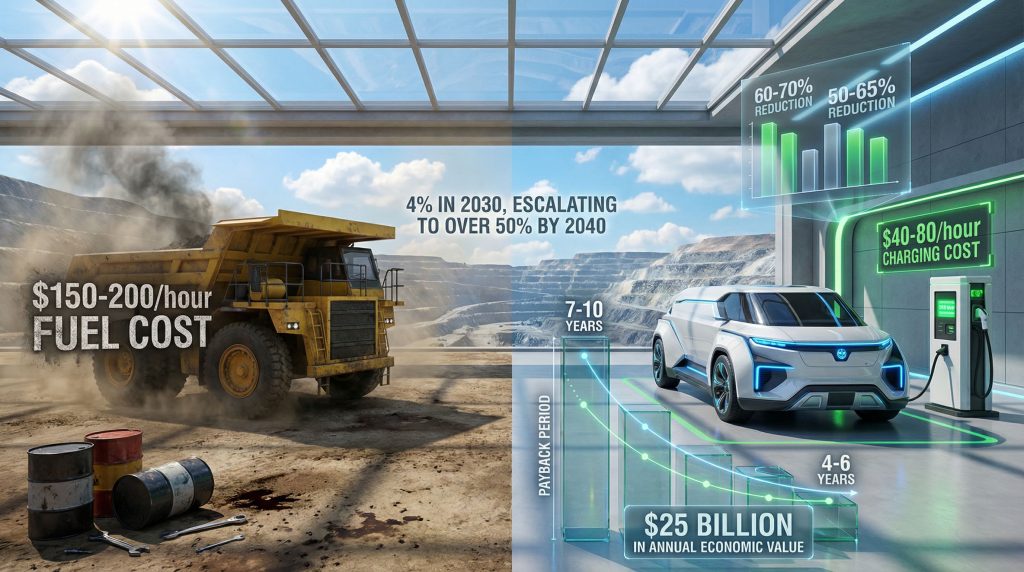
The operational cost advantages of electric mining equipment emerge from multiple sources, creating compound savings that accelerate payback timelines. Energy cost differentials represent the most immediate benefit, with electricity typically costing 60-70% less than diesel fuel on an equivalent energy basis. This differential becomes more pronounced in remote mining locations where diesel transportation costs can add 30-50% to fuel expenses.
Maintenance cost reductions stem from the fundamental mechanical differences between electric and diesel systems. Electric motors contain significantly fewer moving parts than internal combustion engines, eliminating the need for oil changes, filter replacements, and complex transmission maintenance. Industry data suggests maintenance costs can decrease by 50-65% compared to diesel equivalents, with some operations reporting even greater savings in harsh operating environments.
| Operational Metric | Diesel Equipment | Battery-Electric | Improvement Range |
|---|---|---|---|
| Energy Cost per Hour | $150-200 | $40-80 | 60-70% reduction |
| Maintenance Cost per Hour | $80-120 | $30-60 | 50-65% reduction |
| Annual Downtime | 15-20% | 5-10% | 50-75% improvement |
| Noise Level | 85-95 dB | 65-75 dB | 20-30 dB reduction |
Strategic Approaches to Accelerating Investment Recovery
Maximising Productivity Through Enhanced Utilisation
The path to faster cost recovery often lies in maximising equipment utilisation rates rather than simply reducing operating costs. Electric mining vehicles offer several productivity advantages that can significantly impact revenue generation. Higher equipment availability, typically 5-15% better than diesel equivalents, translates directly to increased production capacity without additional capital investment.
Noise reduction capabilities create opportunities for extended operating hours in noise-sensitive environments. Furthermore, many mining operations can extend shift patterns by 1-2 hours per day when using electric equipment, particularly in underground settings or operations near residential areas. This extended operational window can increase daily production by 10-20%, dramatically improving payback calculations.
Precision control systems in electric vehicles often deliver improved digging accuracy and reduced material waste. Underground operations report ore recovery improvements of 2-5% through more precise excavation control, while surface operations benefit from reduced overburden removal and improved grade control accuracy. These operational improvements contribute significantly to recovering the cost of battery-electric vehicles in mining through enhanced productivity metrics.
Revenue Diversification Through Asset Optimisation
Mining companies are discovering innovative approaches to extract additional value from their electric vehicle investments. Battery systems maintain significant residual value even after their primary mining applications, creating secondary revenue streams that weren't possible with conventional diesel equipment.
End-of-life battery repurposing for stationary energy storage applications can generate substantial returns. When mining equipment batteries reach 70-80% of their original capacity, they remain highly suitable for grid stabilisation and renewable energy storage applications. Market pricing for repurposed batteries ranges from $100-200 per kWh, depending on remaining capacity and integration requirements.
Material recovery programmes add another dimension to long-term value creation. Advanced battery recycling breakthrough processes can recover 80% of lithium, 95% of cobalt, and 95% of nickel content, with recovered materials commanding premium prices in tight supply markets. Some mining companies are establishing partnerships with battery manufacturers to guarantee material buyback programmes, providing predictable residual value calculations.
Financial Modelling Frameworks for Investment Decisions
Scenario-Based Analysis and Risk Assessment
Successful electric vehicle adoption requires sophisticated financial modelling that accounts for the numerous variables affecting payback timelines. Conservative scenario planning typically assumes 7-10 year payback periods under standard operational assumptions, including current energy price differentials and moderate productivity improvements.
Optimistic modelling scenarios can justify 4-6 year recovery timelines when incorporating maximum efficiency gains, extended operational hours, and material recovery benefits. These models typically assume energy cost savings of 65-70%, maintenance reductions of 60-65%, and productivity improvements of 15-20% through enhanced utilisation.
However, Monte Carlo simulations provide valuable risk assessment capabilities by modelling thousands of potential outcomes across varying fuel prices, electricity costs, equipment reliability, and market conditions. These analyses help mining companies understand the probability distributions of different payback scenarios and identify the key risk factors that could impact investment returns.
Integration with Broader Electrification Strategies
The most successful cost recovery strategies integrate individual vehicle acquisitions within comprehensive fleet electrification programmes. Shared infrastructure investments can be amortised across multiple equipment categories, reducing the per-unit infrastructure burden and accelerating overall payback timelines. In addition, this approach to mining industry innovation creates synergies that enhance overall operational efficiency.
Coordinated surface and underground electrification programmes create operational synergies that individual vehicle purchases cannot achieve. Common charging infrastructure, shared maintenance capabilities, and bulk purchasing agreements can reduce total electrification costs by 20-30% compared to piecemeal adoption strategies. Moreover, fleet transition planning enables mining companies to optimise capital allocation timing, often coordinating electric vehicle purchases with scheduled diesel equipment replacements to minimise stranded asset risks and maximise operational continuity.
Market Dynamics Influencing Recovery Calculations
Regional Variations and Energy Market Conditions
Geographic location plays a crucial role in determining electric vehicle payback timelines. Mining operations in regions with low-cost renewable electricity, such as parts of Australia, Chile, and Scandinavia, typically experience faster cost recovery due to more favourable energy cost differentials. Conversely, operations in regions dependent on expensive grid electricity may find payback periods extended by 2-3 years.
Carbon pricing mechanisms are beginning to influence recovery calculations as jurisdictions implement emissions trading systems and carbon taxes. Australia's voluntary carbon market, for example, provides opportunities for mining companies to monetise emissions reductions, with carbon credits trading between $15-30 per tonne CO2 equivalent.
Technology cost trajectories create both opportunities and risks for investment timing decisions. Battery costs have declined 85% since 2010 and are projected to fall another 40-50% by 2030. This ongoing cost reduction can accelerate payback periods for current investments while potentially creating obsolescence risks for equipment purchased today. According to research on cost recovery for battery-electric vehicles, successful implementation requires careful consideration of these technology trends.
Supply Chain and Implementation Considerations
Equipment availability constraints currently extend delivery timelines for electric mining vehicles, with some manufacturers reporting 12-18 month lead times for specialised equipment. This extended procurement cycle affects project planning and can delay the start of cost recovery periods, impacting overall investment returns.
Charging infrastructure scalability presents another implementation challenge. Grid capacity limitations in remote mining areas often require substantial electrical infrastructure investments before equipment deployment, potentially adding 6-12 months to implementation timelines and increasing upfront costs.
The availability of skilled technicians capable of maintaining electric mining equipment varies significantly by region. Areas with established automotive or renewable energy sectors typically have better access to qualified personnel, while remote mining regions may require extensive training programmes or contractor arrangements. Furthermore, the development of comprehensive data-driven mining operations requires additional technical expertise in system integration and performance monitoring.
Battery Technology Evolution and Future Considerations
Next-Generation Performance Improvements
Advancing battery technology continues to improve the economic proposition of electric mining equipment. Current lithium iron phosphate batteries used in mining applications typically provide 4,000-6,000 charge cycles, but next-generation chemistries promise 8,000-12,000 cycles, effectively doubling operational lifespans and improving payback calculations.
Energy density improvements allow for extended operational range between charging cycles. Current mining equipment batteries provide 200-300 Wh/kg, but emerging technologies target 400-500 Wh/kg, reducing charging frequency and associated downtime costs. These improvements, combined with lithium extraction advancements, are revolutionising the supply chain for battery materials.
Fast-charging capabilities are advancing rapidly, with some new systems capable of reaching 80% capacity in 45-60 minutes compared to current 2-4 hour charging times. These improvements reduce operational downtime and can improve equipment utilisation rates by 10-15%.
Technology Risk Management and Upgrade Planning
Mining companies must balance the benefits of early adoption against technology obsolescence risks. Equipment purchased today may be significantly outperformed by systems available in 3-5 years, potentially affecting resale values and competitive positioning.
Modular battery design approaches are emerging that allow for capacity upgrades or chemistry changes without replacing entire vehicle systems. This modularity can extend equipment lifecycles and provide protection against technology advancement risks. Consequently, these developments significantly impact the calculations for recovering the cost of battery-electric vehicles in mining.
Performance degradation modelling becomes critical for accurate payback calculations. Mining duty cycles are more demanding than automotive applications, and battery capacity typically declines 15-25% over the first 5 years of operation, affecting operational efficiency and requiring adjustment in long-term financial projections.
The next major ASX story will hit our subscribers first
Optimising Recovery Through Lifecycle Management
Second-Life Applications and Value Recovery
The emergence of robust secondary markets for used mining equipment batteries creates previously unavailable value recovery opportunities. When mining batteries reach 70-80% of original capacity, they retain substantial value for stationary energy storage applications, grid stabilisation, and renewable energy integration projects.
Market research indicates that comprehensive battery recycling programmes could supplement global cobalt supply by 4% in 2030, escalating to over 50% by 2040. This material recovery potential generates economic value estimated at $25 billion annually while avoiding 16 megatons of CO2 emissions through reduced primary material extraction.
Current recycling capabilities handle approximately 35,000 electric vehicle batteries annually at major facilities, but industry capacity is expanding rapidly to meet growing demand. The battery recycling sector is projected to exceed $40 billion in annual revenue by 2040, creating lucrative end-of-life value recovery opportunities for mining equipment operators. This development is explored in detail through research on responsible management of retired mining vehicle batteries.
Material Recovery Economics and Circular Value Creation
Advanced recycling processes can recover critical materials with high efficiency rates: lithium at 80% recovery, cobalt at 95% recovery, and nickel at 95% recovery. These recovered materials often command premium prices compared to mined equivalents due to their refined state and reduced processing requirements.
Integration with renewable energy systems creates additional value streams for repurposed mining batteries. Solar and wind power installations can utilise second-life batteries for energy storage, with mining companies receiving ongoing rental income or revenue sharing from energy storage operations.
For instance, some mining companies are establishing vertical integration strategies that include battery manufacturing and recycling capabilities, capturing additional value throughout the entire battery lifecycle and reducing dependence on external suppliers for both new and end-of-life processing.
The financial recovery timeline for recovering the cost of battery-electric vehicles in mining operations varies significantly based on operational intensity, energy market conditions, and lifecycle management strategies. While conservative estimates suggest 7-10 year payback periods, optimised implementations combining high utilisation rates, favourable energy pricing, and comprehensive lifecycle value recovery can achieve cost recovery in 4-6 years. Success requires sophisticated financial modelling, strategic implementation planning, and active management of both primary operational benefits and secondary value creation opportunities throughout the equipment lifecycle.
This analysis is based on current market conditions and technology performance. Mining companies should conduct detailed financial modelling specific to their operational requirements and regional conditions before making investment decisions. Payback calculations are subject to changes in energy prices, technology advancement rates, and regulatory environments.
Ready to Stay Ahead of Mining's Electric Evolution?
Discovery Alert's proprietary Discovery IQ model provides instant notifications on significant ASX mineral discoveries, including breakthrough developments in electric vehicle technologies and battery materials that are reshaping the mining sector. Explore our discoveries page to understand how major technological shifts can create exceptional investment opportunities, then begin your 14-day free trial to position yourself ahead of the market's next electrification breakthrough.