August 13, 2026
The Hidden Economics of Aluminium Smelting and Why Electricity Is Everything
Few industrial processes expose the raw economics of energy dependency as starkly as aluminium smelting. Unlike steel, cement, or chemical manufacturing, aluminium production has virtually no lever to pull when power costs spike, because electricity is not merely an input, it is the process itself. The electrolytic reduction of alumina into aluminium metal, known as the Hall-Heroult process, consumes roughly 13 to 15 megawatt-hours of electricity per tonne of aluminium produced. At industrial scale, that figure translates into a smelter consuming as much electricity as a small city, continuously, around the clock, every single day of the year.
This structural reality is what makes the Tomago Aluminium government bail out one of the most consequential industrial policy decisions in Australia's recent history, not because of its dollar size, but because of what it reveals about the collision between the energy transition and the economics of heavy manufacturing.
When big ASX news breaks, our subscribers know first
Australia's Largest Aluminium Smelter and the 2028 Power Cliff
Tomago Aluminium, situated in the Hunter Valley of New South Wales, holds the distinction of being Australia's largest single aluminium smelting operation. The facility operates under a joint venture structure, with Rio Tinto holding a majority stake. It directly employs more than 1,000 workers, a figure that understates its true economic footprint considerably, because logistics operators, maintenance contractors, chemical suppliers, and port facilities all orbit around the smelter's continued operation.
What brought the facility to the point of requiring government intervention was not mismanagement or declining demand, it was a hard deadline. The smelter's existing electricity supply agreement was approaching expiry in 2028, and the arithmetic of Australia's evolving wholesale power market made a straightforward commercial renewal essentially impossible.
Here is the critical dynamic that is rarely explained clearly in public reporting:
- Aluminium smelters require firm, continuous baseload power at predictable pricing, intermittent supply or spot market exposure is incompatible with the smelting process
- Australia's coal-fired generation fleet, which historically provided that baseload at affordable prices, is retiring faster than replacement capacity is being commissioned
- The wholesale electricity market price for industrial consumers has structurally increased as coal exits the grid, with no equivalent low-cost renewable baseload yet available at the scale smelters require
- Long-term power purchase agreements at commercially viable rates have become difficult to structure without some form of concessional support or government underwriting
Without a credible replacement power arrangement, the smelter's closure was not a theoretical risk. It was a commercially logical outcome.
Unpacking the A$2.5 Billion Package
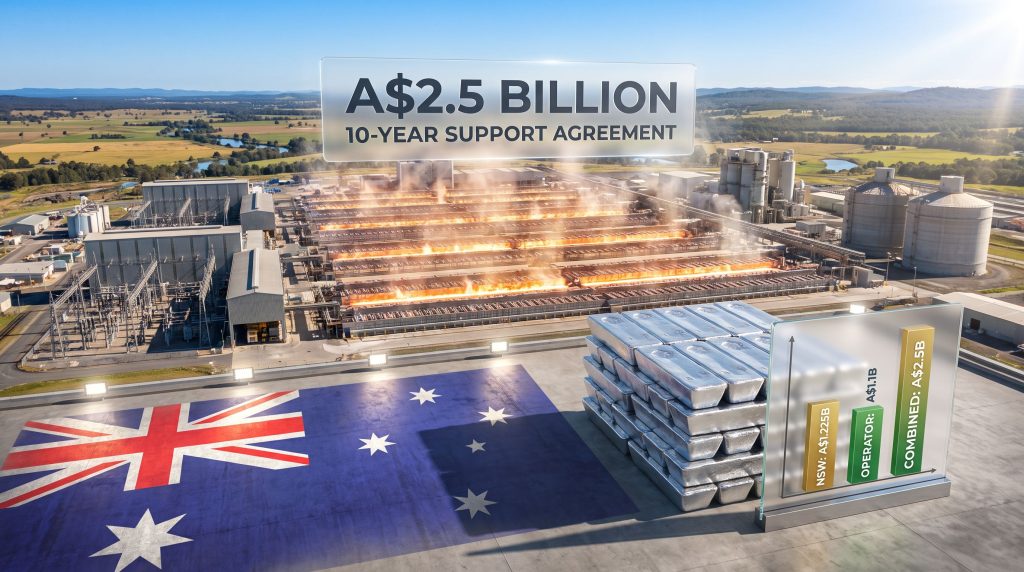
The combined support package, announced jointly by the Federal Government and the New South Wales Government, is valued at approximately A$2.5 billion structured across a 10-year period. Understanding what this figure actually represents requires moving past the headline number. The billion-dollar bailout is designed to secure more than 1,500 jobs beyond 2028 according to regional reporting.
| Funding Component | Estimated Value |
|---|---|
| NSW State Government contribution | Up to A$1.225 billion |
| Tomago Aluminium operator commitment | Approximately A$1.1 billion |
| Federal Government contribution | Comprising the remainder of the A$2.5 billion total |
Several aspects of this structure are worth examining carefully:
This is not a direct cash transfer. The package is primarily architected around a long-term power purchase agreement framework, meaning governments are effectively underwriting the cost difference between market electricity prices and the rates at which the smelter can commercially operate. This distinction matters enormously for how the public cost should be assessed.
Tomago's own A$1.1 billion commitment is directed toward facility upgrades and decarbonisation initiatives, meaning the operator is not a passive recipient. The commercial structure implies shared risk, not a unidirectional subsidy flow.
The potential for taxpayer returns exists if aluminium prices remain elevated over the agreement's duration, a caveat that the government has used to frame the arrangement as an investment rather than a rescue operation.
The framing distinction between an investment and a bailout is not merely semantic. An investment implies enforceable return mechanisms and shared downside risk. The credibility of that framing depends entirely on whether the contractual architecture actually delivers those protections, and the public has not yet seen the full terms.
What the Budget Omission Reveals
Furthermore, it is worth noting that industry minister Tim Ayres has faced scrutiny over the omission of the roughly $300 million annual cost of the smelter bailout from the federal budget, raising questions about transparency in how the package's long-term fiscal impact is being communicated to the public.
The Energy Physics That Make Smelters Uniquely Vulnerable
There is a technical dimension to this situation that deserves more attention than it typically receives in policy discussions. Aluminium smelters cannot simply be switched off and restarted when power prices normalise. The electrolytic cells at the core of the smelting process, called pot lines, must remain continuously operational. If a pot line cools below critical operating temperatures, the molten aluminium and cryolite bath solidifies, and the cell may be permanently damaged.
This means that unlike a steel mill or a chemical plant that can idle during high-cost periods, an aluminium smelter faces a binary choice: operate continuously or close permanently. There is no middle state. This is precisely why long-term, fixed-price power contracts are existential requirements for smelter viability, not merely commercial preferences.
This physical constraint also explains why international smelting operations have historically clustered in locations with access to captive, low-cost hydroelectric power:
- Canada uses provincial hydro arrangements to underwrite smelter energy costs
- Norway and Iceland leverage geothermal and hydroelectric resources to maintain structurally low industrial power prices
- The Middle East uses stranded gas resources as a feedstock advantage
- Australia historically relied on proximity to cheap coal-fired generation, an advantage now eroding as the grid transitions
Without government intervention, Australian smelters cannot compete on energy cost alone against producers with access to genuinely cheap renewable baseload power. The Tomago bail out is therefore as much about competitive repositioning as it is about immediate crisis management. Renewable energy solutions for heavy industry remain a work in progress across the broader Australian economy.
The Hunter Valley Economic Equation
The Hunter Valley's economic identity has been shaped by two industries that are simultaneously undergoing structural transformation: coal mining and heavy manufacturing. The convergence of these transitions in the same geographic labour market creates a compounding pressure that makes Tomago's continuation especially significant from a regional policy perspective.
The smelter's 1,000-plus direct employees represent a concentration of high-wage industrial work in a region where comparable alternative employment opportunities are limited. But the indirect employment multiplier effect is where the true economic weight sits. Aluminium smelting creates demand across:
- Port operations and shipping logistics
- Specialised industrial maintenance contracting
- Chemical and materials supply chains (alumina, cryolite, carbon anodes)
- Electrical infrastructure services
- Transport and warehousing
A 10-year support horizon, if it is accompanied by genuine investment in renewable energy infrastructure capable of powering the smelter at competitive rates, provides sufficient time for both workforce stabilisation and the regional economic diversification that post-coal transition requires.
What a permanent closure would have triggered, beyond the direct job losses, is a cascading contraction in the Hunter Valley's supplier ecosystem, reduced tax revenue at both state and federal level, and potential acceleration of regional economic decline in a community already navigating the coal sector's withdrawal.
Australia's Pattern of Industrial Intervention: Tomago Is Not Isolated
The Tomago Aluminium government bail out needs to be understood within a broader pattern of Australian industrial policy responses emerging across multiple sectors simultaneously. This pattern of intervention is closely connected to aluminium sector restructuring occurring across the country, as operators and governments alike grapple with the same fundamental energy economics.
| Facility | Intervention | Scale |
|---|---|---|
| Whyalla Steelworks (SA) | Federal and SA combined commitment toward low-emissions pit-to-port transformation | A$1.9b as part of a broader A$2.4b assistance package |
| Collie Green Steel Mill (WA) | WA Government funding to advance Australia's first low-emissions steel recycling facility | A$9.8 million |
| Fuel Security Package | Federal Government package covering fuel and fertiliser infrastructure | A$15 billion total; A$7.5b for storage and supply |
| Tomago Aluminium (NSW) | Combined PPA-based support and capital investment framework | A$2.5 billion over 10 years |
What these interventions share is a common structural driver: the energy transition is collapsing the commercial viability of legacy industrial operations faster than market mechanisms can generate replacement solutions. Governments are being forced to choose between managed transition support and allowing permanent deindustrialisation.
This is not a return to the protectionist industry policy of previous decades. The architecture of these interventions is different. They are linked to decarbonisation conditionality and structured around future commercial viability rather than simply preserving the status quo at taxpayer expense.
How Does This Compare to Other States?
In addition, Gladstone aluminium repowering in Queensland illustrates a parallel effort to future-proof aluminium production through renewable energy transitions. Similarly, green industrial production in South Australia demonstrates that state governments across the country are increasingly willing to commit capital to anchor heavy industry through the energy transition.
The next major ASX story will hit our subscribers first
The Decarbonisation Conditionality Question
Perhaps the most consequential aspect of the Tomago package from a long-term policy perspective is the decarbonisation obligation embedded in Tomago's own A$1.1 billion commitment. If the operator's capital expenditure is genuinely directed toward lower-emissions production processes, then the support package achieves something beyond mere crisis avoidance: it creates a pathway toward a competitive, green aluminium production capability.
Green aluminium, produced using renewable energy, is attracting a growing price premium in international markets as manufacturers and governments in Europe and North America seek to reduce the embodied carbon in their supply chains. Australia's green metals push places the country in a theoretically strong position, given its exceptional solar and wind resources, to produce aluminium at globally competitive cost once renewable energy infrastructure reaches sufficient scale.
Several unanswered questions will determine whether the package delivers on that potential:
- What specific renewable energy generation and storage infrastructure is being committed to under the PPA framework?
- Are there enforceable milestone-based targets tied to emissions reductions over the 10-year period?
- What contractual mechanisms exist for government cost recovery if commercial conditions change materially?
- How is the 2036 endpoint being planned for, and is a further intervention anticipated if the renewable grid is not yet cost-competitive by that date?
What the Tomago Decision Signals for Industrial Policy
For the better part of three decades, Australian industrial policy operated on a market-neutral framework, the assumption being that capital should flow to its most efficient use without government interference. The simultaneous collapse of that framework across steel, aluminium, fuel refining, and related sectors is forcing a fundamental reassessment.
The Tomago Aluminium government bail out is best read as an empirical test of a new policy hypothesis: that targeted, conditional, time-limited government support can bridge the gap between legacy industrial economics and the emerging renewable energy system, without simply delaying inevitable structural adjustment.
If the smelter reaches 2036 with a credible low-emissions power supply and competitive production costs, the intervention will have achieved what its architects claimed. If it instead creates a precedent for ongoing support without genuine structural transformation, the policy framework will need substantial revision.
The energy transition is not waiting for industrial policy to catch up. The 2028 power contract deadline at Tomago was always going to force a decision, and governments chose intervention over closure. Whether that choice proves strategically sound will depend on execution over the next decade, not on the announcement itself.
Disclaimer: This article contains forward-looking analysis, industry projections, and policy assessments. These represent informed perspectives based on publicly available information and should not be construed as financial or investment advice. Readers are encouraged to conduct their own research before making any investment or policy-related decisions.
Want to Stay Ahead of Major ASX Mineral Discoveries Shaping Australia's Industrial Future?
As Australia navigates the energy transition and the reshaping of its heavy industry sector, the demand for critical minerals powering that transformation continues to surge — and Discovery Alert's proprietary Discovery IQ model delivers real-time alerts the moment significant ASX mineral discoveries are announced, turning complex data into actionable opportunities for investors at every level. Explore historic discoveries and their market returns and begin your 14-day free trial today to position yourself ahead of the market.