August 13, 2026
The Hidden Criticality of Fluorite and Why Supply Chains Are Being Rewired
Most investors and industry observers focus their attention on lithium, cobalt, and rare earths when assessing critical mineral supply chain risk. Yet fluorite, also known as fluorspar, sits quietly at the foundation of some of the most strategically important industrial processes in the modern economy. Steel hardening, aluminium smelting, hydrofluoric acid production, refrigerant manufacturing, and increasingly, the electrolyte systems within next-generation lithium-ion batteries all depend on reliable fluorspar supply. The Tivan Speewah fluorite project funding story has emerged as one of the most structurally significant examples of how this gap is being addressed.
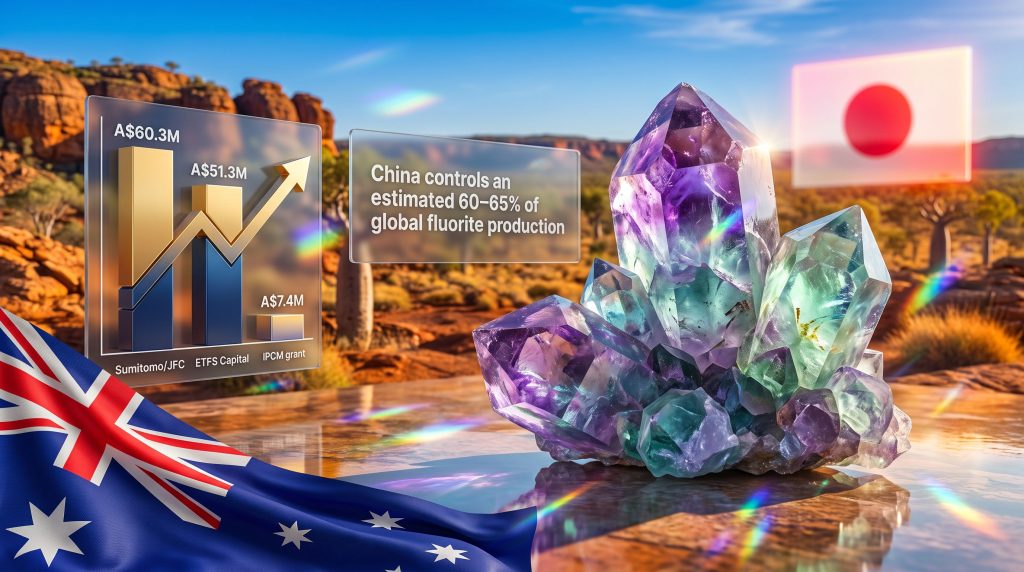
What makes this particularly urgent is the degree of geographic concentration that defines the global fluorite market. China accounts for an estimated 60 to 65 percent of annual global fluorite production, according to industry supply chain analyses. For nations like Japan, whose industrial base is heavily reliant on fluorine chemistry across sectors ranging from semiconductors to automotive manufacturing, this concentration is not an abstraction. It is a live and compounding strategic vulnerability.
Furthermore, against this backdrop, the Tivan Speewah fluorite project funding story is not merely a corporate finance update. It represents a deliberate, architecturally complex effort to build a Western-aligned fluorite supply chain from the ground up, in a jurisdiction that currently has no operating fluorite mine at commercial scale.
When big ASX news breaks, our subscribers know first
What the Speewah Deposit Represents in a Globally Undersupplied Market
The Speewah project is located in the Kimberley region of Western Australia, one of the continent's most remote but geologically significant landscapes. The deposit is notable not just for its size but for its position as one of the few large-scale fluorite development candidates outside of Chinese-controlled supply chains that has attracted serious institutional capital and bilateral sovereign interest. The Speewah fluorite strategy has been carefully designed to address precisely this gap in global supply.
Fluorspar is commercially processed into three primary grades, each serving distinct industrial functions:
- Acid grade fluorspar (acidspar): Minimum 97% calcium fluoride (CaF2) purity, used predominantly in hydrofluoric acid production, which in turn feeds refrigerant and fluoropolymer manufacturing
- Metallurgical grade fluorspar (metspar): Typically 60 to 85% CaF2, used as a flux in steel and iron production to lower melting points and remove impurities
- Optical grade fluorspar: Extremely high purity, used in specialty optics, lenses, and semiconductor manufacturing
The distinction between these grades matters enormously for project economics. Acid grade commands the highest prices and longest-term offtake interest, particularly from Japanese industrial buyers whose semiconductor and fluoropolymer sectors require guaranteed supply at consistent purity thresholds. Projects capable of producing acid grade material from a stable, non-Chinese source carry a structural premium in today's supply chain environment.
Fluorite's opaque pricing structure, unlike exchange-traded metals such as copper or nickel, means that offtake agreements and bilateral supply contracts are often the primary mechanism through which project economics are validated. This makes partner identity as important as resource grade.
How the Tivan Speewah Fluorite Project Funding Structure Works
A Capital Stack Built for Pre-FID Risk
Understanding the Tivan Speewah fluorite project funding architecture requires distinguishing between two fundamentally different phases of mining finance: pre-FID (before a Final Investment Decision) and post-FID construction capital. These phases carry vastly different risk profiles, and matching the right capital type to each phase is the central challenge of project finance in the critical minerals sector.
The Speewah capital structure has been deliberately layered to address this challenge:
| Funding Source | Instrument Type | Committed Amount | Status |
|---|---|---|---|
| Australian Government (IPCM Program) | Grant | A$7.4 million total | A$6.4M received; A$1.0M pending milestone |
| Sumitomo Corporation / JFC | Staged Equity | Up to A$60.3 million | Binding agreement in place |
| ETFS Capital | Equity + FID Tranche | Up to A$51.3 million | A$11.3M deployed Jan 2026; A$40M at FID |
| Export Finance Australia (EFA) | Debt Facility | TBC | Advanced discussions |
| Northern Australia Infrastructure Facility (NAIF) | Debt Facility | TBC | Advanced discussions |
The grant funding from the International Partnerships in Critical Minerals (IPCM) Program targets the highest-risk portion of the project lifecycle: the technical studies, engineering assessments, and economic modelling that form the definitive feasibility study. Private capital typically avoids this phase because the work consumes significant cash without producing revenue, and its outputs, while essential, do not guarantee a positive investment decision.
By de-risking this phase with grant funding, the IPCM program performs a catalytic function: it lowers the threshold at which private and institutional capital becomes willing to commit, effectively bridging a market failure that would otherwise stall projects of national strategic importance before they reach investment-readiness.
The IPCM Grant: Tranching, Milestones, and the August 2026 Payment
The Australian Government awarded a A$7.4 million IPCM grant to the Speewah project in December 2024. As of August 2026, cumulative receipts have reached A$6.4 million, with the most recent tranche of A$3 million paid in August 2026 following a review of project progress through the first half of the year.
The August payment was enabled by a deed of variation executed between JAFA and the Commonwealth earlier in 2026, which brought the tranche forward in time and realigned the milestone schedule to reflect actual progress on the ground. This kind of administrative flexibility, while rarely discussed publicly, is a meaningful indicator that the funding relationship between the project entity and the government department is active and constructive.
Tivan's executive chairman noted that the August payment reflected the Department of Industry, Science and Resources' assessment that material progress had been achieved at Speewah during the first half of 2026, and described the IPCM grant as a meaningful contributor to the project's pre-FID funding pathway.
The remaining A$1.0 million of the original grant is subject to outstanding milestone conditions and has not yet been received.
Why the Grant Was Transferred to JAFA
One of the more technically significant structural developments in the Speewah funding story is the transfer of the IPCM grant agreement from Tivan Limited to Japan Australia Fluorite Associates (JAFA) in August 2025. This transfer aligned the funding flow with the actual legal owner of the project.
JAFA is the incorporated joint venture vehicle through which Tivan, Sumitomo Corporation, the Japan Organization for Metals and Energy Security (JOGMEC), and ETFS Capital collaborate. From a project finance standpoint, it is standard practice for grant funding and eventually debt facilities to be directed to the entity that holds the mining tenements and development rights, rather than a parent or listed company. The JAFA transfer reflects this principle and signals that the project's legal and financial architecture is maturing in line with institutional lender expectations.
Who Are the Partners and What Does Their Involvement Signal?
Sumitomo Corporation and JOGMEC: The Japan Dimension
Japan's involvement in Speewah through two distinct but complementary entities reveals the depth of strategic intent behind the project. Sumitomo Corporation is a Fortune Global 500 trading and investment conglomerate with a long track record of participating in resource projects globally, structuring offtake arrangements, and managing complex multi-party joint ventures across Asia and the Pacific.
JOGMEC operates on a different mandate. As a Japanese Government agency tasked with securing stable, long-term supplies of energy and mineral resources for Japan's industrial economy, JOGMEC's participation in a project is a meaningful signal that the commodity in question has been assessed at a sovereign level as strategically important. Japan's domestic fluorite supply is effectively negligible, and the country's dependence on Chinese sources has been a persistent concern for policymakers and industrial planners for decades.
The binding equity terms between Sumitomo, JFC (Japan Finance Corporation), and JAFA involve a commitment of up to A$60.3 million in staged tranches. The initial A$5.3 million secured a 7.5% project interest, with further capital deployments available to grow that stake to 22.5% as the project advances through defined milestones.
ETFS Capital: Institutional Validation from a Commodities Specialist
ETFS Capital's participation in Speewah adds a layer of institutional credibility that extends beyond the bilateral government-to-government dynamic. As a commodities-focused investment firm, ETFS Capital's decision to deploy capital into Speewah reflects a commercial assessment of fluorite's supply-demand fundamentals and the project's economics.
The structure of ETFS Capital's commitment is instructive:
- A$11.3 million in acceleration capital was deployed in January 2026, providing working capital to sustain DFS progress and maintain project momentum
- A$40.0 million is committed to be deployed at the point of Final Investment Decision, representing the single largest equity trigger event in the project's pre-construction phase
This back-loaded structure is consistent with how sophisticated project investors manage risk: commit enough early capital to maintain optionality and influence over project development, then deploy the bulk of the commitment when the project's feasibility has been independently validated through the DFS and debt financing has been confirmed.
The Definitive Feasibility Study: What It Will Determine and Why It Matters
Inside the DFS Process
A Definitive Feasibility Study is the most rigorous and resource-intensive technical document produced before a mining project reaches a construction decision. You can explore the full feasibility study announcement on Tivan's official website for further context. For a project like Speewah, the DFS will need to address a comprehensive set of engineering and economic questions:
- Capital expenditure estimates, covering mining infrastructure, processing plant, water and power supply, and site access
- Operating cost modelling across mining, ore processing, and product handling
- Recovery rates and product quality specifications, which determine whether the operation can consistently produce acid-grade or metallurgical-grade material
- Environmental and social baseline assessments required for regulatory approvals
- Revenue modelling based on fluorite pricing assumptions and offtake terms
- Project financing requirements and debt serviceability under various commodity price scenarios
The DFS is targeted for completion in the second half of 2026. Its conclusions will form the primary basis upon which the joint venture partners and their lenders make a Final Investment Decision.
The Path from DFS Completion to FID
The road from DFS completion to a sanctioned project involves several sequential steps, each with its own dependencies:
- Independent review and sign-off of DFS outputs by qualified persons and technical advisers
- Completion of debt financing discussions with Export Finance Australia and the Northern Australia Infrastructure Facility, which are currently described as advanced but not yet concluded
- Activation of ETFS Capital's A$40 million FID tranche once formal investment conditions are satisfied
- Joint venture partner alignment at board level across Tivan, Sumitomo/JFC, and JOGMEC
- Formal project sanction and commencement of construction planning
The appointment of project finance advisers in August 2026 is a prerequisite for engaging institutional lenders in any structured debt process. This appointment signals that the project is actively preparing for the debt phase, rather than treating it as a distant consideration.
Key Milestones and Risk Factors to Track
Milestone Tracker: 2026 to 2027
| Milestone | Expected Timing | Why It Matters |
|---|---|---|
| DFS completion | H2 2026 | Validates project economics and defines capex |
| Remaining IPCM tranche (A$1.0M) | Subject to conditions | Confirms full grant utilisation |
| EFA and NAIF debt terms finalised | 2026 to 2027 | Completes the capital stack |
| ETFS Capital FID tranche (A$40M activated) | At FID | Triggers major equity deployment |
| Final Investment Decision | Post-DFS | Authorises project construction |
Risks That Investors and Observers Should Monitor
Several material uncertainties remain between the project's current state and a construction decision:
- Debt financing completion remains the most structurally significant outstanding item. EFA and NAIF discussions are advanced, but binding terms have not been publicly confirmed
- DFS cost sensitivity is a universal risk in pre-FID mining projects. Capital cost estimates in feasibility studies for remote Australian projects have a history of exceeding earlier projections, and Speewah's Kimberley location introduces genuine logistical complexity
- Fluorite pricing opacity is a genuine market risk. Unlike copper or nickel, fluorspar does not trade on a major commodity exchange, making pricing benchmarks difficult to verify independently and offtake terms critically important to project economics
- Regulatory and permitting timelines in Western Australia, particularly for large-scale developments in environmentally sensitive or remote regions, can extend beyond initial planning assumptions
- Milestone compliance for the remaining A$1.0 million IPCM grant tranche is contingent on outstanding conditions being satisfied
This article contains forward-looking information about project timelines, funding milestones, and development outcomes. All such information is subject to material risk and uncertainty. Readers should conduct their own independent research before making investment decisions.
The next major ASX story will hit our subscribers first
The Broader Strategic Picture: Australia, Japan, and the Fluorite Supply Imperative
The Tivan Speewah fluorite project funding structure is more than a corporate finance story. It is a case study in how two allied economies are attempting to co-construct a supply chain that neither could build alone. Australia brings the resource endowment and regulatory stability. Japan brings capital, industrial demand, and the sovereign urgency of a nation acutely aware of its mineral import dependency.
This is the same structural logic that has driven Australia-Japan collaboration in rare earths, where strategic mineral supply chains have received sustained bilateral investment, and in lithium, where multiple Japanese trading houses have taken positions in Australian development projects. Speewah follows and extends this pattern into a commodity that has received far less public attention despite its industrial significance.
Furthermore, the surge in critical minerals demand across key industrial sectors has reinforced the urgency behind projects like Speewah. What distinguishes Speewah is the degree of structural intentionality in its capital architecture. Grant funding de-risks the study phase. Staged private equity aligns capital deployment with demonstrated milestones. Sovereign-backed institutional participation from JOGMEC signals strategic validation beyond pure commercial returns.
The pursuit of concessional debt through EFA and NAIF reflects an understanding that the final capital stack must be optimised for project viability, not merely assembled from whatever sources are available. In addition, Australia's critical minerals policy framework has been instrumental in creating the conditions that make this kind of multi-partner capital structure possible.
If the DFS delivers commercially viable outcomes and debt financing is confirmed on acceptable terms, Speewah has the potential to become the first large-scale commercial fluorite operation in Australian history and a replicable model for how bilateral critical mineral partnerships can move from diplomatic aspiration to operating mine.
Frequently Asked Questions: Tivan Speewah Fluorite Project Funding
What is the total government grant funding awarded to the Speewah project?
The Australian Government awarded a A$7.4 million grant through the International Partnerships in Critical Minerals (IPCM) Program in December 2024. As of August 2026, A$6.4 million has been received, with the remaining A$1.0 million subject to outstanding milestone conditions.
Who legally owns the Speewah Fluorite Project?
The project is owned by Japan Australia Fluorite Associates (JAFA), an incorporated joint venture vehicle. Tivan Limited, Sumitomo Corporation alongside JFC, and JOGMEC are joint venture partners within this structure. ETFS Capital participates as a strategic financial partner.
What is the total equity funding committed to Speewah?
Binding equity arrangements total up to approximately A$111.6 million across Sumitomo/JFC (up to A$60.3 million) and ETFS Capital (up to A$51.3 million), though both commitments are staged and partially contingent on project milestones and FID.
What is a Definitive Feasibility Study and why does it matter?
A DFS is a comprehensive technical and economic assessment that determines whether a mining project is commercially viable at the proposed scale. It sets capital cost estimates, operating cost projections, production forecasts, and return on investment modelling. Completion of the DFS is a prerequisite for the Final Investment Decision that would authorise construction.
What is JOGMEC's role at Speewah?
JOGMEC is a Japanese Government agency mandated to secure stable supplies of minerals and energy for Japan's industrial economy. Its participation in the JAFA joint venture reflects Japan's sovereign-level interest in accessing a reliable, non-Chinese fluorite source for its manufacturing sectors.
When is the Final Investment Decision expected?
No specific FID date has been publicly confirmed by Tivan or its partners. The DFS is targeted for completion in the second half of 2026, after which debt financing must be finalised before a formal investment decision can be made by the joint venture.
For ongoing coverage of Australia's critical minerals sector, project developments, and government funding programmes, readers can explore Australian Mining at australianmining.com.au, which provides regular reporting on feasibility developments, joint venture structures, and policy frameworks across the sector.
Want to Stay Ahead of the Next Major Mineral Discovery?
Discovery Alert's proprietary Discovery IQ model scans ASX announcements in real time, instantly identifying significant mineral discoveries across critical commodities — including the fluorite and critical minerals sector reshaping global supply chains — and delivering actionable insights directly to subscribers. Explore how historic discoveries have generated substantial returns and begin your 14-day free trial to position yourself ahead of the broader market.