August 13, 2026
The Energy Economics That Make Aluminium Smelting So Vulnerable
Few industrial processes on earth are as electricity-dependent as aluminium smelting. The Hall-Héroult process, which converts alumina into molten aluminium through electrolytic reduction, consumes roughly 13 to 15 megawatt-hours of electricity per tonne of metal produced. That figure is not a variable that engineering innovation has dramatically shifted in decades. It is a structural feature of the chemistry itself, which means electricity pricing is not simply an input cost for aluminium smelters. It is the single most consequential factor in whether a smelter survives or closes.
This is the lens through which the Tomago Aluminium power deal must be understood. It is not primarily a story about one facility or one contract negotiation. It is a case study in how nations with decarbonising electricity grids and legacy energy-intensive industries must reconcile two forces that, left unchecked, pull in opposite directions.
When big ASX news breaks, our subscribers know first
Tomago's Position Inside Australia's Industrial Architecture
Situated approximately 13 kilometres west of Newcastle in the Hunter Valley, Tomago Aluminium has operated continuously since 1983. That four-decade track record of round-the-clock production is itself significant, because aluminium smelters cannot simply be switched off and restarted. The electrolytic cells used in the smelting process must remain operational, and any extended shutdown risks permanently damaging the pot lining infrastructure, effectively destroying the asset.
With annual production capacity of up to 590,000 tonnes, Tomago accounts for close to 40 per cent of Australia's total primary aluminium output. The majority of that metal flows to customers across the Asia-Pacific, embedding the facility within regional supply chains that span automotive, construction, packaging, and increasingly, the renewable energy sector itself. Aluminium is a core material in solar panel frames, wind turbine components, and electric vehicle bodies, giving the smelter an ironic but strategically important role in the clean energy transition it is now being asked to participate in.
The facility's economic footprint extends well beyond its fence line. Tomago directly employs approximately 1,000 workers and is estimated to support around 5,000 indirect jobs throughout the Hunter Valley region, spanning logistics, maintenance contracting, chemical supply, and associated services. Closure would not simply eliminate those roles. It would destabilise the broader regional economy of an area already navigating the structural decline of thermal coal.
The Power Contract Problem and Why It Created an Existential Horizon
Tomago's existing electricity supply arrangement with AGL Energy was scheduled to expire at the end of December 2028. For most industrial facilities, a contract expiry two years away would represent a routine procurement exercise. For an aluminium smelter consuming power at the scale Tomago does, the situation was fundamentally different.
Smelters require electricity in volumes that dwarf virtually any other industrial consumer. Tomago's demand is so substantial that it functions effectively as a baseload anchor on the New South Wales grid, drawing power continuously regardless of time of day, weather, or season. Sourcing a replacement supply contract at a commercially viable tariff from an open wholesale market where prices have escalated sharply presented a near-impossible challenge without structural intervention.
The gap between what wholesale electricity markets deliver and what energy-intensive smelters can economically absorb has widened considerably as Australia's grid transitions away from coal-fired generation. Dispatchable power that once provided cheap, continuous supply is being progressively retired, and the firming capacity needed to backstop renewable generation carries a cost premium that smelters, competing in global commodity markets on thin margins, cannot simply pass through to customers.
Without a negotiated power solution, Tomago faced the realistic prospect of becoming economically unviable once its AGL contract lapsed, following a pattern seen at aluminium smelters across multiple countries where energy price escalation has preceded closure.
Breaking Down the $3.6 Billion Capital Commitment
The Tomago Aluminium power deal brings together public and private capital in a structure that is worth examining in detail, because the architecture of the funding carries as much meaning as the total figure.
| Funding Component | Amount | Source |
|---|---|---|
| Federal Government Contribution | $1.25 billion | Commonwealth |
| NSW Government Contribution | $1.25 billion | State |
| Tomago Aluminium Own Investment | At least $1.1 billion | Rio Tinto / Smelter |
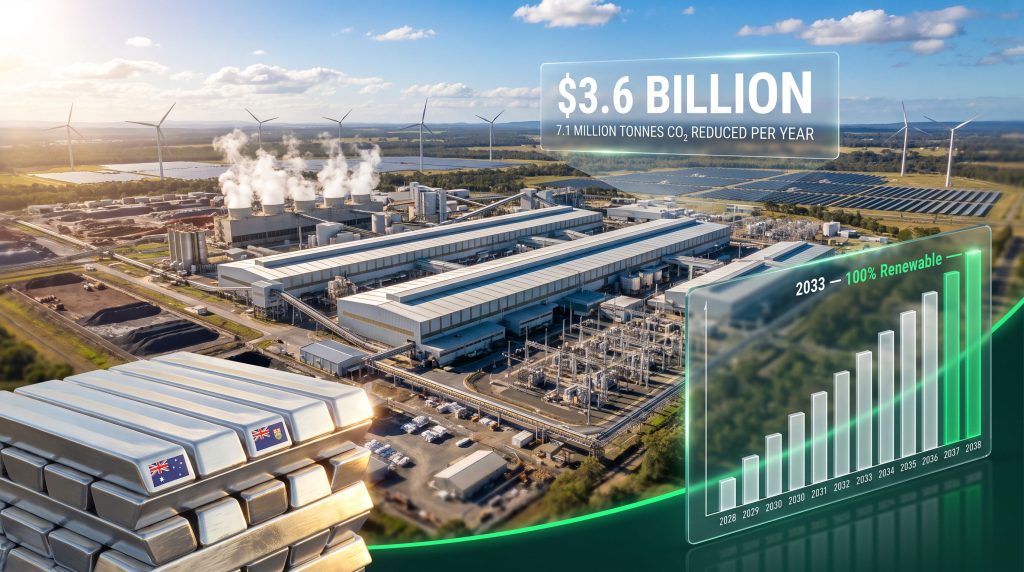
| Total Capital Mobilised | ~$3.6 billion | Combined |
The 50/50 split between federal and state governments signals a deliberately cooperative approach to industrial policy, distributing both the fiscal burden and the political accountability across two levels of government. Neither jurisdiction is seen to be acting unilaterally or absorbing disproportionate risk.
The private co-investment component of at least $1.1 billion serves a function beyond simply adding capital to the pool. It acts as a credibility mechanism, demonstrating that Tomago's majority owner Rio Tinto views the facility as commercially viable under the new energy framework rather than simply accepting a government lifeline for an operation it would otherwise wind down. That distinction matters for how markets and policymakers interpret the deal's durability.
Within Tomago's own investment allocation, the spending priorities break down as follows:
- Approximately $1 billion directed toward plant and equipment upgrades, major maintenance cycles, asset life extension, and productivity enhancement programmes
- Approximately $100 million dedicated to decarbonisation initiatives and demand-response infrastructure, enabling the smelter to modulate its electricity consumption in response to grid conditions
That demand-response capability is a detail that tends to get overlooked in reporting on the deal, but it carries genuine grid-level value. A facility capable of temporarily reducing its power draw during peak stress events effectively provides a form of virtual capacity to the NSW grid, reducing the likelihood of supply shortfalls during high-demand periods.
How the Power Purchase Agreement Is Structured Over a Decade
The 10-year power purchase agreement covering the period through to 2038 is designed with a deliberate transition architecture rather than a single static arrangement.
From 2028 to 2033, the agreement draws on a combination of generation sources to bridge the gap between the expiry of the AGL contract and the availability of sufficient renewable capacity. This transitional phase is where the approximately 3 gigawatts of new electricity generation and associated storage and firming capacity being developed to underpin the deal becomes critical. Firming refers to the dispatchable generation or storage capacity required to ensure renewable output remains reliable when solar and wind conditions vary.
From 2033 onward, the agreement shifts to sourcing electricity entirely from renewable generation, marking a structural decarbonisation milestone for the facility and for Rio Tinto's Australian operations more broadly. This phased approach mirrors the broader green industrial transition occurring across Australian heavy industry, where a bridging period is often necessary before full renewable supply becomes technically and commercially feasible.
The 10-year duration of the PPA is not arbitrary. Aluminium smelter planning cycles operate over very long timeframes because capital expenditure on pot relining, anode systems, and associated infrastructure requires investment certainty that extends far beyond typical commercial contract horizons. A decade-long power agreement provides exactly the kind of forward visibility that makes a $1.1 billion private investment programme rational from a capital allocation perspective.
The Decarbonisation Arithmetic: What 7.1 Million Tonnes Means in Practice
Once Tomago operates exclusively on renewable electricity from 2033, Rio Tinto projects the transition will reduce the smelter's operating carbon emissions by 7.1 million tonnes of CO₂-equivalent per year. To contextualise that figure:
- Australia's total national greenhouse gas emissions in recent years have been measured in the range of 470 to 490 million tonnes of CO₂-equivalent annually
- A reduction of 7.1 million tonnes represents roughly 1.4 to 1.5 per cent of total national emissions eliminated from a single facility's transition to renewable power
- In transport equivalence terms, that reduction approximates removing approximately 1.5 million petrol-powered passenger vehicles from Australian roads each year
For Rio Tinto, the emissions reduction feeds directly into the company's Scope 1 and Scope 2 reduction commitments across its global portfolio. This commitment aligns closely with the company's broader zero-carbon metals strategy, which spans multiple operations and jurisdictions. Aluminium smelting accounts for a disproportionate share of Rio Tinto's total emissions footprint given the electricity intensity of the process, making Tomago's decarbonisation trajectory one of the more material levers available to the company within its climate strategy.
The $100 million decarbonisation allocation within Tomago's private investment is likely to fund a combination of demand-response control systems, energy monitoring infrastructure, and potentially early-stage investigation of process efficiency improvements. It is worth noting that while electrolysis-based smelting emissions are largely addressed through the shift to renewable power, there are also anode-related process emissions from carbon anode consumption that renewable electricity alone cannot eliminate. These represent an ongoing research challenge across the global aluminium industry.
The next major ASX story will hit our subscribers first
The Industrial Policy Debate: Is This Scale of Commitment Justified?
The Tomago Aluminium power deal has not escaped scrutiny on fiscal grounds. Some analysts have estimated the implied cost of the government contribution, spread across a decade and relative to the power volumes involved, could amount to hundreds of millions of dollars annually in effective subsidy. That is a significant number, and it raises legitimate questions about the appropriate role of public capital in sustaining private industrial operations.
The economic case for intervention rests on several distinct arguments:
- Direct employment preservation: Approximately 1,000 direct jobs in a region with limited alternative industrial employers at comparable wage levels
- Indirect economic multiplier: The estimated 5,000 indirect roles that depend on the smelter's continued operation across the Hunter Valley supply chain
- Sovereign manufacturing capability: Once a smelter closes and its potlines are decommissioned, restart costs and timelines make reactivation economically prohibitive in most scenarios, meaning closure is effectively permanent
- Grid services value: The demand-response capability Tomago provides has measurable value to NSW electricity system reliability that is not typically captured in straightforward subsidy calculations
- Decarbonisation co-benefit: A functioning, renewable-powered aluminium smelter produces lower-carbon metal for global markets, whereas closure simply shifts production to jurisdictions with higher grid emissions intensities, delivering no net global climate benefit
Furthermore, IEEFA's analysis of how Tomago can serve as a blueprint for industrial decarbonisation suggests the deal's structural elements could provide a replicable model for other energy-intensive facilities facing similar energy transition challenges.
The counterargument centres on precedent risk. A commitment of this scale to a single facility signals to other energy-intensive industries that comparable arrangements may be available, potentially creating a queue of claimants for public energy subsidies. The policy architecture required to evaluate and respond to those future claims is not yet clearly defined.
How Tomago and Boyne Compare: Australia's Dual-Smelter Strategy
The Tomago Aluminium power deal did not emerge in isolation. In March 2026, a separate agreement was reached between Rio Tinto and the federal and Queensland governments to secure the future of the Boyne aluminium smelter at Gladstone, making Tomago the second major agreement of its type within a single year. Indeed, the Gladstone aluminium repowering initiative demonstrated that a structured government-industry partnership could deliver operational certainty at scale, providing a useful precedent for the Tomago negotiations.
| Feature | Tomago Aluminium (NSW) | Boyne Smelter (QLD) |
|---|---|---|
| Location | Hunter Valley, NSW | Gladstone, QLD |
| Agreement Timing | August 2026 | March 2026 |
| Government Partners | Federal + NSW | Federal + QLD |
| Operational Security | Secured to 2038 | Secured beyond current contract |
| Renewable Transition Target | 2033 | Under development |
The fact that Australia's two largest aluminium smelters have now both secured government-supported energy pathways within months of each other reflects a deliberate approach to preserving the country's primary aluminium production base during the energy transition. Individually, each deal might be characterised as a case-by-case intervention. Taken together, they represent something closer to a coherent sovereign industrial strategy, even if that strategy has not been articulated as such in formal policy documents.
What the Deal Signals to Global Capital About Australia as an Industrial Host
Beyond the immediate economics of power supply, the Tomago Aluminium power deal carries a message for international investors evaluating Australia as a location for long-term energy-intensive manufacturing.
Aluminium's role in the materials economy is expanding, not contracting. Electric vehicles require significantly more aluminium than conventional internal combustion engine vehicles. Solar and wind infrastructure are aluminium-intensive. Low-carbon construction trends favour aluminium over heavier materials in certain applications. The global demand trajectory for primary aluminium over the coming decades is broadly positive, particularly for metal that can be verified as produced with renewable electricity, which commands a growing premium in markets with corporate decarbonisation commitments.
Among the aluminium industry leaders globally, Australia's willingness to commit $2.5 billion in joint government funding to retain this production capacity, rather than accept its migration to lower-cost or lower-regulation jurisdictions, communicates a form of sovereign seriousness about industrial capability that policy statements alone cannot convey. For Rio Tinto's global capital allocation decisions, long-term power certainty of this nature unlocks investment in Australian operations that might otherwise have been directed elsewhere.
In addition, the deal's structure invites comparison with the Alcoa-Ignis-EQT venture, which similarly demonstrates how private capital can be mobilised alongside strategic partners to secure the long-term viability of aluminium production in a decarbonising environment.
The Tomago power deal establishes a replicable architecture for how government and industry can co-invest in industrial energy transitions, combining operational certainty, private capital commitment, and measurable emissions reduction within a single structured agreement.
Frequently Asked Questions: Tomago Aluminium Power Deal
What is the Tomago Aluminium power deal?
A joint commitment by the Australian federal and New South Wales governments totalling $2.5 billion, combined with at least $1.1 billion in private investment by Tomago Aluminium, to secure a 10-year renewable-backed power purchase agreement keeping the smelter operational through to 2038.
Why did Tomago Aluminium need a new power arrangement?
The smelter's existing electricity contract was set to expire at the end of December 2028, creating genuine uncertainty about whether Tomago could source affordable power at the scale required to remain commercially viable in an open wholesale market.
How is Tomago's $1.1 billion private investment allocated?
Approximately $1 billion covers plant and equipment upgrades, major maintenance, asset life extension, and productivity improvements. The remaining $100 million funds decarbonisation initiatives and demand-response infrastructure.
When does the renewable energy transition take effect?
Under the current agreement structure, Tomago is expected to transition to entirely renewable electricity sources from 2033, with the power purchase agreement extending through to 2038.
What is the projected emissions reduction from renewable power?
Once operating on fully renewable electricity, the smelter is expected to reduce its annual operating carbon emissions by approximately 7.1 million tonnes of CO₂-equivalent per year.
How many jobs does Tomago Aluminium support?
The facility directly employs approximately 1,000 people and is estimated to sustain around 5,000 indirect jobs throughout the Hunter Valley region.
This article contains forward-looking projections including emissions reduction estimates and renewable transition timelines. These are based on current agreement terms and stated intentions and are subject to change depending on technology availability, regulatory conditions, and grid development progress. Nothing in this article constitutes financial advice.
Want to Catch the Next Major Resource Discovery Before the Market Does?
Discovery Alert's proprietary Discovery IQ model delivers real-time alerts on significant ASX mineral discoveries — instantly translating complex data across more than 30 commodities into clear, actionable insights for both traders and long-term investors. Explore historic discoveries and their returns to understand what's possible, then begin your 14-day free trial to position yourself ahead of the broader market.