June 25, 2026
When Niche Minerals Meet Geopolitical Fire: The Hidden Fragility of Export-Dependent Industrial Commodities
Most conversations about Australian mining risk centre on iron ore price cycles, lithium demand volatility, or the regulatory complexity surrounding rare earth extraction. Rarely does the industrial garnet sector attract serious scrutiny. Yet the decision by Mineral Resources (ASX: MIN) to suspend its Lucky Bay garnet operation and implement MinRes layoffs at Australian Garnet Lucky Bay reveals something far more instructive than a single operational setback. It exposes the structural fault lines embedded within niche mineral export businesses that depend on geographically concentrated customer bases in politically unstable regions.
When a single regional conflict can simultaneously destroy demand and inflate logistics costs for an operation thousands of kilometres away, the risk architecture of that business deserves careful examination. Furthermore, resource export challenges of this nature highlight how exposed Australian producers can be when geopolitical volatility strikes key customer regions without warning.
When big ASX news breaks, our subscribers know first
Understanding Australian Garnet as an Industrial Mineral
What Makes Garnet Commercially Valuable and Structurally Vulnerable
Industrial garnet occupies a specific and often underappreciated corner of the specialty minerals market. Unlike battery metals or bulk commodities, garnet is consumed primarily in three end-use applications: waterjet cutting, abrasive blasting, and water filtration media. Its appeal in these applications comes from a combination of hardness, angular particle shape, and chemical inertness that makes it highly effective at cutting and abrading without contaminating the workpiece.
The waterjet cutting industry, which uses high-pressure streams of water mixed with garnet abrasive to slice through steel, stone, and composites, has grown substantially across Middle Eastern construction and industrial manufacturing sectors over the past two decades. This regional concentration of demand is precisely the vulnerability that the Lucky Bay situation has now made visible.
What distinguishes Australian garnet from competing sources is its single-source, unblended character. The Lucky Bay garnet project produces a pure garnet sand product that has not been mixed with materials from other geological sources, a quality differentiation that commands premium pricing in international markets. This purity is a function of the deposit's geological setting along the Western Australian coast south of Kalbarri, where aeolian and marine reworking processes have naturally sorted and concentrated garnet grains to commercially exploitable grades over geological time.
The deposit's scale is significant by any measure:
- Total mineral resource tonnage of 523 million tonnes
- Heavy minerals total mineral resource of 21.7 million tonnes
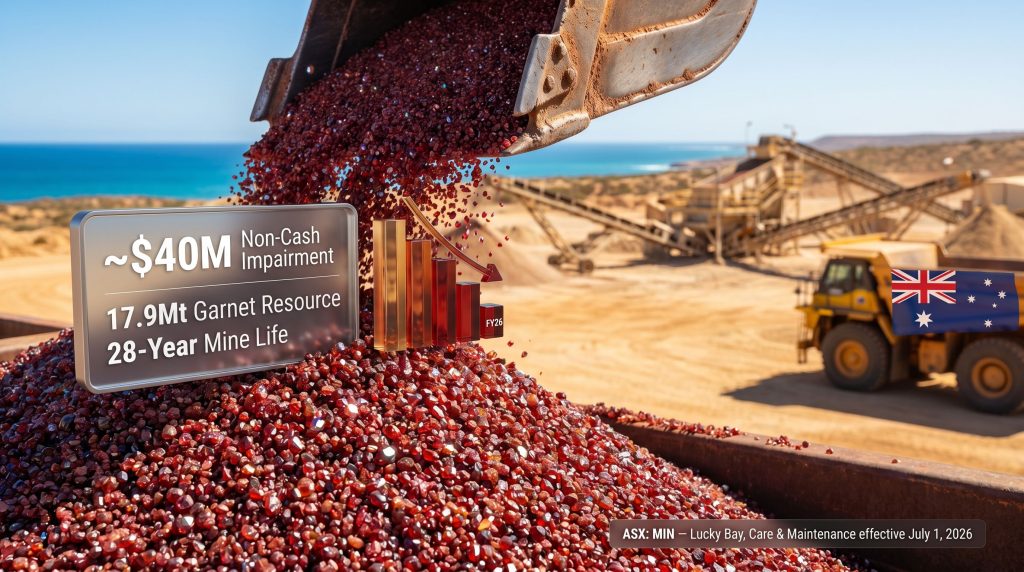
- Garnet-specific total mineral resource of 17.9 million tonnes
- Projected mine life of 28 years based on current resource estimates
These figures represent a world-class garnet endowment. The geological irony is that exceptional resource quality and scale provide no protection when the customer base evaporates.
The Acquisition That Preceded the Crisis: MinRes and the RDG Asset Sale
How MinRes Came to Own Lucky Bay
MinRes acquired the Australian Garnet operation in September 2025 through an asset and share sale agreement executed with the administrators of Resource Development Group (RDG), the prior owner, which had entered voluntary administration. This acquisition pathway is common in the Australian mining industry: a distressed seller creates an entry point for a well-capitalised acquirer to obtain strategic assets at potentially favourable valuations.
The acquisition thesis likely rested on several assumptions: that garnet demand would remain stable, that the operation's premium single-source product positioning would protect margins, and that the 28-year resource life represented durable long-term value within a diversified MinRes portfolio. Within roughly nine months of completing the acquisition, those assumptions had been materially tested.
| Acquisition Factor | Original Expectation | Post-Acquisition Reality |
|---|---|---|
| Market demand stability | Steady Middle East industrial demand | Conflict-driven demand destruction |
| Operating cost structure | Manageable diesel and freight costs | Materially elevated on both counts |
| Revenue diversification | Premium single-source positioning | Concentration risk fully realised |
| Portfolio fit within MinRes | Specialty minerals exposure | Underperforming relative to core assets |
This outcome is not necessarily a reflection of poor acquisition discipline. Geopolitical escalation in the Middle East is by definition difficult to price into an acquisition model. However, the speed at which compounding commodity price impacts materialised alongside demand destruction does raise questions about the stress-testing applied to the single-region customer concentration.
The Care-and-Maintenance Decision: Economics, Process, and Strategic Logic
What Triggered the Review and What It Found
A structured financial review of Lucky Bay's operational performance identified two compounding pressures that, in combination with demand destruction from the Middle East conflict, rendered continued operation commercially unviable. Elevated diesel prices directly increased the cost of running mining and processing equipment at the remote Western Australian site. Simultaneously, materially higher shipping costs eroded the margin on every tonne of garnet sold into export markets.
The Middle East represents a structurally significant share of Lucky Bay's total sales. When conflict disruption simultaneously reduces volumes and inflation in logistics costs reduces the net margin on remaining sales, the financial case for continued operation collapses rapidly in a single-commodity, single-region business.
Care and maintenance is not permanent closure. It is a deliberate holding strategy that preserves the asset's resource classification, environmental approvals, and physical infrastructure while avoiding the much larger financial commitment of full decommissioning. For a deposit with a 28-year mine life and nearly 18 million tonnes of garnet resource, this distinction matters enormously to any future acquirer or restart scenario.
The transition to care and maintenance becomes effective 1 July 2026, giving the operation a defined suspension date and providing MinRes with a clean break point for FY26 financial reporting purposes.
The $40 Million Impairment: What It Means and What It Doesn't
MinRes has disclosed a non-cash impairment of approximately $40 million on the written-down value of the Lucky Bay asset, to be recognised in the company's FY26 Full Year results. Several aspects of this figure deserve careful interpretation.
First, a non-cash impairment does not represent money leaving the company. It is a balance sheet revaluation that adjusts the carrying value of the asset to reflect its diminished near-term economic utility. The company's cash position, debt servicing capacity, and operational liquidity are not directly affected by this accounting entry.
Second, considered against MinRes's scale, the impairment is relatively contained. With a market capitalisation in the range of $12.13 billion to $12.94 billion as at late June 2026, the $40 million write-down represents less than 0.33% of total market capitalisation. For long-term shareholders, the more meaningful signal lies not in the dollar quantum but in what the write-down reveals about MinRes's exposure to geopolitically sensitive specialty commodity markets.
MinRes Layoffs at Australian Garnet Lucky Bay: The Human Dimension
110 Workers and the Redeployment Question
The MinRes layoffs at Australian Garnet Lucky Bay directly affect approximately 110 employees. MinRes has committed to providing workforce support and offering redeployment opportunities across its broader operational portfolio where suitable positions exist.
This redeployment pathway is a meaningful differentiator from the outcomes typically experienced at smaller, single-asset operations where no internal labour market exists. MinRes operates across lithium, iron ore, and mining services divisions, creating a diversified internal employment base from which redeployment pathways can be drawn.
| Scenario | Workforce Outcome | Asset Preservation | Financial Impact |
|---|---|---|---|
| Care and Maintenance (current) | ~110 redundancies; redeployment offered | Resource and approvals intact | ~$40M non-cash impairment |
| Full Operational Closure | Larger workforce exit, no redeployment | Partial decommissioning costs triggered | Higher write-down plus remediation liability |
| Continued Operation | No job losses | Ongoing production | Negative cash flow risk in current market |
The care-and-maintenance pathway, while painful for affected workers, represents the outcome that best preserves both asset optionality and shareholder value relative to the alternatives.
Structural Weaknesses in Single-Source Industrial Mineral Operations
Why Lucky Bay's Quality Strength Became a Market Flexibility Weakness
The single-source, unblended positioning of Australian Garnet's Lucky Bay product is simultaneously its greatest commercial strength and its most significant strategic vulnerability. In stable market conditions, purity and provenance command premium pricing and customer loyalty. In disrupted market conditions, the inability to pivot product blends, redirect into alternative end-use markets, or substitute different mineral sources means the operation has no defensive flexibility.
Diversified heavy mineral sands operations, which produce combinations of ilmenite, rutile, zircon, and garnet from the same deposit, carry structurally lower geopolitical exposure because regional demand destruction for one product can be partially offset by continuing sales of others. Lucky Bay has no such buffer.
This architectural weakness is common across specialty industrial mineral operations globally, and the Lucky Bay situation consequently serves as a case study for how concentration risk compounds when demand-side geopolitics and supply-side cost inflation strike simultaneously.
The next major ASX story will hit our subscribers first
Three Scenarios for Lucky Bay's Future
Modelling the Strategic Pathways Forward
MinRes has confirmed it will assess all strategic options for Lucky Bay, including potential divestment. Three scenarios emerge from the current situation, each carrying distinct probability weightings and financial implications.
Scenario 1: Geopolitical De-escalation and Demand Recovery
If Middle East conflict eases within a 12 to 18 month horizon, garnet demand from regional construction and manufacturing sectors could recover sufficiently to justify restarting Lucky Bay under a restructured cost model. The fundamental resource quality remains intact. This pathway requires both geopolitical resolution and logistics cost normalisation, making it contingent on factors entirely outside MinRes's control.
Scenario 2: Divestment to a Specialist Operator
Given MinRes's core strategic focus on lithium, iron ore, and mining services, the Lucky Bay asset may ultimately prove non-core regardless of market conditions. Asset sales and consolidation of this kind are increasingly common across the Australian resources sector as major operators rationalise their portfolios. A specialist heavy mineral sands or industrial minerals operator could extract more strategic value from the asset precisely because garnet would represent a primary revenue stream rather than a peripheral holding. MinRes has explicitly flagged divestment as an option under active consideration, making this a high-probability scenario.
Scenario 3: Extended Care and Maintenance with Market Evolution
Lucky Bay remains suspended for two to four years while the global garnet market evolves. Emerging demand clusters in Asian waterjet cutting markets, particularly across Southeast Asian manufacturing hubs, could provide a future customer base less exposed to Middle Eastern geopolitical volatility. MinRes carries the asset at a reduced book value while retaining the optionality to restart or divest as conditions develop.
The Broader Signal for Australian Mineral Export Strategy
Geographic Concentration as a Systemic Export Risk
The Lucky Bay situation is not an isolated operational anomaly. It reflects a structural risk pattern that applies to any Australian mineral export business where a dominant share of sales flows into a single geopolitical region. Middle Eastern maritime disruption has also contributed to elevated global shipping costs, creating a secondary cost channel through which regional conflict transmits financial risk to distant operations.
For investors assessing ASX-listed specialty mineral companies, the Lucky Bay case introduces a useful analytical discipline: mapping not just commodity price risk but customer geographic concentration risk. In niche industrial mineral markets where a small number of regional buyers account for the majority of global demand, the absence of customer diversification represents an underpriced risk factor that standard commodity analysis typically fails to capture.
Specialty mineral investors should interrogate the geographic distribution of an operation's customer base with the same rigour applied to resource grade, mining cost, and logistics infrastructure. A world-class deposit selling into a single geopolitical region carries embedded risk that no amount of resource quality can insulate against.
MinRes Portfolio Context: Where Lucky Bay Sits in the Broader Asset Mix
| Asset Category | Strategic Priority | Current Cycle Status |
|---|---|---|
| Lithium (Wodgina, Mt Marion) | Core, battery minerals focus | Subject to lithium price cycle dynamics |
| Iron Ore (Onslow) | Core, bulk commodities | Active development and ramp-up phase |
| Mining Services | Core, revenue diversification | Stable earnings contributor |
| Australian Garnet (Lucky Bay) | Non-core, specialty minerals | Care and maintenance from 1 July 2026 |
The mineral resources Onslow iron project illustrates how even core MinRes assets face their own operational complexities, underscoring why non-core holdings like Lucky Bay attract swift capital allocation discipline. The Lucky Bay decision is consistent with MinRes's broader portfolio management approach: assets that underperform relative to the opportunity cost of capital within a large, diversified portfolio are suspended or divested rather than cross-subsidised. This is rational portfolio management, even if the speed of the reversal from acquisition to impairment is uncomfortable optics for shareholders who watched the RDG asset purchase unfold in September 2025.
FAQ: MinRes Layoffs at Australian Garnet Lucky Bay
How Many Workers Are Affected by the Lucky Bay Suspension?
Approximately 110 employees are directly impacted. MinRes has committed to providing workforce support and offering redeployment across other operations where suitable positions exist.
Why Has MinRes Placed Lucky Bay into Care and Maintenance?
A financial review found that the ongoing Middle East conflict had materially reduced demand from a region representing a significant share of Lucky Bay's sales. Combined with elevated diesel and shipping costs, continued operation was no longer commercially viable.
What Is the Financial Impact on MinRes?
MinRes will recognise a non-cash impairment of approximately $40 million on Lucky Bay's written-down value, to be disclosed in the FY26 Full Year results. This is a balance sheet revaluation, not a cash outflow.
When Does the Care-and-Maintenance Transition Take Effect?
The suspension becomes effective 1 July 2026.
Is Lucky Bay Being Permanently Closed?
No. Care and maintenance preserves the asset's resource classification, environmental approvals, and physical infrastructure while suspending active operations. A thorough definitive feasibility study would be required before any restart decision could be formally sanctioned. MinRes retains the option to restart or divest the asset as conditions allow.
When Did MinRes Acquire Australian Garnet?
MinRes acquired the operation in September 2025 via an asset and share sale agreement with the administrators of Resource Development Group (RDG).
What Is the Long-Term Resource Potential of Lucky Bay?
The deposit holds a total mineral resource of 523 million tonnes, a garnet-specific resource of 17.9 million tonnes, and a projected mine life of 28 years, representing a world-class industrial garnet endowment with significant long-term optionality.
This article is intended for informational purposes only and does not constitute financial or investment advice. Readers should conduct their own research and consult a qualified financial adviser before making any investment decisions. Forward-looking scenarios and probability assessments represent analytical frameworks only and should not be relied upon as forecasts.
Want to Stay Ahead of Significant ASX Mineral Discoveries Before the Broader Market Reacts?
The Lucky Bay situation demonstrates how quickly commodity market dynamics can shift — and why identifying the right opportunities at the right time matters. Discovery Alert's proprietary Discovery IQ model delivers real-time alerts on significant ASX mineral discoveries, translating complex mineral data into actionable insights for both traders and long-term investors. Explore historic examples of major discovery returns and begin your 14-day free trial today to position yourself ahead of the market.