May 22, 2026
How a Steelmaker's Pivot to Lithium Is Reshaping the Battery Supply Chain
The global battery supply chain has long been defined by a structural tension: demand for lithium is growing faster than the industry's ability to build trusted, long-term supply relationships. For industrial conglomerates anchored in traditional heavy manufacturing, this tension has created an unusual opportunity. Companies with deep capital reserves, established downstream processing capabilities, and decades of international operational experience are increasingly repositioning themselves as vertically integrated players in the battery materials sector. The Mineral Resources and POSCO lithium joint venture represents one of the most consequential expressions of this industrial transformation to date.
When big ASX news breaks, our subscribers know first
The Industrial Logic Behind POSCO's Lithium Ambitions
POSCO's credentials in conventional heavy industry are formidable. The South Korean giant has held the title of the world's most competitive steelmaker for 15 consecutive years and operates steel production facilities across 13 countries globally. Yet the significance of the MinRes partnership cannot be fully understood through the lens of steel alone.
POSCO has been systematically building a complete rechargeable battery materials value chain, positioning the group at every stage of the lithium supply pipeline, from raw material extraction through to processed battery-grade products. This isn't a passive investment play. It reflects a deliberate corporate transformation driven by the recognition that the materials underpinning the global energy transition require the same operational rigor and capital discipline that POSCO has applied to steelmaking for decades.
Why Hard Rock Lithium in Western Australia Fits POSCO's Blueprint
Not all lithium is equal from a supply chain perspective. Hard rock spodumene extraction operations in Western Australia offer distinct advantages over brine-based lithium extraction in South America. Furthermore, lithium brines present a very different set of operational challenges compared to hard rock operations:
- Production certainty: Hard rock mines can scale output more predictably than brine evaporation operations, which are highly sensitive to seasonal and climatic variation.
- Processing compatibility: Spodumene concentrate can be efficiently converted into lithium hydroxide using established roasting and leaching technologies already deployed in POSCO's processing facilities.
- Geopolitical stability: Australia's regulatory environment, rule of law, and alignment with Western industrial democracies reduces supply disruption risk compared to operations in jurisdictions with higher political volatility.
- Established infrastructure: Unlike greenfield brine developments, Wodgina and Mt Marion are operational mines with proven production track records and existing processing infrastructure.
POSCO's multi-front lithium strategy, combining hard rock exposure in Australia with brine interests in Argentina, reveals a sophisticated portfolio approach designed to diversify across asset types, geographies, and extraction risk profiles simultaneously.
Breaking Down the LithCo Joint Venture Structure
The formal execution of the investment agreement and shareholders agreement on 1 May 2026 represents a pivotal milestone in what has been a carefully sequenced transaction process. The binding agreement on key terms was first announced on 12 November 2025, with formal documentation following approximately six months later.
The transaction centres on the creation of LithCo, a newly incorporated joint venture entity established to hold MinRes' existing 50% ownership interests in both the Wodgina and Mt Marion lithium mines. Understanding the ownership layers is essential:
| Agreement Component | Detail |
|---|---|
| POSCO Acquisition Stake | 30% of LithCo (MinRes' operational lithium business) |
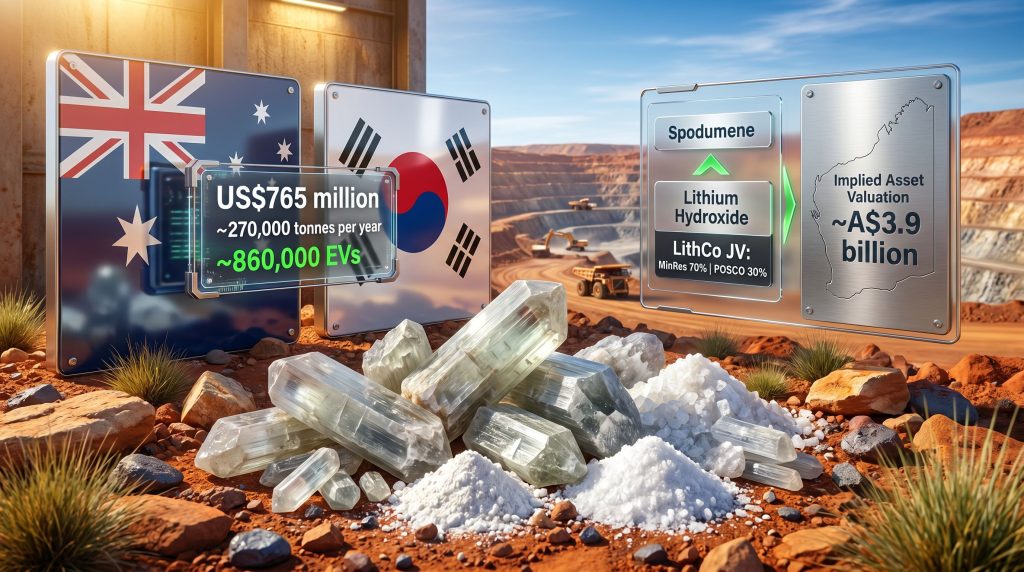
| Upfront Cash Consideration | US$765 million (~A$1.2 billion / KRW 1.1 trillion) |
| MinRes Retained Ownership | 70% of LithCo (35% indirect interest per mine) |
| Assets Under JV | MinRes' existing 50% stakes in Wodgina and Mt Marion |
| Implied Asset Valuation | ~A$3.9 billion for MinRes' combined 50% mine interests |
| Binding Terms First Announced | 12 November 2025 |
| Formal Agreements Executed | 1 May 2026 |
| Expected Transaction Completion | First half of financial year 2027 |
A critical nuance here is the difference between formal agreement execution and full transaction completion. The May 2026 signing establishes legal obligations and locks in commercial terms, but the transaction will not reach completion until regulatory approvals are secured, with MinRes targeting the first half of financial year 2027 as the expected window.
MinRes Retains the Operator's Seat
One of the most strategically significant elements of the LithCo structure is that MinRes continues as the operator of both mines. Operatorship in mining joint ventures carries substantial practical authority: the operator controls production scheduling, capital expenditure decisions, workforce management, contractor selection, and day-to-day mine planning.
For a company that has described Wodgina and Mt Marion as two of the world's best hard rock lithium assets, retaining operational authority while monetising a 30% equity stake represents a sophisticated balancing act between near-term capital realisation and long-term strategic leverage.
The Wodgina and Mt Marion Assets: Understanding What Is Inside the JV
MinRes began identifying lithium as a target commodity more than a decade ago, systematically assembling what became a portfolio of world-class Western Australian hard rock assets. Both Wodgina and Mt Marion are among the most significant spodumene-producing operations globally, characterised by long mine lives and established processing infrastructure.
Existing Partner Dynamics Add Complexity
The LithCo structure sits above MinRes' 50% stakes in each mine, meaning the existing mine-level partnerships remain in place:
- Wodgina: Albemarle, one of the world's largest lithium producers, holds the remaining 50% interest at the mine level.
- Mt Marion: Jiangxi Ganfeng Lithium, a major Chinese lithium refiner and battery material producer, holds the remaining 50% interest at the mine level.
This creates a multi-layered ownership structure where POSCO's effective economic interest in each mine is 15% (30% of MinRes' 50% stake), a detail that is easily overlooked when focusing solely on the LithCo headline figures. Understanding this distinction matters for evaluating the offtake volumes POSCO will receive relative to total mine output.
Offtake Volumes and the EV Supply Chain Mathematics
The commercial rationale for POSCO's participation becomes clearest when examining the offtake structure. POSCO receives spodumene concentrate offtake rights proportional to its 30% ownership of LithCo. Following planned mine expansions across both Wodgina and Mt Marion, this translates into substantial volumes:
| Offtake Metric | Projected Figure |
|---|---|
| Annual Spodumene Offtake (post-expansion) | ~270,000 tonnes |
| Equivalent Lithium Hydroxide Production | ~37,000 tonnes per year |
| Electric Vehicles Supported (annually) | ~860,000 EVs |
The conversion mathematics embedded in these figures are worth examining. A 270,000-tonne spodumene concentrate offtake producing approximately 37,000 tonnes of lithium hydroxide implies a conversion ratio of roughly 13.7% by weight. This reflects the chemical reality of lithium extraction from spodumene, where the concentrate (typically grading 6% Li₂O) undergoes acid roasting and leaching processes to yield battery-grade lithium hydroxide monohydrate.
The 860,000 EV equivalent figure implies an assumption of approximately 43 kilograms of lithium hydroxide per vehicle battery pack, consistent with mid-range EV platforms using NMC (nickel manganese cobalt) cathode chemistry. It is worth noting that as battery pack sizes increase across premium long-range EVs, the lithium content per vehicle rises, potentially meaning the same 37,000 tonnes of hydroxide could support fewer but larger-battery vehicles.
This article contains forward-looking projections based on planned mine expansions. Actual production outcomes, offtake volumes, and EV equivalents are subject to change based on operational performance, market conditions, and regulatory approvals. Nothing in this article constitutes financial advice.
The Downstream Processing Advantage POSCO Brings
A point often overlooked in transaction coverage is why POSCO's downstream processing expertise adds genuine strategic value rather than simply representing a customer relationship. Converting spodumene concentrate to battery-grade lithium hydroxide requires specialised chemical processing capabilities, quality control systems capable of meeting battery manufacturer specifications, and established relationships with cathode active material producers and battery cell manufacturers.
POSCO's position as a fully integrated battery materials producer means the spodumene flowing from Wodgina and Mt Marion enters a processing chain already calibrated to produce materials meeting the purity and specification requirements of advanced battery applications. Indeed, direct lithium extraction technologies are increasingly complementing these processing capabilities, offering further efficiency gains across the broader industry.
What US$765 Million Does for Mineral Resources
The financial engineering underpinning this transaction deserves careful analysis. MinRes receives US$765 million (approximately A$1.2 billion) in upfront cash consideration while retaining 70% of LithCo and continuing as mine operator. This structure achieves several objectives simultaneously:
- Immediate capital injection that strengthens balance sheet flexibility during a period of elevated capital expenditure across MinRes' mining services and iron ore operations.
- Asset monetisation without equity dilution, preserving the interests of existing MinRes shareholders rather than raising capital through share issuance.
- Valuation crystallisation at a time of lithium market volatility, locking in an implied asset valuation of approximately A$3.9 billion for MinRes' combined 50% mine interests.
- Long-term production leverage is preserved through majority ownership and operatorship, ensuring MinRes retains significant upside exposure to any future recovery in lithium prices.
The implied A$3.9 billion valuation for MinRes' 50% interests represents a significant benchmark for Australian hard rock lithium asset pricing. In a market where sentiment toward lithium has been volatile, a transaction of this scale at these implied metrics provides a credible reference point for how well-capitalised strategic buyers are valuing tier-1 spodumene operations. Consequently, shifting lithium market dynamics continue to influence how these assets are priced and structured globally.
Capital Recycling as a Strategic Template
MinRes has previously employed JV structures as a mechanism for capital recycling, with the Onslow Iron project serving as an earlier precedent for monetising strategic assets through partial equity sales while retaining operational control and long-term production exposure. The LithCo transaction follows the same structural logic applied to the company's flagship lithium holdings.
The next major ASX story will hit our subscribers first
Regulatory Pathway to Completion
Several conditions must be satisfied before the Mineral Resources and POSCO lithium joint venture reaches full completion:
- FIRB (Foreign Investment Review Board) approval: As a transaction involving a foreign entity acquiring a significant stake in Australian mining assets, FIRB review is required under Australia's foreign investment screening framework. FIRB assessments for significant resource sector transactions typically involve review of national interest considerations, though FIRB's timelines and specific criteria are not publicly disclosed.
- Merger clearance requirements: Cross-border transactions of this scale may trigger competition law review obligations in relevant jurisdictions, though the complementary (rather than overlapping) nature of MinRes' mining operations and POSCO's processing capabilities reduces the likelihood of competition concerns.
- Cross-border Korean regulatory considerations: POSCO's outbound investment of this magnitude may require internal approvals or notifications under South Korean corporate governance frameworks, though no specific requirements in this regard have been indicated in public disclosures.
The approximately seven-month gap between formal agreement execution (May 2026) and the targeted H1 FY2027 completion window reflects the expected timeline for navigating these regulatory processes rather than any outstanding commercial negotiation.
Geopolitics, Supply Chain Architecture, and Why This Deal Matters Beyond the Numbers
South Korea's battery sector, anchored by manufacturers supplying global EV platforms including LG Energy Solution, Samsung SDI, and SK Innovation, faces a structural vulnerability rooted in lithium supply concentration. The processing and refining stages of the lithium supply chain have historically been concentrated in a small number of jurisdictions, creating risks that South Korean battery manufacturers and their industrial partners have been actively working to mitigate.
Direct equity investment in Australian hard rock assets addresses this vulnerability at the upstream level, creating a controlled pipeline of raw material that is not subject to the same geopolitical risks as supply sourced through intermediary traders or processing-stage refiners in concentrated jurisdictions. Furthermore, shifts across battery raw materials markets are accelerating the urgency of securing such upstream positions.
How Australia Fits Within Western Battery Supply Chain Architecture
Australia's appeal as a lithium source for allied industrial nations extends beyond the scale and quality of its resources:
- Regulatory predictability: Australia's mining approvals framework, while complex, operates under stable rule-of-law conditions with clear appeal mechanisms and established environmental assessment processes.
- Trade relationship alignment: Australia maintains strong trade and strategic relationships with South Korea, Japan, the United States, and European economies, reducing the risk of export restrictions or trade disruptions that have affected other supply chains.
- Established operational track record: Australian spodumene operations have demonstrated consistent production over multiple commodity cycles, providing strategic buyers with operational data and reliability confidence unavailable from newer producing regions.
Comparing JV Equity Structures Against Competing Supply Strategies
Understanding how the LithCo structure compares to alternative supply security mechanisms helps contextualise POSCO's decision to pursue equity ownership rather than simpler contractual arrangements:
| Strategy Type | Control | Capital Exposure | Offtake Security | Operational Risk |
|---|---|---|---|---|
| Full Acquisition | High | Very High | Guaranteed | High |
| JV Equity (30%) | Moderate | Moderate | Proportional | Shared |
| Offtake Agreement Only | Low | Low | Contractual | None |
| Streaming/Royalty | None | Low | Volume-based | None |
A pure offtake agreement would have provided POSCO with volume security but no economic participation in asset appreciation and no governance rights over production decisions. A full acquisition would have provided maximum control but required substantially higher capital and greater regulatory scrutiny.
The 30% JV equity structure occupies a deliberate middle ground: sufficient economic ownership to align incentives with MinRes on mine development decisions, proportional offtake rights that integrate directly into POSCO's processing chain, and a capital commitment calibrated to POSCO's risk appetite without requiring full ownership responsibility. According to POSCO's own strategic rationale, securing upstream lithium resources through equity stakes is central to the group's long-term battery materials ambitions.
Frequently Asked Questions: Mineral Resources and POSCO Lithium Joint Venture
What is LithCo and what does it hold?
LithCo is the newly incorporated joint venture entity created to hold MinRes' existing 50% ownership interests in both the Wodgina and Mt Marion lithium mines in Western Australia. POSCO will acquire a 30% stake in LithCo, with MinRes retaining the remaining 70%.
How much is POSCO paying for its 30% stake?
POSCO is investing US$765 million (approximately A$1.2 billion or KRW 1.1 trillion) as an upfront cash consideration for its 30% interest in LithCo. The original deal announcement confirmed these figures when binding terms were first disclosed in November 2025.
When is the transaction expected to complete?
MinRes has indicated the transaction is expected to reach completion during the first half of the 2027 financial year, subject to regulatory approvals including FIRB clearance.
What is the implied valuation of MinRes' lithium mine interests?
Based on the transaction pricing, MinRes' combined 50% ownership stakes in Wodgina and Mt Marion are implied to be worth approximately A$3.9 billion in total.
Does MinRes retain operational control after the JV is formed?
Yes. MinRes continues as the operator of both mines within the JV structure, maintaining strategic and day-to-day operational authority over Wodgina and Mt Marion.
What does POSCO gain beyond equity ownership?
In addition to its 30% equity stake, POSCO receives spodumene concentrate offtake rights proportional to its ownership, estimated at approximately 270,000 tonnes per year following planned mine expansions, sufficient to produce around 37,000 tonnes of lithium hydroxide annually and support approximately 860,000 electric vehicles per year.
Key Takeaways: What the MinRes–POSCO Lithium JV Means for the Market
- Capital efficiency at scale: The US$765 million transaction delivers substantial inbound capital to MinRes without diluting its listed equity or surrendering operational control of its flagship lithium assets.
- Supply chain integration: POSCO's complete battery materials value chain, from upstream spodumene through to downstream lithium hydroxide processing, transforms this JV into a strategically integrated supply node for Korean and Western battery manufacturers.
- Valuation signal: The implied A$3.9 billion valuation for MinRes' 50% mine interests establishes a credible benchmark for Australian hard rock lithium asset pricing at a time when lithium market sentiment remains volatile.
- Geopolitical alignment: The partnership reinforces Australia's position as a preferred source of battery-critical minerals for allied industrial nations, consistent with broader Western supply chain diversification objectives.
- Long-term commitment: With completion targeted for H1 FY2027 and both parties publicly committed to maximising mine potential, the JV represents a multi-decade strategic alignment rather than a short-term capital transaction.
- Structural complexity: The multi-layered ownership structure, with POSCO holding 30% of MinRes' 50% stakes (effectively 15% at the mine level), means investors should carefully distinguish between LithCo-level economics and mine-level economics when assessing the transaction's true scale.
This article is intended for informational purposes only and does not constitute financial, investment, or legal advice. Readers should conduct independent research and seek qualified professional advice before making any investment decisions. Forward-looking statements and projections referenced in this article are subject to material risks and uncertainties.
Want to Catch the Next Major Lithium Discovery Before the Market Does?
Discovery Alert's proprietary Discovery IQ model delivers real-time alerts the moment significant ASX mineral discoveries are announced, transforming complex commodity data into actionable insights for both short-term traders and long-term investors — explore historic discoveries and their returns to understand the scale of opportunity, then begin your 14-day free trial to position yourself ahead of the broader market.