June 23, 2026
Inside the Vicuña District: How Mirasol's Sobek Project Fits Into One of South America's Most Compelling Copper Corridors
Copper exploration doesn't move in a straight line. The discovery cycles that ultimately deliver the world's next generation of major mines typically begin with years of patient geological work, incremental land consolidation, and systematic drill testing long before any headline resource numbers emerge. The Vicuña District, straddling the high-altitude border zone between northeastern Chile and Argentina, is currently in that critical middle phase — where early-stage tenements are being stress-tested against a geological model that has already delivered one transformative discovery.
Furthermore, the positioning decisions made by junior explorers today will determine who captures value over the next decade. Understanding where the Mirasol Sobek copper mine story fits within the broader Vicuña District development narrative requires separating what is confirmed from what remains prospective, and recognising that the most strategically significant assets in any emerging copper province are rarely the ones generating production headlines.
When big ASX news breaks, our subscribers know first
Understanding the Sobek Project: Exploration Stage, Not Production Stage
One of the most persistent sources of confusion in junior mining coverage is the conflation of exploration assets with operating mines. The Sobek project, operated by Mirasol Resources within the Vicuña District of northeastern Chile, is an active copper-gold-silver exploration asset. No mineral resource compliant with JORC or NI 43-101 standards has yet been defined. No production is occurring or imminent.
What exists is a large, strategically positioned land package being systematically advanced through geological mapping, geophysical surveying, geochemical sampling, and drill testing. This distinction matters enormously for how investors and analysts should assess the project's risk profile, timeline, and potential value. Exploration-stage assets carry fundamentally different characteristics from development or producing assets:
- Higher geological risk: Mineralisation continuity at depth remains unproven until systematic drilling confirms it
- Longer development timelines: Porphyry copper systems typically require 10 to 20 years from initial discovery through to first production
- Greater optionality value: Large, well-located land packages in active districts retain significant strategic worth even before resource definition
- Lower capital intensity at current stage: Pre-resource exploration programs are typically far less capital-intensive than feasibility, construction, or production phases
Sobek Project: Core Metrics at a Glance
| Feature | Detail |
|---|---|
| Project Type | Porphyry copper-gold-silver exploration |
| Total Land Holding | 22,840 hectares |
| Core Ownership | 100% Mirasol Resources |
| Rosita Property Structure | 80% earn-in option (acquired from SQM, 2024) |
| Initial Staking Year | 2016 |
| Current Stage | Pre-resource, active drilling program |
| Exploration Funding Model | Self-funded |
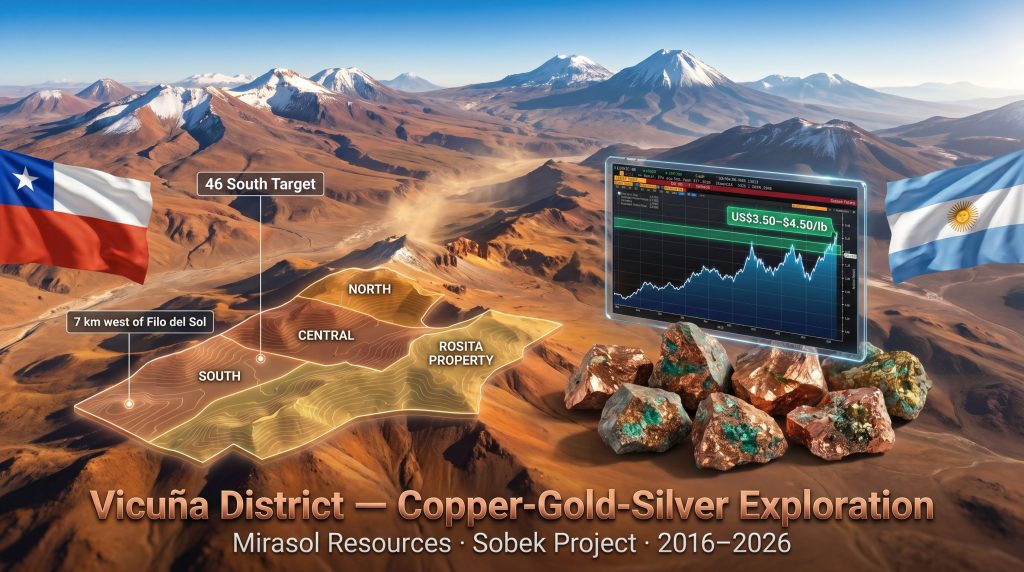
| Structural Blocks | North, Central, South, Rosita |
| Distance to Filo del Sol | 7 km west |
| Distance to Lunahuasi | 3 km southwest |
The Vicuña District: Geography as a Value Driver
Location is rarely incidental in large-scale copper exploration. The Vicuña District's value proposition rests on three intersecting geographic and geological factors that distinguish it from the broader Andean copper exploration landscape. Indeed, the copper supply crunch affecting global markets makes well-positioned district assets increasingly critical to long-term supply pipelines.
First, the district straddles a binational corridor across the Chile-Argentina border at high altitude, placing it within the same geological arc that hosts some of the most prolific copper-producing terranes on the planet. The Andean porphyry copper belt is responsible for a substantial share of global copper production, and the Vicuña District represents one of the less-developed segments of that belt with confirmed large-scale mineralisation.
Second, proximity to multiple advanced-stage projects creates a district-level validation effect that elevates the prospectivity of adjacent tenements. The Sobek project sits 7 km west of the Filo del Sol deposit and 3 km southwest of the Lunahuasi deposit in Argentina — two assets whose geological footprints have significantly shaped exploration models across the wider district.
Third, the concentration of major and mid-tier mining companies already active in the district through the Josemaria and Los Helados projects signals institutional confidence in the district's geological endowment and long-term development potential.
Vicuña District Project Comparison
| Project | Operator | Current Stage | Proximity to Sobek | Notable Characteristic |
|---|---|---|---|---|
| Filo del Sol | Filo Mining / BHP JV | Advanced exploration / development | 7 km east | High-grade feeder zone confirmed 2021 |
| Lunahuasi | Filo Mining | Exploration | 3 km northeast (Argentina) | Cross-border tenure |
| Josemaria | Lundin Mining | Feasibility / Development | Regional | Large-scale copper-gold porphyry system |
| Los Helados | JX Advanced Metals / CODELCO | Pre-feasibility | Regional | Significant defined resource base |
| Sobek | Mirasol Resources | Active exploration | Reference point | 22,840 ha consolidated tenure; self-funded |
Why the 2021 Filo del Sol Discovery Recalibrated the Entire District
To appreciate why Mirasol's Sobek tenure has attracted renewed attention, it is necessary to understand what the 2021 discovery of a high-grade feeder zone at Filo del Sol actually changed for the broader district. Prior to that discovery, Filo del Sol was understood as a large but relatively conventional porphyry-epithermal copper-gold-silver system.
The identification of a high-grade feeder zone at depth fundamentally altered the resource growth trajectory of the project and, more broadly, recalibrated the structural models exploration teams were applying across the Vicuña corridor. For adjacent land holders, this carries a direct implication: the same structural and hydrothermal controls that concentrated mineralisation at Filo del Sol may extend laterally and at depth into neighbouring tenements.
Mirasol's Sobek project, as the largest contiguous land package directly to the west of Filo del Sol, sits squarely within the zone of enhanced prospectivity that the 2021 discovery created. According to Mirasol's official project page, the company has been systematically building its geological understanding of this relationship across multiple field seasons.
It is worth noting that Mirasol staked the Sobek tenure in 2016 based on independent geological assessment, a full five years before the district-wide rerating triggered by the Filo del Sol feeder zone discovery. This early-mover positioning allowed the company to secure a large footprint at relatively low cost, before competitive exploration interest drove tenure acquisition costs significantly higher across the corridor.
Mirasol's Strategic Logic: Self-Funding, Land Consolidation, and the 2024 Rosita Acquisition
Why Self-Funded Exploration Preserves Strategic Optionality
One of the less-discussed but strategically significant aspects of Mirasol's approach to the Sobek project is the decision to advance it through self-funded exploration rather than seeking a joint venture partner at the current stage. In the junior mining sector, this distinction carries meaningful implications for how gold and copper exploration assets are ultimately valued and monetised.
Joint venture arrangements at the exploration stage — while they reduce cash burn for the junior partner — typically involve a major company earning into equity through exploration expenditure commitments, which dilutes the junior's eventual ownership stake. By self-funding, Mirasol retains 100% ownership of the core Sobek tenure and preserves the ability to negotiate from a stronger position once the asset has been advanced to a more de-risked inflection point.
This approach requires disciplined capital allocation and a credible geological thesis, but it also means that any future partnership or acquisition discussions would occur against a backdrop of a more advanced, better-defined asset rather than a nascent prospect.
The Rosita Property Acquisition: Doubling the Footprint Through a Structured Earn-In
The 2024 acquisition of the Rosita Property from SQM, structured as an 80% earn-in option, was a pivotal moment in the Sobek project's development. The transaction effectively doubled the project's land holding to 22,840 hectares and created a contiguous four-block tenure covering the North, Central, South, and Rosita structural domains.
Several aspects of this transaction merit closer analysis:
- Counterparty significance: SQM is one of Chile's largest and most sophisticated mining companies, primarily known for lithium but with significant legacy copper and mineral tenure holdings. Divesting the Rosita Property to Mirasol suggests SQM viewed the asset as non-core to its strategic priorities, creating an opportunity for a more focused explorer to unlock its potential.
- Earn-in structure advantages: Rather than requiring full upfront capital commitment, the earn-in structure allows Mirasol to acquire majority control by meeting defined exploration expenditure milestones. This aligns capital deployment with geological progress.
- Contiguous tenure value: In district-scale exploration, contiguous land packages are disproportionately more valuable than fragmented holdings because they allow coherent geological models to be tested across larger areas without jurisdictional interruptions.
The 46 South Target: What the 2025/26 Drilling Season Means for Project Trajectory
The 46 South Target, positioned 7 km west of the Filo del Sol deposit within the Sobek tenure, was the primary focus of Mirasol's 2025/26 exploration season drilling campaign. Target selection followed a systematic multi-stage methodology that is worth understanding in detail, as it reflects the technical rigour that distinguishes disciplined porphyry exploration from speculative drilling. The exploration drilling programs employed at Sobek reflect best practice across the Andean porphyry sector.
Porphyry Copper Exploration: The Technical Workflow
- Regional geological mapping — Structural corridor identification, alteration zone mapping, and contact geology assessment consistent with porphyry emplacement environments
- Geophysical surveys — Induced polarisation (IP) and magnetic surveys to detect buried sulphide mineralisation and magnetic depletion halos associated with porphyry systems
- Geochemical sampling programs — Soil, rock chip, and stream sediment sampling to define anomalous multi-element signatures (copper, gold, molybdenum, silver)
- Multi-criteria target ranking — Integration of geophysical and geochemical datasets with structural models to prioritise drill targets by size potential and geological confidence
- Diamond and RC drilling — Systematic drill testing to confirm subsurface mineralisation, measure grades, and assess continuity at depth
- Resource estimation — Compilation of drill results into a JORC or NI 43-101 compliant resource estimate (future stage for Sobek)
The 46 South Target's selection reflects the application of this workflow to a setting where the geological case for porphyry mineralisation is supported by the known proximity of the Filo del Sol system. Results from the 2025/26 drilling program will inform subsequent exploration budgeting and target prioritisation across the broader Sobek tenure. As noted in a recent Mirasol drilling update, the programme has been advancing on schedule.
The next major ASX story will hit our subscribers first
Understanding Porphyry Copper Systems: Why These Deposits Define Long-Term Supply
For investors and analysts without a technical geology background, understanding the specific nature of porphyry copper systems is essential for contextualising both the potential and the timeline of assets like the Mirasol Sobek copper mine in the Vicuña District. Porphyry copper deposits are formed by large hydrothermal systems associated with cooling magmatic intrusions, typically at depths of several kilometres. They are characterised by:
- Large tonnage but relatively low average grades — typically 0.2% to 0.6% copper equivalent, with gold and silver credits improving overall economics
- Predictable mineralisation zonation — a concentric alteration pattern (potassic core, phyllic intermediate zone, argillic outer zone) that experienced geologists can use to orient drilling programs
- Significant depth extensions — the Filo del Sol feeder zone discovery is instructive here; high-grade feeder zones at depth can dramatically increase the economic case for large but lower-grade surface systems
- Long mine lives — major porphyry copper mines frequently operate for 30 to 50 years, justifying substantial upfront capital investment
- Infrastructure intensity — the scale of porphyry mines requires significant infrastructure development, particularly at high-altitude Andean locations
The Andean porphyry copper belt running through Chile, Peru, and Argentina hosts a disproportionate share of the world's known undeveloped copper endowment. The Vicuña District represents one segment of this belt that remains relatively early in its development cycle, with the Filo del Sol and Josemaria projects providing the resource definition and feasibility work that will eventually anchor district-wide infrastructure development.
Scenario Analysis: Three Development Trajectories for Sobek
Given the exploration-stage nature of the Sobek project, any forward-looking assessment must be framed as scenario analysis rather than projection. The following three pathways represent the most plausible development trajectories, each with distinct implications for stakeholders.
Scenario 1: Discovery Confirmation and Independent Advancement
Drilling at 46 South and subsequent targets confirms large-scale porphyry mineralisation at economic grades. Mirasol advances toward a maiden resource estimate, attracting joint venture interest or acquisition approaches from major operators already active in the district. Timeline to production in this scenario extends to 12 to 20-plus years from resource confirmation, consistent with typical porphyry copper development cycles.
Scenario 2: Strategic Acquisition Ahead of Resource Definition
A district consolidator with existing Vicuña exposure acquires the Sobek tenure based on land package value and geological optionality rather than defined resources. This scenario would crystallise value for Mirasol earlier than independent development, with acquisition pricing likely reflecting proximity to Filo del Sol and the size of the consolidated tenure.
Scenario 3: Exploration Disappointment and Portfolio Reallocation
Drilling results at 46 South and other prioritised targets fail to confirm economic-grade mineralisation at depth. Mirasol reallocates exploration capital to other portfolio assets. The Sobek land package retains residual optionality value given district-wide geological prospectivity, but near-term catalysts diminish.
Key Risk Factors Investors Should Monitor
| Risk Category | Specific Concern | Mitigation Factor |
|---|---|---|
| Geological risk | No JORC resource defined; mineralisation unproven at depth | Systematic methodology; proximity to confirmed deposits |
| Jurisdictional risk | Binational district requires dual regulatory navigation | Established Chilean mining code; active regulatory environment |
| Operational risk | High-altitude Andean conditions impose cost and logistics constraints | Industry-standard for Andean porphyry exploration |
| Market risk | Copper price sensitivity affects exploration investment levels | Structural demand growth supports long-term price case |
| Timeline risk | Porphyry development cycles are inherently multi-decade | Early-stage land banking strategy aligns with long-duration thesis |
The Copper Supply Gap: Why New Andean Discoveries Are Structurally Important
The long-term investment thesis for the Mirasol Sobek copper position in the Vicuña District is ultimately anchored in the structural dynamics of global copper supply and demand. Understanding the copper price drivers shaping the current investment environment is consequently essential for evaluating any exploration-stage asset in this corridor.
Global copper demand is broadly expected to increase substantially through the mid-2030s and beyond, driven by the electrification of transport, expansion of renewable energy generation capacity, and grid infrastructure upgrades required to support energy transition objectives. Simultaneously, existing copper mines globally face the compounding challenge of declining ore grades, increasing strip ratios, and rising unit production costs — factors that reduce the effective supply contribution of the existing asset base over time.
This creates a structural supply requirement for new, large-scale copper deposits to be discovered, developed, and brought into production. Andean porphyry systems represent the most historically productive source of large-scale copper supply, and the Vicuña District's emerging multi-deposit profile positions it as a potential contributor to that supply pipeline over a multi-decade horizon. In addition, the largest copper mines globally are predominantly Andean porphyry systems, reinforcing the long-term strategic importance of new discoveries in this belt.
Copper Price Scenarios and Exploration Activity Implications
| Copper Price Range | Exploration Activity Impact | Vicuña District Implications |
|---|---|---|
| Below US$3.50/lb | Junior exploration budgets contract; project deferrals | Slower district-wide advancement; consolidation opportunities emerge |
| US$3.50 to US$4.50/lb | Sustained activity; selective program advancement | Steady pre-resource progression; measured JV interest |
| Above US$4.50/lb | Accelerated exploration; major company interest intensifies | Increased acquisition and JV activity for advanced land packages |
| Above US$5.00/lb | District-wide rerating; aggressive tenure consolidation | Significant premium for large, contiguous packages like Sobek |
Note: Copper price scenarios and their associated activity implications are illustrative frameworks for analytical purposes only and do not constitute financial advice or price forecasts. Actual copper prices are influenced by a wide range of macroeconomic, geopolitical, and supply-side variables.
Frequently Asked Questions: Sobek Project and the Vicuña District
Is Sobek a Producing Copper Mine?
No. The Sobek project is an exploration-stage asset with no defined JORC-compliant mineral resource and no current or planned copper production. The characterisation of Sobek as a future potential copper mine reflects the geological prospectivity of its setting, not a confirmed development outcome.
Who Owns the Sobek Tenure?
Mirasol Resources holds 100% ownership of the core Sobek tenure. The adjacent Rosita Property, acquired from SQM in 2024, is held under an 80% earn-in option structure.
How Large Is the Combined Sobek Land Package?
Following the 2024 Rosita acquisition, the consolidated Sobek tenure spans 22,840 hectares across four structural blocks: North, Central, South, and Rosita.
What Is the 46 South Target?
The 46 South Target is a high-priority drill target within the Sobek project, located 7 km west of the Filo del Sol deposit. It was the central focus of Mirasol's 2025/26 exploration season drilling program and represents the current primary test of the project's mineral potential.
Why Did Mirasol Stake the Sobek Tenure in 2016?
The initial staking decision in 2016 was based on the prospective regional geology of the Vicuña corridor, predating the 2021 Filo del Sol feeder zone discovery that subsequently rerated the district. This early-mover positioning allowed Mirasol to secure a large land package before widespread competitive interest developed.
How Is Sobek Exploration Funded?
Mirasol operates a self-funded exploration model for Sobek, preserving full ownership and strategic optionality without reliance on dilutive joint venture arrangements at the current stage.
Key Takeaways: Positioning Sobek Within the Vicuña District Investment Landscape
- The Mirasol Sobek copper mine within the Vicuña District represents a 22,840-hectare exploration footprint in one of South America's most strategically active emerging copper corridors
- Mirasol's 2016 staking decision, made five years before the transformative Filo del Sol feeder zone discovery, reflects geological conviction rather than reactive land banking
- The 2024 Rosita Property acquisition from SQM doubled the project's strategic footprint through a structured earn-in arrangement, creating a consolidated four-block tenure
- Active drilling at the 46 South Target during the 2025/26 season represents the current primary geological test of the project's mineralisation potential
- Investors should assess Sobek as a high-optionality, exploration-stage asset within an actively developing district, with development timelines measured in decades rather than years
- The structural copper demand case driven by global electrification trends provides a long-duration macro backdrop that supports sustained exploration investment in large-scale Andean porphyry systems
This article is intended for informational purposes only and does not constitute financial advice. The Sobek project is an exploration-stage asset, and all forward-looking statements, scenario analyses, and copper price frameworks presented here involve inherent uncertainties. Readers should conduct their own due diligence and consult a licensed financial adviser before making any investment decisions.
Want to Stay Ahead of the Next Major Mineral Discovery in Real Time?
Discovery Alert's proprietary Discovery IQ model instantly scans ASX announcements to deliver real-time alerts on significant mineral discoveries — including copper exploration plays positioned within emerging districts like Vicuña — turning complex geological data into actionable investment insights for both short-term traders and long-term investors. Explore historic discoveries and the substantial returns they generated, then begin your 14-day free trial at Discovery Alert to ensure you're positioned ahead of the market when the next transformative announcement breaks.