June 13, 2026
Understanding the Mechanics of Modern Comminution Systems
The mining industry faces an evolving landscape where traditional processing methods must adapt to increasingly complex challenges. Declining ore grades across global deposits have fundamentally altered the economics of mineral extraction, while environmental regulations demand more energy-efficient approaches to comminution. These converging pressures have catalyzed significant technological advancement in grinding equipment design, with vertical orientation systems emerging as a pivotal solution for next-generation mineral processing facilities.
Traditional horizontal ball mills have dominated comminution for decades, but their energy-intensive impact-based mechanisms are increasingly inadequate for processing lower-grade ores economically. The physics of particle size reduction has become critical as operators seek to maximise recovery rates while minimising operational costs. This shift has accelerated the rise of vertical mills across multiple industrial sectors, driven by their ability to deliver superior energy efficiency through gravitational classification principles.
When big ASX news breaks, our subscribers know first
Core Engineering Principles Behind Vertical Mill Technology
Operational Mechanics and Design Classification
Vertical mills operate fundamentally differently from their horizontal counterparts through attrition-based particle breakdown rather than impact mechanisms. The vertical orientation of the grinding chamber enables gravitational forces to work advantageously, creating natural particle classification during the grinding process. This physics-based approach allows finer particles to discharge quickly while coarser material remains in contact with grinding media until adequately reduced.
The technical superiority stems from several key design elements. Furthermore, these innovations support broader industry innovation trends across mining operations:
- Central agitator systems that minimise moving components in contact with slurry and media
- Steel or ceramic media optimisation tailored to specific ore hardness characteristics
- High solids concentration processing reducing water consumption in secondary and tertiary applications
- Internal classification capabilities preventing overgrinding through natural particle segregation
Modern vertical mills encompass two primary configurations: tower mills utilising central agitator screws and ceramic media mills employing variable-speed disc assemblies. Both leverage identical gravitational classification principles despite differing mechanical designs, demonstrating the versatility of vertical orientation in comminution applications.
Energy Transfer Efficiency and Particle Physics
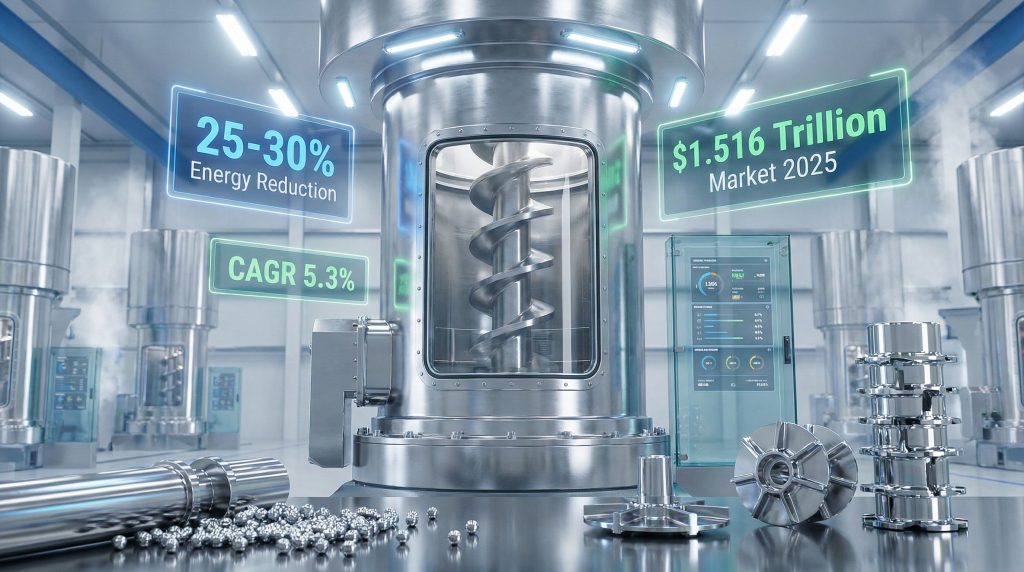
The energy efficiency advantages of vertical mills result from optimised energy transfer mechanisms. According to industry analysis, vertical media mills achieve energy savings of 25-30 percent compared to horizontal alternatives through reduced overgrinding and improved particle classification. Peter Wulff from FLSsmidth explains that the vertical orientation means basic laws of physics work favourably to minimise overgrinding, as finer particles discharge quickly while coarser particles remain in the grinding media charge until further size reduction occurs.
This efficiency translates directly to operational cost reduction and supports decarbonisation objectives across mining operations. The reduced energy consumption correlates with lower carbon emissions, making vertical mills increasingly attractive for operators pursuing Environmental, Social, and Governance (ESG) compliance. Additionally, this aligns with renewable energy transformations being implemented across the sector.
Performance Analysis and Comparative Advantages
Operational Cost Structure Comparison
| Performance Metric | Vertical Mills | Horizontal Mills | Efficiency Gain |
|---|---|---|---|
| Energy Consumption | 25-30% lower | Baseline reference | Significant reduction |
| Footprint Requirements | Compact design | Extensive civil engineering | Space optimisation |
| Installation Timeline | Pre-assembled units | Complex on-site assembly | Faster commissioning |
| Maintenance Points | Single moving component | Multiple wear locations | Reduced downtime |
| Water Consumption | High solids processing | Standard slurry densities | Resource conservation |
The economic advantages extend beyond energy savings to encompass reduced capital expenditure through factory testing and pre-assembly benefits. Components undergo comprehensive testing before delivery, enabling significantly shorter installation and commissioning timeframes. This approach reduces project risk while accelerating return on investment through earlier production startup.
Technical Specifications and Processing Capabilities
Modern vertical mill designs demonstrate remarkable processing flexibility across diverse applications. The FTM tower mill series represents the pinnacle of vertical grinding technology, with the FTM-5000 units constituting the largest vertical mills ever manufactured. These systems handle both primary and secondary grinding stages in iron ore beneficiation, demonstrating the scalability of vertical mill technology.
Critical Performance Indicator: Recent industry orders include 18 FTM-5000 units for a single Indian iron ore beneficiation plant, representing the largest vertical mill order in industry history and highlighting growing market confidence in the technology.
The FTM tower mill configuration features advanced data-driven mining operations capabilities alongside:
- Central agitator screw design as the sole moving component in contact with slurry and steel media
- Robust wear materials providing enhanced operational availability
- Intelligent operations management software for circuit performance optimisation
- High solids concentration capability reducing water consumption in grinding circuits
Specialized Applications and Industry Adoption Patterns
Primary Sector Integration Strategies
Vertical mills have demonstrated particular effectiveness in specific mineral processing applications where particle size control and energy efficiency are paramount. The technology shows exceptional performance in processing operations that support sustainable mining transformation initiatives:
- Iron ore beneficiation utilising multi-stage grinding configurations
- Copper concentrate processing requiring precise particle size distribution
- Lead-zinc operations demanding efficient mineral liberation
- Secondary and tertiary grinding stages where energy optimisation is critical
The Indian iron ore project exemplifies optimal vertical mill integration, with FTM-5000 units processing material from high-pressure grinding rolls featuring 3-metre diameter rolls with 2-metre width in tertiary grinding applications. This configuration demonstrates how vertical mills complement existing comminution equipment to optimise overall circuit performance.
Fine Grinding Applications and Ceramic Media Technology
The VXP ceramic media mill represents specialised technology for ultra-fine grinding requirements. This system achieves product sizes below 20 microns through several key mechanisms. Consequently, operators can optimise performance across diverse applications.
- Variable speed disc assemblies enabling operational optimisation for different target sizes
- Modular impeller systems with removable discs and spacers for application-specific customisation
- Ceramic media utilisation providing superior wear resistance compared to steel alternatives
- Precise discharge control through built-in classification mechanisms
The modular design philosophy allows operators to adjust disc configurations without equipment replacement, optimising energy consumption for specific product size requirements. This flexibility proves particularly valuable in applications requiring frequent product specification changes or multiple product streams.
Infrastructure and Installation Advantages
Footprint Optimisation and Retrofit Capabilities
Space optimisation represents a significant advantage of vertical mill technology, particularly in existing facilities with space constraints. Vertical mills occupy substantially less floor area compared to horizontal mills of equivalent capacity, supporting plant space optimisation while requiring less costly civil engineering infrastructure.
According to FLSsmidth technical assessments, reduced footprint requirements enable easier retrofitting into existing plants, especially where space limitations restrict expansion options. The compact design also reduces foundation engineering requirements, translating to lower capital costs and faster project execution timelines.
Factory Testing and Pre-Assembly Benefits
Modern vertical mills benefit from comprehensive factory testing and pre-assembly protocols that minimise on-site installation risks. However, these systems also integrate seamlessly with modern investment strategy components across mining portfolios. Key advantages include:
- Complete performance verification before shipment reducing commissioning uncertainties
- Modular construction approaches enabling component-specific maintenance scheduling
- Standardised installation procedures accelerating project timelines
- Quality assurance protocols ensuring consistent performance across multiple units
This approach contrasts favourably with traditional horizontal mills requiring extensive on-site assembly and commissioning, where performance verification occurs only after complete installation.
Market Dynamics and Technology Evolution
Industry Response to Declining Ore Grades
The global mining industry confronts systematic ore grade decline across major commodities, fundamentally altering processing economics. Lower-grade deposits require enhanced recovery techniques to maintain economic viability, driving demand for more efficient comminution technologies. Furthermore, vertical mill market trends indicate sustained growth driven by technological advancement.
The rise of vertical mills addresses this challenge through:
- Enhanced particle liberation through controlled attrition mechanisms
- Reduced overgrinding losses preserving valuable mineral content
- Improved recovery rates in downstream flotation processes
- Lower processing costs per ton through energy efficiency gains
This trend particularly affects copper, iron ore, and lead-zinc operations where ore grade decline threatens project economics without technological advancement.
Sustainability and Decarbonisation Imperatives
Environmental regulations and corporate sustainability commitments increasingly influence equipment selection decisions. In addition, vertical mills support decarbonisation objectives through:
- Direct energy consumption reduction of 25-30% compared to horizontal alternatives
- Lower carbon footprint through reduced power requirements
- Water conservation benefits from high solids processing capabilities
- Extended equipment lifecycles reducing replacement frequency and associated emissions
These factors align with broader industry sustainability trends and regulatory frameworks emphasising carbon emission reduction across mineral processing operations.
The next major ASX story will hit our subscribers first
Integration with Digital Technology Systems
Industry 4.0 and Automation Capabilities
Modern vertical mills incorporate advanced control systems enabling real-time performance optimisation and predictive maintenance capabilities. Integration features include sophisticated monitoring protocols that enhance operational efficiency:
- Variable speed control systems optimising energy consumption for different applications
- Real-time monitoring protocols tracking performance metrics continuously
- Predictive maintenance algorithms reducing unplanned downtime
- Circuit optimisation software maximising overall processing efficiency
The intelligent operations management software enhances circuit performance by analysing multiple variables simultaneously and adjusting operational parameters automatically. This capability proves particularly valuable in complex multi-stage grinding circuits where vertical mills operate alongside other comminution equipment.
Quality Control and Process Optimisation
Advanced vertical mill systems feature integrated quality control mechanisms ensuring consistent product specifications. These systems monitor several critical parameters to maintain optimal performance standards:
- Particle size distribution in real-time using laser diffraction technology
- Energy consumption patterns identifying optimisation opportunities
- Wear component conditions enabling proactive maintenance scheduling
- Circuit performance metrics supporting continuous improvement initiatives
Economic Analysis and Investment Considerations
Capital Expenditure and Return on Investment
Vertical mill investments demonstrate favourable economics through multiple cost reduction mechanisms. Capital expenditure advantages include reduced civil engineering requirements, factory pre-assembly benefits, and shorter installation timelines. These factors collectively reduce project risk while accelerating cash flow generation.
Operational expenditure reductions stem from several key efficiency improvements:
- Energy cost savings through 25-30% consumption reduction
- Maintenance cost reductions from simplified mechanical design
- Water cost optimisation through high solids processing
- Labour efficiency gains from automated operation capabilities
The combination of reduced capital and operational costs creates compelling investment propositions, particularly for operators processing lower-grade ores where marginal cost improvements significantly impact project economics.
Total Cost of Ownership Analysis
Lifecycle cost analysis reveals substantial advantages for vertical mill technology over traditional alternatives. The total cost of ownership benefits include several long-term economic advantages:
- Extended equipment lifecycles through robust component design and proven wear materials
- Reduced spare parts inventory requirements due to simplified mechanical configuration
- Lower insurance costs reflecting improved safety profiles and reduced failure risks
- Enhanced resale values due to growing market acceptance and technological superiority
These factors contribute to superior financial returns over equipment lifecycles, supporting capital allocation decisions favouring vertical mill technology.
Future Technology Development and Market Projections
Technological Advancement Trajectories
Ongoing research and development initiatives focus on enhancing vertical mill performance through materials science advancement and control system sophistication. Key development areas include promising innovations that will shape industry evolution:
- Advanced wear materials extending component lifecycles and reducing maintenance requirements
- Artificial intelligence integration for autonomous operation and optimisation
- Renewable energy compatibility supporting carbon-neutral processing operations
- Modular design enhancement enabling rapid configuration changes for different applications
These technological improvements will likely accelerate market adoption as operators seek competitive advantages through advanced comminution technologies.
Market Expansion and Application Diversification
The rise of vertical mills extends beyond traditional mineral processing into emerging applications. Furthermore, this diversification creates new opportunities across multiple industrial sectors including:
- Battery materials processing for lithium-ion and next-generation battery technologies
- Recycling applications recovering valuable materials from electronic waste
- Specialty chemical production requiring precise particle size control
- Advanced manufacturing supporting aerospace and automotive component production
This diversification creates new market opportunities while reducing dependence on traditional mining applications, supporting sustained growth in vertical mill demand across multiple industrial sectors.
Investment Analysis Disclaimer: This article contains forward-looking statements and market projections that involve uncertainties and risks. Actual results may differ materially from projections due to various factors including commodity price fluctuations, regulatory changes, technological developments, and market conditions. Readers should conduct independent analysis and consult qualified professionals before making investment decisions related to mining equipment or related technologies.
Looking to Capitalise on Mining Technology Advancements?
Discovery Alert's proprietary Discovery IQ model delivers real-time notifications on significant ASX mineral discoveries, empowering subscribers to identify actionable opportunities ahead of the broader market as companies announce technological breakthroughs and operational improvements. Explore how major discoveries can generate substantial market returns by examining historic examples, then begin your 14-day free trial today to position yourself ahead of evolving market trends.