August 10, 2026
How Modern Energy Chokepoints Challenge Traditional Maritime Security Frameworks
Global energy infrastructure faces unprecedented vulnerability as traditional naval security doctrines prove inadequate against emerging asymmetric threats. Contemporary maritime conflicts demonstrate how smaller forces can leverage technological advancement and geographic positioning to disrupt critical supply chains, regardless of conventional military superiority. This transformation reflects broader shifts in warfare where economic disruption often achieves strategic objectives more effectively than direct military confrontation.
The evolution of chokepoint control represents a fundamental departure from historical naval engagement patterns. Modern asymmetric strategies integrate multiple threat vectors simultaneously, creating redundant disruption mechanisms that resist traditional countermeasures. Understanding why military force may not be enough to reopen the Strait of Hormuz requires examining how these integrated approaches challenge established maritime security frameworks.
When big ASX news breaks, our subscribers know first
Asymmetric Naval Strategies Transform Maritime Corridor Control
Geographic Advantage Amplification Through Technology
Modern chokepoint control leverages natural geographic constraints enhanced by technological force multipliers. The Strait of Hormuz exemplifies this dynamic, where a 33-55 kilometre width at its narrowest point creates inherent vulnerability for commercial shipping whilst providing defensive advantages for coastal forces.
The Persian Gulf's shallow water characteristics, averaging 30-50 metres depth in critical transit zones, facilitate mine deployment from civilian vessels whilst complicating detection and removal operations. This geographic reality transforms ordinary fishing boats into potential threat platforms, creating surveillance and interdiction challenges that exceed traditional naval intelligence capabilities.
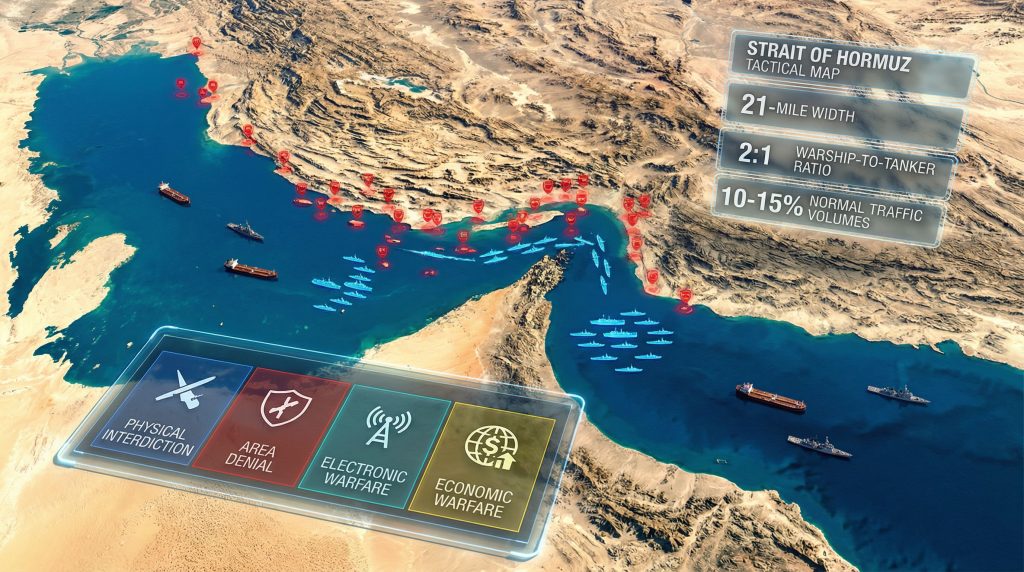
Contemporary threat integration operates across four distinct operational layers, whilst oil price movements amid trade wars complicate regional security calculations:
- Physical interdiction through distributed fast-attack craft and precision-guided munitions
- Maritime mining utilising sophisticated seabed-mounted devices with multiple trigger mechanisms
- Electronic warfare targeting navigation systems and communication networks
- Financial market manipulation through insurance cost elevation and coverage withdrawal
Distributed Threat Networks Versus Centralised Defense
Iranian operational capabilities demonstrate how distributed networks challenge centralised defensive responses. Intelligence estimates suggest Iran maintains approximately 200-300 maritime reconnaissance and attack drones with annual production capacity reaching 50-75 units. This distributed asset base creates persistent threat presence that survives individual platform losses.
The Islamic Revolutionary Guard Corps Navy (IRGC-N) operates an estimated 45-50 fast-attack craft equipped with anti-ship cruise missiles effective at 100-200 kilometre ranges. These platforms employ shoot-and-scoot tactics, launching strikes before relocating to prepared positions along 1,500 kilometres of Iranian coastline.
| Threat Vector | Iranian Capability | Defensive Challenge |
|---|---|---|
| Fast Attack Craft | 45-50 platforms | Mobile target acquisition |
| Maritime Drones | 200-300 units | Swarm attack coordination |
| Coastal Missiles | 25-30 battery positions | Hardened facility targeting |
| Mining Arsenal | 6,000 estimated devices | Detection and clearance time |
Electronic Warfare Integration Creates Persistent Disruption
GPS spoofing operations affecting over 1,650 vessels in a single day demonstrate sophisticated electronic warfare capabilities that compound physical threats. These operations display false position data to commercial vessels' automatic identification systems, creating navigation hazards independent of kinetic attacks.
Electronic warfare tactics generate collision risks in confined waterways whilst disrupting maritime traffic management systems. The coordination required to affect 1,650 vessels simultaneously suggests ground-based transmitter networks or mobile platforms capable of 30-50 kilometre operational ranges.
Why Military Solutions Face Structural Implementation Barriers
Resource Requirements Exceed Available Asset Allocation
Naval escort operations require approximately 2:1 warship-to-tanker ratios with continuous air cover and specialised mine countermeasure support. Current U.S. Fifth Fleet assets could theoretically protect 10-15% of normal traffic volumes, creating massive commercial shipping backlogs.
Sustained escort operations demand:
- 24-48 destroyers for continuous rotation accounting for maintenance cycles
- Mine countermeasure vessels limited to 4 operational regional units
- 6-8 maritime patrol aircraft for persistent surveillance coverage
- 15-20 multi-role fighter aircraft for air superiority maintenance
- 2-3 P-8 Poseidon and 1-2 Global Hawk systems for intelligence gathering
Furthermore, according to Defence Industry Expert, a retired U.S. Army colonel and former NATO Defence Investment Division official, comprehensive military solutions face insurmountable logistical challenges. He emphasises that sustained corridor reopening through force alone presents operational difficulties that exceed available military resources.
Kinetic Operations Confront Hardened and Dispersed Targets
Iranian coastal infrastructure presents approximately 25-30 known missile battery positions distributed across 8-10 primary operating areas with hardened revetments and redundant command networks. Mobile launcher systems utilise rapid deployment and concealment tactics specifically designed to survive initial strike packages.
Underground command and control networks resist systematic degradation through air strikes, whilst civilian infrastructure integration complicates target selection under international humanitarian law. The 51-day mine clearance operation following the 1991 Persian Gulf War required removing 907 confirmed mines despite complete minefield intelligence from captured Iraqi records.
Amphibious Operations Face Unfavourable Force Ratios
Ground-based seizure operations would require 15,000-25,000 Marine and Army personnel against approximately 190,000 IRGC forces specialised in asymmetric warfare. This 1:7.6 to 1:12.7 attacker-to-defender ratio contradicts established military doctrine requiring 1:1 to 3:1 force advantages for successful amphibious assaults against fortified positions.
Iranian mountainous coastal terrain complicates sustained occupation whilst extended supply lines across hostile territory increase operational vulnerability. The IRGC's 190,000-200,000 active personnel distribution across naval, ground, and air components creates multiple defensive layers requiring simultaneous engagement.
Economic Warfare Tactics Exceed Military Countermeasure Effectiveness
Insurance Market Dynamics Function Independently of Military Assessment
War-risk insurance withdrawal creates effective force multiplication beyond direct military capabilities. Major insurers suspended policies for Strait of Hormuz transits beginning March 2026, eliminating approximately 85-90% of available commercial maritime insurance capacity for the corridor.
In addition, Defense Expert characterises this approach as structurally asymmetric, noting that minimal attack frequency sufficient to maintain insurance market dysfunction. He explains that sustained economic pressure requires only 3-4 strikes weekly rather than sustained military engagement.
Premium elevation from 0.25-0.5% baseline to 3-5% for non-escorted vessels represents 600-1,000% cost increases that render commercial transit economically non-viable regardless of military escort availability.
Commercial Shipping Decisions Override Military Security Assessments
Lloyd's List Intelligence analysis indicates that even optimistic escort scenarios would reduce traffic to 10% of normal volume with backlogs exceeding 600 stranded vessels requiring months for clearance. Commercial operators make transit decisions based on insurance availability, cargo owner risk tolerance, and regulatory compliance rather than military protection capability.
Oil price volatility increased from 2-3% daily swings pre-conflict to 8-15% daily movements within two weeks of initial disruption. This oil price rally analysis reflects market uncertainty regarding sustained closure probability rather than military capability assessments.
"Market perception risk functions independently of actual closure capability, with the 2019 Strait closure threat resulting in temporary oil price spikes to $88/barrel without sustained blockade implementation."
Financial Market Weaponisation Creates Sustainable Pressure Mechanisms
The complete withdrawal of war-risk coverage by London Market, U.S. Market, and specialist regional providers demonstrates how economic warfare achieves strategic objectives without decisive military victory. Insurance market manipulation, shipping cost inflation, and supply chain uncertainty generate political pressure exceeding direct military effects.
This dynamic elevates regional powers' strategic influence beyond traditional military capabilities, where localised conflicts generate worldwide economic impacts through interconnected global systems.
Alternative Strategic Framework Development
Diplomatic Settlement Mechanisms Offer Highest Success Probability
Negotiated reopening frameworks require multilateral engagement including China, India, and European allies as stakeholder mediators. Diplomatic solutions address insurance market dysfunction and commercial risk calculations that military force cannot resolve independently.
However, current coalition dynamics reveal significant constraints on unilateral military action, whilst the US economy and tariffs outlook complicates alliance coordination:
- European allies prioritise diplomatic engagement over kinetic responses
- Regional partners fear escalation spillover affecting broader stability
- Asian allies maintain economic relationships complicating military coordination
- Gulf states prefer defensive postures to offensive coalition participation
Counter-Blockade Economic Pressure Applications
Economic pressure mechanisms targeting Iranian energy exports could create reciprocal constraints, potentially affecting China's energy security and accelerating diplomatic engagement. Nevertheless, this approach risks broader regional escalation and third-party economic damage requiring careful implementation.
Alternative routing through Red Sea and Suez Canal corridors adds 15-20 days transit time whilst strategic reserve utilisation in major consuming nations provides temporary supply security. These alternatives reduce Iranian leverage whilst maintaining commercial energy flow continuity.
Technological Solution Development Timelines
Advanced convoy protection systems, including autonomous defensive platforms and enhanced electronic warfare capabilities, could reduce escort requirements whilst maintaining commercial viability. However, development timelines extend 18-24 months for deployment-ready systems.
Consequently, automated defence networks and distributed sensor systems may eventually neutralise asymmetric advantages, but current technological gaps favour defenders in confined waterways with civilian traffic density.
Long-Term Strategic Implications of Chokepoint Conflicts
Global Supply Chain Restructuring Acceleration
Prolonged corridor closure accelerates structural changes in energy trade patterns and infrastructure development. Strategic reserve utilisation, renewable energy adoption acceleration, and regional refining capacity development in Asia-Pacific markets reduce long-term chokepoint dependency.
These adaptations may permanently alter global energy trade flows even after corridor reopening, reducing future strategic leverage for chokepoint control powers.
Naval Doctrine Evolution Requirements
The crisis demonstrates limitations of traditional naval power projection, potentially reshaping maritime strategy globally through increased emphasis on:
- Distributed lethality concepts for persistent presence without concentrated vulnerability
- Enhanced mine warfare capabilities for both deployment and countermeasures
- Autonomous systems integration providing sustained operations without human risk
- Multi-domain operational planning coordinating maritime, cyber, and economic elements
Geopolitical Realignment Scenarios
Extended conflict duration could trigger broader strategic shifts including China-Iran energy relationship deepening, India's strategic autonomy testing under supply pressure, and European energy security policy acceleration.
Furthermore, Middle Eastern alliance structures may evolve toward regional security architectures less dependent on external military guarantees, whilst energy-importing nations develop redundant supply chain resilience.
The next major ASX story will hit our subscribers first
Market Psychology and Investment Strategy Implications
Energy Security Premium Integration into Long-Term Pricing
Market analysis suggests energy security considerations will command permanent risk premiums in global commodity pricing, regardless of immediate military resolution. Investment strategies must account for structural vulnerability exposure in critical infrastructure systems.
Geographic diversification, strategic reserve investment, and alternative energy infrastructure development offer portfolio protection against future chokepoint disruption scenarios. The historic gold price surge exemplifies how geopolitical tensions create new investment dynamics.
Commercial Maritime Industry Adaptation Requirements
Shipping industry adaptation includes enhanced insurance product development, alternative routing capability investment, and autonomous navigation system deployment for electronic warfare resistance.
Container shipping, bulk commodity transport, and specialised energy cargo sectors require different adaptation strategies based on cargo vulnerability and route flexibility considerations. These changes reflect broader tariffs impact on markets affecting global trade flows.
The Strait of Hormuz crisis exemplifies how asymmetric threats exploit systemic vulnerabilities that military force alone cannot address. Geographic constraints, insurance market dynamics, and commercial risk calculations create closure persistence that exceeds traditional military solution effectiveness.
Successful corridor reopening likely requires integrated approaches combining limited military action, diplomatic engagement, and economic pressure mechanisms rather than unilateral force application. The highest probability scenarios involve negotiated settlements supported by multilateral frameworks, whilst extended closure duration increases broader regional conflict likelihood and permanent supply chain restructuring.
Understanding why military force may not be enough to reopen the Strait of Hormuz reveals fundamental shifts in contemporary conflict where economic disruption achieves strategic objectives more effectively than direct military confrontation, reshaping maritime security doctrine for interconnected global systems.
This analysis is based on publicly available information and expert assessments. Geopolitical situations remain fluid, and outcomes may differ from scenario projections presented. Readers should consider multiple perspectives when evaluating strategic maritime security developments.
Are You Tracking Energy Sector Investment Opportunities Amid Global Maritime Disruptions?
Discovery Alert delivers instant notifications on significant ASX mineral and energy discoveries using its proprietary Discovery IQ model, enabling investors to capitalise on market volatility and supply chain disruptions affecting commodity prices. Begin your 14-day free trial today to position yourself ahead of energy security-driven market movements that create exceptional investment opportunities.