June 24, 2026
Understanding Modern Energy Infrastructure Financing Models
Project finance structures fundamentally differ from traditional corporate lending by shifting credit assessment from company balance sheets to specific asset cash flow generation. In structured project financing, lenders evaluate revenue projections based on quantifiable production capacity rather than broader corporate financial health. This approach proves particularly effective for capital-intensive energy infrastructure where future commodity sales provide predictable income streams.
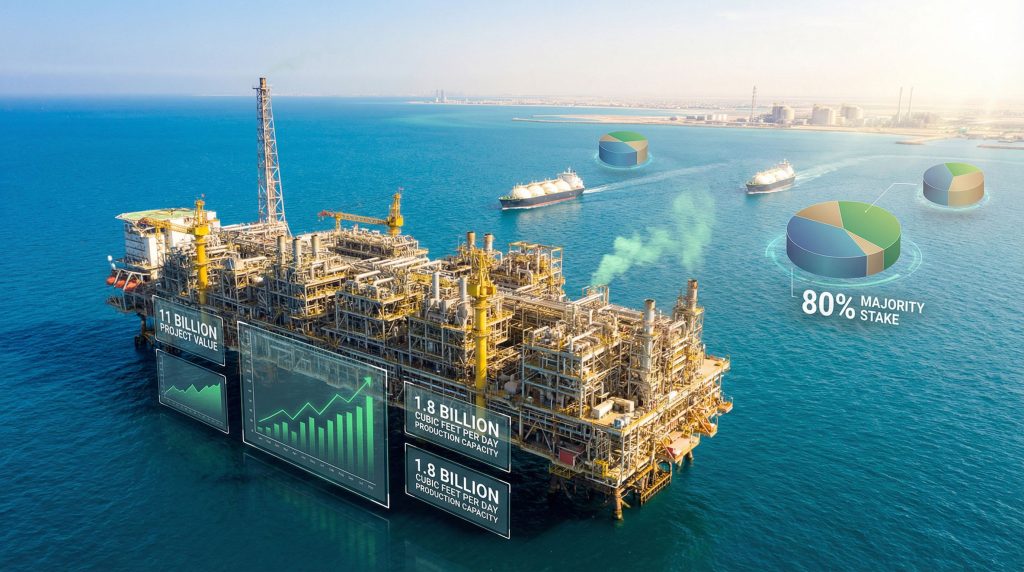
The $11 billion ADNOC offshore gas development financing exemplifies this methodology, securing debt against projected revenues from 1.8 billion cubic feet per day production capacity from the Hail and Ghasha projects. Financial institutions base lending decisions on geological reserve assessments, production forecasts, and long-term gas purchase agreements rather than ADNOC's overall corporate creditworthiness. Furthermore, understanding various capital raising methods helps companies optimise their funding approach for large-scale infrastructure projects.
Project Finance vs. Traditional Corporate Lending
Risk allocation mechanisms in project finance distribute exposure across multiple stakeholder categories. Project sponsors typically contribute 20-30% equity, while senior lenders provide 60-70% of total capital secured by production assets. Mezzanine financing fills the remaining 10-15% gap with higher return expectations reflecting moderate risk positioning.
Cash flow-based lending creates protection through production revenue dedication to debt service obligations. Unlike corporate debt secured by general business assets, project finance structures ring-fence specific asset revenues, isolating lenders from broader corporate operational risks while maintaining direct claims on production income streams. Additionally, implementing effective volatility hedging strategies becomes crucial for managing commodity price risks in these long-term financing arrangements.
The Role of Multilateral Banking Consortiums
The consortium approach spreads $11 billion in total exposure across more than a dozen financial institutions, reducing individual bank risk concentration to manageable levels. Participating institutions include regional development banks such as Agricultural Bank of China, international commercial banks including Citigroup Inc. and Standard Chartered Plc, and Middle Eastern institutions like Abu Dhabi Commercial Bank and Emirates NBD.
This diversified lender structure provides several strategic advantages:
• Risk Distribution: Individual bank exposures typically range from $500-900 million, remaining within standard risk concentration limits
• Geographic Market Access: European and Asian bank participation facilitates international investor relationships
• Regulatory Compliance: Local UAE bank involvement ensures adherence to regional financial regulations
• Currency Diversification: Regional institutions potentially provide local currency financing, reducing foreign exchange exposure
When big ASX news breaks, our subscribers know first
What Makes Offshore Gas Projects Attractive to Infrastructure Investors?
Offshore gas developments present compelling investment characteristics through combination of substantial production volumes, predictable revenue streams, and strategic geographic positioning. The Hail and Ghasha projects demonstrate these attributes with 1.8 Bscf/d production capacity expected to generate approximately 657 billion cubic feet annually when operational by the end of the 2030s.
Abu Dhabi's offshore location provides proximity advantages to high-demand Asian LNG markets, reducing transportation costs compared to more distant supply sources. This geographic benefit enhances project economics by minimising delivery expenses while accessing premium pricing markets experiencing sustained demand growth.
Production Volume Economics and Revenue Predictability
Converting daily production capacity into revenue collateral requires sophisticated modelling of commodity pricing, production ramp-up schedules, and operational cost structures. The 1.8 Bscf/d capacity represents substantial reserve base sufficient to support multi-decade production profiles, providing lenders with extended cash flow visibility for debt service coverage analysis.
Production ramp-up timelines typically follow subsea infrastructure commissioning phases, with initial production beginning in lower volumes before reaching full capacity. The end-of-decade operational target provides sufficient development timeline for technical execution while maintaining attractive project returns through extended production periods.
Long-term gas purchase agreements secure revenue predictability by establishing price benchmarking mechanisms and take-or-pay obligations with creditworthy counterparties. These contractual structures convert volatile commodity exposure into predictable income streams, enhancing financing attractiveness for risk-averse institutional investors.
Strategic Resource Location Advantages
Middle Eastern gas resources benefit from established regional infrastructure developed through decades of crude oil operations. Existing pipeline networks, processing facilities, and export terminals reduce capital requirements compared to greenfield developments in less developed regions.
Asian LNG markets represent the world's fastest-growing natural gas consumption centres, with demand growth driven by industrial expansion and power generation fuel switching. Proximity to these premium markets provides pricing advantages and reduces logistical complexity compared to Atlantic Basin suppliers serving similar customer bases.
Geopolitical stability factors significantly influence infrastructure financing decisions. The UAE's established regulatory framework, transparent legal system, and international business relationships provide investor confidence in contract enforceability and operational continuity throughout multi-decade project lifecycles. For instance, ADNOC's structured financing approach demonstrates the successful integration of traditional project finance with modern sustainability requirements.
Environmental Compliance as Investment Protection
Environmental standards increasingly influence project financing availability and pricing terms. Modern offshore developments integrate carbon capture technologies and emissions reduction systems to meet international lender ESG requirements and regulatory compliance standards.
The inclusion of 1.5 million tonnes annual carbon capture capacity in offshore gas developments demonstrates proactive environmental leadership, reducing regulatory risk while potentially accessing green financing premium opportunities from ESG-focused institutional investors. Consequently, successful green transition financing enables companies to access preferential funding terms while meeting environmental standards.
Net-zero emissions standards function as investment protection by ensuring long-term operational licence to operate under evolving environmental regulations. Projects incorporating advanced environmental technologies maintain competitive advantages in financing markets where ESG compliance becomes standard requirement rather than optional enhancement.
How Do National Oil Companies Structure Mega-Project Partnerships?
National oil company partnership strategies balance operational control with international expertise access and geopolitical risk management. ADNOC's 80% majority ownership in the Ghasha concession provides decision-making authority while benefiting from minority partners' technical capabilities and market relationships.
The recent consolidation of Lukoil's 10% stake in November 2025 demonstrates adaptive partnership management during geopolitical tensions. This acquisition increased ADNOC's control while removing a partner facing U.S. sanctions pressure, maintaining project momentum despite external political constraints.
Equity Distribution and International Collaboration
Strategic partnership structures optimise risk-reward allocation across participant capabilities. ADNOC's majority position ensures alignment with UAE national energy security objectives while international partners contribute specialised technical expertise and regional market access.
Current partnership composition includes:
• ADNOC: 80% ownership providing operational control and strategic direction
• Eni SpA: Italian partner contributing European technical expertise and downstream integration capabilities
• PTT Exploration & Production Pcl: Thai partner facilitating Asian market access and regional LNG relationships
Technical expertise sharing arrangements enable knowledge transfer in advanced offshore development technologies, subsea production systems, and gas processing methodologies. European operators bring decades of North Sea offshore experience, while Asian partners provide regional market intelligence and customer relationship management.
Geopolitical Risk Management Through Diversification
International sanctions affecting Russian companies created partnership restructuring requirements across global energy projects. ADNOC's acquisition of Lukoil's stake eliminated sanctions-related compliance risks while consolidating decision-making authority during a critical development phase.
The forced Russian divestiture reflects broader industry risk management strategies where Western-aligned partners prefer consolidated control over continued collaboration with geopolitically constrained entities. This trend influences partnership selection toward politically stable jurisdictions and sanctions-compliant participants.
Asset divestiture strategies during geopolitical tensions require careful coordination to maintain operational continuity. ADNOC's seamless integration of Lukoil's former stake demonstrates effective transition management, preserving project timeline while eliminating external political risks.
What Financial Instruments Enable $11 Billion Energy Infrastructure Deals?
Large-scale energy infrastructure financing requires sophisticated debt instrument combinations tailored to project cash flow characteristics and lender risk preferences. The $11 billion ADNOC offshore gas development financing demonstrates successful integration of multiple financing sources across diverse institutional investor categories. However, understanding broader investment strategy components helps companies structure optimal financing packages for mega-projects.
| Financing Component | Typical Allocation | Risk Characteristics | Expected Returns |
|---|---|---|---|
| Senior Debt | 60-70% of project cost | Secured by production revenue | Lower returns, priority repayment |
| Mezzanine Financing | 10-15% of project cost | Moderate risk positioning | Higher returns than senior debt |
| Equity Contribution | 20-30% of project cost | Highest risk exposure | Residual cash flow participation |
Structured Finance Mechanics for Large-Scale Projects
Production-based collateral models convert physical hydrocarbon reserves into quantifiable revenue streams for debt service calculations. Lenders evaluate geological assessments, production forecasts, and commodity pricing scenarios to determine sustainable debt capacity against 1.8 Bscf/d production potential.
Reserve-based lending methodologies apply discount factors to proven, probable, and possible reserve categories, creating conservative cash flow projections for debt service coverage analysis. These calculations incorporate operational cost escalation, commodity price volatility, and production decline curves over extended project lifecycles.
Cash flow waterfall structures prioritise payment obligations in predetermined sequences:
- Operating Expenses: Production, transportation, and maintenance costs receive first priority
- Debt Service: Senior debt principal and interest payments follow operational requirements
- Reserve Accounts: Maintenance of debt service coverage and working capital reserves
- Equity Distributions: Remaining cash flows distributed to project sponsors based on ownership percentages
Regional Banking Integration Benefits
The consortium's geographic diversity provides multiple strategic advantages beyond simple risk distribution. Regional bank participation facilitates local currency financing options, reducing foreign exchange exposure while supporting national economic development objectives.
Middle Eastern Banks (Abu Dhabi Commercial Bank, Abu Dhabi Islamic Bank, First Abu Dhabi Bank, Emirates NBD):
• Local currency financing capability
• Regional regulatory compliance expertise
• UAE economic development alignment
• Sharia-compliant financing options
International Banks (Citigroup Inc., Standard Chartered Plc):
• Global capital markets access
• International project finance expertise
• Cross-border transaction management
• Foreign exchange hedging capabilities
Development Banks (Agricultural Bank of China):
• Asian infrastructure investment connectivity
• Long-term development financing focus
• Government policy alignment benefits
• Regional market relationship access
Commodity price hedging strategies protect revenue stability through financial instrument deployment. Fixed-price forward contracts, price collar arrangements, and basis swaps provide protection against adverse price movements while maintaining upside participation in favourable market conditions.
Why Are Offshore Gas Developments Critical for Energy Security?
National energy security strategies increasingly prioritise domestic production capacity development over import dependency management. The UAE's objective to achieve complete natural gas self-sufficiency by the end of the current decade demonstrates this strategic shift toward supply security through indigenous resource development.
ADNOC's $150 billion five-year capital expenditure program reflects comprehensive energy infrastructure investment supporting both crude oil capacity expansion to 5 million barrels per day by 2027 and accelerated natural gas development. This dual-fuel strategy diversifies energy supply sources while reducing import vulnerability. Moreover, understanding potential energy exports challenges helps nations develop robust strategies for achieving energy independence.
National Self-Sufficiency Strategic Planning
Import substitution economics generate multiple benefits beyond simple supply security. Domestic gas production eliminates foreign exchange outflows associated with LNG imports while providing price stability through supply source control rather than international market exposure.
The Hail and Ghasha projects' 1.8 Bscf/d production capacity contributes substantially to UAE domestic consumption requirements for power generation, desalination, and petrochemical feedstock applications. This supply volume reduces dependence on international suppliers while providing feedstock security for downstream industrial development.
Domestic energy price stabilisation occurs through supply source diversification away from volatile international commodity markets. Local production provides price predictability for industrial planning while reducing exposure to geopolitical supply disruptions affecting international trade routes.
Strategic reserve development extends beyond immediate consumption requirements to include export market positioning. Surplus production capacity provides flexibility for LNG export revenue generation while maintaining domestic supply security during demand fluctuation periods.
Export Market Positioning
Asian LNG markets represent the world's fastest-growing natural gas demand centres, with consumption growth driven by industrial expansion, power generation fuel switching, and economic development requirements. Proximity to these premium markets provides UAE gas exports with transportation cost advantages over more distant suppliers.
Competitive positioning against established LNG suppliers requires cost-effective production, efficient transportation, and reliable delivery capabilities. Abu Dhabi's offshore gas developments benefit from existing regional infrastructure and established customer relationships developed through decades of crude oil trade.
LNG export terminal integration planning enables flexible market participation between domestic consumption and international export opportunities. This optionality provides revenue optimisation potential while maintaining supply security through production surplus management. Furthermore, as reported by Bloomberg's analysis of the financing, the project's strategic positioning supports both domestic energy security and regional export capabilities.
Industrial Development Catalyst Effects
Natural gas availability stimulates downstream industrial development through affordable feedstock provision and reliable energy supply access. Petrochemical complexes, aluminium smelting, steel production, and manufacturing sectors benefit from domestic gas supply predictability and competitive pricing.
Economic diversification strategies leverage abundant energy resources to attract international manufacturing investment and develop non-oil industrial sectors. Reliable energy supply at competitive prices enhances UAE's attractiveness for energy-intensive industries seeking stable operating environments.
Manufacturing sector energy cost advantages create competitive positioning for value-added product exports. Lower energy input costs translate to improved profit margins and competitive pricing for international market penetration in manufactured goods sectors.
How Do Environmental Technologies Impact Project Financing?
Environmental compliance requirements increasingly influence project financing availability, pricing terms, and investor participation decisions. Modern offshore gas developments must demonstrate environmental leadership through advanced technology integration to access premium financing sources and maintain long-term operational licences.
Carbon capture integration represents both capital investment requirement and risk mitigation strategy. The incorporation of 1.5 million tonnes annual carbon capture capacity in offshore developments demonstrates proactive environmental management while potentially accessing green financing premiums from ESG-focused institutional investors.
Carbon Capture Integration as Financial Risk Mitigation
Environmental technology investment functions as insurance against future regulatory changes and carbon pricing mechanisms. Projects incorporating advanced emissions reduction systems maintain competitive advantages under evolving environmental regulations while avoiding retrofit costs or operational restrictions.
CAPEX allocation for environmental compliance systems typically represents 10-15% of total project costs but provides long-term operational protection and potential revenue generation through carbon credit sales or environmental certificate programs.
Operating cost implications of carbon capture technology include additional energy consumption, maintenance requirements, and specialised personnel needs. However, these expenses often qualify for carbon pricing benefits, environmental tax advantages, and green financing premium access that offset operational cost increases.
ESG Investment Criteria Alignment
International lender ESG requirements increasingly influence financing availability and terms for large-scale energy infrastructure projects. Institutional investors face pressure from stakeholders and regulators to demonstrate environmental responsibility through investment portfolio management.
Green financing premium opportunities emerge for projects meeting specific environmental performance standards. These preferential financing terms can include:
• Lower interest rates for ESG-compliant projects
• Extended repayment terms supporting longer-term environmental investments
• Reduced covenant requirements for projects with strong environmental governance
• Access to specialised green bond markets with dedicated ESG investor bases
Sustainability reporting and monitoring systems provide transparent environmental performance measurement for lender and investor oversight. Advanced monitoring technology enables real-time emissions tracking, environmental impact assessment, and compliance verification supporting ongoing financing relationships.
The next major ASX story will hit our subscribers first
What Does This Financing Model Signal for Future Energy Projects?
The successful closure of $11 billion in ADNOC offshore gas development financing establishes replicable frameworks for similar projects across international markets. This transaction demonstrates institutional investor appetite for structured energy infrastructure financing despite volatile geopolitical conditions and evolving environmental regulations.
Banking consortium diversity reflects global capital availability for creditworthy energy projects meeting technical, environmental, and commercial feasibility standards. The participation of Middle Eastern, European, and Asian financial institutions indicates broad-based confidence in offshore gas development economics.
Industry Precedent Setting for Structured Finance
Template creation for similar offshore developments emerges through successful financing structure replication. Future projects can reference this transaction's risk allocation mechanisms, consortium composition strategies, and environmental compliance integration as proven methodologies for large-scale project finance.
Risk assessment methodologies developed for this transaction provide benchmarks for similar geological, technical, and commercial risk evaluation. Lenders gain experience in offshore gas project evaluation, creating standardised approaches for future financing decisions.
Lender consortium building strategies demonstrate effective approaches for distributing large-scale project risk across diverse institutional investor categories. The successful integration of regional development banks, international commercial banks, and Islamic financial institutions provides models for future transaction structuring.
Capital Market Evolution in Energy Infrastructure
Institutional investor appetite for energy projects continues despite ESG pressures and climate transition concerns. The $11 billion commitment indicates that projects meeting environmental standards and demonstrating commercial viability maintain access to premium financing sources.
Sovereign wealth fund participation trends reflect national economic development priorities supporting energy sector investment. Regional development bank involvement demonstrates government policy alignment with private sector financing for strategic infrastructure development.
Infrastructure debt market development benefits from successful large-scale transaction completion. Demonstrated financing structures encourage additional institutional investor participation while establishing precedents for similar transaction execution.
Regional Energy Hub Development Strategy
Integrated energy complex planning leverages offshore production with onshore processing, transportation, and export infrastructure. The Hail and Ghasha projects contribute to comprehensive UAE energy hub development supporting both domestic consumption and international export capabilities.
Multi-project financing synergies emerge through shared infrastructure, operational expertise, and market relationships developed across related energy developments. Successful project execution creates platform capabilities for additional expansion opportunities.
Regional supply chain development benefits from sustained energy sector investment and operational activity. Local service providers, equipment suppliers, and skilled workforce development support broader economic diversification beyond direct energy sector employment.
This analysis reflects financing and development information available as of December 2025. Energy project financing involves significant risks including commodity price volatility, regulatory changes, and operational execution challenges. Investors should conduct independent due diligence and consult qualified financial advisors before making investment decisions.
Ready to Capitalise on Major Energy Infrastructure Developments?
Discovery Alert's proprietary Discovery IQ model delivers instant notifications on significant ASX mineral discoveries, providing subscribers with rapid insights into actionable trading and investment opportunities across the resources sector. Explore how major discoveries can generate substantial returns by examining Discovery Alert's dedicated discoveries page, then begin your 30-day free trial today to position yourself ahead of the market.