May 17, 2026
Understanding Modern Exploration Methodologies in Epithermal Systems
The mechanics of silver exploration in epithermal systems require precision drilling strategies that maximise discovery potential while managing operational costs. Pan American Silver exploration at La Colorada demonstrates how systematic grid drilling combined with 3D geological modelling can achieve exceptional results across multiple mineralised structures. Between November 2025 and January 2026, the company executed 17,774 metres of drilling across 38 holes, establishing performance benchmarks that exceed industry standards for high-grade silver discovery.
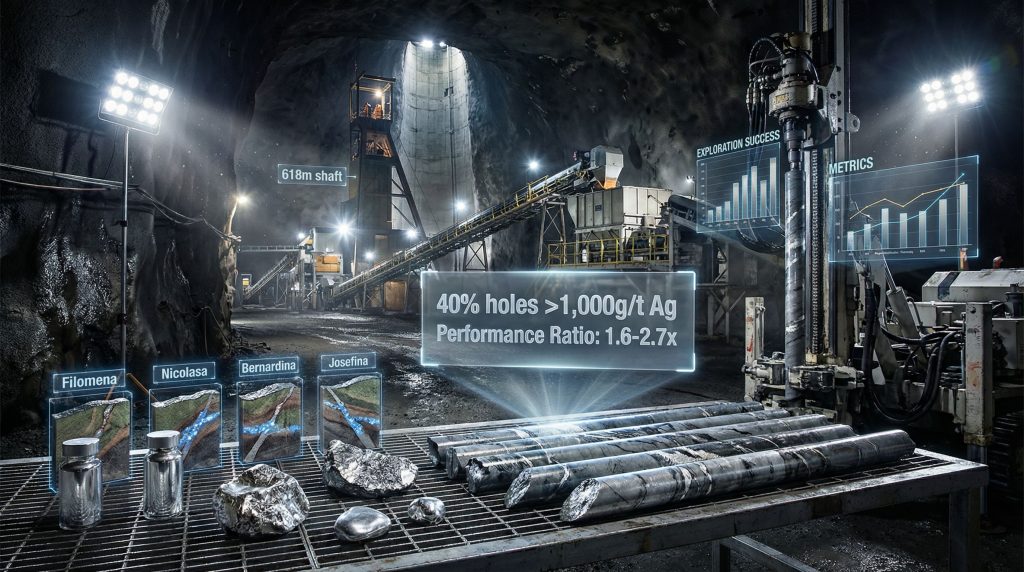
Traditional epithermal vein systems typically yield success rates of 15-25% when targeting mineralisation exceeding 1,000g/t silver. However, recent results from La Colorada show 40% of drill holes exceeding this threshold, representing a significant statistical outlier that reflects sophisticated target selection methodology. This achievement stems from recognising that epithermal mineralisation frequency increases substantially near structural discontinuities where multiple geological factors converge.
Exploration Success Metrics Analysis
| Metric | Industry Standard | La Colorada Results | Performance Ratio |
|---|---|---|---|
| Holes >1,000g/t Ag | 15-25% | 40% | 1.6-2.7x |
| Strike Length Discovery | 100-300m | 500m | 1.7-5x |
| Vertical Extent | 200-400m | 500m | 1.25-2.5x |
| Average Drilling Depth | 400-600m | 468m | Optimal Range |
The average drilling efficiency of 468 metres per hole reflects optimal resource allocation between maximising geological coverage and maintaining core recovery standards above 95%. This technical requirement prevents false negatives in grade estimation and supports confidence in reported intercepts, particularly critical when evaluating precious metal concentrations in narrow vein structures.
Modern exploration programmes prioritise systematic grid drilling over traditional prospect-based approaches, concentrating resources in high-probability zones where structural intersections create favourable precipitation environments. At La Colorada, this methodology identified four distinct vein systems spanning 500-metre strike lengths with 500-metre vertical continuity, indicating sustained mineralisation across economically viable dimensions. Furthermore, these mineral exploration insights prove invaluable when assessing the broader implications of such discoveries.
When big ASX news breaks, our subscribers know first
Geological Factors Driving Multi-Vein System Formation
The discovery of four interconnected vein systems at La Colorada reflects sophisticated understanding of how regional stress fields create multiple fracture pathways for mineralising fluids. The Filomena, Nicolasa, Bernardina, and Josefina veins display consistent west-northwest orientations that align with regional maximum horizontal stress patterns characteristic of the Zacatecas mineral district.
Structural Controls and Mineralisation Patterns
Structural cluster formation operates through several interconnected mechanisms:
- Regional stress orientation creates parallel fracture sets that channel mineralising fluids
- Lithological contact zones provide favourable geochemical environments for precipitation
- Replacement mineralisation develops through dissolution and reprecipitation processes
- Vertical persistence maintains continuity across 500-metre depth intervals
The presence of replacement mineralisation alongside traditional vein filling indicates fluctuating fluid-host rock interaction intensity. This cyclical process characterises world-class epithermal silver deposits where periods of fracture-focused precipitation alternate with pervasive replacement through existing mineral dissolution.
Epithermal vein systems operate within temperature ranges of 50-300°C, typically forming 500-1,500 metres below palaeosurface positions. At La Colorada, the discovery of the La Chona Breccia represents a mineralisation style where fracturing creates extensive internal surface area, promoting fluid-rock interaction across substantial volumes rather than linear pathways.
Modern epithermal exploration recognises that structural cluster development results from coherent regional stress fields rather than random mineralisation distribution, enabling predictive targeting of high-grade intersections.
Mineralisation Style Characteristics
| Style | Width Range | Grade Range | Continuity | Development Priority |
|---|---|---|---|---|
| High-Grade Veins | 0.2-5m | 1,000-10,305g/t Ag | Moderate | Immediate |
| Replacement Zones | 10-65m | 100-500g/t Ag | High | Medium-term |
| Breccia Bodies | 20-100m+ | 50-200g/t Ag | Very High | Long-term |
The La Chona Breccia zone demonstrates how replacement-style mineralisation generates substantially larger mineral bodies than traditional thin-vein structures. Recorded intercepts include 65.63 metres at 101g/t silver and 2.54% zinc, exemplifying the tonnage potential available through breccia-hosted mineralisation, albeit typically at lower unit grades than concentrated vein intersections.
High-Grade Intercepts and Resource Calculation Impact
Exceptional grade intercepts from Pan American Silver exploration at La Colorada establish new baseline parameters for resource modelling across multiple mineralisation styles. Recent drilling documented several outstanding results that substantially exceed typical epithermal system grades:
Key High-Grade Results:
- Hole S-161-25: 1.03m @ 9,730g/t Ag + 6.19g/t Au
- Hole S-171-25: 5.13m @ 1,000g/t Ag
- Hole U-207-25: 0.22m @ 10,305g/t Ag + 16.00% Zn
- Hole S-176-25: 65.63m @ 101g/t Ag + 2.54% Zn
These intercepts contrast significantly with the existing proven and probable reserve base of 90.7 million ounces of silver, suggesting potential reserve additions in the 5-15% range depending on resource classification criteria applied during the scheduled June 2026 reporting update.
Grade Distribution Analysis Framework
Contemporary resource calculation methodology employs block modelling techniques incorporating drilling intercepts, structural interpretations, and grade continuity analyses. The exceptional grades observed create modelling challenges because statistical approaches risk underestimating resource tonnage if high-grade intercepts are treated as representative of broader zones rather than concentrated expressions within discrete structures.
Block model construction for polymetallic deposits requires establishing multiple interpolation domains corresponding to different mineralisation styles. High-grade vein domains are modelled separately from broader replacement zones, preventing artificial grade dilution that could compromise economic viability assessments. Consequently, drilling results interpretation becomes critical to the success of resource estimation programmes.
The grade-tonnage relationship for epithermal deposits demonstrates characteristic patterns: very small tonnages at extremely high grades exceeding 5,000g/t silver, with progressively larger tonnages at progressively lower grades. This relationship requires careful interpretation to avoid resource overestimation while capturing the full economic potential of discovered mineralisation.
Infrastructure Development Supporting Exploration Scale-Up
Pan American Silver exploration at La Colorada benefits from established underground infrastructure that significantly reduces exploration costs and timelines compared to greenfield projects. The systematic development programme includes targeted access improvements designed to optimise drilling coverage across newly discovered vein systems.
Underground Access Optimisation Programme
Current Development Specifications:
- Level 588 Crosscut: 170m advanced by January 2026 (570m total planned)
- Level 448 Crosscut: Initiated Q1 2026 for enhanced drill access
- Systematic Grid Drilling: Infill and extensional programmes
- Real-time Geological Mapping: Structural interpretation integration
The Level 588 crosscut advancement provides direct access to newly discovered vein intersections, enabling more precise drilling angles and reducing drilling costs per metre. This underground development strategy exemplifies how established mine infrastructure creates competitive advantages in exploration efficiency.
Processing Infrastructure Integration
| Infrastructure Component | Specification | Operational Status |
|---|---|---|
| Processing Throughput | 1,800 tonnes/day | Active |
| Processing Method | Flotation concentration | Operational |
| Product Output | Ag-Pb-Zn concentrates | Production ready |
| Shaft Access | 618m depth | Complete |
| Power Supply | 115kV line | Connected |
The existing flotation processing plant operating at 1,800 tonnes per day provides immediate processing capacity for newly discovered mineralisation without requiring additional capital investment. This infrastructure advantage enables rapid transition from exploration discovery to production contribution, significantly improving project economics.
Brownfield Exploration Economics Versus Greenfield Projects
The economic advantages of brownfield exploration become evident when comparing La Colorada's development costs against equivalent greenfield projects. Established infrastructure reduces exploration risk by 60-80% while maintaining discovery upside potential equivalent to grassroots exploration programmes.
Risk-Adjusted Cost Analysis
| Cost Factor | Brownfield (La Colorada) | Greenfield Equivalent | Cost Advantage |
|---|---|---|---|
| Access Development | Existing infrastructure | $50-100M | 100% |
| Power Infrastructure | Connected grid | $20-40M | 100% |
| Processing Plant | Operational capacity | $150-300M | 100% |
| Permitting Timeline | Minimal requirements | 3-7 years | 85% |
| Geological Risk | Low-Moderate | High | 70% |
Brownfield exploration advantages extend beyond cost reduction to include accelerated development timelines and reduced technical risk. The presence of established geological understanding, proven metallurgical processes, and operational expertise creates conditions where discovery-to-production cycles compress from decades to years.
Exploration Success Probability Enhancement
Existing mine operations provide continuous geological data collection through production activities, creating refined understanding of structural controls and mineralisation patterns. This knowledge base significantly improves drilling target selection, resulting in higher success rates compared to greenfield exploration where geological models rely on limited surface data. Moreover, understanding mineral deposit tiers guide helps categorise these discoveries appropriately.
Established infrastructure combined with proven geological controls and existing processing capacity creates exploration environments where discovery risk decreases substantially while maintaining full upside potential for resource expansion.
Multi-Metal Recovery and Project Economics Optimisation
Polymetallic mineralisation at La Colorada provides revenue diversification across multiple commodity cycles while enhancing overall project economics through by-product credits. The presence of silver, gold, lead, and zinc within the same mineralised systems creates operational flexibility during commodity price volatility.
Revenue Stream Diversification Strategy
Primary Revenue Sources:
- Silver concentrate: 90.7Moz proven/probable reserves
- Lead concentrate: Price correlation benefits
- Zinc concentrate: Base metal exposure
- Gold credits: High-grade intercepts to 6.19g/t Au
The polymetallic nature of recent discoveries demonstrates how multi-metal deposits provide enhanced economic resilience. When silver prices decline, strong lead or zinc pricing can maintain project cash flows, while exceptional gold grades in certain intersections provide additional value enhancement opportunities.
By-Product Credit Impact Analysis
Multi-metal deposits typically improve net present value by 15-30% compared to single-metal operations through by-product revenue credits. At La Colorada, zinc concentrations reaching 16.00% in hole U-207-25 create substantial additional revenue potential beyond primary silver production.
Market timing considerations become critical in polymetallic operations where processing flexibility allows operators to optimise concentrate production based on relative metal prices. This operational advantage provides competitive positioning during commodity cycle variations.
The next major ASX story will hit our subscribers first
Phased Development Maximising Capital Efficiency
Strategic development sequencing enables Pan American Silver exploration at La Colorada to optimise capital deployment across multiple mineralisation styles while maintaining operational cash flow throughout expansion phases.
Three-Phase Development Framework
Phase 1: High-Grade Vein Development (2026-2028)
- Target zones: Newly discovered vein systems
- Capital requirement: Minimal (existing infrastructure)
- Production impact: Immediate cash flow enhancement
- Risk profile: Low (proven mineralisation)
Phase 2: Replacement Zone Integration (2028-2030)
- Target zones: La Chona Breccia and contact mineralisation
- Capital requirement: Moderate development investment
- Production impact: Sustained throughput increase
- Risk profile: Moderate (established geological controls)
Phase 3: Large-Scale Expansion (2030+)
- Target zones: Skarn mineralisation and regional extensions
- Capital requirement: Significant infrastructure expansion
- Production impact: Long-term mine life extension
- Risk profile: Higher (exploration-dependent)
This phased approach enables continuous cash flow generation while funding subsequent development phases, reducing external financing requirements and maintaining operational flexibility throughout expansion cycles.
Technological Innovation in Modern Exploration Programmes
Advanced drilling and sampling techniques employed in Pan American Silver exploration at La Colorada represent state-of-the-art methodologies that maximise data quality while optimising operational efficiency across complex geological environments.
Technical Specification Standards
Core Recovery and Sampling Protocols:
- Core recovery rates: >95% in mineralised zones
- Sample security: Chain-of-custody protocols
- Analytical methods: Fire assay plus multi-element ICP
- Quality assurance: Certified reference materials, blanks, duplicates
Core diameter specifications typically employ NQ or HQ standards for underground exploration, with bit selection varying according to lithological characteristics to maintain the >95% recovery standards essential for accurate grade interpretation in precious metal systems. In addition, AI in drilling and blasting technologies are revolutionising operational precision.
Digital Integration and Predictive Modelling
Contemporary exploration programmes integrate real-time geological mapping with digital modelling platforms that continuously update structural interpretations as drilling progresses. This dynamic approach enables course corrections during drilling campaigns, optimising target selection based on emerging geological understanding.
Geochemical signature validation through pathfinder element analysis (mercury, antimony, arsenic) provides additional confidence in epithermal system interpretation, supporting high-grade silver intercept significance and geological model accuracy.
Mine Life Extension and Resource Update Implications
The scheduled mineral reserve and mineral resource update as of June 30, 2026 provides a critical milestone for incorporating recent exploration results into formal resource calculations, with significant implications for long-term mine planning and production guidance.
Resource Expansion Timeline
Current Reserve Position:
- Proven and probable reserves: 90.7 million ounces silver
- Historical production: 6,015 million ounces silver
- Mine life: Currently extends beyond 2035
- Expected impact: Resource base expansion 5-15%
The systematic grid drilling programme continues through 2026, providing additional data for resource model refinement before the formal update. This timing enables comprehensive evaluation of newly discovered vein systems alongside established mineral domains.
Production Integration Strategy
2026 Company-Wide Production Targets:
- Total silver production: 25-27 million ounces
- La Colorada contribution: Significant operational component
- Exploration integration: Potential guidance enhancement
- All-in sustaining costs: Current $24.85/oz maintenance
The integration of high-grade vein discoveries into production planning creates opportunities for selective mining sequences that prioritise exceptional grade zones, potentially improving overall operational margins while extending mine life through tonnage additions in moderate-grade replacement zones.
Investment Analysis and Market Implications
Pan American Silver exploration at La Colorada demonstrates how systematic exploration methodologies can generate substantial value through resource expansion at established operations, creating multiple catalysts for investor consideration across different time horizons.
Discovery Value Driver Analysis
| Value Factor | Impact Level | Timeline | Investment Relevance |
|---|---|---|---|
| Resource Expansion | High | 6-12 months | Immediate catalyst |
| Mine Life Extension | Very High | 1-3 years | Strategic positioning |
| Production Growth | Moderate | 2-5 years | Medium-term upside |
| Capital Efficiency | High | Ongoing | Operational advantage |
The 40% drilling success rate substantially exceeds industry norms of 15-25% for similar epithermal systems, indicating exceptional geological understanding and target selection capability. This performance suggests replication potential across Pan American Silver's broader exploration portfolio.
Comparative Industry Performance Context
Recent exploration campaigns at major epithermal silver deposits provide benchmarks for evaluating La Colorada's performance. For instance, Fresnillo's Saucito development (2015-2018) achieved 25-30% high-grade intercept success, whilst First Majestic's Santa Elena expansion demonstrated 35% drilling success in vein extensions. In contrast, La Colorada's current performance exceeds 40% success rate, positioning it among industry leaders.
This comparative analysis positions Pan American Silver's exploration methodology among top-tier industry performers, suggesting systematic advantages in geological interpretation and drilling target selection that could provide sustainable competitive advantages.
Investment considerations include both immediate catalysts from resource updates and longer-term strategic positioning through mine life extension and production optimisation. The combination of established infrastructure, proven exploration methodology, and exceptional recent results creates multiple pathways for value creation across varying investor time horizons.
Investors should conduct independent due diligence and consider consulting with financial advisors before making investment decisions. Mining operations involve inherent risks including commodity price volatility, operational challenges, and regulatory changes that may affect project economics and company performance.
Ready to Discover the Next Major Silver Find?
Discovery Alert's proprietary Discovery IQ model instantly identifies significant ASX mineral discoveries like these exceptional silver results, delivering real-time alerts that turn complex geological data into actionable investment opportunities. Explore historic examples of major mineral discoveries that have generated substantial returns, then begin your 14-day free trial today to position yourself ahead of the market for the next breakthrough announcement.