July 31, 2026
Understanding the Architecture of Modern Lithium Production Systems
The transition toward electric vehicles has created unprecedented demand for sophisticated mineral supply networks that can deliver battery-grade materials while minimizing environmental impact. Modern production architectures increasingly emphasize regional concentration of operations, technological integration, and renewable energy utilisation to address both supply security concerns and carbon reduction objectives.
Traditional lithium supply chains often span multiple continents, with extraction occurring in one region, processing in another, and final battery manufacturing in yet another location. This geographic dispersion creates vulnerabilities through transportation dependencies, quality control challenges, and substantial carbon emissions from intercontinental shipping.
Contemporary integrated low-carbon lithium supply chain models fundamentally restructure these relationships by consolidating extraction, processing, and refining operations within concentrated geographic areas. This architectural approach enables operators to maintain direct control over product quality, reduce transportation-related emissions, and develop specialised infrastructure optimised for continuous production cycles.
When big ASX news breaks, our subscribers know first
Core Components of Modern Lithium Integration
Technical Infrastructure Requirements
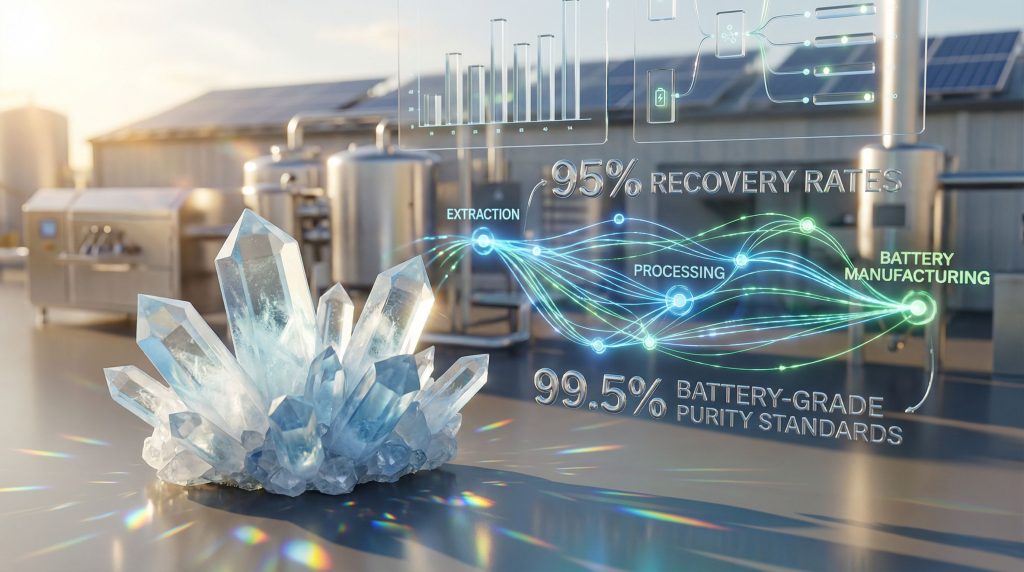
An integrated low-carbon lithium supply chain encompasses several interconnected technical components working in concert. The extraction stage involves either direct lithium extraction (DLE) or traditional evaporation pond methods. Processing stages convert raw lithium compounds into intermediate forms, while refining produces battery-grade lithium carbonate or hydroxide meeting 99.5 percent purity standards.
Geographic proximity across these stages minimises transportation distances and associated carbon emissions. Modern integrated systems incorporate renewable energy infrastructure directly at extraction and processing facilities, substantially reducing Scope 2 emissions compared to grid-dependent operations. Furthermore, these developments align with broader energy transition strategies being implemented globally.
| Production Method | Capital Requirements | Processing Timeline | Recovery Rate | Water Consumption |
|---|---|---|---|---|
| Direct Lithium Extraction | $50-150M per 5,000-10,000 tonne capacity | Days to weeks | 80-95% | Minimal freshwater (closed-loop) |
| Evaporation Ponds | $20-50M per 5,000-10,000 tonne capacity | 12-24 months | 40-60% | 500,000+ gallons per tonne |
| Hard-rock Spodumene | $100-300M for full-scale operations | Continuous but requires transport | 85-92% | Moderate to high |
Quality Control and Specification Management
Battery-grade lithium specifications require sophisticated analytical capabilities and process control systems. Real-time monitoring of brine composition, trace element management, and processing parameter optimisation become critical technical requirements. Integration allows operators to develop proprietary process variations and maintain tighter quality control through unified ownership and management structures.
The critical technical requirement involves achieving battery-grade purity while maintaining closed-loop water systems. This demands sophisticated analytical capabilities including:
- Real-time brine composition monitoring
- Automated trace element detection and removal
- Continuous processing parameter optimisation
- Quality assurance protocols for different battery chemistries
Revolutionary Direct Lithium Extraction Technologies
Electrochemical Processing Innovations
Direct lithium extraction employs electrochemical processes that use selective ion-exchange membranes or electrochemical cells to separate lithium ions from brine solutions under controlled electrical potential conditions. These systems operate continuously rather than in batch cycles, maintaining consistent extraction rates and product quality.
Recovery efficiency represents a critical performance metric: modern DLE technologies achieve recovery rates between 80-95 percent depending on specific technology platforms and brine composition characteristics. This contrasts sharply with evaporation pond methods, which typically achieve 40-60 percent recovery rates.
Processing timelines demonstrate another significant advantage: DLE methods can produce lithium carbonate equivalent within days to weeks from brine extraction, whereas evaporation ponds require 12-24 months for crystallisation and processing cycles. Additionally, innovative approaches such as geothermal lithium extraction are revolutionising traditional processing methods.
Renewable Energy Integration Models
Technical architecture for renewable energy integration involves either direct coupling with geothermal heat and power resources or connection to regional renewable energy infrastructure with energy storage buffers. Geothermal resources provide dual benefits: direct thermal energy for brine heating and electricity generation for electrochemical extraction processes.
Solar and wind integration typically requires battery energy storage systems (BESS) or power purchase agreements ensuring adequate power availability during variable generation periods. Modern DLE facilities increasingly incorporate thermal energy storage systems, storing excess heat during low-demand periods and releasing it during peak extraction processing requirements.
Water Management in Closed-Loop Systems
Closed-loop water systems represent critical technical infrastructure in modern DLE operations. Systems achieve 90 percent or greater water recycling rates by implementing multi-stage separation and purification protocols. Treated brine undergoes deep well reinjection at pressures and rates determined by geologic conditions and regulatory requirements.
This reinjection accomplishes several objectives:
- Maintains subsurface pressure conditions for continued lithium-bearing brine mobility
- Prevents surface water degradation and contamination
- Eliminates waste disposal challenges
- Ensures regulatory compliance with environmental standards
Advanced monitoring systems track reinjection parameters continuously, ensuring environmental compliance and optimising brine resource recovery for sustained operations.
Economic Drivers Behind Supply Chain Integration
Production Cost Analysis and Market Dynamics
Global lithium production demonstrates exceptional growth trajectories, reaching 1.0 million tonnes in 2024 and increasing to 1.4 million tonnes in 2025. This represents approximately 40 percent compound annual growth, reflecting unprecedented market expansion driven by electric vehicle adoption and energy storage demand.
The role of critical minerals in clean energy transitions demonstrates that lithium demand will increase tenfold from 2020 to 2040 to meet clean energy transition objectives. The global lithium market, valued at approximately $15.2 billion in 2022, is projected to expand at a 12.3 percent compound annual growth rate through 2030.
Cost structures vary significantly between production methods. Traditional evaporation pond operations require minimal upfront capital but face extended project development timelines and high operational costs, particularly for water management in water-scarce regions.
DLE operations represent intermediate capital requirements with potentially lower operational costs when powered by renewable energy or geothermal resources.
Investment Flow Patterns and Government Support
Capital sourcing for integrated lithium projects operates through distinct mechanisms compared to traditional mining. Government support mechanisms reflect strategic mineral security objectives rather than pure commercial returns. The European Union's strategic interest in domestic critical raw materials production has triggered substantial public capital deployment.
Contemporary examples demonstrate significant financial backing for integrated operations. Government equity participation and public grants support infrastructure development while de-risking commercial operations. This capital structure differs fundamentally from traditional mining finance, where private equity and project debt dominate capital sources.
Private institutional investors increasingly evaluate lithium projects through environmental, social, and governance (ESG) frameworks, which favour integrated low-carbon approaches, potentially improving project financing costs and availability compared to conventional producers.
Geographic Regions Leading Low-Carbon Development
European Domestic Production Initiatives
European domestic lithium production strategies focus on geothermal extraction in regions like Germany's Upper Rhine Valley, where subsurface conditions support both energy generation and lithium extraction. The European Union's Critical Raw Materials Act provides regulatory framework supporting domestic production capacity development.
European projects benefit from established geothermal infrastructure and favourable regulatory environments. Strategic partnerships between lithium extraction companies and established industrial groups enable collaborative infrastructure development, with specialised operators maintaining extraction rights whilst partners optimise energy and processing infrastructure.
North American Integration Projects
Arkansas brine extraction projects represent significant North American development opportunities, utilising subsurface brines for DLE operations. Canadian hard-rock processing innovations focus on spodumene concentrate processing with renewable energy integration. Mexico's emerging DLE operations target geothermal-powered extraction systems.
These regional initiatives benefit from proximity to major battery manufacturing facilities and automotive production centres, reducing transportation costs and enabling closer customer relationships for supply security arrangements. However, challenges identified in lithium brine insights also apply to North American developments.
Asia-Pacific Technological Advancement
Australia lithium innovations maintain its position as the world's largest lithium producer by volume, accounting for approximately 55 percent of global production in 2023, primarily through hard-rock spodumene mining. However, regional processing capacity development aims to capture additional value through domestic processing before export.
Chilean operations focus on modernising traditional evaporation methods with DLE integration, whilst maintaining access to the world's largest lithium reserves. China's vertical integration model demonstrates comprehensive control from extraction through battery manufacturing, providing strategic supply security for domestic electric vehicle production.
Environmental Impact Minimisation Through Advanced Processing
Carbon Footprint Reduction Strategies
Integrated low-carbon lithium supply chains address carbon emissions through multiple approaches:
Scope 1 Emissions: Direct emissions from extraction and processing operations, minimised through renewable energy integration and process optimisation
Scope 2 Emissions: Indirect emissions from purchased energy, eliminated through on-site renewable generation or renewable energy procurement
Scope 3 Emissions: Value chain emissions, substantially reduced through geographic concentration and transportation optimisation
Geographic concentration within 100-kilometre operational radiuses demonstrates practical implementation of transportation emission reduction. This approach contrasts with traditional supply chains requiring thousands of kilometres of transportation between extraction, processing, and refining facilities.
Biodiversity and Land Use Optimisation
Modern DLE operations require significantly smaller surface footprints compared to traditional evaporation pond methods. Evaporation operations typically require hundreds of hectares for pond construction and infrastructure, whilst DLE facilities operate from compact industrial sites with minimal surface disruption.
Ecosystem restoration protocols post-extraction focus on:
- Subsurface formation pressure maintenance through reinjection
- Surface water protection through closed-loop processing
- Habitat preservation through minimal surface footprint operations
- Community engagement frameworks ensuring local environmental stewardship
The next major ASX story will hit our subscribers first
Automation and Digital Innovation in Modern Operations
Digital Twin Technology Applications
Digital twin technology enables comprehensive real-time monitoring and optimisation of extraction operations. These systems create virtual replicas of physical extraction and processing infrastructure, allowing operators to:
- Monitor subsurface brine conditions continuously
- Optimise extraction rates based on resource availability
- Predict maintenance requirements before equipment failure
- Simulate processing adjustments for quality optimisation
Predictive maintenance capabilities ensure continuous operations essential for meeting supply commitments to battery manufacturers. Quality control automation maintains battery-grade specifications through automated analytical systems and process adjustments.
AI-Driven Resource Optimisation
AI in mining operations has revolutionised modern lithium processing through:
- Brine Composition Analysis: Real-time chemical composition monitoring with automated processing parameter adjustments
- Energy Consumption Optimisation: Algorithms minimising energy requirements whilst maintaining production targets
- Supply Chain Logistics: Automated scheduling and inventory management for consistent product delivery
These technological capabilities enable integrated low-carbon lithium supply chain operators to maintain competitive cost structures whilst meeting stringent quality and environmental requirements.
Meeting Battery Industry Quality Requirements
Battery-Grade Specifications and Traceability
Battery manufacturers require lithium compounds meeting specific purity standards depending on intended applications. Lithium iron phosphate (LFP) batteries may accept lower purity grades, whilst nickel-manganese-cobalt (NMC) chemistries demand higher specifications approaching 99.5 percent purity.
Trace element management becomes critical for different battery chemistries:
- Iron content: Must remain below specified limits for certain applications
- Magnesium levels: Controlled to prevent processing difficulties
- Sodium contamination: Minimised through selective extraction processes
- Heavy metals: Eliminated through purification protocols
Supply Reliability and Production Scheduling
Continuous production capabilities provide significant advantages over batch processing methods. Integrated low-carbon lithium supply chain operations can maintain consistent delivery schedules essential for battery manufacturing, which operates on lean inventory principles.
Contract manufacturing flexibility enables operators to adjust production between lithium carbonate and lithium hydroxide based on customer requirements and market conditions. This adaptability provides commercial advantages through market responsiveness and customer relationship management.
Blockchain-based supply chain tracking enables comprehensive traceability from extraction through final delivery, supporting ESG compliance requirements increasingly demanded by battery manufacturers and automotive companies.
Critical Challenges in Building Integrated Systems
Technical Integration Complexities
Process optimisation across multiple production stages requires sophisticated coordination and control systems. Equipment compatibility and maintenance coordination become complex when integrating diverse technology platforms within unified operations.
Scale-up challenges from pilot to commercial operations represent significant technical and financial risks. Technology platforms proven at pilot scale may encounter unexpected challenges when expanded to commercial throughput requirements. Capital costs can escalate substantially during scale-up phases.
Regulatory and Permitting Frameworks
Multi-jurisdictional compliance requirements create complex regulatory environments for integrated operations. Environmental impact assessment processes must address extraction, processing, and waste management across unified operations.
Critical mineral designation benefits may provide regulatory advantages, including expedited permitting or favourable tax treatment, but also impose obligations for domestic supply commitments or strategic reserve contributions.
Capital Requirements and Risk Management
Project financing for integrated facilities requires substantially higher capital commitments compared to single-stage operations. Technology risk assessment and mitigation become critical for securing financing, particularly for newer DLE platforms without extensive commercial operating history.
Return on investment timelines for complex integrated projects typically extend beyond traditional mining projects due to higher capital requirements and technical complexity. Risk-adjusted return calculations must account for technology, regulatory, and market risks across multiple operational components.
Future Evolution of Low-Carbon Lithium Networks
Emerging Technology Integration
Next-generation DLE technology developments focus on improving recovery rates, reducing energy consumption, and expanding applicable brine compositions. Hybrid extraction and processing methods may combine multiple technologies for optimised resource recovery.
Integration with lithium recycling operations represents significant future opportunity. Closed-loop systems incorporating recycled battery materials with primary extraction could substantially enhance resource efficiency and reduce environmental impact.
Market Evolution and Strategic Positioning
First-mover advantages in regional markets provide strategic positioning benefits as integrated low-carbon lithium supply chain infrastructure requires substantial lead times for development. Technology licensing and partnership strategies enable expansion beyond initial geographic concentrations.
Vertical integration versus specialised service provider models represent different strategic approaches. Some operators may choose comprehensive integration from extraction through battery-grade production, whilst others focus on specialised technology platforms serving multiple extraction sites.
Policy Support and Industry Collaboration
Government incentive programs for domestic production continue expanding across major economies, reflecting strategic mineral security concerns. International cooperation frameworks for critical minerals aim to balance supply security with open trade policies.
Industry standard development for low-carbon certification will likely emerge as market differentiation becomes increasingly important. Standardised carbon intensity measurements and verification protocols could enable premium pricing for verified low-carbon products. Regulatory tailwinds for lithium continue supporting industry growth globally.
Investment in lithium supply chain technologies involves substantial risks, including technology development uncertainties, regulatory changes, and market volatility. Potential investors should conduct comprehensive due diligence and consider professional financial advice before making investment decisions. Past performance of emerging technologies does not guarantee future commercial success.
Want to Capitalise on the Next Major Lithium Discovery?
Discovery Alert's proprietary Discovery IQ model delivers real-time alerts on significant lithium and mineral discoveries across the ASX, instantly empowering subscribers to identify actionable opportunities ahead of the broader market. Explore why major mineral discoveries can lead to substantial market returns by visiting Discovery Alert's dedicated discoveries page, showcasing historic examples of exceptional outcomes, then begin your 14-day free trial today to position yourself ahead of the market.