
August 14, 2026
Understanding Modern Metallurgical Innovation in Critical Mineral Recovery
The global transition toward sustainable energy systems has intensified focus on extracting rare earth elements more efficiently than ever before. Traditional hydrometallurgical processes often struggle with recovery rates below 85%, creating economic barriers for many potential mining operations. Advanced extraction technologies now emerging from Brazilian mineral development projects are demonstrating how dual-product recovery systems can fundamentally reshape project economics while achieving unprecedented extraction efficiency levels.
These technological breakthroughs represent more than incremental improvements; they constitute systematic reimagining of how critical minerals can be processed to maximize both element recovery and economic viability. The intersection of proprietary leaching methodologies with strategic geological positioning is creating opportunities for Western Hemisphere supply chain diversification that could reduce dependence on traditional dominant producers.
When big ASX news breaks, our subscribers know first
What Makes Atlas Critical Minerals' Extraction Technology Revolutionary?
The Altilium Ti/REE™ Process Patent Innovation
Atlas Critical Minerals rare earth extraction employs a proprietary Altilium Ti/REE™ process that represents a significant departure from conventional single-product methodologies. This patent-pending system simultaneously targets rare earth element extraction into leaching solutions while concentrating titanium dioxide in residual materials, creating dual revenue streams from a single processing operation.
The technical foundation relies on nitric acid (HNO₃) leaching under controlled conditions, with samples prepared through air-drying and grinding to achieve 100% passage through 0.5-millimeter mesh screens. This particle size specification balances surface area optimization for chemical reaction rates against energy consumption costs in grinding operations.
Two distinct processing pathways have been tested: direct acid leaching on prepared samples, and thermal pre-treatment (calcination) followed by acid leaching. This flexibility allows operators to optimize processing based on ore characteristics and economic conditions, providing operational adaptability often absent in rigid processing systems.
Metallurgical Performance Benchmarks
Initial metallurgical testing conducted at SGS Canada Inc. laboratory in Lakefield, Ontario, achieved exceptional extraction rates using a representative 50-kilogram composite sample from Block 1 of the Alto do Paranaíba project. The results demonstrate systematic performance advantages across all rare earth element categories, reflecting current industry trends innovation.
Extraction Rate Performance Analysis:
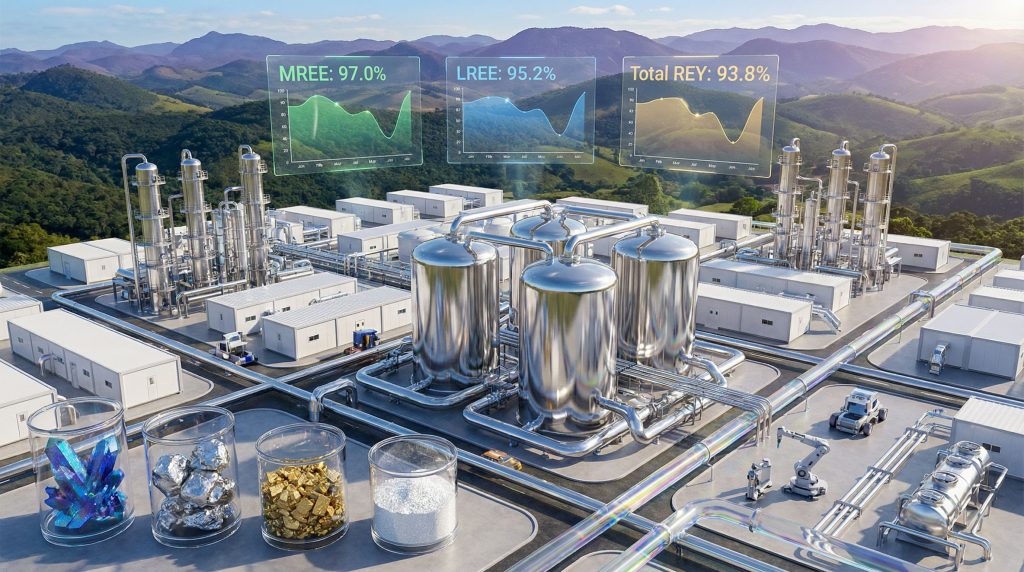
- Magnetic Rare Earth Elements (MREE): 97.0% recovery
- Light Rare Earth Elements (LREE): 95.2% recovery
- Total Rare Earth Elements plus Yttrium (TREY): 93.8% recovery
- Heavy Rare Earth Elements (HREE): 83.9% recovery
These figures represent substantial improvements over typical industry performance, where conventional acid leaching systems commonly achieve 70-85% extraction rates depending on ore characteristics and processing conditions. Furthermore, the differential recovery rates across element groups reflect fundamental chemical principles, as heavy rare earth elements consistently present greater extraction challenges due to their tendency to form more stable residual compounds.
Titanium Co-Product Enhancement Strategy
Beyond rare earth recovery, the Altilium Ti/REE™ process achieved 97% concentration of titanium dioxide (TiO₂) in leaching residues, upgrading TiO₂ content from 13.4% to 26.0%. This dual-product recovery capability transforms what would traditionally be waste materials into valuable titanium concentrates suitable for industrial applications.
The economic implications extend beyond additional revenue streams. Titanium co-product credits can offset operating costs for rare earth production, improving overall project economics and providing price volatility hedging through product diversification. Additionally, this approach reduces dependence on rare earth price fluctuations while creating market optionality in titanium dioxide sectors including pigments, ceramics, and aerospace materials.
How Does the Alto do Paranaíba Project Compare to Global REE Operations?
Geological Advantage Assessment
The Alto do Paranaíba project benefits from mineralisation that demonstrates strong responsiveness to acid leaching, indicating favourable mineral assemblages for hydrometallurgical processing. Located in Minas Gerais state, Brazil, the project occupies a region with established geological understanding and mining infrastructure development.
The mineralogical characteristics that enable high extraction rates suggest ore compositions that minimise processing complexity compared to deposits requiring extensive pre-treatment or alternative extraction methodologies. However, comprehensive mineralogical analysis and comparative ore grade disclosure remain essential for substantive evaluation against established global operations.
Infrastructure and Location Benefits
Brazil's position as a major mineral-producing nation provides established regulatory frameworks for mining development, though specific permitting timelines and environmental requirements for rare earth operations require project-specific analysis. The Minas Gerais location offers proximity to Brazil's industrial centres and established transportation networks connecting to export facilities.
Strategic positioning in the Western Hemisphere provides geopolitical advantages for supply chain diversification initiatives, particularly as consuming nations seek alternatives to traditional rare earth suppliers. For instance, the critical minerals demand surge has highlighted the need for diverse supply sources.
Scale and Resource Potential Evaluation
The Alto do Paranaíba project encompasses multiple exploration properties with Block 1 serving as the initial focus for metallurgical testing. The project's scale and resource potential depend on systematic exploration results and resource estimation studies following established classification standards such as JORC or NI 43-101.
Current testing represents preliminary metallurgical assessment using composite samples from a single property block. Commercial viability assessment requires demonstration of consistent performance across multiple ore samples representing spatial and temporal variations within the broader project area.
What Are the Technical Challenges in REE Extraction Optimisation?
Metallurgical Process Variables
The variation in extraction efficiency across rare earth element categories illustrates fundamental metallurgical challenges in REE processing. Heavy rare earth elements (HREE) achieved 83.9% recovery compared to 95.2% for light rare earth elements (LREE), reflecting the increased chemical stability of heavier elements in residual phases.
Critical process parameters requiring optimisation include:
- Acid consumption rates: Stoichiometric calculations for nitric acid requirements per kilogram of ore processed
- Temperature and pressure conditions: Optimal ranges for maximising extraction while controlling energy costs
- Residence time: Contact duration between acid solutions and ore particles for complete reaction
- pH control: Solution chemistry management throughout leaching cycles
Environmental and Sustainability Considerations
Dual-product processing creates complex waste management solutions requirements beyond traditional single-product operations. While titanium dioxide recovery reduces overall waste generation, comprehensive characterisation of remaining tailings materials is essential for environmental compliance and disposal planning.
Water usage efficiency becomes critical in commercial-scale operations, requiring analysis of:
- Water consumption per kilogram of ore processed
- Recycling potential for process waters
- Water quality requirements for optimal leaching performance
- Treatment requirements for process water discharge
Quality Control and Standardisation Protocols
Testing conducted under SK Item 1300 regulations provides qualified person oversight ensuring technical disclosure compliance. However, scaling laboratory results to commercial operations requires extensive quality control protocols addressing:
- Reproducibility across ore batches: Consistent performance demonstration across different sample compositions
- Process control monitoring: Real-time analytical capabilities for production optimisation
- Product specifications: Meeting customer requirements for rare earth concentrates and titanium products
How Will Atlas Critical Minerals Impact Global REE Supply Chains?
Market Positioning in Critical Minerals Sector
Western Hemisphere rare earth development addresses strategic supply chain diversification objectives for consuming nations seeking alternatives to traditional suppliers. Brazilian rare earth production could provide geographic and political risk mitigation for critical mineral supply chains supporting renewable energy, electric vehicle, and defence applications.
The dual-product capability differentiates Atlas Critical Minerals rare earth extraction from single-product operations, potentially providing competitive advantages in project financing and offtake agreement negotiations. Consequently, titanium co-product revenue streams may enable more attractive project economics and risk profiles for potential partners.
Investment and Development Timeline Projections
Commercial development timelines depend on successful completion of feasibility studies, environmental permitting, project financing, and construction phases. Brazilian regulatory frameworks for mining development provide established pathways, though rare earth-specific requirements may introduce additional considerations.
Understanding mineralogy and mining economics becomes crucial for capital requirements in commercial-scale implementation. These require detailed engineering studies addressing:
- Processing plant design and construction costs
- Infrastructure development for mining and processing operations
- Working capital for operational ramp-up phases
- Contingency provisions for technical and market risks
Competitive Advantages in Processing Technology
Patent protection for the Altilium Ti/REE™ process could provide technological differentiation and potential licensing opportunities to other developers facing similar metallurgical challenges. Technology transfer partnerships may create additional revenue streams while expanding market presence.
The ability to achieve high extraction rates while recovering valuable co-products addresses fundamental economic challenges in rare earth development, where processing costs often determine project viability more than ore grades or resource quantities. Furthermore, Atlas Critical Minerals recently reported strong metallurgical recoveries that validate their extraction methodology.
What Economic Factors Drive REE Extraction Viability?
Cost Structure Analysis for Dual-Product Operations
Titanium co-product recovery fundamentally alters project economics by providing additional revenue streams that can offset rare earth processing costs. This dual-product approach reduces dependence on rare earth price volatility while creating operational flexibility in product marketing strategies.
Operating expense optimisation through co-product credits could enable profitable operations at lower rare earth prices than single-product competitors, providing market advantages during price downturns. However, comprehensive economic analysis requires detailed capital and operating cost estimates from feasibility-level engineering studies.
Market Demand Projections for Critical Elements
Rare earth element demand growth drivers include:
- Electric vehicle battery systems: Permanent magnet motor requirements for neodymium and dysprosium
- Wind power generation: Rare earth permanent magnets in turbine generators
- Defence and aerospace applications: High-performance materials requiring specialised rare earth elements
- Electronics and technology sectors: Continuing demand for consumer and industrial electronics
Titanium dioxide markets provide additional demand exposure through:
- Pigment applications: Paints, coatings, and plastics industries
- Industrial materials: Aerospace, chemical processing, and construction sectors
- Speciality applications: Advanced ceramics and high-performance materials
Price Volatility Management Strategies
Dual-product operations provide natural hedging against price volatility in individual commodity markets. When rare earth prices decline, titanium markets may provide offsetting revenue stability, and vice versa. This diversification reduces overall project risk compared to single-commodity exposures.
Long-term supply contracts with end-users could provide price stability and financing advantages, particularly for strategic buyers seeking secure rare earth supplies. In addition, geographic positioning in Brazil may appeal to customers prioritising supply chain diversification away from traditional suppliers, particularly as renewable energy transformations drive increased demand for these materials.
The next major ASX story will hit our subscribers first
Frequently Asked Questions About Atlas Critical Minerals REE Extraction
What makes the extraction rates so high compared to industry standards?
The Altilium Ti/REE™ process utilises optimised nitric acid leaching under controlled conditions with ore prepared to specific particle size distributions. The favourable mineralogical response of Alto do Paranaíba ore to acid leaching contributes to exceptional recovery rates, though specific mineral assemblages enabling this performance require additional technical disclosure.
How does the titanium co-product affect overall project economics?
Titanium dioxide recovery from leaching residues creates additional revenue streams that can offset rare earth processing costs. Upgrading TiO₂ content from 13.4% to 26.0% produces marketable titanium concentrates while reducing waste generation, improving overall project economics through dual-product revenue streams.
What are the next steps toward commercial production?
Commercial development requires completion of feasibility studies, resource estimation according to established classification standards, environmental permitting, project financing, and construction phases. Current testing represents preliminary metallurgical assessment requiring expansion to demonstrate consistent performance across broader ore sample populations.
How does Brazilian REE development compare to other global projects?
Brazil offers established mining regulatory frameworks, industrial infrastructure, and strategic geographic positioning for Western Hemisphere supply chain diversification. However, comparative analysis requires detailed technical and economic studies addressing project-specific advantages relative to other rare earth developments worldwide. Atlas Critical Minerals provides comprehensive project information for investors seeking detailed assessments.
Disclaimer: This analysis is based on preliminary metallurgical testing results and publicly available information. Commercial viability assessments require comprehensive feasibility studies, environmental analysis, and market evaluation. Rare earth development involves significant technical, environmental, regulatory, and market risks that may affect project outcomes. Investment decisions should consider all available information and professional guidance appropriate to individual circumstances.
Could Atlas Critical Minerals Be Your Next Big Discovery?
Discovery Alert's proprietary Discovery IQ model delivers real-time notifications on significant ASX mineral discoveries like Atlas Critical Minerals, instantly empowering investors to identify actionable opportunities ahead of the broader market. Visit Discovery Alert's dedicated discoveries page to understand how historic mineral discoveries have generated substantial returns, then begin your 30-day free trial to position yourself ahead of the next breakthrough.