May 20, 2026
Understanding Modern Mining Efficiency Through Operational Excellence
The global mining industry stands at a critical juncture where operational excellence determines competitive advantage across commodity cycles. Resource companies that demonstrate consistent throughput improvements while managing unit costs effectively position themselves for sustained profitability regardless of price volatility. Furthermore, this operational foundation becomes particularly important as mining enterprises navigate supply chain disruptions, labour constraints, and evolving environmental regulations.
Modern mining operations increasingly rely on integrated technology platforms, automated systems, and data-driven mining operations to achieve record production levels. Companies achieving breakthrough performance metrics typically combine geological expertise with engineering optimization and financial discipline to extract maximum value from existing assets.
When big ASX news breaks, our subscribers know first
Strategic Portfolio Optimisation in Resource Mining
Mining executives are fundamentally restructuring asset portfolios to concentrate on commodities with favourable long-term demand trajectories. This strategic realignment reflects recognition that traditional bulk commodities face different market dynamics compared to energy transition metals, requiring distinct operational approaches and capital allocation strategies. Consequently, the mining industry evolution continues to reshape investment priorities.
Key Portfolio Transition Indicators:
- Energy transition metal production receiving prioritised capital investment
- Traditional commodity operations focused on cash generation and efficiency improvements
- Geographic diversification reducing single-country exposure risks
- Technology integration improving extraction rates across commodity types
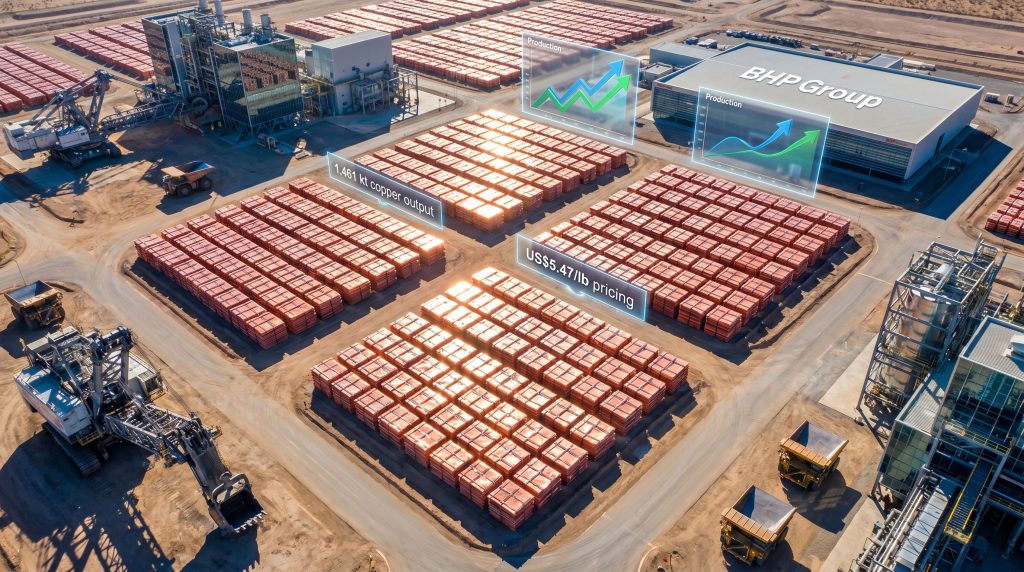
BHP Group copper and iron ore production exemplifies this strategic approach through operational excellence at flagship operations. The company's recent performance demonstrates how mining enterprises can optimise existing assets while positioning for future commodity demand shifts. During the nine months ending March 2026, BHP achieved copper production of 1,461 kt despite a 3% volume decline, while iron ore output increased 2% to 197 Mt, showcasing operational resilience across different commodity segments.
The 31% increase in average realised copper prices to US$5.47/lb during this period illustrates the financial benefits of exposure to energy transition commodities. This pricing performance, combined with record material extraction at Western Australia Iron Ore operations and record concentrator throughput at Escondida, demonstrates how operational excellence translates to financial performance.
Production Guidance Philosophy and Market Communication
Mining companies employ sophisticated guidance methodologies to manage investor expectations while maintaining operational flexibility. The practice of providing range-based guidance allows management teams to demonstrate confidence in achieving minimum production targets while preserving upside potential for operational outperformance.
Guidance Adjustment Significance:
| Guidance Type | Market Signal | Operational Implication |
|---|---|---|
| Range Maintained | Operational consistency | Stable production environment |
| Upper Range Targeting | Increased confidence | Improved operational performance |
| Range Expansion | Capacity optimisation | Enhanced throughput capability |
| Cost Guidance Reduction | Efficiency improvements | Unit economics optimisation |
BHP's approach to FY26 copper production guidance of 1,900-2,000 kt, now expected at the top of the range, signals management confidence in operational execution capabilities. This guidance elevation, driven particularly by performance at Escondida and Antamina operations, reflects tangible improvements in mining processes and concentrate recovery rates.
The reduction in Escondida unit cost guidance to US$1.00-1.20/lb for FY26 demonstrates how operational excellence and by-product performance can substantially improve project economics. This cost performance positions Escondida among the world's lowest-cost copper producers, providing significant margins even during commodity price downturns.
Executive Leadership Transitions in Mining Strategy
Leadership succession planning in large-scale mining operations typically coincides with strategic inflection points, ensuring continuity in capital allocation priorities and operational execution. Effective transitions balance institutional knowledge retention with fresh perspectives on emerging market opportunities and technological capabilities.
Leadership Transition Framework:
- Internal succession preserving strategic continuity and operational knowledge
- Regional expertise aligning with geographic growth priorities
- Operational background ensuring execution-focused leadership approach
- Timing coordination with major project development and market cycles
The appointment of Brandon Craig as BHP's incoming CEO effective July 1, 2026, represents strategic continuity in copper-focused growth initiatives. Craig's 25+ years of experience within BHP, including leadership of the Americas division, provides deep operational knowledge of copper mining processes and project development in key jurisdictions. Additionally, BHP's growth strategy continues to prioritise copper expansion opportunities.
BHP has delivered strong performance over the past nine months, including record material mined and concentrator throughput at Escondida and record production at WAIO. These results reflect the consistency of our operations and the strength of our high margin diversified portfolio in an evolving operating environment.
This leadership transition occurs concurrent with BHP achieving record operational performance and completing substantial divestments, indicating board confidence that the operational foundation supports growth project execution under new leadership.
Asset Divestment Strategies for Capital Efficiency
Modern mining companies employ strategic asset sales to optimise portfolio composition, improve balance sheet flexibility, and concentrate resources on core competencies. Effective divestment programmes balance immediate capital realisation with long-term strategic positioning, ensuring retained assets align with evolving commodity demand trends. In addition, these strategies enhance supply chain resilience across global operations.
Portfolio Optimisation Benefits:
- Capital concentration on highest-return growth opportunities
- Balance sheet strengthening supporting major project financing
- Operational simplification reducing management complexity
- Geographic focus minimising regulatory and political risks
BHP's completion of approximately US$4.8 billion in divestment proceeds, including the Antamina silver stream and Carajás asset sales, exemplifies strategic portfolio optimisation. These divestments provide financial flexibility for copper expansion projects while maintaining exposure to core commodity segments through flagship operations.
The timing of these divestments during favourable market conditions demonstrates management's ability to monetise non-core assets at attractive valuations, enhancing capital available for growth project development and shareholder returns.
Operational Metrics Indicating Industry Efficiency Evolution
Mining industry efficiency improvements typically manifest through increased throughput rates, reduced unit costs, and enhanced recovery percentages. Companies achieving record operational performance demonstrate successful integration of technology upgrades, process optimisation, and workforce productivity initiatives. For instance, understanding iron ore demand insights helps optimise production planning.
Performance Measurement Categories:
| Metric Type | BHP Performance | Industry Significance |
|---|---|---|
| Material Extraction | Record WAIO output | Capacity utilisation optimisation |
| Processing Efficiency | Record Escondida throughput | Technology integration success |
| Unit Cost Management | US$1.00-1.20/lb guidance | Margin expansion potential |
| Recovery Rates | Enhanced by-product credits | Resource utilisation improvement |
The achievement of record material mined at WAIO and record concentrator throughput at Escondida indicates successful implementation of operational enhancement programmes. These performance improvements occur across different commodity types and geographic regions, suggesting systematic rather than isolated operational excellence.
Advanced Mining Technology Integration:
- Automated extraction systems improving safety and productivity
- Real-time ore grade monitoring optimising processing decisions
- Predictive maintenance programmes reducing equipment downtime
- Integrated planning systems coordinating mining and processing activities
The next major ASX story will hit our subscribers first
Supply Chain Resilience and Risk Management
Global mining operations face increasing supply chain complexity due to geopolitical tensions, transportation constraints, and input cost volatility. Companies with diversified supplier networks and centralised procurement capabilities demonstrate greater resilience during external disruptions while maintaining operational consistency.
Risk Mitigation Approaches:
- Supplier diversification reducing single-source dependencies
- Strategic inventory management balancing costs with supply security
- Energy cost hedging protecting against commodity input volatility
- Transportation network optimisation minimising logistics disruptions
BHP Group copper and iron ore production benefits from the company's centralised procurement approach, which provides competitive advantages during supply chain stress periods, particularly regarding higher energy and consumables costs related to ongoing geopolitical tensions. This procurement strategy enables bulk purchasing power while maintaining quality standards across global operations.
The company's low-cost operational structure provides resilience against global cost pressures, ensuring maintained profitability even during periods of elevated input costs or commodity price volatility.
Future-Oriented Investment Priorities in Mining
Capital allocation decisions in modern mining increasingly favour projects with favourable environmental profiles, stable regulatory frameworks, and alignment with energy transition trends. Investment criteria now incorporate long-term sustainability requirements alongside traditional financial return metrics. Furthermore, the energy transition strategy influences project development priorities.
Project Development Evolution:
- Environmental impact optimisation driving project design decisions
- Regulatory stability influencing geographic investment priorities
- Infrastructure availability affecting project economic viability
- Community engagement shaping development timelines and social licence
BHP's advancement of copper growth projects, including environmental application submission for a new Escondida concentrator and progression of the Resolution Copper project in the United States, demonstrates alignment with these evolving investment criteria. These projects benefit from established infrastructure, proven geological resources, and regulatory familiarity.
The company's continued advancement of the Jansen potash project in Canada represents diversification into agricultural commodity exposure, providing portfolio balance against industrial commodity cyclicality while supporting global food security requirements.
Commodity Pricing Strategy and Revenue Optimisation
Mining companies optimise revenue realisation through contract portfolio management, quality premium capture, and strategic market timing. Effective pricing strategies balance spot market exposure with long-term contract security, maximising revenue across different market conditions.
Revenue Enhancement Mechanisms:
- Contract portfolio diversification balancing spot and term exposure
- Quality premium maximisation for high-grade concentrate products
- Geographic arbitrage through strategic shipping and marketing
- Hedging programme management preserving upside while managing downside risk
BHP Group copper and iron ore production demonstrates this through its 31% improvement in average realised copper prices to US$5.47/lb, which reflects effective market positioning and operational flexibility that creates value beyond production volume increases. This pricing performance reflects both favourable market conditions and strategic commercial execution.
Commodity Price Performance Analysis:
| Commodity | Price Change | Production Change | Strategic Implication |
|---|---|---|---|
| Copper | +31% to US$5.47/lb | -3% to 1,461 kt | Value over volume focus |
| Iron Ore | Stable margins | +2% to 197 Mt | Cash generation consistency |
| Energy Coal | -15% pricing | +11% to 12.2 Mt | Volume cannot offset price weakness |
| Steelmaking Coal | Steady performance | +1% to 13.0 Mt | Stable industrial demand |
Industry Transformation Scenarios and Strategic Positioning
Mining industry evolution depends on technological advancement, regulatory development, and global economic trends. Companies positioning for multiple scenarios through diversified portfolios and flexible operations demonstrate strategic foresight necessary for long-term value creation.
Scenario Planning Framework:
- Energy transition acceleration increasing copper demand trajectories across electrification applications
- Automation technology advancement reducing operational costs and improving safety performance
- Environmental regulation evolution driving higher operational standards and compliance requirements
- Geopolitical development impacts affecting trade flows, investment patterns, and supply chain security
Investment Considerations:
BHP Group copper and iron ore production illustrates how mining companies navigate commodity cycles through strategic focus, operational excellence, and leadership continuity. The company's 52% share price appreciation over the past 12 months, significantly outperforming the ASX 200's 15% gain, reflects market recognition of this strategic positioning and execution capability. Moreover, BHP's annual report provides comprehensive insights into operational performance.
The copper-centric growth strategy positions BHP for structural demand trends driven by global electrification and renewable energy deployment, while maintaining iron ore cash generation capabilities that provide portfolio stability and financial flexibility for growth investments.
Risk Considerations:
Mining investments carry inherent risks including commodity price volatility, operational disruptions, regulatory changes, and geopolitical factors. Production guidance represents management estimates based on current operating conditions and may be subject to revision due to unforeseen circumstances or market developments. Investors should consider their risk tolerance and conduct independent research before making investment decisions.
Disclaimer:
This analysis is for educational purposes only and does not constitute financial advice. Past performance does not guarantee future results. Commodity prices and mining company valuations can fluctuate significantly based on market conditions, operational performance, and external factors beyond company control.
Ready to Capitalise on the Next Major Mineral Discovery?
Discovery Alert instantly alerts investors to significant ASX mineral discoveries using its proprietary Discovery IQ model, turning complex mineral data into actionable insights. Understand why major mineral discoveries can lead to substantial market returns by exploring Discovery Alert's dedicated discoveries page, showcasing historic examples of exceptional outcomes, and begin your 14-day free trial today to position yourself ahead of the market.