
August 10, 2026
Understanding Modern Mining's Energy Security Dilemma
Industrial commodity extraction operates within an increasingly complex web of energy dependencies that traditional business models failed to anticipate. Mining operations consume enormous quantities of petroleum-derived fuels across multiple operational vectors, creating exposure to global supply chain disruptions that extend far beyond normal market volatility. When geopolitical tensions escalate into armed conflict, particularly in regions controlling critical energy transit corridors, the fundamental economics of resource extraction undergo rapid transformation.
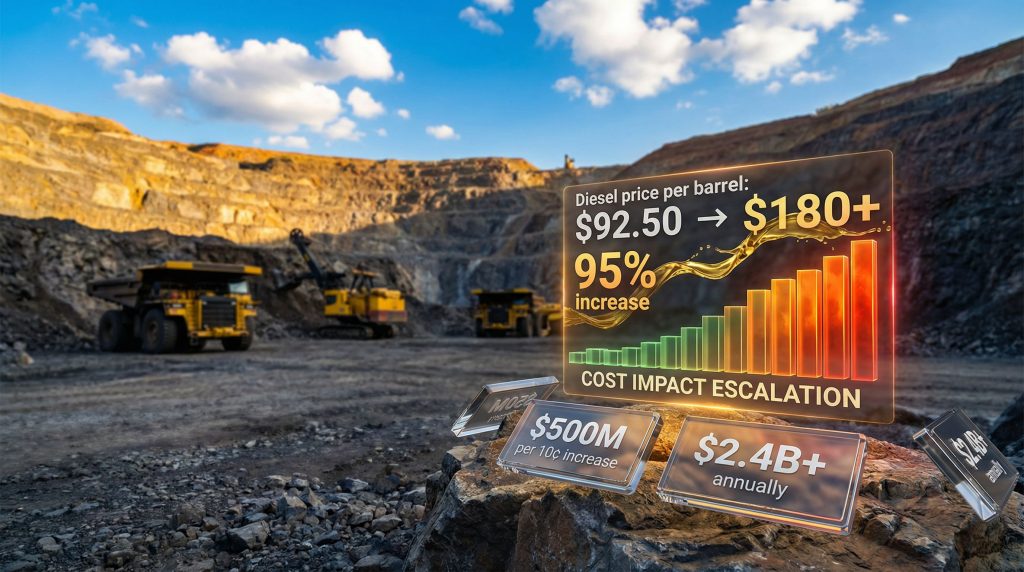
The Iran war impact on mining diesel costs represents more than temporary price adjustments. Current conflicts have disrupted established fuel supply networks, forcing mining companies to confront structural vulnerabilities in their operational models. Singapore benchmark diesel pricing reached approximately $180 per barrel following Middle Eastern tensions, representing a 95% increase from pre-conflict baseline levels of $92.50 per barrel. Furthermore, this crisis has accelerated the energy transition in mining as companies seek alternatives to volatile fuel markets.
Quantifying Financial Exposure Across Mining Operations
Large-scale mining operations demonstrate severe vulnerability to petroleum price movements due to their massive fuel consumption requirements. According to Fortescue Metals Group leadership, a 10-cent movement in diesel pricing creates approximately $70 million in cost impact for their operations alone. When extrapolated across the sector, the top-four iron ore producers collectively experience approximately $500 million in cost impacts per 10-cent diesel price movement.
Moreover, the oil price rally effects have compounded these challenges, creating unprecedented cost pressures across the industry. Financial Impact Assessment by Mining Scale reveals the severity of exposure across different operational tiers.
| Operation Scale | Daily Diesel Consumption | Cost Impact per 10¢ Price Increase | Annual Exposure at Current Levels |
|---|---|---|---|
| Major iron ore operations | 160,000-300,000 litres | $70M+ per company | $2.4B+ sector-wide |
| Mid-tier mining operations | 50,000-150,000 litres | $15-35M per operation | $500M-1.2B estimated |
| Small-scale operations | 10,000-50,000 litres | $3-12M per site | $100M-400M estimated |
Geographic Vulnerability and Supply Chain Dependencies
Mining operations sourcing fuel from Southeast Asian refineries face particular exposure to Strait of Hormuz disruptions, which handle approximately 20% of global oil and LNG transit. This geographic concentration creates systemic risk across multiple mining regions simultaneously, preventing companies from diversifying supply sources during crisis periods.
According to Reuters analysis, mining companies operating in Australia's Pilbara region, Southeast Asian tin and nickel operations, and parts of sub-Saharan Africa face 15-30% fuel transportation cost premiums above base pricing, making them especially vulnerable to supply disruption scenarios.
When big ASX news breaks, our subscribers know first
Structural Vulnerabilities in Mining's Energy Architecture
Modern resource extraction relies on technology choices that create fundamental exposure to petroleum price volatility. Understanding these dependencies reveals why mining operations cannot easily adapt to sustained fuel cost increases without substantial operational modifications. Consequently, the mining industry evolution has been fundamentally shaped by energy security concerns.
Heavy Machinery Fleet Requirements
Large-scale mining operations typically maintain haul truck fleets ranging from dozens to hundreds of vehicles, each consuming 100-200 litres of diesel per operational day. A single major iron ore mine operating 200 haul trucks requires aggregate site consumption exceeding 20,000 litres daily for transportation alone, before considering excavation equipment, drilling rigs, and power generation requirements.
Critical Fuel Consumption Categories:
• Haul truck fleets: 80-150 litres per hour under typical mining conditions
• Excavation and drilling equipment: Continuous fuel requirements for overburden removal
• Remote site power generation: 200-500 litres per megawatt-hour for backup systems
• Processing facility operations: Backup power systems rated at 10-50+ megawatts
Supply Chain Timing and Inventory Management
Southeast Asian refineries serving as primary fuel sources for Indo-Pacific mining operations require 5-14 days shipping time from refinery to site, depending on destination. This transit duration forces mining companies to maintain 10-30 day inventory buffers to ensure operational continuity during supply disruptions, creating substantial working capital requirements during periods of elevated pricing.
Supply Chain Vulnerability Analysis
| Risk Factor | Impact Level | Mitigation Timeline | Capital Requirements |
|---|---|---|---|
| Single-source fuel dependency | Critical | 6-18 months | $50-200M inventory |
| Geographic supply concentration | High | 12-24 months | Supply diversification |
| Transportation corridor disruption | Severe | Immediate | Emergency stockpiling |
Strategic Energy Transition as Crisis Response
Forward-thinking mining operations are leveraging current fuel crises to justify accelerated capital deployment in renewable energy infrastructure previously planned but not prioritised. This strategic pivot transforms sustainability initiatives into core business continuity strategies during periods of petroleum supply volatility. Additionally, the implementation of electric vehicles in mining has become a critical component of long-term energy security planning.
Accelerated Electrification Programs
Fortescue Metals Group projects diesel cost savings exceeding $100 million annually through accelerated electrification programs, with long-term targets of reducing consumption by one billion litres of diesel equivalent over coming years. These projections represent approximately 25-35% of a major producer's annual consumption, suggesting baseline consumption of 3-4 billion litres annually for top-tier iron ore operations.
Technology Implementation Timeline Analysis:
• Electric haul trucks: 2-3 year deployment for fleet conversion
• Solar-powered operations: 1-2 year implementation for primary power
• Battery storage systems: 6-18 months for grid-scale installations
• Charging infrastructure: 12-24 months for fleet-scale capacity
Cost Offset Mechanisms and Financial Justification
Electric haul trucks offer cost offset potential of approximately $70 million annually per 10-cent diesel price increase for major operations. At current pricing levels representing a 95% increase over baseline, this translates to potential $3.36 billion annual savings for the largest producers implementing comprehensive electrification strategies.
Renewable Energy Technology Cost-Benefit Matrix
| Technology Solution | Capital Investment | Implementation Period | Annual Cost Savings | ROI Timeline |
|---|---|---|---|---|
| Electric haul truck fleets | $200-500M | 24-36 months | $70M per 10¢ diesel increase | 3-5 years |
| Solar with battery storage | $50-150M | 12-18 months | 30-40% electricity cost reduction | 2-4 years |
| Grid-scale battery systems | $4-8M per 20MWh | 6-12 months | Peak demand management | 18-30 months |
Sector-Specific Exposure Assessment and Risk Ranking
Different mining commodity sectors demonstrate varying degrees of vulnerability to fuel cost increases based on operational scale, equipment requirements, and geographic location factors. Understanding these distinctions enables more accurate risk assessment for investment and operational planning purposes. However, the broader sustainable mining transformation affects all sectors regardless of their current exposure levels.
Iron Ore Operations: Maximum Vulnerability Profile
Iron ore mining faces the highest sectoral exposure due to massive scale requirements for overburden removal and long-haul transportation to processing facilities. Large open-pit operations require extensive haul truck fleets operating continuously across distances of 400+ kilometres from mine sites to port facilities.
Scale-Dependent Risk Factors:
• Overburden removal ratios: 2-8 tons of waste rock per ton of ore
• Transportation distances: Mine-to-port hauls averaging 300-500 kilometres
• Fleet utilisation rates: 85-95% continuous operation during production cycles
• Remote location dependencies: Limited alternative fuel sourcing options
Comparative Sectoral Analysis
Coal mining operations face intermediate exposure levels with substantial haul truck requirements for pit-to-surface extraction but typically shorter transportation distances to processing facilities. Copper extraction demonstrates moderate exposure due to intermediate-scale trucking requirements and mixed underground/surface operations. Precious metals operations show lowest relative exposure due to smaller equipment footprints and higher value-to-volume ratios.
The Iran war impact on mining diesel costs creates disproportionate effects across commodity sectors, with iron ore producers facing potential $2.4 billion annual exposure while precious metals operations maintain relatively manageable cost increases.
Sectoral Vulnerability Rankings
| Mining Sector | Vulnerability Level | Cost Impact Range | Strategic Response Priority |
|---|---|---|---|
| Iron ore | Critical (Rank 1) | $500M per 10¢ increase | Immediate electrification |
| Coal mining | High (Rank 2) | $200-350M estimated | Renewable energy adoption |
| Copper extraction | Moderate (Rank 3) | $100-200M estimated | Efficiency optimisation |
| Precious metals | Low (Rank 4) | $25-75M estimated | Selective modernisation |
Regional Market Dynamics and Geographic Risk Distribution
Mining operations demonstrate varying degrees of fuel cost exposure based on their geographic location, local refinery access, and regional supply chain dependencies. Understanding these geographic patterns reveals investment opportunities and risk concentration areas across global mining markets.
Asia-Pacific Mining Hub Vulnerabilities
Major mining regions show distinct vulnerability patterns based on fuel sourcing relationships and transportation infrastructure. Australia's Pilbara region faces direct exposure to Southeast Asian fuel pricing through established supply contracts, while Indonesian tin and nickel operations depend on regional refinery networks potentially disrupted by Strait of Hormuz tensions.
As reported by Mining Weekly, the cost implications extend far beyond immediate price increases, affecting long-term operational planning across the sector.
Regional Risk Assessment Matrix:
• Australia: 20-25% diesel price increases affecting iron ore and coal operations
• Southeast Asia: 15-30% cost impacts on tin, nickel, and copper mining
• Sub-Saharan Africa: 25-40% increases affecting gold and platinum operations
• South America: 10-20% impacts with better supply diversification
Supply Chain Resilience Strategies
Mining companies are implementing multi-sourced fuel procurement strategies to reduce dependency on single supply routes affected by conflict zones. These approaches include establishing relationships with multiple regional refineries, developing strategic fuel inventory positions, and creating alternative transportation corridor options.
Investment Evaluation Framework for Energy-Exposed Mining Operations
Investors evaluating mining companies during periods of energy crisis must assess both immediate cost exposure and strategic positioning for long-term energy independence. This analysis requires understanding operational metrics, capital allocation priorities, and management execution capabilities across energy transition initiatives.
Due Diligence Metrics for Energy Resilience
Primary Assessment Criteria:
-
Fuel consumption per unit of production – measured in litres per ton of output
-
Renewable energy adoption timeline – concrete implementation schedules with capital commitments
-
Geographic diversification of fuel supplies – supplier relationship mapping and contract terms
-
Capital allocation toward energy independence – percentage of capex directed to energy transition
Investment Risk Classification System
| Risk Category | Diesel Dependency | Renewable Timeline | Supply Diversification | Investment Rating |
|---|---|---|---|---|
| High-Risk Profile | >80% operations | No concrete plans | Single-source fuel | Avoid/Underweight |
| Moderate Risk | 40-80% operations | 2-5 year timeline | Regional sourcing | Selective exposure |
| Low-Risk Profile | <40% operations | Active implementation | Global supply network | Preferred weighting |
Strategic Positioning Analysis
Companies demonstrating superior crisis response typically combine immediate cost management with accelerated infrastructure investment in energy independence. This dual approach enables both near-term margin protection and long-term competitive advantage development during periods when competitors face sustained cost pressures.
Performance Indicators for Superior Positioning:
• Fuel hedging strategies: Contract coverage extending 12-24 months forward
• Capital deployment acceleration: Bringing forward renewable energy projects by 18-36 months
• Technology partnerships: Establishing relationships with electric vehicle and renewable energy suppliers
• Operational efficiency programmes: Reducing fuel consumption through process optimisation
The next major ASX story will hit our subscribers first
Crisis Management Protocols and Emergency Response Systems
Mining operations implementing effective crisis management during fuel price volatility demonstrate specific organisational capabilities and strategic decision-making frameworks that distinguish successful companies from those experiencing prolonged margin compression.
Immediate Cost Mitigation Strategies
Financial Risk Management Approaches:
• Fuel hedging contracts – Locking in pricing for 6-18 month periods to provide operational predictability
• Operational efficiency improvements – Reducing consumption through equipment optimisation and route planning
• Strategic inventory management – Balancing carrying costs against supply disruption risks
• Production rate modulation – Adjusting output levels based on margin sustainability analysis
Long-Term Resilience Development
Companies demonstrating superior crisis response establish energy independence pathways extending beyond immediate price volatility management. These strategic frameworks anticipate continued geopolitical instability affecting global petroleum markets while positioning operations for competitive advantage during recovery periods.
Mining operations with established renewable energy infrastructure gain significant competitive advantages during fuel price volatility, potentially saving hundreds of millions annually while competitors face margin compression and reduced operational flexibility.
Crisis Response Effectiveness Metrics
| Response Strategy | Implementation Speed | Cost Impact Mitigation | Long-term Value Creation |
|---|---|---|---|
| Fuel hedging programmes | Immediate (1-30 days) | 15-25% cost stability | Limited strategic value |
| Efficiency optimisation | Short-term (1-6 months) | 10-15% consumption reduction | Moderate operational improvement |
| Renewable energy acceleration | Medium-term (6-24 months) | 30-50% energy cost reduction | Substantial competitive advantage |
| Fleet electrification | Long-term (18-36 months) | 40-70% fuel independence | Transformational positioning |
The Iran war impact on mining diesel costs has fundamentally altered the strategic landscape for resource extraction operations globally. Companies positioning themselves for energy independence through renewable technology adoption and operational efficiency improvements will emerge from this crisis period with enhanced competitive positioning, while those maintaining traditional fuel-dependent models face sustained margin pressure and operational vulnerability to future geopolitical disruptions.
Disclaimer: This analysis contains forward-looking projections and cost estimates based on current market conditions and publicly available company information. Actual results may vary significantly based on commodity prices, technological development timelines, and geopolitical developments. Investors should conduct independent due diligence before making investment decisions.
Want to Identify Mining Companies Positioned for Success During Energy Crises?
Discovery Alert's proprietary Discovery IQ model delivers real-time notifications on significant ASX mineral discoveries, helping investors identify companies with strong operational fundamentals and strategic positioning during market volatility. Gain immediate insights into actionable investment opportunities by exploring Discovery Alert's dedicated discoveries page, showcasing historic examples of exceptional returns, and begin your 14-day free trial today to secure your market-leading advantage.