August 14, 2026
The technological revolution reshaping global industries has reached a critical inflection point in mining operations. Engineering the next generation of mine sites represents more than incremental improvement—it demands a fundamental transformation of how mineral extraction facilities are conceived, designed, and operated. Modern mining engineering must navigate complex intersections of artificial intelligence, environmental stewardship, economic optimization, and workforce evolution. Furthermore, these industry evolution trends continue to reshape traditional approaches to mining development.
Contemporary mining operations face unprecedented challenges that traditional engineering approaches cannot adequately address. Climate change regulations, community expectations, technological capabilities, and resource complexity have created a new operating environment requiring innovative solutions. Consequently, the convergence of digital transformation, sustainability imperatives, and operational excellence demands has fundamentally altered the engineering landscape.
Foundations of Modern Mining Engineering Systems
Traditional extraction-focused methodologies are giving way to integrated operational ecosystems that consider the entire mine lifecycle. This evolution encompasses everything from initial resource characterisation through final site remediation. Modern engineering approaches prioritise flexibility, scalability, and environmental integration from project inception.
Digital transformation has become the cornerstone of contemporary mine design. Advanced modelling capabilities, predictive analytics, and real-time optimisation systems enable engineers to develop solutions that were technologically impossible just a decade ago. These capabilities extend beyond simple automation to encompass comprehensive system integration.
Sustainability considerations now influence every aspect of mine site engineering. Environmental stewardship requirements shape fundamental design decisions, from water management systems to energy infrastructure. This shift represents a departure from traditional models where environmental considerations were addressed as compliance afterthoughts rather than core design principles.
Skills development challenges add complexity to engineering project delivery. The mining industry experiences significant knowledge transfer gaps as experienced professionals retire whilst new graduates lack exposure to operational realities. However, this generational transition requires innovative training methodologies and knowledge capture systems that address female leadership challenges in developing inclusive engineering teams.
When big ASX news breaks, our subscribers know first
Artificial Intelligence Revolution in Mine Planning
Machine learning applications have transformed geological modelling from static representations to dynamic, predictive systems. Neural networks analyse multi-dimensional datasets including drill core assays, geophysical surveys, and structural geology data to create sophisticated ore body models. These systems continuously refine predictions as new data becomes available.
Pattern recognition algorithms identify geological relationships that traditional statistical methods might overlook. Advanced systems can detect subtle correlations between mineralisation patterns, structural controls, and alteration zones. This capability enables more accurate resource estimation and improved mine planning decisions.
Automated resource estimation systems reduce human error whilst increasing processing speed. Traditional geological modelling required weeks of manual interpretation and calculation. Modern AI-powered efficiency systems can process equivalent datasets in hours whilst maintaining or improving accuracy. However, human expertise remains essential for geological interpretation and quality control.
Real-time geological data integration represents a significant advancement in mine planning capabilities. As exploration drilling progresses, AI systems automatically incorporate new assay results and geological observations into existing models. This dynamic updating ensures that mine plans reflect the most current geological understanding.
Multi-variable optimisation algorithms balance competing operational objectives across complex mine systems. These systems consider extraction rates, equipment utilisation, energy consumption, capital expenditure, and environmental constraints simultaneously. The optimisation process identifies solutions that maximise overall system performance rather than individual component efficiency.
Autonomous scheduling systems coordinate workforce deployment, equipment allocation, and material flow management. These systems process real-time operational data to adjust schedules dynamically. Equipment availability, weather conditions, and production targets are continuously evaluated to optimise operational efficiency.
Cost-benefit analysis automation enables rapid evaluation of alternative development scenarios. Traditional economic modelling required significant manual effort and time. Automated systems can evaluate hundreds of development options, considering various economic scenarios and operational constraints. This capability enables more informed decision-making during project development.
AI Implementation Performance Metrics:
| Application Area | Efficiency Improvement | Cost Reduction | Implementation Period |
|---|---|---|---|
| Geological Modelling | 20-25% | 10-15% | 8-12 months |
| Equipment Scheduling | 18-22% | 12-18% | 4-8 months |
| Resource Planning | 15-18% | 8-12% | 10-16 months |
Infrastructure Integration and Modern Mine Architecture
Modular processing system design enables phased capacity expansion without complete facility replacement. Standardised equipment interfaces reduce integration complexity whilst maintaining operational flexibility. These systems allow mining operations to adapt to changing market conditions and ore characteristics over the mine life.
Scalable processing units can be added incrementally as production demands increase. This approach reduces initial capital requirements whilst maintaining future expansion capability. Standardised interface protocols facilitate equipment interchangeability, reducing maintenance complexity and spare parts inventory requirements.
Redundancy planning ensures operational continuity during maintenance cycles. Modern processing facilities incorporate backup systems for critical components. This design philosophy minimises production disruptions whilst maintaining safety and environmental compliance standards.
Smart grid energy management systems integrate renewable energy sources with traditional power generation. Solar and wind power installations reduce diesel dependency whilst battery storage systems manage load variability. These systems require sophisticated control algorithms to balance generation and consumption in real-time.
Load balancing algorithms optimise power distribution across processing operations. Different mining processes have varying power requirements that change throughout production cycles. Smart grid systems automatically adjust power allocation to minimise consumption whilst maintaining production targets.
Grid-tie capabilities enable energy export during periods of excess generation. Mining operations with significant renewable energy capacity can sell surplus power to local utilities. This capability requires technical compliance with utility interconnection standards and may generate additional revenue streams.
Transportation network optimisation integrates multiple logistics modes to minimise costs and delivery times. Modern mine sites coordinate rail connections, road haulage, and port facilities through centralised planning systems. Real-time tracking and routing optimisation reduce transportation bottlenecks.
Automated haulage systems have demonstrated significant operational cost reductions in implemented operations. Major mining companies report cost savings of 20-30% compared to traditional truck operations. These systems reduce labour requirements whilst improving safety performance and operational consistency.
Multi-modal transport integration connects rail, road, and port facilities through coordinated scheduling systems. Integrated logistics planning ensures that material flows smoothly from mining operations through processing and ultimately to market. Real-time coordination minimises inventory requirements and reduces handling costs.
Environmental Engineering and Sustainability Solutions
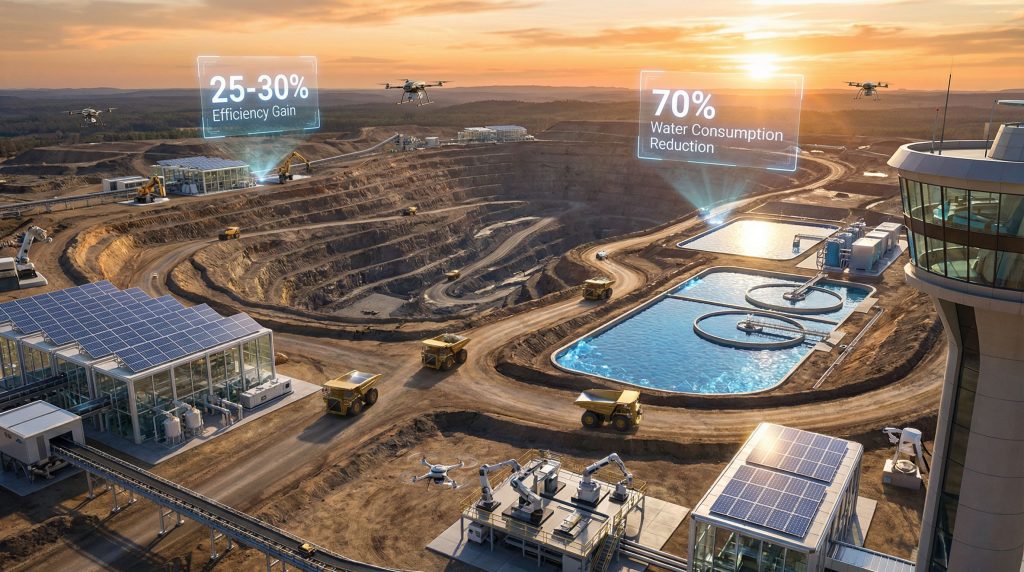
Water management system innovation has become central to modern mine design. Closed-loop water recycling systems can achieve reuse rates of 85-95% in optimal conditions. These systems incorporate advanced treatment technologies to maintain water quality standards whilst minimising freshwater consumption.
Advanced treatment technologies remove contaminants to levels suitable for reuse or environmental discharge. Reverse osmosis, ion exchange, and biological treatment systems address specific water quality challenges. Treatment system selection depends on ore chemistry, processing methods, and local discharge standards.
Groundwater protection systems utilise engineered containment and monitoring networks. Hydrogeological characterisation identifies potential contamination pathways whilst engineered barriers prevent groundwater contact with mining activities. Monitoring networks provide early detection of any unexpected conditions.
Modern water management approaches can reduce freshwater consumption by up to 60% compared to traditional operations whilst maintaining production targets and environmental compliance standards.
Waste minimisation strategies focus on reducing storage requirements and generating value from byproducts. Tailings dewatering technologies can reduce storage footprint by 40-60% depending on ore characteristics and technology selection. Dry stack tailings and paste backfill systems offer alternatives to traditional tailings ponds.
By-product recovery systems generate additional revenue streams whilst reducing waste volumes. Metal recovery circuits extract valuable materials that would otherwise report to waste streams. These systems require careful economic evaluation to ensure positive returns on investment.
Progressive rehabilitation programmes integrate mine closure planning with ongoing operations. Rather than deferring rehabilitation until mine closure, progressive approaches complete rehabilitation work during operations. This strategy reduces final closure costs whilst demonstrating environmental stewardship to stakeholders.
In addition, innovative projects focusing on green iron production demonstrate how environmental considerations drive new approaches to processing technology design. Circular economy approaches maximise resource utilisation whilst minimising waste generation, considering the entire material lifecycle from extraction through final disposition.
Data Analytics and Operational Excellence Framework
Predictive maintenance systems utilise sensor networks to monitor equipment condition continuously. Vibration analysis, temperature monitoring, and acoustic emissions provide early warning of potential equipment failures. These systems enable maintenance scheduling based on actual equipment condition rather than fixed time intervals.
Sensor networks monitor critical equipment including motors, bearings, crushers, and pumps throughout mining operations. Data transmission occurs through industrial communication networks designed for harsh mining environments. Cloud and edge computing platforms process sensor data to identify potential issues.
Failure prediction algorithms analyse historical failure patterns and current operating conditions to estimate remaining equipment life. Machine learning models trained on failure data can identify conditions that precede equipment failures. This capability enables proactive maintenance scheduling and spare parts management.
Maintenance scheduling optimisation balances maintenance costs with production requirements. Predictive systems identify optimal maintenance timing to minimise production disruptions whilst preventing equipment failures. This approach can extend asset life whilst reducing maintenance costs.
Digital twin technology creates virtual replicas of physical mining operations for testing and optimisation. These systems enable scenario testing without operational disruption whilst providing training environments for operators. Digital twins integrate real-time operational data with physics-based models.
Performance monitoring systems provide real-time operational insights through comprehensive dashboards. Key performance indicators track production, efficiency, safety, and environmental metrics. Automated reporting systems identify performance trends and highlight areas requiring management attention.
Benchmarking systems compare performance against industry standards and best practices. These systems identify improvement opportunities whilst tracking progress toward operational targets. Continuous improvement methodologies use performance data to drive systematic enhancements.
Workforce Development and Skills Evolution
Digital skills integration requirements have fundamentally changed mining engineering competency frameworks. Modern engineers require data science capabilities alongside traditional mining knowledge. Cross-disciplinary training programmes combine geological understanding with programming skills and analytics interpretation.
Programming languages including Python, R, and SQL have become essential tools for mining engineers. Geographic Information Systems (GIS) applications enable spatial analysis and visualisation. Mine planning software increasingly requires programming skills for customisation and optimisation.
Remote operation capabilities enable distributed workforce models that improve work-life balance whilst reducing site personnel requirements. Remote Operations Centres (ROCs) provide centralised monitoring and control for multiple mining operations. These facilities require specialised training for operators managing equipment from distant locations.
Continuous learning platforms address rapid technology evolution through flexible training delivery. Online learning systems provide access to current technical content whilst communities of practice connect specialists across operations. These systems support knowledge sharing and professional development.
Collaborative engineering methodologies break down traditional organisational silos between disciplines. Multi-disciplinary project teams integrate geological, mechanical, electrical, and environmental engineering expertise. Integrated project delivery models improve coordination and reduce design conflicts.
Stakeholder engagement processes incorporate community input into engineering decisions. Modern mining projects require extensive consultation with local communities, indigenous groups, and regulatory agencies. Engineering teams must consider social impacts alongside technical and economic factors.
Knowledge transfer systems preserve institutional expertise as experienced professionals retire. Documentation platforms capture decision rationales and lessons learned from project development. Mentoring programmes connect experienced engineers with new graduates to facilitate knowledge transfer.
The next major ASX story will hit our subscribers first
Economic Models Supporting Next-Generation Development
Capital allocation optimisation incorporates Environmental, Social, and Governance (ESG) factors into investment decisions. Risk-adjusted return calculations consider regulatory compliance, community acceptance, and environmental stewardship alongside traditional financial metrics. This approach ensures that projects meet modern stakeholder expectations.
Understanding investment strategy components becomes crucial when evaluating next-generation mining projects. Phased development strategies reduce initial capital requirements whilst maintaining expansion flexibility. Rather than constructing full-scale facilities immediately, phased approaches begin with smaller operations that can be expanded as market conditions justify.
Technology investment frameworks balance innovation with proven solutions. Early adoption of new technologies offers competitive advantages but includes implementation risks. Investment frameworks evaluate technology maturity, vendor stability, and performance guarantees to make informed adoption decisions.
Activity-based costing models identify specific efficiency opportunities within mining operations. Traditional costing approaches may obscure areas where improvements could generate significant savings. Detailed cost analysis enables targeted improvement initiatives with measurable returns.
Shared infrastructure concepts reduce per-unit development costs through collaborative arrangements. Multiple mining operations can share transportation, power, and processing infrastructure where geographic proximity makes sharing economical. These arrangements require careful legal and operational coordination.
Performance-based contracting aligns vendor incentives with operational outcomes. Rather than purchasing equipment or services, performance contracts pay for delivered results. Contractors assume responsibility for achieving performance targets, which can improve reliability whilst reducing owner risks.
Regulatory Frameworks and Design Compliance
Compliance integration strategies embed regulatory requirements throughout design phases rather than addressing them as final checks. Early consultation with regulatory agencies identifies requirements that influence fundamental design decisions. This proactive approach reduces redesign costs and permitting delays.
Automated compliance monitoring systems reduce administrative burden whilst ensuring continuous regulatory compliance. These systems track operational parameters against permit conditions and generate required reports automatically. Real-time monitoring enables immediate response to any compliance deviations.
Stakeholder engagement protocols ensure community acceptance of mining projects. Meaningful consultation involves communities in project planning whilst addressing their concerns and expectations. These processes build social licence to operate, which is essential for project success.
Future-proofing strategies accommodate evolving regulatory standards through adaptive design frameworks. Regulations continue evolving to address environmental and social concerns. Engineering designs that can accommodate likely future requirements avoid costly retrofits and compliance issues.
Adaptive design frameworks incorporate flexibility to accommodate regulatory changes without fundamental redesign. These approaches consider potential future requirements during initial design phases. Technology selection criteria prioritise solutions that can adapt to changing compliance standards.
Documentation systems support comprehensive regulatory reporting throughout the mine lifecycle. Modern regulations require extensive documentation of design decisions, environmental impacts, and operational performance. Integrated documentation systems ensure that required information is captured and accessible.
Emerging Technologies Shaping Future Mining Operations
Autonomous systems integration extends beyond individual equipment to encompass entire mining operations. Fully autonomous mining systems coordinate extraction, processing, and transportation activities with minimal human intervention. These systems promise significant labour cost reductions whilst improving safety performance.
Autonomous mining equipment reduces labour costs by 30-40% in implemented operations whilst improving safety through reduced human exposure to hazardous conditions. Equipment manufacturers continue developing autonomous capabilities for dozers, draglines, and processing equipment beyond the haul trucks that were first automated.
Drone-based surveying and monitoring systems provide high-resolution data collection at reduced costs compared to traditional methods. Unmanned aerial vehicles equipped with advanced sensors can conduct topographic surveys, environmental monitoring, and equipment inspections. These systems improve data quality whilst reducing safety risks.
Robotic maintenance systems enable equipment servicing in hazardous environments where human access is dangerous or impractical. Robots can perform routine maintenance tasks in areas with extreme temperatures, toxic gases, or structural instability. These systems extend equipment life whilst improving worker safety.
Advanced materials and construction methods are revolutionising mine facility construction. Three-dimensional printing technologies enable on-site component manufacturing, reducing transportation costs and delivery times. Custom components can be manufactured as needed rather than maintaining extensive spare parts inventories.
Smart materials respond to environmental conditions automatically, potentially reducing maintenance requirements. Self-healing concrete can seal cracks automatically whilst shape-memory alloys return to original configurations after deformation. These materials may reduce long-term maintenance costs.
Prefabrication strategies reduce construction timelines by 25-35% through off-site manufacturing of facility components. Standardised modules can be manufactured in controlled factory environments whilst site preparation proceeds simultaneously. This approach improves construction quality whilst accelerating project delivery.
What Technical Capabilities Must Next-Generation Suppliers Deliver?
Modern mining operations require suppliers who can integrate multiple technologies seamlessly while maintaining reliability and performance standards. Engineering capabilities for next-generation mines must encompass digital integration, modular design, and adaptive systems that evolve with changing operational requirements.
How Are Universities Preparing Tomorrow's Mining Engineers?
Academic institutions are fundamentally restructuring mining engineering curricula to address industry transformation. Next-generation mining education programmes integrate digital technologies, environmental stewardship, and interdisciplinary collaboration skills essential for engineering the next generation of mine sites.
Building Mining's Sustainable Future
The transformation of mining engineering represents a fundamental shift toward integrated, technology-driven operations that balance productivity with environmental stewardship and community value. Success requires embracing digital transformation whilst maintaining focus on operational excellence and stakeholder expectations.
Organisations investing in next-generation engineering capabilities position themselves for competitive advantage in an increasingly complex regulatory and social environment. The integration of artificial intelligence, advanced materials, and sustainable practices creates opportunities for significant operational improvements whilst meeting evolving stakeholder requirements.
Engineering the next generation of mine sites demands more than technological adoption—it requires comprehensive transformation of design philosophies, operational approaches, and organisational capabilities. The mining industry stands at a critical juncture where traditional practices must evolve to meet contemporary challenges whilst preserving the fundamental objective of efficient resource extraction.
The convergence of digital technologies, environmental imperatives, and workforce evolution creates both opportunities and challenges for mining organisations. Those that successfully navigate this transformation will establish sustainable competitive advantages whilst contributing to responsible resource development that benefits all stakeholders.
This analysis incorporates current industry trends and technological developments. Specific implementation outcomes may vary based on site conditions, regulatory requirements, and organisational capabilities. Readers should consult qualified engineering professionals for project-specific guidance.
Ready to Discover Tomorrow's Mining Investment Opportunities?
Discovery Alert's proprietary Discovery IQ model delivers instant notifications on significant ASX mineral discoveries, empowering investors to identify groundbreaking opportunities in next-generation mining operations before the broader market reacts. Explore how major mineral discoveries have historically generated exceptional returns and begin your 14-day free trial today to position yourself ahead of the technological revolution reshaping the mining sector.