July 27, 2026
Understanding Modern Monazite Processing Infrastructure
The global mining sector has witnessed remarkable transformation in recent years, with SMM breaks ground on Western Cape monazite plant representing a pivotal development in rare earth element processing capabilities. Moreover, this initiative demonstrates how modern facilities now incorporate advanced metallurgical systems designed for both efficiency and environmental compliance. Contemporary monazite concentration requires sophisticated infrastructure combining proven separation technologies with stringent regulatory frameworks, particularly given the radioactive thorium content inherent in these mineral deposits.
Furthermore, the industry evolution trends have significantly influenced facility design parameters. The Western Cape's emerging rare earth processing capabilities represent a technical milestone in gravity separation and flotation methodologies. Additionally, these systems enable operators to achieve concentrate grades exceeding 50% total rare earth oxide (TREO) content, meeting international feedstock specifications required by downstream processing facilities worldwide.
Contemporary processing infrastructure integrates multiple separation stages optimised through extensive pilot testing programmes. The Steenkampskraal facility has successfully commissioned its on-site laboratory circuits, producing monazite concentrate for the first time in over six decades. Initial metallurgical testing has demonstrated approximately 50% TREO content, confirming the deposit's exceptional grade characteristics.
Key Technical Components:
- Multi-gravity separation circuits with enhanced recovery efficiency
- Flotation concentration stages for precise mineral separation
- Real-time grade control monitoring systems
- Environmental compliance infrastructure for radioactive materials
- Automated process control systems enabling consistent product quality
The integration of gravity separation with flotation technology represents proven methodology dating back to historical operations while incorporating modern refinements. Furthermore, AI-driven process optimization through research partnerships with organisations including the Saskatchewan Research Council and Mintek ensures contemporary facilities meet both technical performance and environmental standards.
Laboratory-scale hydrometallurgical circuits are currently undergoing optimisation at Steenkampskraal. Consequently, early results indicate successful production of mixed rare earth carbonate (MREC) alongside thorium separation capabilities. This demonstrates technical feasibility for subsequent processing phases while maintaining strict separation of thorium co-products required under nuclear regulatory frameworks.
When big ASX news breaks, our subscribers know first
What Makes Commercial Production Viable Through Strategic Targets?
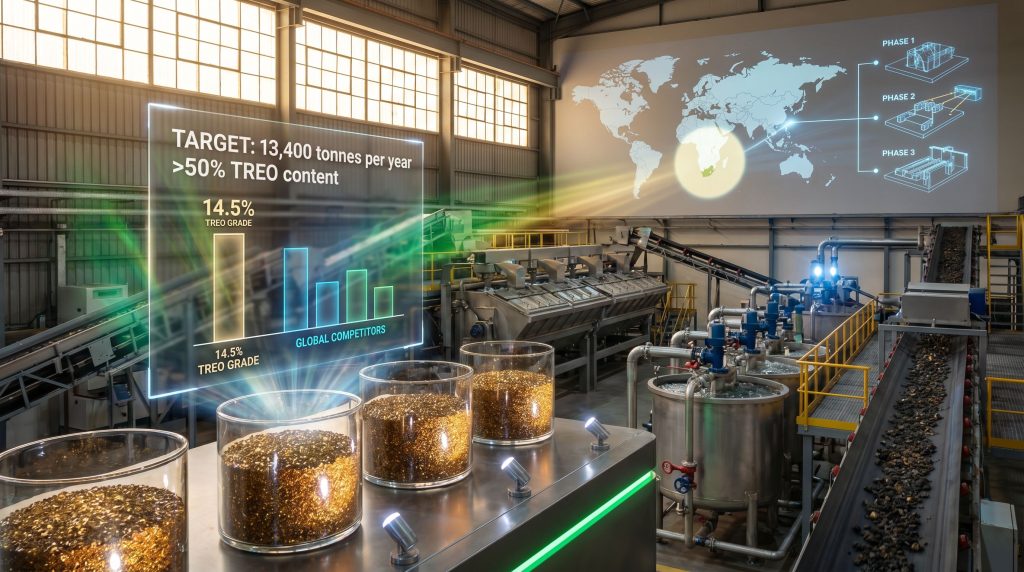
Achieving commercial viability in rare earth processing requires carefully calibrated production targets balancing operational efficiency with market demand. The Steenkampskraal facility has established steady-state output targets of approximately 13,400 tonnes annually of monazite concentrate containing greater than 50% TREO content.
During initial ramp-up operations, production will commence at approximately 6,600 tonnes per year. However, this will escalate to full capacity as operational experience accumulates and process optimisation continues. This phased approach reduces technical risk while enabling workforce development and equipment fine-tuning essential for sustained commercial operations.
Production Specifications and Timeline:
| Phase | Annual Capacity | TREO Content | Timeline | Operational Focus |
|---|---|---|---|---|
| Ramp-up | 6,600 tonnes | >50% | Year 1 | Process optimisation |
| Steady-state | 13,400 tonnes | >50% | Year 2+ | Full commercial production |
| Phase 2 | TBD | MREC production | 2026+ | Hydrometallurgical processing |
| Phase 3 | TBD | Separated oxides | 2027+ | Individual rare earth separation |
The facility design incorporates material sourcing from both existing stockpiles and underground ore extraction. Consequently, this reduces initial capital requirements while enabling early revenue generation. This hybrid approach minimises operational risk by providing feed flexibility during infrastructure development phases.
Processing plant infrastructure includes front-end crushing and milling circuits designed to deliver consistent feed characteristics to concentration stages. In addition, grade control protocols ensure product specifications remain within international standards, critical for maintaining premium pricing in global rare earth markets.
Current resource assessments indicate 665,000 tonnes grading 14.5% TREO alongside valuable thorium co-products at 2.14% grades. These exceptional characteristics position the deposit among the highest-grade rare earth resources globally, enabling economic processing at relatively modest scales compared to lower-grade operations requiring massive throughput volumes.
The 13,400 tonne annual capacity target reflects careful analysis of market conditions, processing costs, and infrastructure capabilities. At current international pricing for high-grade monazite concentrate, this production level supports positive cash flow generation while maintaining flexibility for market condition variations.
How Has Processing Technology Evolved from Historical Methods?
Contemporary monazite processing builds upon proven methodologies established during Anglo American's Steenkampskraal operations between 1952 and 1963. These historical operations successfully demonstrated the fundamental viability of gravity separation and flotation approaches, providing the technical foundation for modern facility design.
The eleven-year operational period under Anglo American management established critical processing parameters still relevant to contemporary operations. However, modern facilities incorporate substantial technological refinements addressing process control, environmental management, and worker safety requirements that were not priorities during mid-twentieth century operations.
Technological Evolution Comparison:
Historical Operations (1952-1963):
- Manual process control and monitoring
- Basic gravity separation circuits
- Limited environmental management protocols
- Conventional flotation methodology
- Manual grade control procedures
Contemporary Operations (2026+):
- Automated process control systems
- Multi-gravity separation with enhanced recovery
- Comprehensive environmental compliance infrastructure
- Optimised flotation with pilot-tested parameters
- Real-time grade control monitoring
Modern environmental standards require sophisticated waste management systems for thorium-bearing residues. Furthermore, this represents a substantial advancement over historical practices. Contemporary facilities must comply with nuclear regulatory frameworks addressing radiation monitoring, worker safety protocols, and environmental impact mitigation measures.
Process control technology enables real-time optimisation of separation parameters, improving concentrate grades by 2-5% compared to historical manual operations. In addition, multi-gravity separation circuits under evaluation incorporate technological refinements unavailable during the 1950s-1960s era, potentially enhancing rare earth recovery rates by 3-7%.
The modern facility design emphasises consistent feed delivery through integrated crushing and milling circuits. Consequently, this addresses a significant limitation of historical operations that lacked comparable feed standardisation systems. Purpose-built conveyor infrastructure connects underground extraction directly to surface processing, eliminating intermediate handling stages that historically introduced inefficiencies.
Enhanced Environmental and Safety Standards
Contemporary operations benefit from extensive pilot testing through research partnerships, enabling process parameter optimisation before commercial-scale implementation. This contrasts with historical operations that relied primarily on trial-and-error approaches during facility commissioning.
Moreover, the sustainability transformation in mining operations has fundamentally changed operational approaches. Modern facilities must incorporate mine reclamation innovation from the initial design phase, ensuring environmental responsibility throughout the operational lifecycle.
Laboratory Circuit Optimization and Quality Control
On-site laboratory facilities serve critical functions in process optimisation, quality control monitoring, and technical development for subsequent processing phases. The Steenkampskraal laboratory has successfully commissioned metallurgical circuits producing monazite concentrate meeting international specifications for the first time in over sixty years.
Laboratory capabilities encompass both metallurgical circuit testing for concentrate production and hydrometallurgical process development for subsequent value-addition phases. Initial concentrate production has demonstrated approximately 50% TREO content, confirming successful separation of rare earth minerals from gangue materials.
Laboratory Infrastructure and Capabilities:
- Metallurgical circuit testing for concentrate optimisation
- Real-time concentrate grade analysis and quality control
- Hydrometallurgical process development for mixed rare earth carbonate
- Thorium separation methodology testing and optimisation
- Process parameter validation for commercial-scale operations
Hydrometallurgical laboratory circuits currently undergoing optimisation have produced encouraging early results. Furthermore, these include successful mixed rare earth carbonate (MREC) production alongside thorium separation capabilities. These achievements validate technical feasibility for Phase 2 hydrometallurgical processing while demonstrating appropriate handling of thorium co-products.
Laboratory-scale testing enables identification of optimal processing conditions before commercial implementation. Consequently, this reduces operational risk and capital requirements. Process parameters including flotation reagent dosages, gravity separation settings, and hydrometallurgical reaction conditions can be refined through systematic testing programmes.
Quality control protocols ensure consistent product specifications essential for international market acceptance. Laboratory analysis capabilities enable real-time monitoring of concentrate characteristics, supporting grade control decisions and process adjustments necessary for maintaining premium product quality.
The laboratory serves as a technical development platform for subsequent processing phases. In addition, this includes oxide separation and downstream product manufacturing planned for Phase 3 operations. This integrated approach ensures technical continuity across all processing stages while maintaining rigorous quality standards.
How Does Integrated Material Handling Optimise Operations?
Modern mineral processing facilities require sophisticated material handling systems ensuring consistent feed delivery while minimising operational costs and environmental impacts. The Steenkampskraal design incorporates purpose-built conveyor infrastructure connecting underground operations directly to surface processing circuits.
This integrated approach eliminates intermediate material handling stages, reducing costs while ensuring consistent ore delivery characteristics essential for process optimisation. Furthermore, the conveyor system enables continuous operation independent of weather conditions or vehicle availability, supporting reliable production scheduling.
Material Handling System Components:
- Underground-to-surface conveyor networks with automated controls
- Direct ore transport from decline shaft exits to processing circuits
- Stockpile management systems for feed blending and inventory control
- Quality control sampling points enabling real-time grade monitoring
- Environmental containment systems minimising dust generation
The facility design utilises both existing stockpiled materials and fresh underground ore. Consequently, this provides operational flexibility while reducing initial capital requirements. This hybrid sourcing strategy enables early revenue generation during infrastructure development phases.
Conveyor infrastructure supports effective grade control protocols through automated sampling systems positioned at strategic points along the transport route. Real-time grade monitoring enables process optimisation decisions based on feed characteristics, maintaining consistent concentrate specifications.
Integration of material handling with processing circuits enables continuous operation while supporting environmental compliance requirements. Moreover, enclosed conveyor systems minimise dust generation and environmental exposure, addressing regulatory requirements for radioactive material handling.
Operational Efficiency Benefits
The design approach prioritises operational efficiency through elimination of truck-based material transport. Additionally, this reduces fuel costs, vehicle maintenance requirements, and associated environmental impacts. Automated systems enable operation with minimal direct workforce involvement, improving both safety and cost effectiveness.
Resource Quality and Global Grade Comparisons
The Steenkampskraal deposit demonstrates exceptional grade characteristics compared to established rare earth resources worldwide. Current National Instrument 43-101-compliant resource assessments indicate 665,000 tonnes grading 14.5% TREO alongside valuable thorium co-products at 2.14% grades.
These grade specifications position Steenkampskraal among the highest-quality rare earth deposits globally. Consequently, this enables economic processing at relatively modest scales compared to lower-grade operations requiring massive throughput volumes to achieve commercial viability.
Global Rare Earth Resource Grade Comparison:
| Deposit | Location | TREO Grade | Thorium Content | Operational Status |
|---|---|---|---|---|
| Steenkampskraal | South Africa | 14.5% | 2.14% | Development |
| Mountain Pass | United States | 8.9% | Minimal | Operating |
| Mount Weld | Australia | 7.9% | Low | Operating |
| Bayan Obo | China | 6.0% | Variable | Operating |
| Kvanefjeld | Greenland | 1.06% | 0.28% | Development |
The exceptional grade characteristics enable premium concentrate pricing in international markets. High-grade feedstock typically commands price premiums of 15-25% compared to marginal-grade concentrates. Furthermore, this pricing advantage supports commercial viability at smaller production scales than conventional rare earth operations.
Thorium co-product potential at 2.14% grades represents additional revenue opportunities in specialised industrial applications. These include high-temperature ceramics, welding electrodes, and research applications. Appropriate thorium handling requires compliance with nuclear regulatory frameworks but offers potential value enhancement beyond rare earth concentrate sales.
The deposit's monazite mineralogy provides processing advantages compared to bastnaesite or other rare earth mineral types. Moreover, established separation technologies and well-understood metallurgical characteristics support operational confidence. Monazite processing benefits from decades of operational experience and proven separation methodologies.
Strategic Grade Control Advantages
Resource quality enables selective mining approaches targeting higher-grade zones while maintaining consistent feed characteristics for processing optimisation. This operational flexibility supports grade control strategies essential for premium product positioning in international markets.
The next major ASX story will hit our subscribers first
What Regulatory Framework Governs Modern Operations?
Monazite processing operations require comprehensive regulatory compliance addressing both rare earth processing and nuclear materials handling due to thorium content inherent in these mineral deposits. Modern facilities must incorporate advanced environmental management systems ensuring compliance with nuclear safety and environmental protection standards.
The regulatory framework encompasses multiple approval stages, from infrastructure development permits through processing licence approvals and operational commissioning authorisations. Full regulatory approvals have been secured for the Steenkampskraal facility, enabling construction and subsequent operational phases.
Regulatory Compliance Requirements:
- Nuclear materials handling protocols for thorium-bearing ores
- Environmental impact management and monitoring systems
- Worker safety standards for radioactive material exposure
- Waste management systems for thorium-bearing residues
- Community safety protocols and emergency response procedures
Environmental management systems incorporate radiation monitoring infrastructure, waste containment protocols, and worker safety measures substantially more sophisticated than conventional mineral processing operations. These requirements reflect the radioactive nature of thorium co-products requiring specialised handling procedures.
The facility design includes advanced environmental compliance infrastructure ensuring waste management systems meet nuclear regulatory standards while supporting sustainable operations. Thorium separation capabilities enable appropriate handling of radioactive co-products, addressing both regulatory requirements and potential commercial opportunities.
Furthermore, regulatory approval processes demonstrate recognition of the facility's technical and environmental compliance capabilities. This supports investor confidence and commercial development timelines. Established regulatory framework provides operational certainty essential for long-term business planning and market development.
Community engagement and environmental rehabilitation commitments form integral components of the regulatory compliance framework. Additionally, these address local stakeholder concerns while supporting sustainable development objectives.
Strategic Partnership and Technical Development
Contemporary rare earth processing development relies on strategic partnerships providing access to specialised expertise, established infrastructure, and proven operational methodologies. The Steenkampskraal project benefits from partnerships with experienced mining services organisations and research institutions.
Collaboration with mining services company Bora Mining Investments provides access to established underground infrastructure, experienced workforce capabilities, and operational expertise essential for rapid development deployment. This partnership approach reduces development timelines while managing operational risk through proven methodologies.
Partnership Benefits and Capabilities:
- Access to established underground infrastructure and services
- Experienced operational workforce with specialised mining expertise
- Mining equipment and technical services reducing capital requirements
- Knowledge transfer from experienced rare earth processing operations
- Risk management through established operational protocols
Research partnerships with organisations including the Saskatchewan Research Council and Mintek provide technical expertise in metallurgical process optimisation and environmental compliance methodologies. These collaborations enable access to specialised knowledge and testing facilities essential for process development.
The partnership approach enables progressive technical development through multiple phases. Furthermore, this spans from initial concentrate production through subsequent hydrometallurgical processing and oxide separation stages. This phased development strategy manages capital deployment while optimising technical risk.
Strategic partnerships support market development through established relationships with international rare earth consumers and processing facilities. Early-stage offtake discussions demonstrate market recognition of product quality and supply reliability essential for commercial success.
Technical development partnerships ensure access to contemporary processing methodologies and environmental management systems. Additionally, these address both operational efficiency and regulatory compliance requirements essential for sustainable operations.
Market Positioning and Commercial Applications
High-grade monazite concentrate serves as critical feedstock for downstream rare earth processing facilities worldwide. The >50% TREO specification meets international standards for advanced separation plants. Furthermore, this product positioning supports competitive advantages in global supply chains increasingly focused on supply security and feedstock quality.
Premium-grade concentrate enables access to specialised market segments demanding high-quality feedstock. These include renewable energy technology manufacturing, advanced electronics applications, and medical technology production. These applications typically offer premium pricing compared to conventional rare earth markets.
Commercial Applications and Market Segments:
- Renewable energy technology components (wind turbines, solar panels)
- Electronics manufacturing feedstock (permanent magnets, phosphors)
- Medical technology applications (MRI systems, cancer treatment)
- Defence industry materials (guidance systems, communication equipment)
- Advanced materials research and development applications
International offtake discussions currently underway demonstrate market recognition of product quality and supply reliability. Consequently, this supports long-term commercial viability and revenue predictability. These negotiations reflect growing international demand for non-Chinese rare earth sources.
The facility's phased development strategy enables progressive value addition through subsequent processing stages. Moreover, this spans from initial concentrate production through mixed rare earth carbonate and individual oxide production. This approach maximises value retention within South African operations while supporting local beneficiation objectives.
Market positioning benefits from the deposit's exceptional grade characteristics, enabling consistent product quality and competitive pricing compared to lower-grade concentrate sources. Premium product specifications support long-term supply agreements essential for commercial stability and growth planning.
Strategic Supply Chain Positioning
The significance of SMM breaks ground on Western Cape monazite plant extends beyond individual project success to broader supply chain implications. South Africa's emergence as a rare earth concentrate producer addresses growing international demand for supply chain diversification away from dominant Chinese sources. Furthermore, this development aligns perfectly with the critical minerals energy transition requirements driving global economic transformation.
This strategic positioning supports South Africa's role in global critical minerals supply chains. Additionally, the project demonstrates how modern mining operations can successfully balance commercial viability with environmental responsibility, setting new standards for sustainable resource development in the region.
This analysis is for informational purposes only and should not be considered as investment advice. Mineral processing operations involve technical, commercial, and regulatory risks that may affect project outcomes. Readers should conduct independent research and seek professional advice before making investment decisions.
Looking to capitalise on ASX mineral discoveries?
Discovery Alert's proprietary Discovery IQ model delivers real-time notifications when significant ASX mineral discoveries are announced, instantly transforming complex geological data into actionable trading insights for both short-term opportunities and long-term investment positions. Begin your 14-day free trial today and position yourself ahead of the market with the same advanced technology that has identified historic discoveries delivering exceptional returns.