May 21, 2026
The mineral processing industry is experiencing a paradigm shift as traditional custom-built grinding circuits give way to innovative modular grinding classification system solutions. These standardised, pre-engineered systems are revolutionising how mining operations approach circuit design and implementation. Furthermore, the integration of data-driven mining operations with modular technology is setting new benchmarks for operational efficiency and cost optimisation.
Engineering Architecture Behind Modular Grinding Classification Systems
Modern mineral processing operations face mounting pressure to optimise throughput while minimising capital expenditure and installation risks. Traditional grinding circuits, with their complex custom-built classification systems, often require extensive engineering phases and lengthy commissioning periods that can stretch project timelines beyond acceptable limits.
The emergence of modular grinding classification technology represents a fundamental shift toward standardised, pre-engineered solutions. These systems address operational challenges through innovative design principles and containerised deployment strategies. Additionally, the mining industry evolution has accelerated the adoption of such technologies across global operations.
Core Components and Technical Architecture
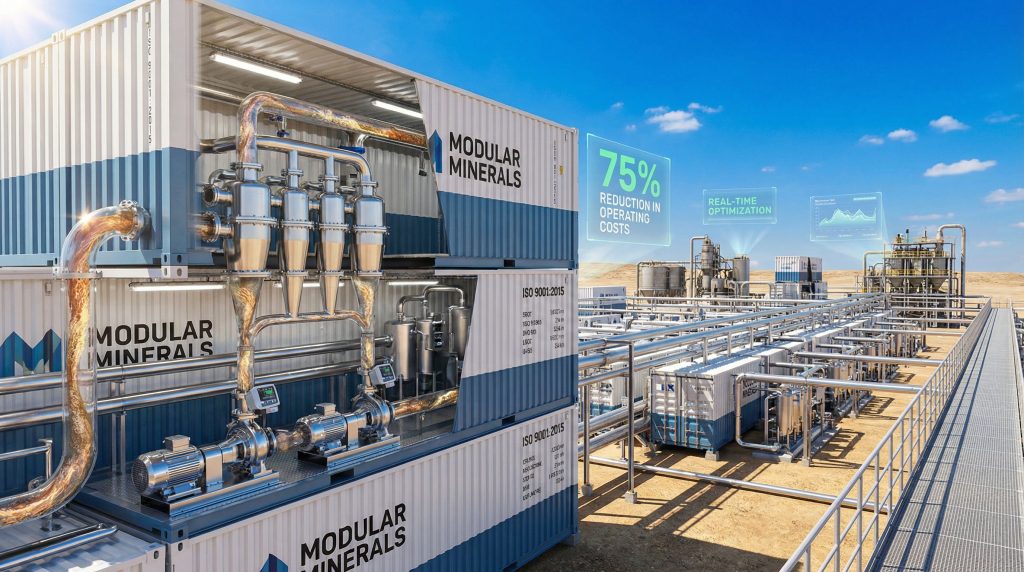
A modular grinding classification system integrates multiple specialised components within standardised housing units designed for rapid deployment and seamless integration. The primary elements include hydrocyclone clusters engineered for precise particle separation, centrifugal pump assemblies with variable operational parameters, and sophisticated monitoring equipment that enables real-time process optimisation.
The hydrocyclone configuration typically features multiple units arranged to maximise classification efficiency while maintaining compact footprint requirements. These cyclones operate on centrifugal force principles, utilising pressure differentials to separate particles based on size and density characteristics.
Feed pressures generally range from 50 to 200 kilopascals, with flow rates spanning 100 to 2,000 cubic metres per hour depending on circuit requirements and ore characteristics. The incorporation of AI in mining operations further enhances these systems' precision and efficiency.
Pump systems within modular configurations employ variable frequency drives that allow operators to adjust flow rates and pressure parameters dynamically. This flexibility enables optimisation across different ore types without requiring hardware modifications.
The integration of liquid resistance starters ensures smooth motor acceleration and reduces electrical stress during startup sequences. Particle size analysers provide continuous monitoring capabilities, feeding data to control systems that can automatically adjust operational parameters.
These instruments utilise laser diffraction or ultrasonic measurement techniques to deliver real-time particle size distribution data. Consequently, operators can maintain optimal classification cut points throughout varying feed conditions.
Standardised Container Integration Design
The containerisation approach addresses one of the most significant challenges in mineral processing equipment deployment: transportation logistics and site integration complexity. By designing modules to conform with ISO 20-foot and 40-foot shipping container dimensions, manufacturers enable standard transportation methods whilst ensuring global compatibility with existing logistics infrastructure.
Structural engineering considerations include load distribution systems that accommodate vertical stacking configurations up to three levels, depending on foundation capabilities and seismic requirements. The modular design incorporates pre-engineered lifting points that facilitate crane operations during installation whilst maintaining structural integrity throughout the equipment lifecycle.
Climate control systems protect sensitive instrumentation from environmental extremes commonly encountered in mining operations. These systems maintain optimal operating temperatures for electronic components whilst preventing condensation that could affect measurement accuracy or cause equipment failures.
When big ASX news breaks, our subscribers know first
Performance Comparison Between Modular and Traditional Classification Systems
Installation Timeline and Risk Mitigation
The installation acceleration achieved through modular systems represents one of the most significant operational advantages in contemporary mining projects. Industry reports indicate that modular approaches can achieve installation speeds four times faster than conventional custom-built solutions, translating to substantial reductions in project risk and capital exposure.
Traditional classification circuits typically require extensive site-specific engineering, with design phases often extending 8 to 12 months before construction can commence. The custom nature of these installations necessitates detailed geological assessments, process modelling, and iterative design refinements that can introduce significant schedule variability.
Pre-engineered modular systems eliminate many variables through standardised designs that have undergone extensive testing and optimisation. This standardisation enables design phase compression to 2 to 4 months whilst reducing the likelihood of unexpected technical challenges during installation.
The commissioning advantages of modular systems stem from factory testing and validation prior to site deployment. Individual modules undergo comprehensive performance verification in controlled environments, allowing potential issues to be identified and resolved before field installation.
This approach contrasts sharply with traditional systems where initial commissioning occurs entirely on-site, often under challenging conditions that complicate troubleshooting and optimisation. Furthermore, projects like the green iron project demonstrate how modular approaches accelerate sustainable mining initiatives.
Cost Structure Analysis and Economic Benefits
Capital cost optimisation through modular systems extends beyond simple equipment procurement to encompass multiple project phases. Engineering and design costs typically experience reductions of 20 to 30 percent due to standardised approaches and reduced customisation requirements.
Site preparation represents another area of significant cost advantage, with savings of 40 to 60 percent possible through standardised foundation designs and reduced civil works requirements. The predictable loading patterns and standardised connection interfaces of modular systems enable streamlined site preparation that eliminates much of the uncertainty associated with custom installations.
Installation labour optimisation achieves cost reductions of 70 to 80 percent through factory pre-assembly and standardised connection procedures. The containerised approach enables significant portions of system integration to occur in controlled manufacturing environments rather than challenging field conditions.
Mill Type Compatibility and Application Ranges
Vertical Grinding Mill Integration
Vertimill technology represents one of the most suitable applications for modular classification systems due to the high-efficiency fine grinding requirements and space constraints typically encountered in these installations. The vertical orientation of these mills naturally complements modular classification approaches that emphasise compact footprint utilisation.
Fine grinding applications in the P80 range of 10 to 150 microns particularly benefit from the precise classification control enabled by modular systems. The standardised nature of modular classification enables consistent performance across different installations whilst maintaining the flexibility to accommodate varying ore characteristics through operational parameter adjustments.
Capacity scalability represents a critical advantage, with modular systems supporting throughput ranges from 50 to 4,000 tonnes per hour through parallel module deployment and configuration optimisation. This scalability enables mining operations to match processing capacity with ore body development and market demand fluctuations.
Energy consumption optimisation occurs through precise classification control that minimises overgrinding whilst ensuring product specifications are consistently met. The real-time monitoring capabilities of modular systems enable automatic adjustments that maintain optimal energy efficiency throughout varying feed conditions.
Stirred Media Reactor Applications
Ultra-fine grinding requirements in the P80 range of 5 to 45 microns present unique challenges for classification systems due to the tendency of fine particles to exhibit complex settling behaviours. Modular classification systems address these challenges through specialised hydrocyclone configurations and precise flow control capabilities.
High-intensity grinding with ceramic or steel media generates particle size distributions that require sophisticated classification approaches to achieve target product specifications. The standardised nature of modular systems ensures consistent performance whilst maintaining the flexibility to accommodate different media types and grinding intensities.
Continuous discharge classification requirements align well with modular system capabilities, particularly the ability to maintain stable operating parameters throughout extended production periods. The integrated monitoring systems enable predictive maintenance scheduling that minimises unplanned downtime.
Conventional Ball Mill Circuit Enhancement
Multi-stage grinding operations involving primary, secondary, and tertiary stages benefit from modular classification systems through standardised interfaces that facilitate integration with existing equipment. The modular approach enables selective upgrades to specific circuit stages without requiring complete system replacement.
Closed-circuit operation with optimised circulating loads represents a key application area where modular systems excel through precise flow control and automated adjustment capabilities. The ability to maintain optimal circulating load ratios enhances grinding efficiency whilst minimising energy consumption.
Retrofit applications for existing plant upgrades present particular advantages for modular systems due to their standardised connection interfaces and compact configurations. The containerised approach enables installation during scheduled maintenance periods with minimal disruption to ongoing operations.
Technical Specifications and Design Parameters
Hydraulic System Design Requirements
| Parameter | Operating Range | Optimisation Factors |
|---|---|---|
| Feed Pressure | 50-200 kPa | Cyclone diameter and apex sizing |
| Flow Capacity | 100-2,000 m³/h | Pump selection and pipeline design |
| Solids Content | 15-65% by weight | Ore characteristics and circuit objectives |
| Particle Range | 1-1,000 microns | Classification efficiency requirements |
Pressure management systems within modular configurations utilise variable frequency drives to maintain optimal operating conditions across different feed characteristics. The ability to adjust pressure parameters dynamically enables operators to optimise classification performance for varying ore types without hardware modifications.
Flow distribution systems ensure uniform feed to multiple hydrocyclones whilst maintaining pressure stability throughout the circuit. The standardised manifold designs eliminate many potential flow irregularities that can compromise classification efficiency in custom-built systems.
Solids concentration control represents a critical parameter that affects both classification efficiency and downstream processing requirements. Modular systems incorporate automated density measurement and control systems that maintain optimal solids loading throughout varying feed conditions.
Electrical and Control System Integration
Variable frequency drive compatibility spans voltage ranges from 480 volts to 6.6 kilovolts, accommodating different site electrical infrastructure requirements. The standardised electrical interfaces simplify integration with existing plant control systems whilst maintaining flexibility for future upgrades.
Process control integration utilises programmable logic controllers (PLCs) with SCADA compatibility, enabling seamless integration with existing plant automation systems. The standardised control interfaces reduce commissioning complexity whilst ensuring consistent operational behaviour across different installations.
Automated startup and shutdown sequences minimise operator intervention whilst ensuring safe and consistent system operation. These sequences incorporate safety interlocks and diagnostic capabilities that protect equipment and personnel whilst optimising operational efficiency.
Performance monitoring systems provide real-time data on classification efficiency, energy consumption, and equipment condition. This information enables predictive maintenance scheduling and operational optimisation that maximises system availability and performance.
Process Optimisation Strategies for Different Ore Types
Hard Rock Mineral Processing Applications
Copper-gold porphyry deposits require multi-stage classification strategies that accommodate the complex mineralogy and varying liberation characteristics typical of these ore bodies. The modular approach enables flexible circuit configurations that can be optimised for specific mineral associations and grade distributions.
Iron ore operations demand high-tonnage processing capabilities with coarse classification requirements that emphasise throughput over fine particle recovery. Modular systems address these requirements through parallel module deployment and optimised hydrocyclone configurations designed for high-capacity operation.
Nickel laterite processing presents unique challenges due to corrosive environments and complex clay mineralogy that can affect classification performance. The modular approach enables rapid equipment replacement and specialised material selection that extends service life in these challenging conditions.
Industrial Mineral Processing Requirements
Limestone and cement raw material processing emphasises high-capacity, low-pressure systems that minimise energy consumption whilst maintaining product quality specifications. The standardised nature of modular systems enables consistent performance across multiple installations serving cement manufacturing operations.
Phosphate rock processing requires chemical compatibility considerations due to the corrosive nature of phosphate slurries and the potential for scale formation. Modular systems accommodate these requirements through specialised material selection and design features that facilitate maintenance and cleaning operations.
Silica sand operations demand ultra-fine classification precision to meet stringent glass manufacturing specifications. The sophisticated monitoring capabilities of modular systems enable the precise control necessary to consistently achieve these demanding product requirements.
Installation and Commissioning Methodology
Site Preparation and Infrastructure Development
Foundation design optimisation for modular systems emphasises load distribution principles that accommodate the concentrated loading patterns typical of containerised equipment. The standardised foundation requirements reduce engineering complexity whilst ensuring adequate support for vertical stacking configurations.
Utility connection planning encompasses electrical, water, compressed air, and instrumentation interfaces that follow standardised specifications. This standardisation reduces site preparation complexity whilst ensuring compatibility with existing plant infrastructure.
Process piping interfaces utilise standard connection specifications and expansion joint arrangements that accommodate thermal cycling and mechanical vibration. The standardised approach simplifies installation whilst ensuring long-term reliability under challenging operating conditions.
Crane access requirements for module placement and maintenance operations necessitate careful site layout planning that considers both initial installation and ongoing service needs. The standardised lifting arrangements simplify crane selection and positioning requirements.
Commissioning Protocol and Performance Validation
Critical Success Factor: Industry best practices emphasise phased commissioning approaches that validate individual module performance before integrating complete circuits, minimising startup risks whilst enabling systematic optimisation of performance parameters.
Module-by-module testing protocols enable systematic validation of individual system components before full circuit integration. This approach facilitates troubleshooting and optimisation whilst reducing the complexity of initial startup operations.
Integrated circuit performance verification encompasses flow balance testing, classification efficiency measurement, and control system validation that ensures optimal performance across all operating conditions. The standardised testing procedures reduce commissioning duration whilst ensuring consistent results.
Process control system calibration requires sensor validation, control loop tuning, and alarm testing that verifies system safety and performance capabilities. The standardised control systems reduce calibration complexity whilst ensuring consistent operational behaviour.
Operator training and documentation transfer encompasses system operation, maintenance procedures, and troubleshooting guidance that enables effective ongoing operation. The standardised nature of modular systems facilitates training programme development and knowledge transfer between installations.
Moreover, events like the global mining innovation expo showcase these advanced commissioning methodologies and their practical implementations across various mining applications.
The next major ASX story will hit our subscribers first
Maintenance Optimisation and Lifecycle Management
Preventive Maintenance Strategies
Standardised component specifications enable consolidated spare parts inventory management that reduces holding costs whilst improving parts availability. The modular approach facilitates component standardisation across multiple installations, enabling economies of scale in maintenance operations.
Modular replacement capabilities minimise downtime duration through rapid component exchange rather than extensive repair operations. The containerised design enables complete module replacement during scheduled maintenance periods, reducing production impact.
Predictive maintenance integration utilises Internet of Things (IoT) sensors and machine learning algorithms that identify potential failures before they occur. This approach enables proactive maintenance scheduling that maximises equipment availability whilst minimising maintenance costs.
Remote monitoring capabilities enable centralised oversight of multiple installations through digital connectivity and cloud-based data analysis. This capability facilitates expert support and optimisation across geographically distributed operations.
According to recent industry reports from Metso's modular grinding innovations, these predictive maintenance strategies are showing significant promise in reducing operational costs.
Lifecycle Cost Analysis and Economic Projections
| Cost Category | 5-Year Traditional | 5-Year Modular | Savings Achieved |
|---|---|---|---|
| Maintenance Labour | $850,000 | $620,000 | 27% reduction |
| Spare Parts Inventory | $1,200,000 | $890,000 | 26% reduction |
| Production Downtime | $2,100,000 | $1,400,000 | 33% reduction |
| Total Lifecycle Cost | $4,150,000 | $2,910,000 | 30% reduction |
Note: Cost projections are based on industry analysis and may vary depending on specific site conditions, ore characteristics, and operational practices. Actual results should be validated through site-specific engineering studies.
Maintenance labour optimisation occurs through standardised procedures and reduced complexity that enable more efficient maintenance execution. The modular design facilitates access to components whilst minimising the specialised knowledge required for service operations.
Spare parts consolidation achieves cost reductions through standardised component specifications that enable bulk purchasing and reduced inventory diversity. The economies of scale possible with standardised components significantly reduce ongoing maintenance costs.
Downtime minimisation represents the most significant economic benefit, with rapid replacement capabilities and predictive maintenance enabling substantial improvements in equipment availability. The production value preserved through improved availability typically exceeds other cost savings combined.
Future Technology Integration and Development Trends
Digital Transformation and Industry 4.0 Implementation
Artificial intelligence applications in process optimisation represent emerging capabilities that enable autonomous adjustment of classification parameters based on real-time performance data and predictive modelling. These systems can identify optimal operating conditions more rapidly and accurately than traditional control approaches.
Machine learning algorithms for predictive maintenance utilise historical performance data and real-time sensor information to predict component failures and optimise maintenance scheduling. This capability enables transition from reactive to proactive maintenance strategies that maximise equipment availability.
Digital twin technology enables virtual performance modelling that can simulate different operating scenarios and predict system behaviour under varying conditions. This capability facilitates optimisation without disrupting production operations whilst enabling training and scenario planning.
Blockchain integration for supply chain transparency provides component traceability and maintenance history documentation that enhances quality assurance and warranty management. This technology enables improved vendor accountability and lifecycle cost optimisation.
Furthermore, industry publications like Construction Equipment Guide highlight how these digital transformation initiatives are reshaping the mineral processing landscape.
Sustainability and Environmental Innovation
Energy efficiency improvements through advanced motor technology and process optimisation algorithms reduce power consumption whilst maintaining or improving performance. The modular approach facilitates technology upgrades that improve efficiency throughout the equipment lifecycle.
Water recycling integration and closed-loop system design minimise fresh water consumption whilst reducing environmental discharge requirements. The standardised approach facilitates consistent implementation of water conservation technologies across multiple installations.
Material waste reduction through precision classification control minimises overgrinding and improves recovery of valuable minerals. The improved process control enabled by modular systems typically results in measurable improvements in resource utilisation efficiency.
Carbon footprint reduction occurs through optimised manufacturing processes, reduced transportation requirements, and improved operational efficiency that collectively reduce greenhouse gas emissions throughout the equipment lifecycle.
Frequently Asked Questions About Modular Grinding Classification Systems
Can modular systems accommodate varying ore characteristics within the same operation?
Operational flexibility represents a key advantage of modular grinding classification systems, with adjustable parameters including hydrocyclone configurations, pump speeds, and classification cut points that enable optimisation for different ore types within the same circuit. The standardised control systems facilitate rapid parameter changes without requiring hardware modifications.
The real-time monitoring capabilities enable automatic adjustment of operational parameters in response to changing ore characteristics, maintaining optimal performance throughout varying feed conditions. This adaptability eliminates the need for multiple specialised circuits whilst maintaining consistent product quality.
How do space requirements compare between modular and traditional installations?
Spatial efficiency improvements of 30 to 50 percent are typically achieved through vertical stacking capabilities and optimised equipment arrangement that maximises processing capacity within constrained footprints. The containerised approach enables creative installation configurations that would be difficult or impossible with traditional equipment layouts.
Brownfield expansion applications particularly benefit from the compact configurations possible with modular systems, enabling capacity increases within existing plant boundaries that would otherwise require facility relocations or major infrastructure modifications.
What transportation and logistics considerations apply to remote mining locations?
Standard ISO container compatibility ensures seamless integration with existing transportation infrastructure, including road, rail, and sea freight options that eliminate the need for specialised handling equipment or transportation arrangements. The containerised approach significantly simplifies logistics for remote locations.
Specialised handling equipment availability for remote site delivery includes container-capable cranes and transport vehicles that are widely available in most mining regions. The standardised dimensions eliminate many logistical challenges associated with oversize equipment transportation.
Installation flexibility enables deployment in locations where traditional construction would be challenging or impossible, providing mining operations with processing capabilities in previously inaccessible areas whilst maintaining full functionality and performance standards.
Are You Ready to Capitalise on the Next Breakthrough in Mining Technology?
The modular grinding revolution is transforming mineral processing operations worldwide, and Discovery Alert's proprietary Discovery IQ model ensures you're immediately notified when ASX-listed companies announce significant technological advancements or discoveries that could drive substantial returns. Discover how historic mineral discoveries have generated exceptional market performance, then begin your 30-day free trial today to position yourself ahead of these game-changing developments in the mining sector.