July 10, 2026
Why the Vicuña District Keeps Rewriting the Rules of Copper Exploration
There are geological addresses in the world where the structural conditions are so favourable, so persistently productive, that each new drill program seems to uncover something significant. The Vicuña district, straddling the high-altitude border region between Argentina and Chile, has earned that reputation through results rather than rhetoric. It is a belt that has produced multiple world-class copper-gold deposits in relatively quick succession, and the Mogotes Metals Filo Sur copper-gold discovery is the latest chapter in that story.
Understanding why this district keeps delivering requires looking past individual intercepts and into the architecture of the rock itself. The Macho Muerto Fault Zone, a deep-seated structural feature running through the district, functions as a long-lived conduit for hydrothermal fluids — the superheated mineral-rich waters that carry copper, gold, silver, and molybdenum upward through the crust. When those fluids interact with the right host rocks and cool or depressurise, they deposit their metal cargo.
The Vicuña district has experienced this process repeatedly, across multiple geological episodes, which is precisely why it hosts successive large-scale finds rather than isolated pockets. Furthermore, these copper-gold giant belts are among the most consequential geological features in modern mining exploration, and Vicuña sits firmly within that category.
The established names in the district speak for themselves. BHP and Lundin Mining's Filo del Sol ranks among the most consequential copper-gold-silver discoveries made globally in the past three decades. NGEx Minerals' Lunahuasi and Los Helados sit along the same structural belt, both in active resource definition. These are not coincidental clusters — they reflect a shared geological plumbing system that mineralised repeatedly over deep time.
Key Geological Principle: When a structural corridor hosts more than two independent copper-gold deposits of scale, geologists treat the entire belt as prospective until disproven. The Vicuña district has surpassed that threshold several times over.
When big ASX news breaks, our subscribers know first
The Filo Sur Land Package: Position, Structure, and Targeting Logic
Against this backdrop, the Mogotes Metals Filo Sur copper-gold discovery takes on a context that raw grade numbers alone cannot convey. The Filo Sur project sits directly adjacent to Filo del Sol, sharing the same structural corridor and, critically, the same style of mineralisation. The project's land package spans both Argentina and Chile, covering an 8-kilometre strike length that has now demonstrated copper-gold bearing rock across its full extent.
Within the project, four distinct exploration areas have been defined across a 3.5-kilometre internal corridor: Meseta, Luz del Sol, Cumbre, and Albor. The Luz del Sol target trend provides the broader structural framework connecting these zones, functioning as the surface expression of the same deep fault architecture that channelled fluids into the Filo del Sol system next door. This configuration is reminiscent of another major copper-gold project where structural positioning proved central to defining mineralisation at scale.
What distinguished the 2025-2026 inaugural drill program from conventional exploration campaigns was the sequencing of work. Before a single hole was drilled, the team deployed underground geophysical scanning surveys to map subsurface anomalies consistent with large hydrothermal systems. This survey-first methodology reduces the probability of drilling past mineralisation and adds interpretive weight to any positive result. When geophysics predicts an anomaly and drilling confirms copper-gold at that location, the result is scientifically credible in a way that randomly targeted holes are not.
The 2025-2026 season totalled 6,207 metres of drilling across the Filo Sur project, with Argentina results being released first and Chile-side results expected separately in mid-2026.
Dissecting the Albor Intercept: Grades, Depths, and Geological Signals
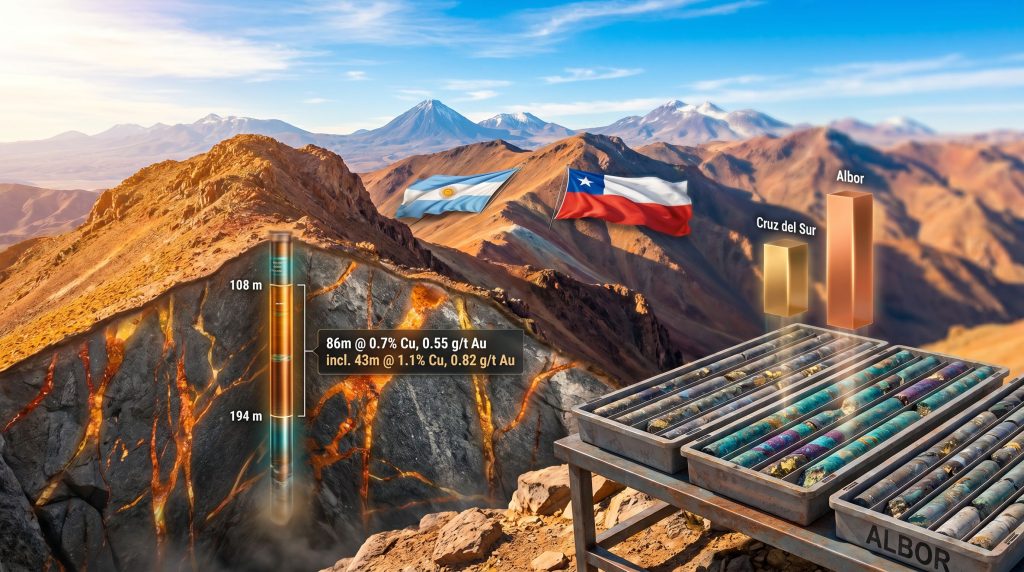
The Albor result, released in May 2026, represents the strongest single drill intercept in the project's exploration history. The numbers warrant close examination — not only for their absolute values but for what the associated rock characteristics reveal about system scale.
The Headline Drill Data
| Metric | Albor Result |
|---|---|
| Total Mineralised Interval | 86 metres |
| Average Copper Grade | 0.7% Cu |
| Average Gold Grade | 0.55 g/t Au |
| Average Silver Grade | 2.7 g/t Ag |
| Molybdenum | 169 ppm |
| High-Grade Core Length | 43 metres |
| High-Grade Core Copper | 1.1% Cu |
| High-Grade Core Gold | 0.82 g/t Au |
| Mineralisation Start Depth | 108 metres |
| Reported Interval End | 194 metres |
| Total Hole Depth | 464 metres |
| Assays Pending | 270 metres (below 194m) |
Several aspects of this data carry significance beyond the headline grades. The fact that meaningful copper-gold mineralisation begins at just 108 metres below surface is geologically and economically notable. Shallower mineralisation reduces the stripping and extraction costs associated with any potential future development scenario, even if that consideration remains distant at this stage of exploration. Surface sampling nearby confirmed that copper-gold grades continue upward toward the surface beneath shallow cover, suggesting the system's upper boundary has not yet been defined.
The partial nature of the assay release deserves emphasis. The reported interval covers the section from 108 to 194 metres. The remaining 270 metres of the 464-metre hole had not been processed by the laboratory at the time of announcement. In practical terms, this means the vertical extent of mineralisation at Albor remains an open question — and potentially a significant one. For investors new to this space, interpreting drill results at this stage requires careful attention to what has and has not yet been reported.
What the Rock Tells Geologists That Grade Alone Cannot
The most analytically important detail from Albor is not the copper number. It is the evidence of multiple distinct hydrothermal fluid pulses preserved in the rock record. In copper-gold exploration, particularly in porphyry and high-sulphidation epithermal systems of the type found in the Andes, the presence of superimposed mineralising events indicates a system that was fed repeatedly over geological time.
Single-pulse systems tend to be smaller. Multi-phase systems — where successive fluid injections each add copper and gold to the rock package — tend to be larger and more consistent. Moreover, understanding true width vs apparent width in these intercepts is essential for accurately assessing what the 86-metre interval truly represents in three dimensions.
Technical Insight: The identification of multiple hydrothermal overprinting events at Albor mirrors the documented geological history of Filo del Sol. This characteristic is a recognised hallmark of large-scale Andean copper-gold systems, not a feature typically associated with isolated, economically marginal mineralisation.
Two additional metallurgical signals from Albor warrant attention. First, the low arsenic levels recorded in the drill core. Arsenic is a problematic contaminant in copper concentrates because it complicates smelting, can attract penalty charges from offtake buyers, and in high concentrations can effectively make a copper deposit unprocessable by conventional methods. Albor's low arsenic signature removes a potential future complication.
Second, the co-occurrence of molybdenum at 169 ppm alongside copper and gold is geologically meaningful. Molybdenum is commonly associated with the cores of porphyry systems, and its presence in a gold-copper context often signals proximity to a deep porphyry heat engine — the source of the mineralising fluids. These are precisely the kinds of large-scale ore system features that experienced geologists look for when assessing a project's potential scale.
Cruz del Sur and Albor: Reading the Two-Discovery Signal
Approximately four weeks before the Albor announcement, Mogotes released results from Cruz del Sur — the first confirmed copper-gold area from the inaugural drilling season. Cruz del Sur returned high-grade gold and zinc at shallow depth, with a copper-gold-molybdenum system confirmed at greater depth. Copper grades at Cruz del Sur were observed strengthening with depth, a characteristic that geologists interpret positively because it suggests the system becomes more economically relevant as drilling goes deeper toward its source.
The significance of confirming two separate mineralised areas in a single inaugural program cannot be overstated in the context of exploration risk assessment. These are not extensions of the same zone. They are independent mineralising centres within the same project boundary, each with its own structural controls and hydrothermal histories.
Statistical Context: Confirming two distinct copper-gold-silver-molybdenum systems within a single first-pass drilling campaign — both pre-identified through geophysics before any holes were turned — is an uncommon exploration outcome. Most inaugural programs return one priority result, if any.
Both Cruz del Sur and Albor were identified through underground scanning surveys before drilling began. This pre-drill geophysical prediction, followed by drill confirmation, is the same sequencing that underpinned early-stage work at the Vicuña district's most significant discoveries. Consequently, the credibility of the targeting methodology is now supported by two independent positive outcomes.
Contextualising Albor Against the Vicuña District Benchmark
Placing the Mogotes Metals Filo Sur copper-gold discovery in its regional context requires honest comparison. The Vicuña belt has set a high bar.
| Discovery | Operator | Character | Status |
|---|---|---|---|
| Filo del Sol | BHP / Lundin Mining (TSX: LUN) | Large-scale Cu-Au-Ag | Advanced development |
| Lunahuasi | NGEx Minerals | High-grade Cu-Au | Resource definition |
| Los Helados | NGEx Minerals | Bulk-tonnage Cu-Au | Resource definition |
| Cruz del Sur | Mogotes Metals (TSXV: MOG) | Au-Zn shallow / Cu-Mo at depth | Early-stage, inaugural program |
| Albor | Mogotes Metals (TSXV: MOG) | 0.7% Cu, 0.55 g/t Au over 86m | One hole, partial assays |
Albor has been described by Mogotes' management as representing results that are materially superior to any previous drilling conducted on the Filo Sur property. That characterisation frames it not merely as a strong individual drill result but as a fundamental shift in the project's exploration narrative. Whether Albor ultimately resembles the scale of adjacent systems will be determined over multiple drilling campaigns and years of follow-up work.
The Exploration Cycle Investors Need to Understand
Discovery-stage copper-gold projects in structurally complex belts like Vicuña follow a recognisable progression. Understanding where Albor sits within that cycle is essential for any investor attempting to assess the risk-reward equation.
- Geophysical Target Generation — Systematic underground scanning identifies subsurface anomalies before drilling capital is committed. Both Cruz del Sur and Albor were pre-selected this way.
- First-Pass Drill Testing — Initial holes test the highest-priority geophysical targets, establishing whether mineralisation is present and characterising the system type.
- Partial Assay Release — Early laboratory results from the first portion of the hole are published while the remainder is being processed, creating a staged newsflow sequence.
- Full Hole Results and System Characterisation — Complete assay data allows assessment of the vertical extent of mineralisation and informs the design of follow-up drilling.
- Follow-Up Drilling Program — A second campaign tests the lateral and depth extent of the system, with the objective of demonstrating continuity.
- Resource Estimation — Once sufficient drilling density is achieved, a formal mineral resource estimate is prepared under applicable standards such as NI 43-101.
Investor Framework: At the current stage, Albor sits between Steps 2 and 3. One hole has been drilled, partial assays have been released, and the remaining 270 metres of drill core is still being processed. The distance between this point and a defined resource represents both the material risk and the potential upside that early-stage investors are pricing.
The next major ASX story will hit our subscribers first
Risk Factors and What Remains Unproven
Material Uncertainties at This Stage
- Albor has been tested by a single drill hole. Lateral continuity, system width, and horizontal dimensions are entirely uncharacterised.
- The lower 270 metres of the Albor hole remain unreported, leaving the vertical extent of mineralisation undefined.
- No mineral resource estimate exists for Albor or Cruz del Sur under any reporting standard.
- Chile-side results from the Filo Sur project have not yet been released, meaning a significant portion of the project's geological story remains unpublished.
- Exploration-stage companies carry inherent risks including financing requirements, permitting timelines, and execution challenges distinct from development or production-stage assets.
Factors That Differentiate Filo Sur's Risk Profile
- A reported $42 million cash position provides a funded pathway to follow-up drilling without immediate dilution pressure.
- The geophysical pre-selection of both discoveries reduces the probability that future drill programs miss mineralisation at already-identified targets.
- Low arsenic at Albor eliminates a common source of metallurgical complexity that has complicated other Andean copper projects.
- Proximity to Filo del Sol provides an exceptionally well-characterised geological analogue for system-scale interpretation.
Pending Newsflow and Upcoming Catalysts
The majority of assay results from the 6,207-metre 2025-2026 season had not been released at the time of the Albor announcement. The upcoming newsflow sequence includes several distinct potential announcement events:
- Full Albor hole assays covering the remaining 270 metres below 194 metres depth.
- Remaining 2025-2026 season results from Argentina, representing the bulk of the season's unannounced drilling.
- Chile-side results, expected as a separate announcement in mid-2026, covering the Chilean portion of the Filo Sur land package.
- November 2026 follow-up drilling program, which will test the lateral and depth extensions of Albor as the primary objective.
Each of these represents an independent information event. The November 2026 program is the critical scientific test: it will determine whether copper-gold bearing rock at Albor extends meaningfully outward from the single intercept confirmed so far, or whether the first hole captured an isolated occurrence.
FAQs: Mogotes Metals Filo Sur Copper-Gold Discovery
What did the Albor drill intercept return?
The first partial assay from the Albor target returned 86 metres averaging 0.7% copper and 0.55 g/t gold, including a 43-metre higher-grade core grading 1.1% copper and 0.82 g/t gold, starting at 108 metres depth. These results cover the interval from 108 to 194 metres, with 270 metres of the 464-metre hole still awaiting laboratory results.
Why do multiple hydrothermal pulses matter geologically?
In Andean copper-gold systems, evidence of repeated fluid injection events in the rock record is associated with larger, more consistent mineralisation packages. Single-pulse systems tend to be more limited in scale. The multi-phase signature at Albor mirrors what has been documented at the adjacent Filo del Sol deposit.
What is Cruz del Sur and how does it relate to Albor?
Cruz del Sur is a separate mineralised area on the Filo Sur project, confirmed approximately four weeks before Albor. It returned shallow high-grade gold and zinc, with copper-gold-molybdenum confirmed at depth. Cruz del Sur and Albor are independent mineralising centres, not extensions of the same zone.
How much of the drill program remains unreported?
Of the 6,207 metres drilled in the 2025-2026 season, the majority of assay results had not been released at the time of the Albor announcement. Chile-side results are expected separately in mid-2026.
What is the Vicuña district and why does it attract institutional attention?
The Vicuña district is a structurally controlled copper-gold corridor along the Argentina-Chile border that hosts multiple world-class deposits including Filo del Sol, Lunahuasi, and Los Helados. Its track record of producing successive large-scale finds along a shared geological structure makes it one of the most closely watched copper exploration addresses globally.
When is the next major catalyst for the project?
The full Albor hole assay results, remaining 2025-2026 season results, Chile-side results expected in mid-2026, and the November 2026 follow-up drilling program represent the primary near-term announcement milestones.
This article contains forward-looking statements and exploration-stage analysis. Drill results from a single hole do not establish the presence of a mineral resource. Investors should review all public disclosure from Mogotes Metals Inc. (TSXV: MOG) and consult qualified financial and geological advisors before making investment decisions. Early-stage exploration investments carry material risk of total loss.
Want to Be First to Know About the Next Major Copper-Gold Discovery on the ASX?
Discovery Alert's proprietary Discovery IQ model scans ASX announcements in real time, instantly identifying significant mineral discoveries and translating complex geological data into actionable investment insights — the same kind of structural copper-gold plays that have historically generated extraordinary returns. Explore Discovery Alert's dedicated discoveries page to understand how major mineral finds have rewarded early investors, and begin your 14-day free trial at Discovery Alert to position yourself ahead of the broader market.