July 14, 2026
The Processing Gap That Will Define Africa's Mineral Century
For decades, the story of African resource wealth has followed a familiar and frustrating arc: minerals extracted from the ground, loaded onto ships in raw form, and transformed into finished industrial materials somewhere else, with the majority of economic value captured far from the continent where those resources originated. Graphite is no exception to this pattern, and yet it may be among the first minerals where an African-owned enterprise attempts to fundamentally rewrite the terms of engagement.
Understanding why Mohammed Dewji battery-grade graphite ambition in Tanzania matters requires stepping back from the announcement itself and examining the structural economics of critical mineral supply chains, because the investment logic only becomes clear once you grasp where value is actually created in the graphite market.
When big ASX news breaks, our subscribers know first
What Battery-Grade Graphite Actually Is, and Why the Purity Gap Is So Consequential
Raw natural graphite mined from the earth typically achieves carbon purity levels somewhere between 85% and 95%, depending on the deposit's geology and the beneficiation methods applied on-site. That material has commercial uses, particularly in refractory applications and industrial lubricants, but it cannot go directly into a lithium-ion battery.
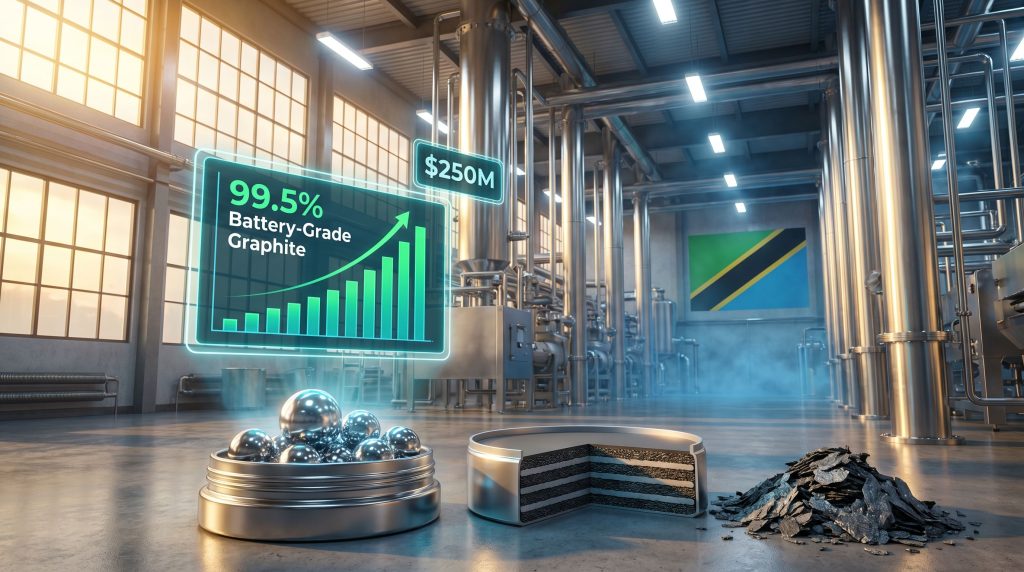
Battery manufacturers require a fundamentally different product. Spherical graphite, the form used in lithium-ion battery anodes, must achieve a minimum carbon purity of 99.5%. Reaching that threshold from a 94–95% starting point requires a series of chemically intensive purification steps, followed by micronisation and spheronisation processes that reshape graphite flakes into rounded particles optimised for electrochemical performance.
This is not a marginal refinement operation; it is a sophisticated industrial manufacturing process that demands precision engineering, chemical handling infrastructure, and consistent process control.
The economic consequence of this technical gap is significant. The price differential between run-of-mine graphite concentrate and battery-grade spherical graphite can represent a multiple of the raw material value, meaning the processing stage, not extraction, is where the majority of economic surplus is generated. Any nation or company that controls processing infrastructure captures this premium. Any that exports raw material surrenders it.
Why Graphite's Role in the Energy Transition Is Structurally Different from Other Critical Minerals
Graphite occupies a uniquely important position in the battery supply chain that is not always appreciated in mainstream coverage of critical minerals. Each electric vehicle battery pack requires roughly 50 to 100 kilograms of graphite by weight, more than any other single mineral input. Cobalt, lithium, and nickel receive far more public attention, but graphite is the dominant material by mass in every commercially deployed lithium-ion battery chemistry currently in use.
Furthermore, the battery metals investment landscape highlights just how central graphite is to the broader energy transition. This matters for several interconnected reasons:
- Graphite's electrical conductivity allows electrons to flow efficiently through the anode during charge and discharge cycles
- Its thermal stability enables batteries to operate safely across a wide temperature range without structural degradation
- The layered crystalline structure of graphite provides the physical framework within which lithium ions intercalate and de-intercalate during cycling, making it functionally irreplaceable in current battery designs
- Unlike some critical minerals where substitution is being actively researched, graphite's role in battery anodes remains essentially unchallenged by commercially viable alternatives at scale
Applications extend well beyond electric vehicles. Grid-scale energy storage systems, consumer electronics, industrial refractory materials used in steelmaking, electrodes in electric arc furnaces, and advanced aerospace composites all depend on graphite's unique physical properties.
Tanzania's Position in the Global Graphite Supply Picture
Reserve Scale and Geological Character
| Metric | Data Point |
|---|---|
| Estimated National Reserves | 17 million tonnes |
| Global Reserve Ranking | 6th largest globally |
| Primary Deposit Locations | Central and southeastern Tanzania |
| Africa's Largest Graphite Holders | Madagascar, Mozambique, Tanzania |
| Africa's Share of Global Reserves | ~24% |
Tanzania's graphite deposits are characterised by their geological accessibility relative to other major African reserve holders, a factor that meaningfully affects the economics of extraction and the capital required to bring production to scale. The country's proximity to Indian Ocean shipping corridors also provides a logistical advantage for reaching export markets in Asia and Europe, both of which are growing buyers of battery materials.
The China Concentration Problem That Makes African Graphite Strategically Important
China currently controls approximately 70% of global natural graphite mining and commands an even larger proportion of the world's graphite processing and refining capacity. This concentration has created a structural vulnerability that automakers, battery manufacturers, and policymakers across Europe, Japan, South Korea, and the United States have identified as a priority risk to manage.
The global graphite shortage is, in part, a consequence of this extreme concentration, which makes African supply alternatives all the more urgent. As noted by industry analysts:
Africa holds approximately 24% of the world's known natural graphite reserves, positioning the continent as the most credible alternative supply source outside China's existing production infrastructure.
The geopolitical and commercial pressure to diversify graphite supply chains is therefore not a theoretical future concern; it is an active procurement priority for battery manufacturers assembling their medium-term supply strategies right now. Tanzania's 17 million tonne reserve base, if converted into processed battery-grade material through facilities like the one MeTL Group is developing, represents exactly the kind of alternative supply source those manufacturers are seeking.
How Tanzania Compares Within Africa's Graphite Landscape
| Country | Current Status | Value-Addition Ambition |
|---|---|---|
| Tanzania (MeTL) | Processing plant under development | 99.5% battery-grade spherical graphite |
| Mozambique | Active raw graphite export | Limited domestic processing |
| Madagascar | Established graphite mining | Primarily raw export |
| South Africa | Graphite exploration stage | Beneficiation policy framework in place |
Madagascar and Mozambique established graphite export operations ahead of Tanzania, but both countries remain primarily raw material exporters. Tanzania's entry into battery-grade processing, rather than raw concentrate export, positions it to compete on margin rather than volume — a strategically superior position if execution is successful.
Mohammed Dewji, MeTL Group, and the Industrial Logic Behind the Investment
Who MeTL Group Is and Why This Investment Is Structurally Different
MeTL Group is among the largest diversified conglomerates operating across East and Central Africa, with business activities spanning manufacturing, agriculture, real estate, and trade across more than 13 African countries. Unlike the foreign-capital-driven mining projects that have historically dominated African extractive industries, MeTL's graphite initiative is a domestically anchored industrial investment led by an African-owned entity with deep operational roots in Tanzania.
This distinction matters beyond optics. Foreign-owned mining projects have historically been structured to optimise returns for offshore shareholders, with limited incentive to invest in local processing infrastructure that would reduce the volume of material available for export and increase operating complexity. An African conglomerate with long-term industrial interests in Tanzania faces a fundamentally different set of incentives.
Mohammed Dewji has publicly set a target of tripling MeTL Group's annual revenue to $10 billion by 2035, with critical minerals identified as a central growth pillar in that trajectory. Forbes has estimated his net worth at $2.1 billion, placing him among East Africa's wealthiest individuals, which provides some indication of the financial backing available to support long-term capital commitments. According to Bloomberg's reporting on the investment, Dewji's expansion into battery minerals reflects a deliberate strategy to capture value at the processing stage rather than the extraction stage.
The Investment Architecture: Phase One Then Phase Two
The investment is structured in two distinct phases, each with different technical objectives and capital requirements:
Phase One: Establishing Commercial Processing Capacity
| Parameter | Detail |
|---|---|
| Facility Type | Graphite processing plant |
| Annual Throughput Capacity | 50,000 tonnes |
| Target Output Purity | 94–95% graphite concentrate |
| Expected Commissioning | Within 18 months of announcement |
| Initial Export Strategy | China (for further refining into battery-grade material) |
Phase Two: Upgrading to Full Battery-Grade Output
| Parameter | Detail |
|---|---|
| Target Purity | 99.5% spherical graphite |
| Additional Capital Required | $250 million |
| Timeline | Medium- to long-term horizon |
| Processing Technology | Sourced in part from Chinese technology providers |
| Target End Markets | European, Japanese, and South Korean battery manufacturers |
The phased structure reflects a commercially pragmatic approach to entering a technically demanding market. Phase One generates operational cash flows and builds process knowledge while Phase Two capital is assembled and the technical capability to achieve 99.5% purity at commercial scale is developed.
The decision to initially route Phase One exports through China for further refining is not a contradiction of the value-addition philosophy. It is a commercially realistic bridge strategy that allows MeTL to enter the market with existing infrastructure while building toward full in-country battery-grade processing over time.
Engaging European Battery Manufacturers on Technical Specifications
One of the less-discussed but technically critical aspects of MeTL's strategy is its active engagement with European partners to understand the precise product specifications required by battery manufacturers. This is more complex than simply reaching 99.5% purity.
Battery manufacturers impose detailed requirements on particle size distribution, surface area, tap density, and electrochemical performance characteristics that go well beyond a single purity metric. Developing a product that actually qualifies for battery supply chains requires iterative technical dialogue with end customers, and MeTL appears to be structuring those relationships from an early stage. The battery raw materials market is, furthermore, evolving rapidly, making early engagement with manufacturers strategically essential.
Africa's Broader Critical Minerals Positioning and What MeTL's Move Signals
The Value Capture Deficit That Defines Africa's Resource Economy
Africa holds approximately 30% of global critical mineral reserves but currently captures less than 1% of global manufacturing value derived from those resources, according to data referenced by the African Development Bank. This disparity is the defining structural problem of African resource economics, and it is the specific gap that beneficiation-first investment strategies are designed to address.
The African Development Bank has identified graphite, alongside lithium, cobalt, and manganese, as minerals where African nations have the most credible opportunity to move up the value chain in the near to medium term. The combination of reserve scale, existing geological characterisation, and growing global demand driven by EV adoption creates a window for African producers to establish processing infrastructure before global supply chains fully crystallise around alternative sources.
The Geopolitical Tailwind Without Overstating Its Effect
Western governments and major automakers are operating under mounting pressure to reduce their dependence on Chinese-controlled graphite supply chains. Consequently, the connection between critical minerals and energy security has become a core policy priority across the United States, European Union, Japan, and South Korea, each of which has developed frameworks to incentivise non-Chinese sourcing of critical battery materials.
It is important to be precise here: these are policy frameworks operating at a macro level, not project-specific commitments or designated support for MeTL's facility. However, they do establish a procurement environment in which European and Asian battery manufacturers are actively motivated to develop qualifying alternative supply relationships, which aligns directly with MeTL's target customer base.
What Dewji's Philosophy Means for African Industrial Development
Speaking at the Africa Unlocked 2026 conference hosted by Standard Bank in Cape Town on 9–10 July, Dewji articulated a position that Africa's renewed importance in global critical mineral supply chains represents an opportunity that must be approached differently than previous commodity cycles. His argument, paraphrased accurately, is that African nations must prioritise retaining the value generated from their own mineral resources rather than exporting that value in the form of raw materials.
MeTL's graphite investment is framed explicitly as an expression of that principle in practice, not merely as a financial opportunity. In addition, strategic critical minerals reserves being developed by other nations underscore just how geopolitically significant these supply chain decisions have become.
Execution Risks and Market Realities That Investors and Observers Should Understand
No serious analysis of this investment can avoid engaging with the substantial execution challenges involved. As reported by mining.com.au, the Mohammed Dewji battery-grade graphite initiative in Tanzania faces several critical hurdles:
-
Technical complexity at scale: Achieving and sustaining 99.5% purity in spherical graphite production at 50,000 tonnes per year requires sophisticated chemical processing infrastructure and consistent operational control. This is a genuine technical challenge that Chinese processors took decades to master.
-
Chinese competitive position: Established Chinese graphite processors benefit from decades of accumulated process knowledge, deep supply chain integration, and cost structures built at extraordinary scale. Competing with them on price alone is not viable; MeTL's path to market must be built on supply chain diversification value and product qualification with non-Chinese buyers.
-
Price volatility exposure: Global graphite prices are cyclical and have experienced significant volatility. The economics of battery-grade processing depend on maintaining the price premium that battery-grade material commands over raw concentrate. If that premium compresses, the financial case for Phase Two investment weakens.
-
Offtake agreement necessity: The $250 million Phase Two investment is only commercially supportable if long-term offtake agreements with European or Asian battery manufacturers can be secured. These agreements typically require qualification testing periods and demonstrated product consistency before volumes are committed.
-
Workforce development: Battery-grade graphite processing requires a technically trained workforce with skills that do not currently exist in significant numbers within Tanzania's industrial labour market. Building that capability in parallel with facility construction is a non-trivial challenge.
The next major ASX story will hit our subscribers first
Frequently Asked Questions
What purity level distinguishes battery-grade graphite from standard processed graphite?
Battery-grade spherical graphite requires a minimum carbon purity of 99.5%. Standard graphite processing typically yields material in the 94–95% range. The gap between these two specifications represents the most technically demanding and economically valuable stage of the entire graphite supply chain.
How significant are Tanzania's graphite reserves in a global context?
Tanzania holds an estimated 17 million tonnes of graphite reserves, ranking it sixth globally by reserve size. Deposits are concentrated in the central and southeastern regions of the country, and the resource base is considered sufficient to support large-scale commercial processing over multiple decades.
Why is reducing dependence on Chinese graphite supply such a priority for EV manufacturers?
China controls approximately 70% of global graphite mining and processing capacity, creating a single-point vulnerability in global EV battery supply chains. Any supply disruption, export restriction, or geopolitical tension affecting Chinese graphite exports would have immediate and severe consequences for battery production in Europe, Japan, and South Korea.
What is the total capital commitment MeTL Group is making to the graphite sector?
Phase One involves establishing a 50,000-tonne-per-year processing facility targeting 94–95% purity. Phase Two targets an additional $250 million investment to upgrade output to 99.5% battery-grade spherical graphite, representing MeTL's medium- to long-term ambition in the sector.
Who are the intended customers for MeTL's battery-grade graphite output?
MeTL is targeting battery manufacturers and automotive supply chain operators in Europe, Japan, and South Korea, all of which are actively diversifying away from Chinese graphite dependence. Phase One material will initially be routed through China for further processing before in-country battery-grade capability is fully established.
Key Takeaways for Understanding This Investment's Significance
- Scale: A $250 million commitment to in-country battery-grade processing is among the largest announced by any African-owned entity in the critical minerals sector
- Strategic positioning: The phased approach from 94–95% purity to 99.5% reflects a realistic, commercially structured path toward capturing the high-margin portion of the graphite value chain
- Geopolitical alignment: MeTL's target customer base in Europe and Asia is precisely the group most motivated to find qualifying non-Chinese graphite supply
- Tanzania's window: With 17 million tonnes of reserves and a government increasingly supportive of local processing policies, Tanzania has a credible, time-limited opportunity to establish itself as a meaningful non-Chinese source of Mohammed Dewji battery-grade graphite
- Replication potential: If MeTL's model succeeds technically and commercially, it provides a replicable template for other African conglomerates to enter critical mineral value chains as industrial processors rather than raw material exporters
Africa's critical minerals conversation is evolving from a question of what the continent holds in the ground to a more consequential debate about who processes it, where, and under what terms. Mohammed Dewji's battery-grade graphite initiative in Tanzania is one of the most concrete private-sector expressions of that shift yet attempted by an African-led enterprise.
Readers seeking ongoing coverage of Africa's critical minerals sector, energy transition developments, and industrial policy can explore related reporting from Ecofin Agency at ecofinagency.com.
Want to Catch the Next Major Critical Mineral Discovery Before the Market Does?
Discovery Alert's proprietary Discovery IQ model scans ASX announcements in real time, instantly identifying significant mineral discoveries — including battery materials like graphite — and translating complex data into actionable investment insights for both short-term traders and long-term investors. Explore historic examples of major discoveries and their extraordinary returns, then begin your 14-day free trial to position yourself ahead of the market.