July 14, 2026
The Invisible Mine: Why Tailings Are Reshaping the Economics of Modern Resource Extraction
For most of the twentieth century, the dominant logic of mining was straightforward: extract the target mineral, process the ore, and manage what remained as cheaply as possible. The material left over, ground to a fine powder and pumped into engineered containment facilities, was treated as a cost to be minimised rather than a resource to be recovered. That assumption is now being fundamentally challenged, as tailings as a resource moves from fringe concept to mainstream strategic consideration, with significant implications for how the industry accounts for value, risk, and long-term liability.
The convergence of three structural forces is driving this reassessment. Commodity prices for critical minerals have risen sharply relative to historical averages. Processing technologies have advanced to the point where fine-grained, chemically complex residues can be treated economically. Furthermore, the regulatory and investor pressure to close or remediate legacy tailings storage facilities (TSFs) has created a financial incentive to extract value before undertaking costly closure programmes.
When big ASX news breaks, our subscribers know first
How Large Is the Global Tailings Inventory, and What Is It Actually Worth?
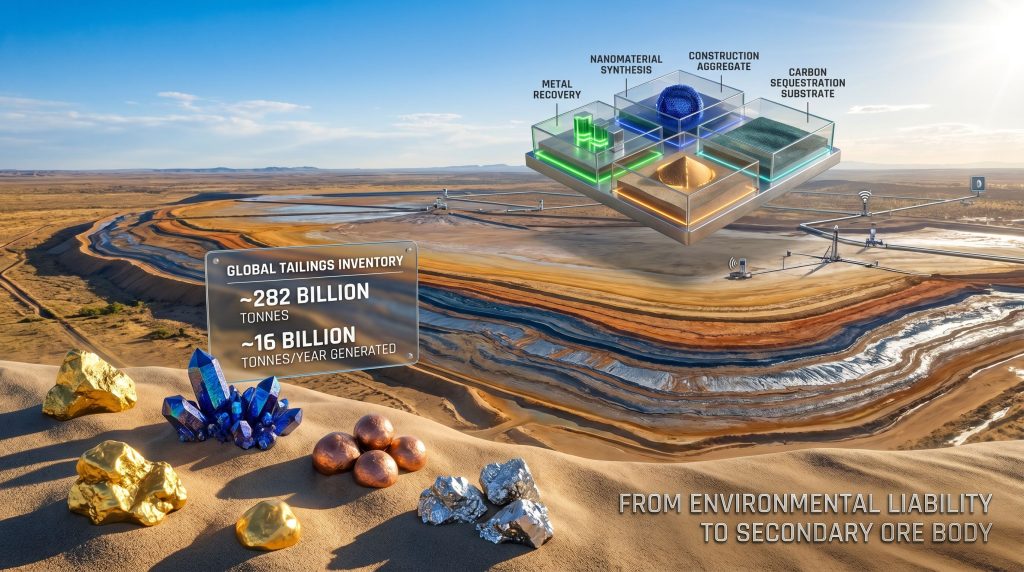
The scale of the global tailings inventory is rarely appreciated outside specialist circles. Cumulative global tailings stockpiles are estimated at approximately 282 billion tonnes, with the mining industry generating a further 16 billion tonnes per year through ongoing operations. These figures, cited in industry literature and resource sector analyses, represent a mineral inventory of extraordinary breadth.
| Metric | Estimated Figure |
|---|---|
| Global tailings inventory (cumulative) | ~282 billion tonnes |
| Annual tailings generation (global) | ~16 billion tonnes/year |
| Recoverable metals present | Gold, silver, copper, zinc, nickel, cobalt, REEs |
| Critical minerals identified in legacy tailings | Gallium, titanium, manganese, rare earth elements |
A critical insight that is frequently overlooked is that legacy tailings, particularly those generated before the 1980s, often contain residual mineral concentrations that compare favourably with grades found in active primary mines today. Older processing operations used higher cut-off grades and applied less efficient extraction chemistry, leaving behind ore that was simply not economical to treat at the time but is increasingly viable under modern conditions.
Industry Insight: The concept of the "hidden mine" is gaining traction among resource engineers. Legacy TSFs are being recharacterised not as permanent waste disposal sites, but as above-ground mineral deposits with known location, measured volume, and increasingly quantifiable grade distributions.
Todd Wisdom, a principal consultant in non-conventional tailings at SRK Consulting, has described the evaluation of tailings deposits as involving a comprehensive assessment of original processing flowsheets, feed grades, and historical recovery rates to estimate what minerals remain. This forensic approach to historical records is now considered the first step in any serious tailings resource assessment.
What Metals and Critical Minerals Can Be Recovered from Tailings?
Precious and Base Metal Recovery Potential
The metal recovery potential of tailings varies significantly by deposit type, age, and original processing method. The most commonly targeted metals include:
- Gold and silver: Legacy cyanide heap leach and vat leach operations frequently left significant precious metal residuals, recoverable through modern hydrometallurgical methods including carbon-in-leach and bioleaching circuits
- Copper and zinc: Sulphide-rich tailings from historical concentrator operations retain recoverable base metal content, particularly where flotation efficiencies were limited by equipment constraints rather than mineralogy
- Nickel and cobalt: Both metals are being actively targeted in tailings reprocessing assessments given their centrality to battery cathode chemistry and energy transition supply chains
- Iron: Recoverable as a bulk commodity from tailings associated with iron ore, magnetite, and hematite processing operations, with applications in both steel production and construction materials
Critical Minerals Driving the Strategic Reappraisal
Beyond conventional metals, tailings are now recognised as potentially significant repositories of critical minerals whose strategic importance has grown sharply in recent years. Indeed, the broader surge in critical minerals demand is a key driver of this reassessment:
- Rare Earth Elements (REEs): Found in legacy tailings from uranium, phosphate, and iron ore processing operations, where REEs were historically considered a nuisance rather than a product
- Gallium: A semiconductor-critical mineral present as a trace co-product in zinc smelter residues and bauxite processing tailings; gallium deposits within tailings are increasingly drawing investor and government attention given their strategic importance to high-frequency electronics
- Titanium and Manganese: Distributed across a broad range of mineral processing residues, with titanium particularly prevalent in heavy mineral sand tailings
- Cobalt: Recoverable from copper-cobalt tailings in historically mined regions of central Africa and from historical nickel operations in Canada and Australia
One dimension of this that receives insufficient attention is the spatial heterogeneity within tailings storage facilities. Grade distribution within a TSF is rarely uniform. Mineralogical zonation occurs as a result of hydraulic deposition patterns, particle settling dynamics, and the sequential discharge of ore from different zones of a mine or processing plant over time. Consequently, a tailings deposit cannot be characterised from a single composite sample. Systematic core drilling and 3D geological modelling are essential to understand recoverable inventory.
Beyond Metal Recovery: Alternative Value Streams from Tailings
Construction and Infrastructure Applications
Metal recovery is not the only economic pathway for treating tailings as a resource. Construction applications represent a large-volume, lower-complexity alternative that can be pursued in parallel with or independently of metallurgical recovery:
- Concrete aggregate replacement: Fine-grained tailings can partially substitute for virgin sand and gravel in structural concrete mixes, subject to geochemical compatibility testing
- Road base and sub-base materials: Coarser tailings fractions, particularly from hard rock operations, are technically suited to compacted foundation layers in road construction
- Non-fired brick manufacturing: Tailings blended with cementitious binders can be compressed into construction bricks without kiln firing, reducing embodied energy compared to conventional fired clay bricks
- Underground backfill: Direct placement of processed tailings into mined-out underground voids reduces surface storage volumes, geotechnical risk at TSF sites, and long-term closure liability
Advanced Industrial and High-Technology Applications
| Application | Tailings-Derived Product | End-Use Sector |
|---|---|---|
| Mineral carbonation | Calcium carbonate | Industrial chemicals |
| Silica extraction | Silica aerogels | Insulation, aerospace |
| Agricultural amendment | Soil conditioners (Zn, Mn, P) | Agriculture |
| Nanomaterial synthesis | Nanoparticulate copper, iron, gold | Catalysis, biomedical |
| Climate technology | Carbon sequestration substrate | Net-zero initiatives |
The nanomaterial synthesis pathway, while still largely at research and pilot scale, deserves attention as an emerging value stream. Acidic and alkaline leaching processes applied to tailings can extract metal nanoparticles with properties distinct from bulk metals, suitable for applications in heterogeneous catalysis, environmental remediation, and battery component manufacturing. The capital intensity of these processes remains a barrier to commercial scale, however falling processing costs and rising specialty metal valuations are gradually improving the economics.
Technical and Operational Challenges of Tailings Reprocessing
Processing Complexity: Why Tailings Reprocessing Requires Careful Engineering
One of the less widely understood aspects of tailings reprocessing is the challenge posed by particle size distribution. Legacy tailings are typically composed of ultra-fine particles, a direct consequence of the original comminution circuit designed to liberate target minerals from host rock. These fine particles respond poorly to conventional gravity separation and standard flotation circuits, requiring significant process engineering adaptation.
Residual chemical contamination adds a further layer of complexity. Historical processing reagents, including cyanide compounds, heavy metal precipitants, and flotation reagents, remain embedded within the tailings matrix. Their presence affects both the metallurgical behaviour of the material and the regulatory approval pathway for any reprocessing operation. For further context on the environmental dimensions of tailings storage and management, the International Council on Mining and Metals provides extensive guidance on industry standards and best practice.
Dewatering and Water Management
Water management is widely regarded by specialists as one of the most technically demanding aspects of any tailings reprocessing project. The key challenges include:
- Moisture content management: Fine tailings retain high pore water volumes, increasing handling, transport, and pre-treatment costs significantly relative to conventional ore
- Process water recycling: Water extracted during reprocessing frequently carries dissolved heavy metals and residual reagents, requiring capture and treatment before reuse or discharge
- TSF drawdown: Physically accessing legacy tailings for reprocessing requires progressive dewatering of the storage facility, a geotechnically complex process that must be managed to maintain facility stability
- Regulatory discharge thresholds: Jurisdictional water quality standards govern what treated process water can be released to the environment, adding compliance cost and timeline risk to project development
SRK Consulting's work in this space, as described by Todd Wisdom, emphasises that dewatering strategy must be developed in parallel with processing design rather than as an afterthought. The interaction between dewatering rate, tailings consolidation behaviour, and facility stability creates a system-level engineering challenge that cannot be resolved by optimising individual components in isolation.
How Does Tailings Reprocessing Fit Within a Mine's Financial Model?
The Three-Driver Economic Framework
Financial Framework: The economic viability of any tailings reprocessing project rests on three intersecting value drivers that must be assessed together rather than independently:
- Metal price sensitivity — Higher commodity prices expand the economically recoverable inventory within a given tailings deposit by improving the marginal returns on lower-grade material
- Processing cost reduction — Unlike primary ore bodies, tailings require no drilling, blasting, loading, or primary crushing, which materially reduces operating cost per tonne of material processed
- Liability offset value — The avoided cost of long-term TSF maintenance, monitoring, and eventual closure can be substantial, and when credited against reprocessing project economics, frequently transforms marginal projects into viable ones
| Scenario | Impact on Mine Economics |
|---|---|
| Reprocessing integrated into active operations | Extends mill throughput without new resource development capital |
| Standalone tailings retreatment project | New revenue stream with lower capital intensity than greenfield development |
| Partial tailings valorisation (construction materials) | Reduces TSF volume and associated long-term closure liability |
| Full tailings remediation and resource recovery | Converts environmental obligation into productive, reportable asset |
A particularly important and underappreciated dimension of tailings project economics is the permitting advantage that legacy tailings can offer in certain jurisdictions. Because the ground disturbance associated with a tailings deposit already exists, and the environmental baseline conditions are already characterised, reprocessing projects can in some cases navigate regulatory approval processes more efficiently than equivalent greenfield developments.
Formal Resource Classification of Tailings
Where sufficient characterisation data exists, tailings deposits can be formally classified under internationally recognised reporting standards, including the JORC Code in Australia and NI 43-101 in Canada. Achieving formal resource status requires systematic sampling, assaying, and three-dimensional geological modelling of the tailings deposit, applying the same rigour expected of primary ore body estimation.
The step-by-step framework for a credible tailings resource assessment involves:
- Review of historical processing records, feed grades, and recovery rates to establish residual metal content assumptions
- Geotechnical and geochemical characterisation through systematic core drilling across the TSF
- Mineralogical analysis to identify which mineral phases host residual metals and how amenable they are to modern extraction methods
- Bench-scale and pilot-scale process testwork to validate recovery rates under proposed processing conditions
- JORC or NI 43-101 compliant resource estimation to define a formal mineral resource inventory
- A definitive feasibility study incorporating processing capital, operating costs, and commodity price assumptions
- Environmental and social baseline studies to underpin permitting and community engagement processes
The next major ASX story will hit our subscribers first
The Technology Frontier: What Is Accelerating the Tailings Resource Transition?
Advanced Characterisation and Processing Technologies
Several technological developments are compressing the timeline between tailings identification and economic recovery:
Sensor-based sorting applied at the TSF face or during reprocessing allows rapid mineralogical classification of material streams, directing higher-grade parcels to more intensive treatment circuits and reducing processing costs on bulk lower-grade fractions.
Bioleaching, which uses microbial communities to oxidise sulphide minerals and release encapsulated metals, has demonstrated particular effectiveness on fine-grained refractory tailings where conventional hydrometallurgical methods achieve limited recovery. Processing times and capital requirements for bioleaching have fallen meaningfully over the past decade.
Artificial intelligence applications in tailings grade estimation are an emerging area with genuine commercial potential. Machine learning models trained on historical assay data and geophysical survey results can generate three-dimensional grade predictions for TSF interiors with fewer physical sample points than conventional geostatistical methods require.
ESG Frameworks and the Investor Imperative
The environmental, social, and governance (ESG) framework that now governs institutional investment in the mining sector is creating a direct financial incentive to address legacy tailings liabilities. TSFs represent one of the most significant sources of environmental risk in the mining industry, as demonstrated by high-profile failures at facilities in Brazil and Canada. Furthermore, research published in peer-reviewed environmental studies highlights the long-term ecological risks associated with inadequately managed tailings infrastructure.
Investors and lenders are increasingly applying discount rates or haircuts to the valuations of companies carrying large, inadequately characterised tailings liabilities. Converting a tailings liability into a characterised, partially recovered resource does not just generate revenue. It also reduces the ESG risk premium applied to the underlying mining company's valuation, creating a dual financial benefit that strengthens the business case for proactive tailings resource assessment even where metal recovery economics are marginal in isolation.
Frequently Asked Questions: Tailings as a Resource
What are mining tailings?
Tailings are the finely ground rock and mineral residues remaining after target metals or minerals have been extracted from ore during processing. They are typically stored in engineered containment facilities known as tailings storage facilities.
Can tailings be classified as a formal mineral resource?
Yes. Where sufficient characterisation data exists, tailings deposits can be formally classified under internationally recognised reporting standards such as JORC or NI 43-101, enabling them to be reported as mineral resources and included in project economics.
What metals are most commonly recovered from tailings reprocessing?
Gold, silver, copper, zinc, and nickel are the most frequently targeted metals. Critical minerals including cobalt, rare earth elements, gallium, and titanium are increasingly being evaluated as priority recovery targets given their strategic and economic significance.
How does tailings reprocessing reduce environmental risk?
Reprocessing reduces the physical volume and chemical complexity of tailings stockpiles, lowers long-term TSF closure liability, and can eliminate the need for ongoing containment infrastructure, reducing acid mine drainage and heavy metal leaching risks over the long term.
Is tailings reprocessing economically viable at current commodity prices?
Economic viability is site-specific. The elimination of blasting, haulage, and primary crushing costs, combined with liability offset savings and construction material revenue streams, frequently improves project economics relative to comparable greenfield developments, even at moderate commodity price assumptions.
What role do tailings play in the critical minerals supply chain?
Legacy tailings represent a domestically accessible secondary source of critical minerals including REEs, cobalt, and gallium, reducing dependence on primary production sourced from geopolitically complex regions and supporting supply chain diversification objectives.
Rethinking the Mine's Full Value Chain
The mining industry is at a genuine strategic inflection point with respect to how it conceptualises tailings as a resource. For decades, the dominant framework treated tailings management as a cost centre: necessary, regulated, and ultimately a drag on project economics. The emerging framework treats tailings as a resource inventory: characterisable, recoverable, and capable of generating returns that offset closure costs and extend productive mine life.
This transition is not uniform across the industry. It requires site-specific technical assessment, process engineering expertise, and a willingness to invest in characterisation before economics can be confirmed. However, the direction of travel is clear. Rising commodity prices, critical mineral supply imperatives, advancing processing technology, and ESG-driven investor pressure are all pointing toward the same conclusion.
The tailings deposit that a mining company is currently managing as a liability may, under a rigorous technical and economic assessment, prove to be one of its most strategically significant assets. The companies and consultants who develop the expertise to identify, characterise, and recover value from these deposits are likely to occupy an increasingly important position in the next phase of global mineral supply development.
This article is intended for informational purposes only and does not constitute financial or investment advice. Forecasts and projections regarding commodity prices, project economics, or processing technology outcomes involve inherent uncertainty and should not be relied upon as predictions of future performance. Readers should conduct independent due diligence before making investment decisions.
Want to Know Which ASX Miners Are Unlocking Value from Overlooked Mineral Deposits?
Discovery Alert's proprietary Discovery IQ model scans ASX announcements in real time, delivering instant alerts when significant mineral discoveries — including those tied to critical minerals and non-conventional resource opportunities — are announced, so subscribers can act well ahead of the broader market. Explore historic examples of exceptional discovery returns and begin your 14-day free trial at Discovery Alert to position yourself at the forefront of the next major find.